









- Which channel has the highest ROI in the global traffic ecosystem? Comparative analysis of search, social media, and advertisingJul 10, 2026View details
- What multilingual website services are available in Sanya? Which model is more suitable for local businesses going global?Jul 08, 2026View details
- How to view the complete list of China SaaS companies in the top 100? Practical methods for screening website-building and marketing service providersJul 08, 2026View details
- How to view pricing in the global traffic ecosystem? Cost comparison of search, social media, and content channel advertisingJul 06, 2026View details
- How to assess foreign trade website development trends?Looking at 2026 changes from multilingual,AI content to conversion pathsJul 04, 2026View details
- What are the new trends in multilingual marketing data analytics tools in 2026? Focus on attribution、automation and complianceJul 04, 2026View details
How to choose a WhatsApp service provider? Assessing account stability, API capabilities, and compliance risks
Why Can't You Just Look at the Price and Account Opening Speed When Choosing a WhatsApp Service Provider?
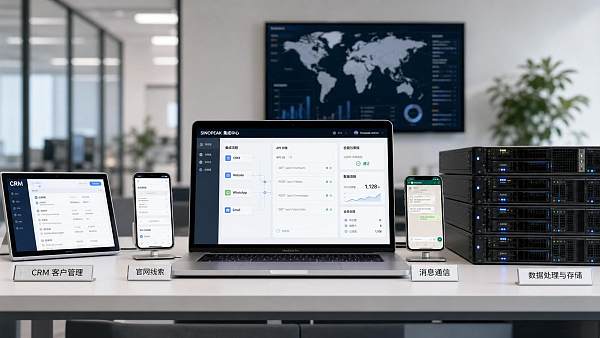
When choosing a WhatsApp service provider, the easiest factors to compare are often pricing, the number of channels, and delivery time. But what really determines the long-term result is usually not how fast it can be set up, but whether it is stable, whether it can be connected, and whether it will cause problems.
For website development and overseas marketing integrated projects, WhatsApp is not a standalone tool. It often needs to work together with website forms, ad traffic, CRM, customer service systems, and automated marketing workflows. Once an account is frequently restricted, the previous advertising, SEO, and independent site conversion efforts will all be affected.
A more realistic issue is that some WhatsApp service providers are good at sales, but may not necessarily have long-term operational capabilities. The initial launch may seem smooth, but issues only become obvious later, during large-scale delivery, message template review, session attribution, and API integration.
Therefore, evaluating a WhatsApp service provider is essentially about judging whether a communication capability can be stably embedded into the marketing technology stack, rather than simply buying an account resource.
Account Stability: Which Signals Should You Actually Look At?
Many people ask what “stability” in a WhatsApp service provider really means. Simply put, it is not just whether the account stays online; it also includes number quality, message sending rhythm, appeal handling capability, template approval rate, and anomaly warning mechanisms.
In practice, the more common way to judge is to see whether the service provider understands the underlying rules, rather than whether they promise “high delivery rates.” Delivery rates are affected by the industry, list quality, content compliance, and touch frequency, so a single promise is not reliable.
If a service provider can clearly explain these issues, it usually means its understanding of stability is closer to real-world delivery. On the other hand, if they only talk about price advantages while avoiding risk control and historical cases, later fluctuations are often greater.
How Strong Does API Capability Need to Be to Affect Marketing System Efficiency?
Many projects, when choosing a WhatsApp service provider, only confirm whether “there is an API.” That is not enough. What really matters is whether the API is complete and stable, whether the documentation is clear, whether callbacks are timely, whether error codes are traceable, and whether it can integrate with the existing business system.
Taking overseas lead generation as an example, if form submissions from an independent site can automatically enter CRM and then sync into the WhatsApp conversation workflow, manual distribution can be reduced and lead response speed improved. If API capability is weak, the middle process can only rely on manual form forwarding, and the marketing chain will become noticeably slower.
What needs to be confirmed in advance is whether the WhatsApp service provider supports these common interface scenarios:
- Message sending, status callbacks, and resend on delivery failure.
- Template message calls and variable management.
- Session assignment, customer service routing, and tag synchronization.
- Data connection with the official website, ad forms, and SaaS website-building systems.
- Unified attribution with SEO leads and ad leads.
This is also why, when doing website and marketing integration, the technical background must be considered together. Platforms like 易营宝, which have long been focused on intelligent website building, SEO optimization, ad placement, and multi-channel customer acquisition, make it easier to determine whether the WhatsApp interface can truly be implemented throughout the entire conversion chain, rather than just staying at the verbal level of “can connect.”
Where Do Compliance Risks Usually Hide?
Compared with interface issues, compliance risks are often more hidden. Many account abnormalities are not technical failures, but rather platform rule violations caused by triggering logic, user authorization, content templates, or industry attributes.
There are three main types of common risks. The first is unclear list sources, where users have not explicitly authorized message receipt. The second is overly direct marketing content, especially when promotional messages, prices, or links are sent too frequently during the cold-start stage. The third is the service provider itself using opaque resources, causing the account to remain in a high-risk state for a long time.
A more common misunderstanding is treating “being able to send messages” as “compliance can be sustained.” Short-term smooth operation does not mean long-term usability. Especially in cross-border marketing, the website landing page, privacy policy, lead authorization, form instructions, and message content form a complete chain; if any link is unclear, it may affect the delivery results of the WhatsApp service provider.
If the company is already doing multilingual websites, Google advertising, social media traffic generation, and SEO growth, then it becomes even more necessary to unify authorization and data retention management from the entry point. This helps reduce compliance risk and also makes it easier to trace account issues later.
What Are the Main Differences Between Different Types of WhatsApp Service Providers?
WhatsApp service providers in the market all seem to offer channels, interfaces, and account support, but the delivery boundaries vary greatly. When selecting one, it is usually helpful to understand them from three directions: “resource-based,” “tool-based,” and “integrated.”
Resource-based service providers focus on account opening and channel supply, suitable for short-term trials, but their support for business system adaptation and ongoing operations is often limited. Tool-based service providers usually provide panels, bots, and basic automation, suitable for standardized workflows. Integrated service providers pay more attention to the coordination between websites, traffic, data, and communication tools.
If the project goal is to integrate website inquiries, ad leads, social media private messages, and WhatsApp into a unified chain, a single channel supply is often not enough. At this point, what matters more is whether the service provider understands the complete growth path and can connect website building, traffic acquisition, lead management, and session touchpoints into a closed loop.
From this perspective, teams that have long been deeply involved in overseas marketing technology have more advantages. They not only deliver WhatsApp capabilities, but also pay attention to page conversion, traffic quality, lead filtering, and subsequent automated operations, which are more critical for stable output.
Before Formal Selection, Which Questions Should Be Clarified?
When entering the comparison stage, the most effective method is not to keep listening to solution introductions, but to clarify the key questions. The more specific the questions, the easier it is to distinguish truly capable WhatsApp service providers from suppliers that only know how to package themselves.
- When an account is abnormal, how long does it take to locate the problem, and who is responsible for escalation and handling?
- Is the API documentation open, and is there a sandbox or test environment?
- Can it connect with existing official websites, CRM, ad lead systems, and customer service platforms?
- After template review fails, are modification suggestions and a resubmission process provided?
- Does it support segmented sending strategies for different regions and different business lines?
- In previous projects, has it implemented scenarios linking independent sites and marketing systems?
If the other party can combine practical business explanations with implementation methods, rather than repeatedly emphasizing “many cases” and “the system is mature,” it is usually more worth pursuing further. Because true selection is not about how many highlights you hear, but whether you can see future maintenance costs in advance.
How Can the Judgement Results Be Turned into Actionable Decisions?
A relatively stable approach is to first list the business chain, and then reverse-engineer the must-have capabilities of the WhatsApp service provider. For example, where leads come from, whether they come from the independent site, the ad landing page, or social media; whether sales need to be assigned after entry; whether message sending is notification-based or marketing-based; and whether automated nurturing is needed later.
After organizing it this way, many choices become clearer. If the core need is low-cost trial runs, you can first verify account stability and basic interfaces. If the goal is long-term overseas growth, then API scalability, compliance mechanisms, and cross-channel collaboration should be placed further upfront.
For teams that have already deployed official website development, SEO, ad placement, and social media operations, WhatsApp service providers are more suitable to be viewed as a key node in the growth chain rather than a standalone purchase. Only when communication capability, website handoff capability, and marketing data capability are established at the same time can the system run more smoothly.
Finally, you can create an internal scorecard and assign points around five dimensions: stability, interface capability, compliance risk, operational response, and implementation cycle. First do a small-scale coordination test, and then decide whether to fully go live; this is closer to the real result than simply comparing quotations.
Related Articles
 Comparison between Easyyingbao and WordPress: Which is better suited for the long-term operation of foreign trade enterprises?
 How to choose a WhatsApp service provider? Assessing account stability, API capabilities, and compliance risks
 How to choose a GEO generative engine optimization company? Capability boundaries, deliverables, and evaluation criteria


Related Products
 EasyCamp SaaS Smart Website Marketing SystemE-Yingbao SaaS Smart Website Marketing System: AI-powered, zero-code website building. Rapidly launch multilingual independent e-commerce sites in just 10 minutes. Global server acceleration and AI-driven SEO optimization empower businesses to efficiently connect with global markets. The seamless integration of technology and user-friendly operation makes building e-commerce sites incredibly simple.
 AI+SEM Intelligent Advertising Marketing SystemAI+SEM drives intelligent ad creation, empowering full-funnel precision advertising marketing. The system automatically generates weekly/monthly reports, AI recommends keywords and target countries, monitors core metrics in real-time with intelligent alerts, and enables one-click high-conversion ad solutions to help quickly acquire customers and improve ROI.
 AI+SEO Dual Engine Optimization ServiceEasyWin AI+SEO Dual Engine Optimization System leverages AI-powered keyword mining, content generation, and comprehensive technical optimization to help foreign trade enterprises acquire high-quality organic traffic, significantly improving search rankings and conversion rates.
 AI+SNS Social Media Marketing SystemYingbao AI+SNS Social Media Marketing System - Precision social capture for the social media era. Supports one-click content synchronization across major platforms like Facebook and LinkedIn. AI intelligently rewrites posts for enhanced relevance. 24/7 AI customer service and user profiling analysis empower businesses to efficiently expand into global markets.
 AI+SEO营销解决方案易营宝AI+SEO营销解决方案,通过AI批量写作、智能生成TDK、精准关键词扩词等功能,全面优化网站SEO效果,提升流量与转化率。助力企业构建高效智能网站新生态。
 AI+SEM Advertising Marketing SolutionsAI+SEM Advertising Marketing Solution leverages AI technology to deeply empower SEM ad campaigns. It automatically generates weekly/monthly reports using AI, presenting account data across multiple dimensions for comprehensive insights into campaign performance and trends. The system precisely recommends keywords and target countries, intelligently generates high-conversion ad copy, and enables one-click activation of efficient campaign plans to help businesses rapidly acquire customers. Simultaneously, it monitors core metrics in real time, intelligently identifies abnormal fluctuations, and issues timely alerts to ensure stable, high-return advertising results.
 Domain Name ServicesEasyWin provides professional domain name services, including intelligent queries, one-stop registration, brand protection, and full lifecycle management, helping businesses build a digital brand image.
 EasyOperate B2C Cross-Border E-Commerce Platform & Independent WebsiteEasyStore B2C Cross-border E-commerce Independent Store is an intelligent website building and cross-border e-commerce integrated solution independently developed by EasyStore Information Technology (Beijing) Co., Ltd. The system is specially designed for small and medium-sized as well as large export enterprises, integrating 'website building, operation, marketing, advertising, and conversion' into one, helping enterprises quickly establish cross-border e-commerce independent stores to achieve brand globalization and global sales growth.
The platform supports multiple languages, multiple currencies, and multi-channel marketing, with built-in AI intelligent translation and SEO optimization systems, suitable for mainstream markets such as Southeast Asia, Europe and America, Latin America, and the Middle East, assisting Chinese manufacturing enterprises in efficiently deploying international e-commerce strategies. SSL证书易营宝提供专业SSL安全证书服务,包括单域名和泛域名证书,确保网站数据传输加密、身份验证和完整性保护,助力企业建立安全可信的在线业务环境。









