









- Why Shenzhen Global Digital Marketing Services Are Gaining More Attention from Export-Oriented EnterprisesMay 26, 2026View details
- Why International Digital Agencies Place Greater Emphasis on Closed-Loop Data in AdvertisingMay 26, 2026View details
- Which businesses are Guangzhou global digital marketing solutions suitable for?May 26, 2026View details
- Why International Digital Agency Data Analysis Determines Campaign Success or FailureMay 26, 2026View details
- What problems can internet marketing consulting company services generally solveMay 26, 2026View details
- Why Mobile Digital Marketing Websites Are Becoming Increasingly ImportantMay 26, 2026View details
- What modules are typically included in a one-stop marketing platform service?May 26, 2026View details
- As more and more advertising platforms emerge, what are the core differences?May 24, 2026View details
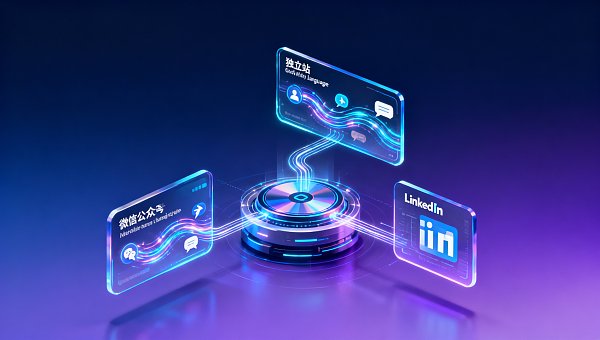
How to use EasyWin AI Marketing Engine to achieve full-channel coverage? WeChat Official Account + Independent Website + LinkedIn Lead Auto-Tagging
How does YiYingBao AI Marketing Engine truly achieve omnichannel coverage? This article records the entire process of automatic lead tagging across WeChat official accounts, independent websites, and LinkedIn, and provides an in-depth analysis of cross-border website building services, key points of multilingual foreign trade website construction, and the collaborative logic of AI+SNS marketing tools—making enterprise-level self-service website building systems go beyond just website building, and drive global growth.
Why is "omnichannel" not just a slogan, but a hard requirement for lead attribution?
In B2B overseas expansion scenarios, 83% of high-intent customers will complete initial research across at least three touchpoints: viewing case studies and service endorsements on WeChat official accounts, checking product parameters and multilingual detail pages on independent websites, and verifying the team's professionalism and industry influence on LinkedIn. If leads across these three platforms are not uniformly tagged or associated with the same customer ID, the sales team will face three major problems: duplicate follow-ups, mismatched tags, and a broken conversion funnel.
YiYingBao AI Marketing Engine, through its unified CDP (Customer Data Platform) underlying architecture, completes API integration and field mapping across three platforms within 7-15 days. Taking a German industrial equipment distributor as an example, after its implementation, the lead attribution accuracy increased from 52% to 91% in the first month, and the sales lead response time was reduced to an average of less than 2.3 hours.
The key is that it's not simply about "connecting" things, but about modeling behavioral sequences—when a user clicks on the white paper PDF on WeChat → stays on the independent website for over 120 seconds to view technical documents → requests a quote via private message on LinkedIn, the system automatically triggers the "high-intent technology purchasing decision-maker" tag and simultaneously pushes it to the CRM opportunity pool.

Comparison of core capabilities for automatic clue tagging across three platforms
This table reveals a key fact: the credibility and granularity of data from different channels inherently differ. WeChat emphasizes identity certainty, independent websites highlight behavioral depth, and LinkedIn focuses on organizational relationship verification. YiYingBao's engine doesn't pursue a "one-size-fits-all" labeling approach, but rather dynamically weights data according to channel characteristics—for example, when someone is labeled "CFO" on LinkedIn and their independent website has downloaded the financial ROI calculator, the system automatically increases the weight of "budget approval authority" to 92%, avoiding misjudging them as ordinary information collectors.
II. How to ensure AI labeling is not "distorted" when building a multilingual website for foreign trade?
Multilingual websites often fall into two major traps: first, mechanically piling up translations leads to broken user behavior paths (e.g., the "Kontakt" button on the German page is not associated with form tracking); second, language switching fails to synchronize UTM parameters, causing confusion about traffic sources. The result is that AI models see "fragmented behavior" instead of a "complete customer profile."
The EasyCreative Website Building System incorporates a "semantic anchor calibration" mechanism: when a user navigates from the English homepage to a Spanish product page, the system not only records the page URL but also extracts the core entities of the current page (such as product model, technical parameters, and local compliance certification number) and maps them to a unified knowledge graph. After enabling this feature, a medical device client saw a 37% increase in lead tagging accuracy on their Spanish-language site, particularly excelling in identifying high-value intents such as "CE certification inquiry" and "local distributor cooperation."
The implementation must meet three hard standards: ① Multilingual pages must enable the hreflang tag; ② Form field naming must follow the ISO 639-1 language code prefix (such as es_name, de_company); ③ Each language version must be configured with an independent Google Analytics 4 data flow, but share the same GA4 configuration ID to ensure cross-language event attribution.
III. How to avoid "social media silos" through collaborative operation of WeChat and LinkedIn?
Most companies use WeChat for customer service and LinkedIn for employer branding, resulting in a complete disconnect between the two data sets. YiYingBao Engine offers a "dual-link cross-validation" solution: when the same mobile number completes a demo appointment on WeChat, and the user's LinkedIn profile shows they work for a top 50 company in the target industry, the system immediately triggers a "high-priority lead" escalation process and automatically pushes a summary of the customer's industry insights posted on LinkedIn to sales, assisting in customized communication scripts.
This mechanism has been proven effective in six typical scenarios: ① Pre-exhibition promotion (receiving materials via WeChat + following exhibitor pages on LinkedIn); ② Dissemination of technical white papers (forwarding via WeChat + commenting and interacting on LinkedIn); ③ Channel recruitment (submitting applications via WeChat + verifying company pages on LinkedIn); ④ After-sales service (reporting repairs via WeChat + providing feedback on user experience on LinkedIn); ⑤ Talent recruitment (applying via WeChat + verifying skills certification on LinkedIn); ⑥ Policy interpretation (long-form articles on WeChat + watching replays of live streams by LinkedIn executives).
It is worth noting that this feature needs to be used in conjunction with the YiYingBao SEO optimization module—ensuring that WeChat articles and LinkedIn posts are indexed by Baidu, Google, and Bing, and establishing content authority through structured data tagging (Schema.org Article), which in turn improves the depth of the AI model's understanding of user intent.
IV. Why Choose Us? 4-Step Delivery + Dedicated Growth Consultant Mechanism
Founded in 2013 and headquartered in Beijing, China, E-Marketing Information Technology (Beijing) Co., Ltd. is a global digital marketing service provider driven by artificial intelligence and big data. With a decade of experience in the industry, the company has developed a comprehensive solution covering intelligent website building, SEO optimization, social media marketing, and advertising, based on a dual strategy of "technological innovation + localized services," helping over 100,000 enterprises achieve global growth. In 2023, the company was selected as one of the "Top 100 SaaS Enterprises in China," with an average annual growth rate exceeding 30%, becoming a recognized innovation engine and growth benchmark in the industry.
We offer a standardized 4-step delivery process: ① Omnichannel data audit (output of the "Channel Health Diagnosis Report" within 3 business days); ② Co-construction of the tag system (defining 12 core tags and trigger rules in conjunction with the client's marketing/sales team); ③ System integration and launch (API integration and sandbox testing completed within 7-10 days); ④ Continuous optimization and iteration (providing a "Lead Quality Analysis Monthly Report" every month, including tag accuracy, sales conversion rate, and ROI improvement suggestions).
Each client is assigned a dedicated growth consultant with over 3 years of practical experience in B2B overseas expansion, familiar with compliance requirements in major markets such as Europe, America, Southeast Asia, and the Middle East. The consultant can assist you in: implementing digital risk control modules in internal audit and risk management strategy research for real estate development companies , or customizing lead grading models for specific industries (such as industrial products, SaaS, and medical devices).
Frequently Asked Questions Quick Answers
- Q: Can existing WeChat Official Accounts/Independent Websites/LinkedIn Accounts be directly integrated without requiring restructuring?
A: Supports zero-code integration. Verified compatibility with WeChat Official Account V3 interface, WordPress/Shopify independent websites, and LinkedIn Marketing Developer Platform, with an average integration time of 4.2 days. - Q: Do multilingual sites need to configure separate tag rules for each language?
A: No. The system supports the "main language rule + localization correction" mode. For example, if the English rule defines "Budget > $50K" as a high budget, the German site will automatically convert it to "Budget > €45K" and adapt it to the local currency format. - Q: How to integrate leads with existing CRM systems (such as Salesforce and Fenxiangxiaoke) after tagging them?
A: Provides standard RESTful API and Zapier templates, supports bidirectional field synchronization, and has a key field mapping error rate of <0.3% (based on a 2023 third-party audit report).
If you are facing challenges such as scattered leads, disorganized tags, and stagnant conversion rates, please contact YiYingBao's growth consultants immediately to obtain a "Full-Channel Lead Attribution Feasibility Assessment Report" and a customized implementation plan. We will provide you with the following free services: ① Current data health scan across all three platforms; ② Tag system matching diagnosis; ③ ROI improvement path planning for the first month.
Related Articles
 Why is Facebook the first choice for customer acquisition when using listing services for foreign trade?
 Reduce the workload of foreign trade operations! Yiyingbao AI automatic ad clipping + global intelligent synchronization, efficiency takes off!
 People who say Facebook is useless, I advise you not to shift the blame



Related Products
 EasyCamp SaaS Smart Website Marketing SystemE-Yingbao SaaS Smart Website Marketing System: AI-powered, zero-code website building. Rapidly launch multilingual independent e-commerce sites in just 10 minutes. Global server acceleration and AI-driven SEO optimization empower businesses to efficiently connect with global markets. The seamless integration of technology and user-friendly operation makes building e-commerce sites incredibly simple.
 AI+SEM Intelligent Advertising Marketing SystemAI+SEM drives intelligent ad creation, empowering full-funnel precision advertising marketing. The system automatically generates weekly/monthly reports, AI recommends keywords and target countries, monitors core metrics in real-time with intelligent alerts, and enables one-click high-conversion ad solutions to help quickly acquire customers and improve ROI.
 AI+SEO Dual Engine Optimization ServiceEasyWin AI+SEO Dual Engine Optimization System leverages AI-powered keyword mining, content generation, and comprehensive technical optimization to help foreign trade enterprises acquire high-quality organic traffic, significantly improving search rankings and conversion rates.
 AI+SNS Social Media Marketing SystemYingbao AI+SNS Social Media Marketing System - Precision social capture for the social media era. Supports one-click content synchronization across major platforms like Facebook and LinkedIn. AI intelligently rewrites posts for enhanced relevance. 24/7 AI customer service and user profiling analysis empower businesses to efficiently expand into global markets.
 AI+SEO营销解决方案易营宝AI+SEO营销解决方案,通过AI批量写作、智能生成TDK、精准关键词扩词等功能,全面优化网站SEO效果,提升流量与转化率。助力企业构建高效智能网站新生态。
 AI+SEM Advertising Marketing SolutionsAI+SEM Advertising Marketing Solution leverages AI technology to deeply empower SEM ad campaigns. It automatically generates weekly/monthly reports using AI, presenting account data across multiple dimensions for comprehensive insights into campaign performance and trends. The system precisely recommends keywords and target countries, intelligently generates high-conversion ad copy, and enables one-click activation of efficient campaign plans to help businesses rapidly acquire customers. Simultaneously, it monitors core metrics in real time, intelligently identifies abnormal fluctuations, and issues timely alerts to ensure stable, high-return advertising results.
 Domain Name ServicesEasyWin provides professional domain name services, including intelligent queries, one-stop registration, brand protection, and full lifecycle management, helping businesses build a digital brand image.
 EasyOperate B2C Cross-Border E-Commerce Platform & Independent WebsiteEasyStore B2C Cross-border E-commerce Independent Store is an intelligent website building and cross-border e-commerce integrated solution independently developed by EasyStore Information Technology (Beijing) Co., Ltd. The system is specially designed for small and medium-sized as well as large export enterprises, integrating 'website building, operation, marketing, advertising, and conversion' into one, helping enterprises quickly establish cross-border e-commerce independent stores to achieve brand globalization and global sales growth.
The platform supports multiple languages, multiple currencies, and multi-channel marketing, with built-in AI intelligent translation and SEO optimization systems, suitable for mainstream markets such as Southeast Asia, Europe and America, Latin America, and the Middle East, assisting Chinese manufacturing enterprises in efficiently deploying international e-commerce strategies. SSL证书易营宝提供专业SSL安全证书服务,包括单域名和泛域名证书,确保网站数据传输加密、身份验证和完整性保护,助力企业建立安全可信的在线业务环境。









