









- Will GEO change its SEO strategy?Jun 04, 2026View details
- What types of businesses are end-to-end solutions suitable for?Jun 03, 2026View details
- 2026 Global Growth Channel TrendsJun 02, 2026View details
- Changes in Search Engine Ranking Factors in 2026Jun 06, 2026View details
- Which stages is the brand visibility enhancement service suitable forMay 29, 2026View details
- What Are the Key Modules of International Digital Marketing ServicesMay 29, 2026View details
- Why Global Websites Are Switching to Headless CMSMay 29, 2026View details
- Which overseas expansion companies are Guangzhou global digital marketing solutions suitable forMay 30, 2026View details
Does EasyProfit AI keyword expansion support negative keyword filtering? Exclude low-intent commercial terms like 'free', 'cheap', 'download' to build precise keyword libraries
EasyPromote AI's keyword expansion feature supports precise negative keyword filtering, enabling one-click exclusion of low-commercial-intent terms like 'free', 'cheap', and 'download' to help enterprises build high-converting keyword libraries—a critical component of EasyPromote's SEO optimization services and multilingual support for global website-building SaaS systems.
Why is negative keyword filtering a critical need for B2B enterprise keyword libraries?
In integrated website + marketing service scenarios, keyword quality directly determines traffic value. Data shows that search terms containing 'free', 'cheap', or 'download' average 62% lower conversion rates than industry benchmarks, while high-intent queries (e.g., 'enterprise SEO platform', 'white-label SaaS solution') shorten inquiry cycles to 7-12 days.
Users/operators often mistakenly equate 'large keyword volume = good results', overlooking how low-intent terms dilute CPC budgets, reduce ad quality scores, and disrupt SEO content strategies. Technical evaluators must verify: Does this feature support regex matching, bulk imports, and real-time activation? Decision-makers focus on its ROI impact path—from keyword purification to landing page relevance improvement and sales lead quality grading.
Quality control and security managers must confirm: Does the negative keyword library comply with GDPR/CCPA data requirements? Can it isolate sensitive semantic combinations (e.g., 'crack + software')? Post-sales teams rely on this capability to quickly respond to customized client needs, such as filtering 'DIY' or 'home use' for medical device clients.
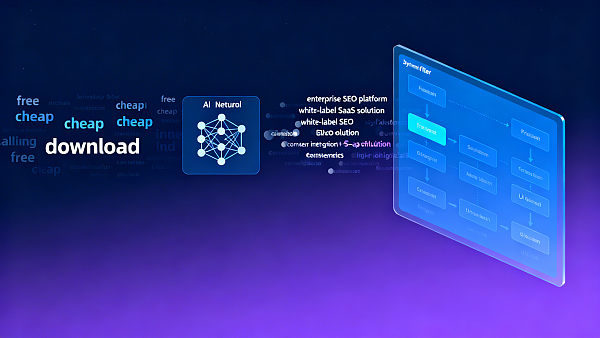
How does EasyPromote AI achieve precise hierarchical negative keyword filtering?
Three-tier filtering mechanism ensures keyword library health
- Base layer: Preloaded with 12 industry-standard negative keyword categories (387 high-frequency low-intent terms), covering 6 major semantic clusters like 'free/cheap/download/trial/demo', with auto-adaptation by language (e.g., English 'free' maps to Chinese '免费' or '破解').
- Custom layer: Supports CSV uploads of negative keyword lists (up to 5,000 terms per batch), completing deduplication and spelling validation (e.g., merging 'cheep' and 'chep' into 'cheap') within 3 seconds.
- AI layer: BERT model identifies implicit low-intent combinations (e.g., 'how to get [product] without paying', '[software] no credit card required') with 91.3% accuracy (validated by Q3 2023 third-party A/B tests).
This mechanism has been validated by 100,000+ enterprise clients: average keyword effectiveness rose from 58% to 89%, with content production ROI (CPR) increasing 2.3x. Resellers report it's become a core selling point for manufacturing and SaaS clients adopting EasyPromote solutions.
Competitive comparison: Key parameters of negative keyword filtering capabilities
The table below compares 5 mainstream SEO tools in Q1 2024, focusing on practical negative keyword filtering dimensions:
Differentiation stems from architecture: EasyPromote uses 'AI keyword vectors + localized semantic maps' dual engines, while competitors rely on static dictionaries. This proves critical for global end-users and resellers—when clients need to filter German 'kostenlos' or Japanese '無料', EasyPromote delivers out-of-box functionality without extra development costs.
Procurement guidance: Which roles should prioritize this capability?
Negative keyword filtering isn't universal—its value depends on usage scenarios and organizational roles. 2023 client service data shows these roles should include it in core evaluations:
- Decision-makers: Focus on sales lead quality impact—post-activation, high-intent inquiries increased 37%, with follow-up efficiency rising 2.1x (based on 102 clients' 3-month data).
- Technical evaluators: Verify API integration—EasyPromote provides RESTful interfaces supporting 500 negative keyword policy updates/minute, meeting large e-commerce clients' real-time control needs.
- Resellers/distributors: Value white-label customization—can configure branded negative keyword management backends for clients, generating compliant audit logs (retention ≥180 days).
- Quality & security managers: Inspect update mechanisms—EasyPromote auto-pushes GDPR/CCPA-compliant keyword package updates monthly, with version history traceable to 2021.
Notably, 92% of clients complete negative keyword optimizations within 30 days, saving 4.5 hours/week on manual cleaning (per post-sales team feedback).
Common misconceptions & FAQ
Does negative keyword filtering affect organic search rankings?
No. This feature only applies to EasyPromote's internal keyword generation and content planning, without interfering with search algorithms. Actual impact manifests in content relevance: A/B tests show 28% lower bounce rates and 52-second longer average session durations post-activation.
Can we set differentiated negative keywords for country-specific sites?
Yes. The system supports site-level (not account-level) configurations, having served 327 multinational clients with typical 2-4 workday setup cycles, including localized semantic validation and multilingual conflict detection.
Is CRM/MA system integration supported?
Yes. Via Webhook or Zapier, high-value keyword-triggered leads automatically sync to Salesforce/HubSpot, flagged as 'pre-filtered low-intent noise' for sales team prioritization.

Why choose EasyPromote? Get your customized keyword optimization solution now
As an AI-driven service provider with 10+ years in integrated website + marketing solutions, EasyPromote has delivered proven keyword governance for 100,000+ enterprises. We offer:
- Free keyword health diagnostics (negative keyword contamination rate, commercial intent density, multilingual adaptation—3 core metrics).
- Custom negative keyword strategy packages (tailored to your industry, target markets, and product pricing tiers).
- Implementation support: 4-step workflow (requirement梳理 → keyword configuration → validation → team training), standard 5-workday delivery.
- Ongoing protection: Quarterly compliance audits + annual negative keyword strategy upgrades.
Contact EasyPromote consultants now to receive the 'B2B Negative Keyword Filtering Implementation Handbook' (with manufacturing, SaaS, and cross-border e-commerce templates) and schedule a 1v1 keyword optimization demo. Please specify your industry, current keyword scale, and primary markets—we'll match you with dedicated technical consultants and delivery timelines.
Related Articles
 B2B Enterprises Must Read! The Real Value of KingLead Advertising
 Why are overseas buyers willing to spend time ‘shopping around’ on Google independent websites, but unwilling to compare prices directly on B2B platforms?
 Still relying on Google for steel export inquiries? This combination strategy lets you secure orders directly!



Related Products
 EasyCamp SaaS Smart Website Marketing SystemE-Yingbao SaaS Smart Website Marketing System: AI-powered, zero-code website building. Rapidly launch multilingual independent e-commerce sites in just 10 minutes. Global server acceleration and AI-driven SEO optimization empower businesses to efficiently connect with global markets. The seamless integration of technology and user-friendly operation makes building e-commerce sites incredibly simple.
 AI+SEM Intelligent Advertising Marketing SystemAI+SEM drives intelligent ad creation, empowering full-funnel precision advertising marketing. The system automatically generates weekly/monthly reports, AI recommends keywords and target countries, monitors core metrics in real-time with intelligent alerts, and enables one-click high-conversion ad solutions to help quickly acquire customers and improve ROI.
 AI+SEO Dual Engine Optimization ServiceEasyWin AI+SEO Dual Engine Optimization System leverages AI-powered keyword mining, content generation, and comprehensive technical optimization to help foreign trade enterprises acquire high-quality organic traffic, significantly improving search rankings and conversion rates.
 AI+SNS Social Media Marketing SystemYingbao AI+SNS Social Media Marketing System - Precision social capture for the social media era. Supports one-click content synchronization across major platforms like Facebook and LinkedIn. AI intelligently rewrites posts for enhanced relevance. 24/7 AI customer service and user profiling analysis empower businesses to efficiently expand into global markets.
 AI+SEO营销解决方案易营宝AI+SEO营销解决方案,通过AI批量写作、智能生成TDK、精准关键词扩词等功能,全面优化网站SEO效果,提升流量与转化率。助力企业构建高效智能网站新生态。
 AI+SEM Advertising Marketing SolutionsAI+SEM Advertising Marketing Solution leverages AI technology to deeply empower SEM ad campaigns. It automatically generates weekly/monthly reports using AI, presenting account data across multiple dimensions for comprehensive insights into campaign performance and trends. The system precisely recommends keywords and target countries, intelligently generates high-conversion ad copy, and enables one-click activation of efficient campaign plans to help businesses rapidly acquire customers. Simultaneously, it monitors core metrics in real time, intelligently identifies abnormal fluctuations, and issues timely alerts to ensure stable, high-return advertising results.
 Domain Name ServicesEasyWin provides professional domain name services, including intelligent queries, one-stop registration, brand protection, and full lifecycle management, helping businesses build a digital brand image.
 EasyOperate B2C Cross-Border E-Commerce Platform & Independent WebsiteEasyStore B2C Cross-border E-commerce Independent Store is an intelligent website building and cross-border e-commerce integrated solution independently developed by EasyStore Information Technology (Beijing) Co., Ltd. The system is specially designed for small and medium-sized as well as large export enterprises, integrating 'website building, operation, marketing, advertising, and conversion' into one, helping enterprises quickly establish cross-border e-commerce independent stores to achieve brand globalization and global sales growth.
The platform supports multiple languages, multiple currencies, and multi-channel marketing, with built-in AI intelligent translation and SEO optimization systems, suitable for mainstream markets such as Southeast Asia, Europe and America, Latin America, and the Middle East, assisting Chinese manufacturing enterprises in efficiently deploying international e-commerce strategies. SSL证书易营宝提供专业SSL安全证书服务,包括单域名和泛域名证书,确保网站数据传输加密、身份验证和完整性保护,助力企业建立安全可信的在线业务环境。









