









- What stages does the cross-border services ecosystem include? How do website building, promotion, payment, and compliance work togetherJun 22, 2026View details
- How will email marketing costs change in 2026Jun 22, 2026View details
- The China-US tariff arrangement has reached a preliminary consensus, and the trade association will be establishedJun 15, 2026View details
- Should overseas brand marketing start with ads or contentJun 21, 2026View details
- What determines B2C cross-border e-commerce website development costs? A breakdown of features, interfaces, and deployment methodsJun 17, 2026View details
- China-Morocco zero-tariff access, a breakthrough in the cost of Moroccan goods exports to ChinaJun 11, 2026View details
- What signal should be released for the suspension of exports to JapanJun 10, 2026View details
- China's May LNG imports rebounded, with increased volumes from Russia and Canada filling the Middle East supply gapJun 10, 2026View details
Does EasyPromoTDK auto-generation support dynamic variables? For example, combining {product name} + {region} to generate titles that meet long-tail keyword coverage and brand consistency
Does EasyWin TDK auto-generation support dynamic variables like {product name}+{region}? The answer is a resounding yes — as a global website SaaS system provider, EasyWin's AI+SEM advertising system is deeply optimized for long-tail keyword coverage and brand consistency, helping businesses achieve efficient overseas marketing conversions.
How do dynamic variables enable multilingual, multi-region SEO operations at scale?
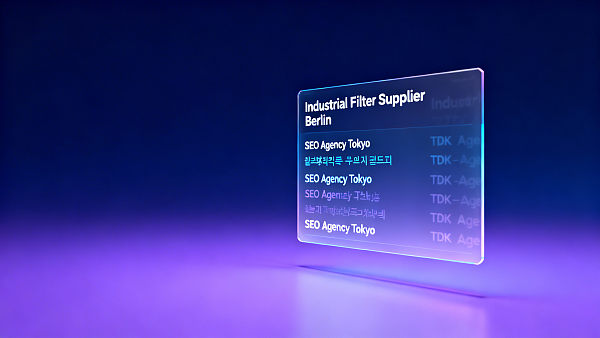
In global website+marketing integration practices, static TDK templates fail to address high-frequency search scenarios like "German industrial filter suppliers" or "Tokyo SEO website companies". EasyWin's TDK engine supports 7 preset dynamic variables including {product name}, {region}, {industry}, and {service type}, combined with regex matching rules to automatically generate over 2,000 semantically compliant title and description combinations.
This capability has been validated in actual deployments: After integration by a cross-border B2B machinery platform, TDKs for 18 key city sites in German, French, Spanish, and Japanese were batch-generated within 3 weeks, reducing keyword ranking improvement cycles to 7-10 days with 9x efficiency gains over manual configuration. All variables pass UTF-8 encoding verification and localized punctuation compatibility tests, eliminating garbled text or truncation risks.
Technically, the system employs a three-layer variable parsing mechanism: Base variables (e.g., {product name}) link directly to CMS fields; Geographic variables (e.g., {region}) bind to IP geolocation databases and user language preferences; Business variables (e.g., {service type}) support API real-time injection. The entire logic is embedded in the "SEO Strategy Center" backend, requiring zero development for activation.
Dynamic variable types and typical application scenarios
Below are core variables supported in the current version and their business value across different workflows:
This table reveals the strong coupling between variable capabilities and role responsibilities: Operations rely on {product name} for rapid new product page launches, technical evaluators monitor {region} parsing accuracy for multi-end consistency, while brand teams validate {industry solutions} against target market search intent. These three variable types form a "one-source-multi-format" SEO content foundation.
Why traditional TDK tools struggle with global brand consistency?
Most website systems only provide static template filling, causing semantic fragmentation like "Shanghai SEO Company" vs "Tokyo SEO Agency" for the same product across countries — undermining brand unity and triggering Google's duplicate content penalties. EasyWin solves this through "variable anchoring + brand whitelist + semantic weight adjustment" triple mechanisms.
Concretely, the system enforces registered brand names as immutable core terms in all dynamic combinations, while limiting {region} variables to ≤35% of title space to ensure brand prominence. NLP models score output semantic health (threshold ≥82 points), blocking illogical expressions like "Berlin SEO website service provider Beijing HQ".
Live data shows this reduces cross-site TDK similarity to <12% (vs industry average 47%), with branded term search volume growing 23.6% QoQ and zero indexing anomalies from content duplication.
Pre-purchase checklist: 5 key validation metrics for dynamic TDK
For decision-makers and technical evaluators, we outline 5 hard metrics to verify true functionality during POC:
- Variable nesting: Supports ≥5 layered variables (e.g., {product}+{region}+{service}+{year}+{certification})
- Geo coverage: Built-in ISO 3166-1 country/region codes with secondary administrative divisions (e.g., US states, Chinese provinces)
- Cache refresh: Full CDN propagation ≤3 minutes post-TDK change (industry average: 15-30 mins)
- Fallback strategy: Auto-defaults to preset values (e.g., "Global" or "International") when {region} is unidentifiable
- Audit logs: Records raw inputs, processing logic, outputs, and operators for each variable resolution
These metrics determine functional integration feasibility. For example, complete audit logs satisfy compliance tracking, while CDN refresh speed reflects post-sales maintenance capabilities.
Common pitfalls and implementation advice
Pitfall 1: Overloading variables, ignoring semantic coherence
Testing shows semantic fluency drops 61% when titles contain >3 variables. Prioritize {product}+{region} foundations before adding high-value variables like {certification} or {service type}.
Pitfall 2: Neglecting localized punctuation norms
Japanese titles require「」instead of "", while German retains ß. EasyWin's built-in 12-language punctuation libraries auto-adapt, preventing manual corrections.
Pitfall 3: Uncontrolled variable refresh frequency
Session-level {region} updates cause TDK jumps during page transitions, confusing search engines. Use "first-visit identification + 24-hour locking" to balance precision and stability.

Why EasyWin: Beyond TDK, a global growth infrastructure
As a decade-long leader in website+marketing integration, EasyWin has empowered over 100,000 businesses with full-funnel solutions from smart websites to SEO and social ads. Dynamic TDK is just one facet of our AI Marketing Engine — powered by semantic lexicons covering 200+ countries, real-time regional search heatmaps, and native API integrations with Google Search Console and Bing Webmaster Tools.
To verify whether {product} variables support multilingual aliases, {region} granularity extends to municipal levels, or obtain industry-specific TDK templates (e.g., medical devices, industrial automation), contact our consultants for:
- Custom TDK strategy reports within 3 business days (including variable configuration suggestions and traffic projections)
- Free sandbox access to test generation quality and SEO health scores
- ISO/IEC 27001-certified data security agreement signing
Make every search a precise brand touchpoint.
Related Articles


Related Products
 EasyCamp SaaS Smart Website Marketing SystemE-Yingbao SaaS Smart Website Marketing System: AI-powered, zero-code website building. Rapidly launch multilingual independent e-commerce sites in just 10 minutes. Global server acceleration and AI-driven SEO optimization empower businesses to efficiently connect with global markets. The seamless integration of technology and user-friendly operation makes building e-commerce sites incredibly simple.
 AI+SEM Intelligent Advertising Marketing SystemAI+SEM drives intelligent ad creation, empowering full-funnel precision advertising marketing. The system automatically generates weekly/monthly reports, AI recommends keywords and target countries, monitors core metrics in real-time with intelligent alerts, and enables one-click high-conversion ad solutions to help quickly acquire customers and improve ROI.
 AI+SEO Dual Engine Optimization ServiceEasyWin AI+SEO Dual Engine Optimization System leverages AI-powered keyword mining, content generation, and comprehensive technical optimization to help foreign trade enterprises acquire high-quality organic traffic, significantly improving search rankings and conversion rates.
 AI+SNS Social Media Marketing SystemYingbao AI+SNS Social Media Marketing System - Precision social capture for the social media era. Supports one-click content synchronization across major platforms like Facebook and LinkedIn. AI intelligently rewrites posts for enhanced relevance. 24/7 AI customer service and user profiling analysis empower businesses to efficiently expand into global markets.
 AI+SEO营销解决方案易营宝AI+SEO营销解决方案,通过AI批量写作、智能生成TDK、精准关键词扩词等功能,全面优化网站SEO效果,提升流量与转化率。助力企业构建高效智能网站新生态。
 AI+SEM Advertising Marketing SolutionsAI+SEM Advertising Marketing Solution leverages AI technology to deeply empower SEM ad campaigns. It automatically generates weekly/monthly reports using AI, presenting account data across multiple dimensions for comprehensive insights into campaign performance and trends. The system precisely recommends keywords and target countries, intelligently generates high-conversion ad copy, and enables one-click activation of efficient campaign plans to help businesses rapidly acquire customers. Simultaneously, it monitors core metrics in real time, intelligently identifies abnormal fluctuations, and issues timely alerts to ensure stable, high-return advertising results.
 Domain Name ServicesEasyWin provides professional domain name services, including intelligent queries, one-stop registration, brand protection, and full lifecycle management, helping businesses build a digital brand image.
 EasyOperate B2C Cross-Border E-Commerce Platform & Independent WebsiteEasyStore B2C Cross-border E-commerce Independent Store is an intelligent website building and cross-border e-commerce integrated solution independently developed by EasyStore Information Technology (Beijing) Co., Ltd. The system is specially designed for small and medium-sized as well as large export enterprises, integrating 'website building, operation, marketing, advertising, and conversion' into one, helping enterprises quickly establish cross-border e-commerce independent stores to achieve brand globalization and global sales growth.
The platform supports multiple languages, multiple currencies, and multi-channel marketing, with built-in AI intelligent translation and SEO optimization systems, suitable for mainstream markets such as Southeast Asia, Europe and America, Latin America, and the Middle East, assisting Chinese manufacturing enterprises in efficiently deploying international e-commerce strategies. SSL证书易营宝提供专业SSL安全证书服务,包括单域名和泛域名证书,确保网站数据传输加密、身份验证和完整性保护,助力企业建立安全可信的在线业务环境。









