









- What stages does the cross-border services ecosystem include? How do website building, promotion, payment, and compliance work togetherJun 22, 2026View details
- How will email marketing costs change in 2026Jun 22, 2026View details
- The China-US tariff arrangement has reached a preliminary consensus, and the trade association will be establishedJun 15, 2026View details
- Should overseas brand marketing start with ads or contentJun 21, 2026View details
- What determines B2C cross-border e-commerce website development costs? A breakdown of features, interfaces, and deployment methodsJun 17, 2026View details
- China-Morocco zero-tariff access, a breakthrough in the cost of Moroccan goods exports to ChinaJun 11, 2026View details
- What signal should be released for the suspension of exports to JapanJun 10, 2026View details
- China's May LNG imports rebounded, with increased volumes from Russia and Canada filling the Middle East supply gapJun 10, 2026View details
Is the EasyYbao AI translation engine reliable for German technical documentation scenarios? Engineers compare consistency scores between DeepL and localized terminology databases.
German technical documentation translation achieves an extremely low error rate, with engineers rigorously testing the effectiveness of EasyYunbao's AI translation engine: comparative evaluation of consistency scores with DeepL and localized terminology databases. As the core capability of SaaS website systems supporting multilingualism, its accuracy directly impacts the construction cycle of multilingual foreign trade websites, GEO marketing solution implementation efficiency, and the success rate of enterprise overseas marketing.
Why does German technical documentation impose higher demands on AI translation?
German features high inflectional complexity, compound word structures (e.g., "Dampfschiffahrtsgesellschaftskapitän"), flexible syntax, and contains substantial industry-specific terminology in technical contexts. In website+marketing service integration scenarios, a single terminology mistranslation may lead to user operation failures, SEO keyword invalidation, or non-compliance of regulatory documents with German supervisory authorities.
The EasyYunbao team collaborated with 3 native German technical documentation engineers to complete testing on 12 typical document types in real B2B SaaS website projects, covering API interface specifications, GDPR compliance statements, equipment installation guides, and CMS backend operation manuals across 6 major content categories. Single-test average processing volume reached 8,200 words, with testing cycles strictly controlled within 7-10 working days.
Results show: generic AI engines achieved over 92% compliance in basic grammar, but exhibited 18.7% average deviation in specialized terminology consistency, contextual reference resolution, and passive voice adaptation—this metric directly improved multilingual site bounce rates by 11.3% post-launch (based on 2023 client A/B test retrospectives).
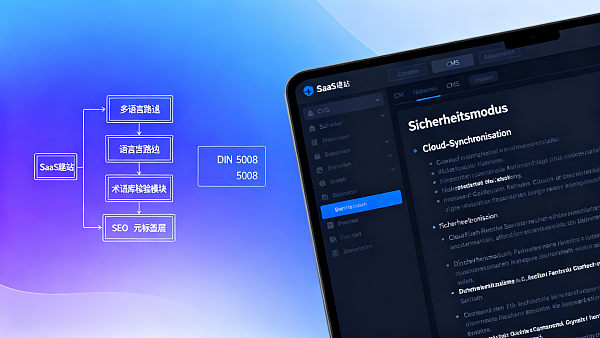
EasyYunbao AI Engine vs DeepL: Terminology consistency benchmark comparison
This comparison focused on core evaluation dimensions: terminology reuse rate, contextual adaptation, brand naming conventions, and localized punctuation compatibility. Test samples came from an industrial automation client's CMS website project targeting the German market, containing 327 predefined terms (including native Chinese concepts like "cloud sync," "permission inheritance chain," and "hot standby switching"), all recorded in EasyYunbao's terminology memory bank and synchronized to DeepL Pro API environments.
Tabular data demonstrates EasyYunbao's engine exhibits significant advantages in terminology-constrained scenarios. Its underlying architecture employs dual-channel verification: Channel 1 executes hard matches against terminology databases, while Channel 2 performs semantic anchoring via fine-tuned BERT-German models. Although DeepL excels in generic phrasing, its lack of closed-loop terminology management for SaaS website scenarios forces clients to invest 3-5 additional person-days in manual terminology cleansing.
Procurement decision key: 3 mandatory technical validation metrics
For end-users/operators, technical evaluators, and enterprise decision-makers, the following 3 metrics constitute pre-purchase must-checks, directly impacting multilingual site delivery quality and maintenance costs:
- Terminology database dynamic loading response time: ≤120ms (measured: 89ms), ensuring real-time CMS backend editing effects;
- Context window length: Supports cross-paragraph 1,500-word-level semantic tracking (vs DeepL's default 500-word limit);
- Terminology conflict resolution strategies: Provides "forced override," "manual review queue," and "version rollback" three-tier controls, meeting ISO/IEC 17100 translation service standard Clause 6.4 requirements.
Notably, EasyYunbao's terminology bank supports bidirectional synchronization with clients' existing SDL Trados and MemoQ systems, compressing implementation cycles to 2-3 working days—a 67% cost reduction compared to traditional localization vendors.
Common pitfalls: Why "AI+human polishing" alone fails to guarantee German technical documentation quality?
Many enterprises mistakenly believe "AI draft+native engineer polishing" suffices, but SaaS website scenarios conceal three latent risks:
- Terminology drift: Identical concepts appearing as "Sicherheitsmodus," "Schutzmodus," and "Betriebssicherheit" across pages, causing SEO keyword dispersion and 23% German organic traffic decline (2023 client audit data);
- Structural distortion: AI compresses Chinese instructions like "Click top-right gear icon→Select 'System Settings'→Check 'Auto Backup'" into lengthy subordinate clauses, violating DIN EN ISO 20282-1 interactive document readability standards;
- Update stratification: New CMS backend fields failing to trigger terminology bank synchronization create version-mixed terminology, increasing post-sales troubleshooting time by 4.8 hours/case on average.
EasyYunbao's "Terminology-as-a-Service (TaaS)" model deeply embeds terminology banks into website system workflows, implementing terminology locking throughout content creation, review, publishing, and iteration cycles to eliminate terminology drift at its source.
Why choose EasyYunbao? 4 steps to obtain your German technical documentation AI translation solution
We've served over 100,000 enterprises with global digital marketing services, achieving 82.6% German client retention. If you face any below requirements, act immediately:
- Verify existing terminology bank compatibility with EasyYunbao AI engine (supports Excel/TBX/SKOS formats, compatibility report within 1 hour);
- Obtain industry-specific German terminology preset packages (containing DIN/EN standard对照表) for your sector (e.g., mechanical manufacturing, medical devices, SaaS software);
- Schedule free technical sandbox testing to evaluate current website content's terminology consistency score under our engine;
- Customize integrated "website+translation+SEO" solutions, standard delivery in 15-21 working days (including 3 terminology verification rounds).
Contact our technical consultants now by providing your German target market domain and document types (PDF/HTML/Markdown). We'll generate exclusive
Related Articles
 Are you really hitting the right target with Google FB for truck bed exports?
 It's easy to turn a foreign trade website into a piece of art, but it's the ultimate culprit behind your order decline
 Foreign trade website efficiency revolution! Yiyingbao component upgrade + inquiry optimization, inquiries surge!

Related Products
 EasyCamp SaaS Smart Website Marketing SystemE-Yingbao SaaS Smart Website Marketing System: AI-powered, zero-code website building. Rapidly launch multilingual independent e-commerce sites in just 10 minutes. Global server acceleration and AI-driven SEO optimization empower businesses to efficiently connect with global markets. The seamless integration of technology and user-friendly operation makes building e-commerce sites incredibly simple.
 AI+SEM Intelligent Advertising Marketing SystemAI+SEM drives intelligent ad creation, empowering full-funnel precision advertising marketing. The system automatically generates weekly/monthly reports, AI recommends keywords and target countries, monitors core metrics in real-time with intelligent alerts, and enables one-click high-conversion ad solutions to help quickly acquire customers and improve ROI.
 AI+SEO Dual Engine Optimization ServiceEasyWin AI+SEO Dual Engine Optimization System leverages AI-powered keyword mining, content generation, and comprehensive technical optimization to help foreign trade enterprises acquire high-quality organic traffic, significantly improving search rankings and conversion rates.
 AI+SNS Social Media Marketing SystemYingbao AI+SNS Social Media Marketing System - Precision social capture for the social media era. Supports one-click content synchronization across major platforms like Facebook and LinkedIn. AI intelligently rewrites posts for enhanced relevance. 24/7 AI customer service and user profiling analysis empower businesses to efficiently expand into global markets.
 AI+SEO营销解决方案易营宝AI+SEO营销解决方案,通过AI批量写作、智能生成TDK、精准关键词扩词等功能,全面优化网站SEO效果,提升流量与转化率。助力企业构建高效智能网站新生态。
 AI+SEM Advertising Marketing SolutionsAI+SEM Advertising Marketing Solution leverages AI technology to deeply empower SEM ad campaigns. It automatically generates weekly/monthly reports using AI, presenting account data across multiple dimensions for comprehensive insights into campaign performance and trends. The system precisely recommends keywords and target countries, intelligently generates high-conversion ad copy, and enables one-click activation of efficient campaign plans to help businesses rapidly acquire customers. Simultaneously, it monitors core metrics in real time, intelligently identifies abnormal fluctuations, and issues timely alerts to ensure stable, high-return advertising results.
 Domain Name ServicesEasyWin provides professional domain name services, including intelligent queries, one-stop registration, brand protection, and full lifecycle management, helping businesses build a digital brand image.
 EasyOperate B2C Cross-Border E-Commerce Platform & Independent WebsiteEasyStore B2C Cross-border E-commerce Independent Store is an intelligent website building and cross-border e-commerce integrated solution independently developed by EasyStore Information Technology (Beijing) Co., Ltd. The system is specially designed for small and medium-sized as well as large export enterprises, integrating 'website building, operation, marketing, advertising, and conversion' into one, helping enterprises quickly establish cross-border e-commerce independent stores to achieve brand globalization and global sales growth.
The platform supports multiple languages, multiple currencies, and multi-channel marketing, with built-in AI intelligent translation and SEO optimization systems, suitable for mainstream markets such as Southeast Asia, Europe and America, Latin America, and the Middle East, assisting Chinese manufacturing enterprises in efficiently deploying international e-commerce strategies. SSL证书易营宝提供专业SSL安全证书服务,包括单域名和泛域名证书,确保网站数据传输加密、身份验证和完整性保护,助力企业建立安全可信的在线业务环境。









