









- What stages does the cross-border services ecosystem include? How do website building, promotion, payment, and compliance work togetherJun 22, 2026View details
- How will email marketing costs change in 2026Jun 22, 2026View details
- The China-US tariff arrangement has reached a preliminary consensus, and the trade association will be establishedJun 15, 2026View details
- Should overseas brand marketing start with ads or contentJun 21, 2026View details
- What determines B2C cross-border e-commerce website development costs? A breakdown of features, interfaces, and deployment methodsJun 17, 2026View details
- China-Morocco zero-tariff access, a breakthrough in the cost of Moroccan goods exports to ChinaJun 11, 2026View details
- What signal should be released for the suspension of exports to JapanJun 10, 2026View details
- China's May LNG imports rebounded, with increased volumes from Russia and Canada filling the Middle East supply gapJun 10, 2026View details
What Should You Focus on Most in Responsive Corporate Website System Case Studies
When reviewing “responsive corporate website system case studies,” what technical evaluators truly need to examine has never been whether the homepage looks premium, but whether the system has stable cross-device adaptability, whether page performance meets standards, whether the SEO foundation is solid, whether the backend is easy to scale, and whether it can work in coordination with subsequent marketing tools. In other words, case studies are not meant to be “admired,” but to verify whether the technical solution can support business growth over the next three to five years.
From the perspective of search intent, when users search for “responsive corporate website system case studies,” their core goal is not simply to find inspiration, but to screen vendors, evaluate solution feasibility, or find a basis for internal project approval. For technical evaluators, the main concerns are: whether the system is stable, whether it is easy to maintain, whether it will hinder promotional performance after launch, and whether future feature additions will require rebuilding everything from scratch.
Therefore, a truly valuable interpretation of a case study should focus on answering four questions: first, whether it is reliable across different devices and browsers; second, whether performance and code structure are sufficient to support SEO and conversions; third, whether the backend, permissions, components, and interfaces are convenient for long-term operations; fourth, whether the website system can work synergistically with content marketing, advertising campaigns, and lead management, rather than ending once the website is finished.
First look at the technical foundation of the case study, not whether the page is “visually appealing”
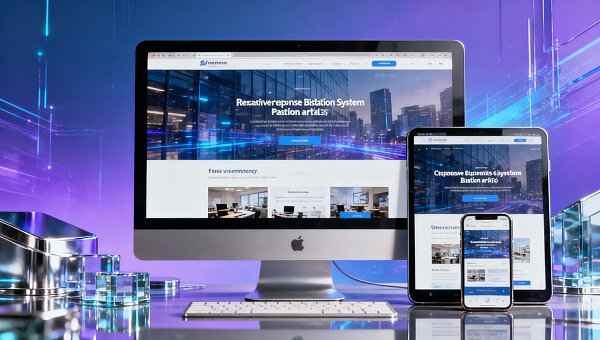
When technical evaluators review responsive corporate website system case studies, the first step should be to move beyond the visual layer. Page design is certainly important, but that is more a matter of brand and market judgment. What is truly worth prioritizing from a technical perspective is the front-end responsive implementation method, degree of componentization, resource loading strategy, template reuse logic, and whether the backend content structure is standardized.
A mature responsive corporate website system case study usually does not only show desktop renderings, but also simultaneously presents layout rules for mobile phones, tablets, and different screen resolutions. If a case study only provides static screenshots without showing real interactions, navigation collapse behavior, image cropping strategy, or form input experience, then its reference value is actually limited.
Going a step further, technical evaluation should not stop at the level of “being responsive.” Many systems can barely rearrange layouts when widths change, but the real challenge is whether complex modules remain usable across different devices. For example, whether multi-level navigation becomes unmanageable on mobile, whether product filters retain interaction efficiency, and whether long forms affect conversion rates—these are all closer to real business outcomes than visual impressions.
Architectural compatibility is the most easily overlooked yet most critical aspect in a case study
In responsive corporate website system case studies, compatibility assessment cannot rely only on vague statements such as “supports mainstream devices.” What technical evaluators should ask is: which browser versions are supported, whether different operating system engines are adapted, whether the front-end framework creates performance pressure on older devices, and how fonts and multimedia resources degrade under weak network conditions.
Compatibility is not only about visual consistency; it is also tied to maintenance costs. If a case study relies heavily on custom scripts, the initial effect may look good, but once browser policies change or third-party plugins fail, subsequent problems may break out all at once. Especially for corporate websites, marketing sites, and multilingual sites, compatibility issues are often not “occasional bugs,” but directly affect indexing, bounce rates, and conversion rates.
Therefore, when reviewing case studies, several details can be checked carefully: whether standardized HTML semantic structure is used; whether CSS and JS are clearly layered; whether key content remains readable after delayed script loading; and whether images, videos, and forms have mobile compatibility plans. Systems that handle these details well are usually also better suited for long-term operations.
Loading performance determines not only user experience, but also SEO and customer acquisition costs
Many companies tend to overlook page speed when reviewing case studies, assuming that as long as the server can open the page, it is enough. But for technical evaluators, performance is actually a hard metric. This is because first-screen website speed, interaction response time, and resource compression strategies all affect search engine crawling efficiency, and also directly impact the quality score of ad landing pages and the performance of organic traffic.
A truly reference-worthy responsive corporate website system case study should make it possible to see whether image lazy loading, static resource compression, cache control, CDN distribution, critical CSS optimization, and similar measures have been implemented. If a case study is visually rich but heavy to load, it may “look pretty good” in the early launch stage, but problems will gradually emerge when doing SEO, paid traffic campaigns, or overseas access optimization later on.
From an evaluation method perspective, it is advisable to ask the provider to conduct simple speed validation, including core metrics such as mobile first-screen time, LCP, CLS, and TTFB. The technical team does not necessarily need to pursue extreme benchmark scores, but at the very least it should confirm that the system is not sacrificing maintainability in exchange for short-term presentation effects. A system with strong performance is essentially reducing traffic waste for subsequent marketing.
For SEO foundational capabilities, look at the “structure” in the case study, not just the “ranking”
Many service providers like to emphasize “keywords ranking on the first page” or “how much traffic has grown” when presenting case studies. These results are certainly attractive, but technical evaluators should focus more on whether the underlying SEO foundation is reproducible. This is because the ranking of a single case may be affected by industry competition, content investment, and brand history, and cannot fully represent the system’s capabilities.
What is more worth paying attention to is: whether the URL structure is clear, whether titles and descriptions can be customized, whether the hierarchy of H tags is reasonable, whether image ALT text can be managed, whether the sitemap is generated automatically, whether 301 and canonical are supported, whether pagination and filter pages are controllable, and whether it is convenient for multilingual SEO deployment. These determine whether the website can continue to gain search traffic in the future.
If a responsive corporate website system case study only emphasizes page design and rich site sections, while showing no foundational SEO configuration capability, then technical evaluators should be more cautious. Because once content marketing, industry keyword layout, or regional keyword expansion is needed later, system-level defects will severely limit operational space.
Under the trend of integrating website and marketing services, a website system is no longer an isolated front-end tool, but a traffic entry point. For platform-based service providers such as Yiyingbao Information Technology (Beijing) Co., Ltd., which have long served enterprises in global growth, the advantage often lies not only in “being able to build websites,” but in whether intelligent website building, SEO optimization, advertising campaigns, and content operations are designed in coordination under the same logic.
Backend maintainability determines whether the technical team can work with ease afterward
Technical evaluators usually also face a practical issue: a website project does not end once it goes live, but needs continuous iteration. Whether a case study is worth referencing depends to a large extent on whether the backend management capabilities are mature enough. For example, whether content entry is standardized, whether page modules are reusable, whether permissions can be hierarchical, whether form data can be exported, and whether logging and backup mechanisms are complete.
Many case studies that look impressive actually rely heavily on manual maintenance by the vendor. Such systems may feel fine during initial demonstrations, but once the enterprise internally needs to frequently update news, products, case studies, recruitment information, or multilingual pages, problems such as low scaling efficiency, high training costs, and difficult version upgrades will be exposed.
Therefore, when reviewing responsive corporate website system case studies, it is recommended not only to look at the front-end pages, but also to request to see the backend operating logic. What technical evaluation should focus on is: whether non-technical personnel can complete basic maintenance, whether technical personnel can quickly add new modules, and whether the system supports API integration with CRM, CDP, customer service, or advertising tracking platforms. These determine whether the website can truly become part of the business system.
Whether a case study has marketing synergy capabilities directly affects the project’s long-term value
Today, enterprise website building is increasingly less about pure display needs. More often, the official website must take on multiple roles such as brand reception, search-based customer acquisition, content distribution, form conversion, and data accumulation. Therefore, when technical evaluators review case studies, they should also judge whether the system supports event tracking, conversion tracking, marketing automation integration, and multi-channel traffic attribution.
If a case study clearly demonstrates capabilities such as rapid landing page creation, special page reuse, form component configuration, and automatic lead distribution, then its value to the marketing team is usually higher. Conversely, if every new campaign page requires redevelopment and every new advertising platform integration requires extensive code modification, then even if the initial cost of such a solution is not high, its long-term total cost is often higher.
This is similar to many digital transformation projects across industries. For example, when evaluating management topics such as integration and operational optimization strategies for property management enterprise mergers and acquisitions, decision-makers do not only look at surface-level synergy effects, but also whether the integrated processes, systems, and organization can continue to operate sustainably. The logic for judging website system case studies is actually similar: going live in the short term is not difficult, but long-term collaboration reveals the real capability.
During technical evaluation, a “case study review checklist” can be used for rapid screening
To avoid being carried away by the rhythm of the case study presentation, it is recommended that technical evaluators establish a concise review framework. First, whether responsive adaptation is truly complete, including navigation, forms, images, list pages, and detail pages; second, whether performance can be verified, including first-screen speed and resource optimization; third, whether the SEO foundation is configurable and structurally sound; fourth, whether the backend supports high-frequency maintenance and permission management.
Fifth, whether interface expansion, third-party tool integration, and data tracking are supported; sixth, whether there are mechanisms for security, backup, logging, and version updates; seventh, whether the industry of the case study is close to the complexity of one’s own business; eighth, whether the case study can reflect the complete chain from website building to marketing conversion. The more items it meets, the higher the reference value of the case study.
If the vendor can only show design drafts or homepage screenshots, but cannot demonstrate a real website, backend logic, performance data, and SEO configuration, then this case study is more sales material than technical proof. Evaluators should try to shift the discussion back from “whether the style is satisfactory” to “whether the system can support business goals.”
Conclusion: what is truly worth examining is the system’s ability to support growth over the long term
Returning to the original question, what should be examined most in responsive corporate website system case studies? The answer is very clear: look at compatibility, performance, SEO foundation, backend maintainability, and marketing synergy capabilities, rather than first looking at visual packaging. Because the responsibility of technical evaluation is not to choose the most eye-catching page at the moment, but to choose a platform that will not hold the business back in the future.
For technical evaluators, the value of excellent case studies lies in helping determine whether the system is reliable, scalable, and suitable for continuous operation. Especially in an integrated website + marketing service environment, a website is no longer a static business card, but the infrastructure of enterprise digital growth. Understanding case studies is not about being impressed by the presentation, but about using structured judgment to find the solution that can truly create long-term value.
Related Articles
 Are you really hitting the right target with Google FB for truck bed exports?
 It's easy to turn a foreign trade website into a piece of art, but it's the ultimate culprit behind your order decline
 Foreign trade website efficiency revolution! Yiyingbao component upgrade + inquiry optimization, inquiries surge!



Related Products
 EasyCamp SaaS Smart Website Marketing SystemE-Yingbao SaaS Smart Website Marketing System: AI-powered, zero-code website building. Rapidly launch multilingual independent e-commerce sites in just 10 minutes. Global server acceleration and AI-driven SEO optimization empower businesses to efficiently connect with global markets. The seamless integration of technology and user-friendly operation makes building e-commerce sites incredibly simple.
 AI+SEM Intelligent Advertising Marketing SystemAI+SEM drives intelligent ad creation, empowering full-funnel precision advertising marketing. The system automatically generates weekly/monthly reports, AI recommends keywords and target countries, monitors core metrics in real-time with intelligent alerts, and enables one-click high-conversion ad solutions to help quickly acquire customers and improve ROI.
 AI+SEO Dual Engine Optimization ServiceEasyWin AI+SEO Dual Engine Optimization System leverages AI-powered keyword mining, content generation, and comprehensive technical optimization to help foreign trade enterprises acquire high-quality organic traffic, significantly improving search rankings and conversion rates.
 AI+SNS Social Media Marketing SystemYingbao AI+SNS Social Media Marketing System - Precision social capture for the social media era. Supports one-click content synchronization across major platforms like Facebook and LinkedIn. AI intelligently rewrites posts for enhanced relevance. 24/7 AI customer service and user profiling analysis empower businesses to efficiently expand into global markets.
 AI+SEO营销解决方案易营宝AI+SEO营销解决方案,通过AI批量写作、智能生成TDK、精准关键词扩词等功能,全面优化网站SEO效果,提升流量与转化率。助力企业构建高效智能网站新生态。
 AI+SEM Advertising Marketing SolutionsAI+SEM Advertising Marketing Solution leverages AI technology to deeply empower SEM ad campaigns. It automatically generates weekly/monthly reports using AI, presenting account data across multiple dimensions for comprehensive insights into campaign performance and trends. The system precisely recommends keywords and target countries, intelligently generates high-conversion ad copy, and enables one-click activation of efficient campaign plans to help businesses rapidly acquire customers. Simultaneously, it monitors core metrics in real time, intelligently identifies abnormal fluctuations, and issues timely alerts to ensure stable, high-return advertising results.
 Domain Name ServicesEasyWin provides professional domain name services, including intelligent queries, one-stop registration, brand protection, and full lifecycle management, helping businesses build a digital brand image.
 EasyOperate B2C Cross-Border E-Commerce Platform & Independent WebsiteEasyStore B2C Cross-border E-commerce Independent Store is an intelligent website building and cross-border e-commerce integrated solution independently developed by EasyStore Information Technology (Beijing) Co., Ltd. The system is specially designed for small and medium-sized as well as large export enterprises, integrating 'website building, operation, marketing, advertising, and conversion' into one, helping enterprises quickly establish cross-border e-commerce independent stores to achieve brand globalization and global sales growth.
The platform supports multiple languages, multiple currencies, and multi-channel marketing, with built-in AI intelligent translation and SEO optimization systems, suitable for mainstream markets such as Southeast Asia, Europe and America, Latin America, and the Middle East, assisting Chinese manufacturing enterprises in efficiently deploying international e-commerce strategies. SSL证书易营宝提供专业SSL安全证书服务,包括单域名和泛域名证书,确保网站数据传输加密、身份验证和完整性保护,助力企业建立安全可信的在线业务环境。









