









- The China-US tariff arrangement has reached a preliminary consensus, and the trade association will be establishedJun 15, 2026View details
- China-Morocco zero-tariff access, a breakthrough in the cost of Moroccan goods exports to ChinaJun 11, 2026View details
- What signal should be released for the suspension of exports to JapanJun 10, 2026View details
- China's May LNG imports rebounded, with increased volumes from Russia and Canada filling the Middle East supply gapJun 10, 2026View details
- Will GEO change its SEO strategy?Jun 04, 2026View details
- What types of businesses are end-to-end solutions suitable for?Jun 03, 2026View details
- 2026 Global Growth Channel TrendsJun 02, 2026View details
- Changes in Search Engine Ranking Factors in 2026Jun 06, 2026View details
Enterprise Self-Service Website Builder Tutorial: Structure First or Content First
When creating a tutorial for an enterprise-grade self-service website builder system, whether you build the framework first or write the content first determines the efficiency of later conversions. This article combines website SEO optimization tutorials, search engine optimization services, and cross-border website development solutions to help you clarify an integrated approach to website building and marketing.
For users, business decision-makers, after-sales maintenance personnel, and channel partners, a corporate website is no longer just an online business card, but a unified entry point for customer acquisition, conversion, service, and brand accumulation. Especially under the integrated website + marketing service model, the sequence of website building will directly affect subsequent SEO deployment, content production efficiency, and lead conversion quality.
Since its establishment in 2013, Yiyingbao Information Technology (Beijing) Co., Ltd. has continuously provided coordinated solutions centered on intelligent website building, SEO optimization, social media marketing, and advertising placement. For teams planning to build enterprise-level official websites, cross-border independent sites, or multilingual marketing websites, understanding the sequence logic between “framework” and “content” is often more important than launching blindly.
Build the framework first or write the content first: the correct decision-making logic for enterprise website building
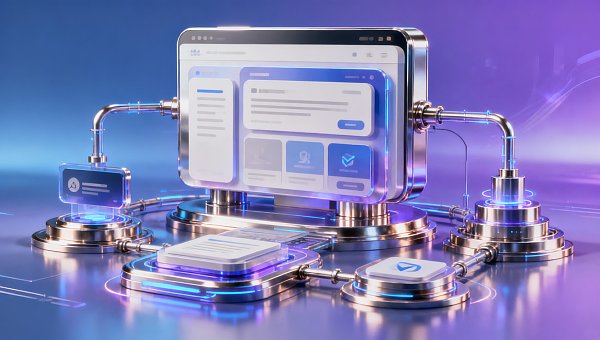
The biggest difference between an enterprise-grade self-service website builder system and ordinary template-based website building is that it is not only about solving page display, but also about simultaneously supporting brand expression, search engine crawling, inquiry conversion, and later maintenance. In actual projects, more than 80% of rework is related to unclear early-stage structure, so “framework first, content second” is usually more suitable for B2B companies.
The framework here is not just the navigation bar and the number of pages, but information architecture, URL hierarchy, category logic, keyword layout, form entry points, product classification, and conversion paths. If content comes first without structural constraints, the common result is duplicate pages, keyword conflicts, and broken internal links. When later carrying out the basic configurations in a website SEO optimization tutorial, costs will increase by 30% to 50%.
But this does not mean content can be postponed to the final step. A more reasonable approach is to first complete version 1 of the site framework, then simultaneously sort out the core content list, forming a delivery method of “framework first, content in parallel.” In this way, you can both ensure the technical foundation required for search engine optimization services and allow the marketing department, sales team, and operations staff to participate in content definition in advance.
Why corporate websites are more suitable for building the framework first
Corporate websites usually include at least 6 to 10 core page types such as the homepage, product pages, industry solution pages, about us, news center, case pages, and contact pages. Without a unified framework, content production will lose priority, causing the team to spend 2 weeks writing a large amount of introduction content without placing it on the pages that can truly convert.
- Putting the framework first helps determine a website hierarchy within 3 levels, avoiding overly deep directories that affect crawling efficiency.
- It helps lay out core keywords, long-tail keywords, and regional keywords in advance, reducing later page restructuring.
- You can first define inquiry entry points, CTA buttons, online customer service, and form fields, shortening the conversion path.
- It is more convenient for after-sales maintenance personnel to take over updates later, reducing the difficulty of training and handover.
In which situations can content planning be done first
If a company already has a mature product catalog, case study materials, and a multilingual copy library, content planning can be introduced in advance, especially for cross-border website development solutions. For example, export-oriented companies usually need bilingual Chinese-English or even 3-language versions. In this case, product selling points, application scenarios, and FAQ can be organized first and then mapped into the website structure.
The table below is suitable for determining whether your project is “framework first” or “content first.”
If the company currently values organic traffic and lead acquisition most, it is recommended to prioritize structural design; if the core goal is brand display and materials are complete, content planning can be brought in earlier, but framework planning still cannot be skipped.
What key modules should be included in the framework of an enterprise-grade self-service website builder system
A sustainably operated corporate website should not only focus on homepage performance, but should build its framework from four dimensions: search, conversion, maintenance, and expansion. It is usually recommended to control phase 1 of the site within 8 to 15 core pages, and then expand special topic pages, case libraries, and multilingual versions in phase 2, which is more conducive to controlling launch pace and content quality.
In the integrated website + marketing service scenario, the framework must at least have four basic capabilities: searchable by search engines, expandable content, convertible forms, and maintainable backend. The lack of any one of these will lead to reduced promotion efficiency later. For example, unclear category naming will shorten user dwell time; chaotic backend permissions will increase after-sales maintenance costs.
The 5 structural layers recommended to define first
- Homepage positioning layer: clearly define the company’s main business, core advantages, target market, and main conversion entry points.
- Product and service layer: split by category, scenario, or industry to ensure each page focuses on 1 group of keywords.
- Trust endorsement layer: about us, qualification descriptions, service processes, customer reviews, or cooperation methods.
- Content growth layer: news, knowledge base, case analysis, and frequently asked questions, used to capture long-tail searches.
- Conversion capture layer: inquiry forms, phone buttons, WhatsApp, online consultation, and document download entry points.
If the company belongs to industries related to design, decoration, or architecture, the visual presentation of the website will also directly affect business negotiation efficiency. For example, using immersive full-screen scroll interactions, panoramic Banners, and refined grid layouts is more suitable for showcasing material details and brand positioning. For solution pages requiring high-end visual presentation, you can refer to the display logic of interior design, decoration, architecture and plan the content structure and visual storytelling simultaneously.
The focus points of different roles on website framework
Users care more about whether the backend is easy to edit, business decision-makers focus on brand and customer acquisition results, after-sales maintenance personnel value permission allocation and update efficiency, dealers pay attention to whether product information is complete, and end consumers care about whether the information is clear and whether contact is convenient. Therefore, framework design must take into account at least 5 types of roles, rather than only satisfying aesthetic design needs.
The table below can serve as the phase 1 framework checklist for a corporate website.
From the implementation sequence perspective, the homepage, product pages, and contact page should go live first; case studies, news, and topic pages can continue to iterate after the first batch of traffic starts running. This both ensures launch speed and avoids delaying project progress in pursuit of one-time perfection.
Content is not a fill-in-the-blank task, but part of the conversion system
Many companies mistakenly believe that content simply means “completing the company introduction.” In fact, in search engine optimization services, content undertakes at least 3 tasks: explaining the business, matching search intent, and guiding conversion. If content only emphasizes company history but lacks solutions, application scenarios, and action entry points, then even if the page is indexed, it is still difficult to generate effective inquiries.
It is recommended that companies divide content into four layers: basic introduction content, transactional content, trust-building content, and growth content. Basic introduction is used to explain who the company is; transactional content is used to introduce products or services; trust-building content includes delivery processes, after-sales explanations, and frequently asked questions; growth content is used to cover tutorials, trends, and industry issues.
The 4 priorities of corporate website content planning
- Priority 1: product or service pages, with each page recommended to contain 800 to 1200 words, focusing on a single topic and a single conversion goal.
- Priority 2: industry solution pages, suitable for breakdown by manufacturing, foreign trade, regional markets, or channel models.
- Priority 3: FAQ and technical explanations, convenient for covering search questions such as “how to choose,” “how long is delivery,” and “how to maintain.”
- Priority 4: case studies and information, used for continuous updates to improve page activity and keyword coverage.
For cross-border website development solutions, special attention must also be paid to language consistency, regional term differences, and form field settings. For example, if an English website targets North America and Southeast Asia, the display methods of inquiry entry points, time zone prompts, and contact methods should differ. It is generally recommended to launch 3 to 5 key market pages in the first batch to avoid spreading too widely at once and causing insufficient content quality.
Common content misunderstandings and correction suggestions
Common misunderstandings include: overloaded homepage information, product pages without parameters, case pages with only images, news pages that only post company updates, and vague CTA buttons. The correct approach is to let each type of page undertake a clear task. For example, a product page should at least answer 4 questions: application scenarios, delivery cycle, service boundaries, and consultation methods.
If your industry relies heavily on visual persuasion, such as marketing websites for interior design, decoration, and architecture, you can also introduce asymmetrical dynamic layouts, dynamic hover sections, and fully responsive interactions on brand display pages to strengthen premium positioning and business communication efficiency. However, the premise remains a clear content structure so that visual effects do not overshadow information delivery.
Integrated implementation of website building and marketing: the execution process from launch to customer acquisition
A corporate website usually creates real value not on the day it goes live, but through continuous operation after 30 days, 90 days, and 180 days after launch. Therefore, a self-service website builder system tutorial should not only explain how to build pages, but also how to connect post-launch marketing actions. For integrated website + marketing service providers like Yiyingbao, website building is only the starting point; subsequent coordination of SEO, content operations, and promotion is the key.
From an execution perspective, a relatively reliable approach is to adopt the “5-step implementation method”: research, architecture, content, launch, and optimization. If materials are complete, phase 1 of a corporate website can usually be completed within 2 to 4 weeks; if it involves multiple languages, more than 100 products, or CRM integration, the timeline may extend to 4 to 8 weeks.
Standard process for integrated implementation
- Requirement clarification: define the target market, main business, conversion method, role permissions, and launch schedule.
- Framework design: define navigation, categories, URL, keyword grouping, form entry points, and technical configuration.
- Content assembly: complete the homepage, service pages, product pages, FAQ, case pages, and basic SEO element deployment.
- Testing and launch: check mobile adaptation, page speed, indexing settings, redirect rules, and form collection.
- Operational optimization: track indexing, rankings, clicks, and inquiry quality weekly, and continuously supplement content.
To facilitate decision-making, below is a coordination milestone table from website building to marketing.
The key conclusion of this process is: website architecture is responsible for “laying the foundation,” content is responsible for “clearly explaining value,” and marketing coordination is responsible for “amplifying traffic and conversions.” None of the three can be missing. Especially for companies with global growth demands, it is even more necessary to regard website building, SEO, and promotion as one continuous process rather than fragmented procurement.
FAQ: common questions and decision-making suggestions for enterprise-grade self-service website builder systems
How to determine whether a company is currently suitable for upgrading the official website instead of just changing a few pages?
If the website already has more than 2 of the following 3 types of problems, it is more suitable for an overall upgrade: first, poor mobile experience; second, chaotic page structure that cannot be expanded; third, it has been live for more than 2 years but still has almost no stable inquiries. In this case, simply redesigning the homepage has little meaning, and the framework, content, and conversion path should be rebuilt as a whole.
How long is generally reasonable for the delivery cycle?
A standard corporate website can usually complete its initial launch in 2 to 4 weeks; if it includes multiple languages, a complex product library, API integration, or regional sites, a reasonable timeline is generally 4 to 8 weeks. “Ultra-fast launch” in less than 7 days is common for simple template websites and may not necessarily suit companies that have requirements for SEO and customer acquisition.
What indicators should be prioritized when purchasing website building services?
It is recommended to look at at least 6 items: backend usability, category scalability, mobile adaptation, forms and lead management, basic optimization capability, and follow-up service response time. If the supplier can only talk about visual effects but cannot explain the website structure, content planning, and follow-up promotion connection methods, later investment will often increase passively.
What do after-sales maintenance personnel most need to focus on?
Focus on permission hierarchy, content update processes, backup mechanisms, and training materials. Ideally, ordinary editors should be able to master common operations such as publishing news, updating products, and replacing images within 1 hour; at the same time, the website should have regular backups and exception recovery plans to avoid business display being affected by misoperations.
The core of an enterprise-grade self-service website builder system tutorial is not simply answering “build the framework first or write the content first,” but helping companies establish a site growth logic that can continuously acquire customers, is easy to maintain, and supports expansion. For most B2B companies, the more reliable path is to build the framework first, then organize content according to conversion goals, and let website building, SEO, social media, and advertising form a coordinated closed loop.
If you are planning a corporate website upgrade, a cross-border website development solution, or search engine optimization services, choosing an integrated team with technical capabilities and localization service experience will be more conducive to shortening the trial-and-error cycle, improving launch efficiency, and enhancing subsequent conversion quality. If you want to further evaluate which implementation path is suitable for your website, it is recommended to contact us immediately to obtain a customized solution and learn more solutions.
Related Articles



Related Products
 EasyCamp SaaS Smart Website Marketing SystemE-Yingbao SaaS Smart Website Marketing System: AI-powered, zero-code website building. Rapidly launch multilingual independent e-commerce sites in just 10 minutes. Global server acceleration and AI-driven SEO optimization empower businesses to efficiently connect with global markets. The seamless integration of technology and user-friendly operation makes building e-commerce sites incredibly simple.
 AI+SEM Intelligent Advertising Marketing SystemAI+SEM drives intelligent ad creation, empowering full-funnel precision advertising marketing. The system automatically generates weekly/monthly reports, AI recommends keywords and target countries, monitors core metrics in real-time with intelligent alerts, and enables one-click high-conversion ad solutions to help quickly acquire customers and improve ROI.
 AI+SEO Dual Engine Optimization ServiceEasyWin AI+SEO Dual Engine Optimization System leverages AI-powered keyword mining, content generation, and comprehensive technical optimization to help foreign trade enterprises acquire high-quality organic traffic, significantly improving search rankings and conversion rates.
 AI+SNS Social Media Marketing SystemYingbao AI+SNS Social Media Marketing System - Precision social capture for the social media era. Supports one-click content synchronization across major platforms like Facebook and LinkedIn. AI intelligently rewrites posts for enhanced relevance. 24/7 AI customer service and user profiling analysis empower businesses to efficiently expand into global markets.
 AI+SEO营销解决方案易营宝AI+SEO营销解决方案,通过AI批量写作、智能生成TDK、精准关键词扩词等功能,全面优化网站SEO效果,提升流量与转化率。助力企业构建高效智能网站新生态。
 AI+SEM Advertising Marketing SolutionsAI+SEM Advertising Marketing Solution leverages AI technology to deeply empower SEM ad campaigns. It automatically generates weekly/monthly reports using AI, presenting account data across multiple dimensions for comprehensive insights into campaign performance and trends. The system precisely recommends keywords and target countries, intelligently generates high-conversion ad copy, and enables one-click activation of efficient campaign plans to help businesses rapidly acquire customers. Simultaneously, it monitors core metrics in real time, intelligently identifies abnormal fluctuations, and issues timely alerts to ensure stable, high-return advertising results.
 Domain Name ServicesEasyWin provides professional domain name services, including intelligent queries, one-stop registration, brand protection, and full lifecycle management, helping businesses build a digital brand image.
 EasyOperate B2C Cross-Border E-Commerce Platform & Independent WebsiteEasyStore B2C Cross-border E-commerce Independent Store is an intelligent website building and cross-border e-commerce integrated solution independently developed by EasyStore Information Technology (Beijing) Co., Ltd. The system is specially designed for small and medium-sized as well as large export enterprises, integrating 'website building, operation, marketing, advertising, and conversion' into one, helping enterprises quickly establish cross-border e-commerce independent stores to achieve brand globalization and global sales growth.
The platform supports multiple languages, multiple currencies, and multi-channel marketing, with built-in AI intelligent translation and SEO optimization systems, suitable for mainstream markets such as Southeast Asia, Europe and America, Latin America, and the Middle East, assisting Chinese manufacturing enterprises in efficiently deploying international e-commerce strategies. SSL证书易营宝提供专业SSL安全证书服务,包括单域名和泛域名证书,确保网站数据传输加密、身份验证和完整性保护,助力企业建立安全可信的在线业务环境。









