









- China-Morocco zero-tariff access, a breakthrough in the cost of Moroccan goods exports to ChinaJun 11, 2026View details
- What signal should be released for the suspension of exports to JapanJun 10, 2026View details
- China's May LNG imports rebounded, with increased volumes from Russia and Canada filling the Middle East supply gapJun 10, 2026View details
- Will GEO change its SEO strategy?Jun 04, 2026View details
- What types of businesses are end-to-end solutions suitable for?Jun 03, 2026View details
- 2026 Global Growth Channel TrendsJun 02, 2026View details
- Changes in Search Engine Ranking Factors in 2026Jun 06, 2026View details
- Which stages is the brand visibility enhancement service suitable forMay 29, 2026View details
Is a Free Website Builder Really Enough
Free website building platforms may seem to have a low barrier to entry and go live quickly, but can they really support a company’s long-term growth? From website design templates and search engine optimization services to website traffic growth solutions, choosing the right integrated website building and marketing solution is the key to improving conversions and competitiveness.
Why free website building platforms often only solve “going live” but struggle to solve “growth”
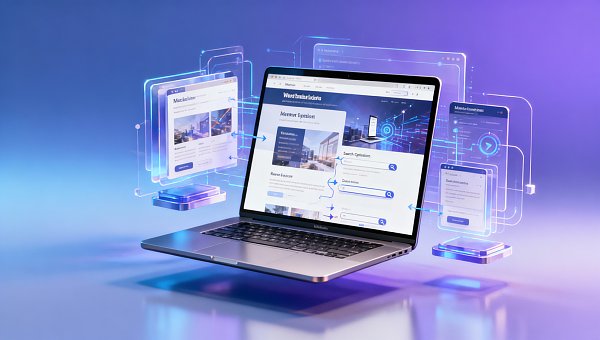
For many companies, the main appeal of free website building platforms lies in 3 points: 0 basic operational threshold, the ability to go live quickly within 1–3 days, and relatively low upfront budget pressure. For temporary campaign pages, test pages, or personal showcase sites, these tools do have some value.
But a corporate website is not just a simple collection of pages. It usually takes on 6 functions: brand presentation, lead generation and conversion, content accumulation, search engine indexing, sales support, and after-sales service. Solving only “can be opened” does not mean solving “can close deals.” This is exactly why many companies frequently redesign later on.
The most common problem users and operators encounter is that the backend functions seem simple, but when it comes to category expansion, form management, landing page configuration, and data tracking, limitations quickly appear. Business decision-makers care more about return on investment. Once they find that traffic is not coming in and inquiries cannot be retained, the limitations of free solutions become very obvious.
In the integrated website + marketing services industry, the website itself is only the starting point. Without search layout, content strategy, ad landing pages, social media coordination, and conversion path design, even if a website goes live quickly, it may still fall into the awkward situation of “having a website but no inquiries” after 3–6 months.
What companies really need is often not free, but sustainable
For distributors, agents, and reseller teams, the official website is often the gateway for partner recruitment; for end consumers, the official website is an important basis for judging whether a company is trustworthy; for after-sales support staff, the help center, ticket entry, and service instructions also need to operate stably over the long term.
If a website lacks an independent structure, content scalability, and marketing integrations, then subsequent SEO optimization, social media advertising, and remarketing tracking usually require secondary development, which instead increases time costs and migration costs. On the surface, it may save the upfront budget, but in reality it may slow down the growth pace for the entire year.
- Suitable scenarios for short-term use: event registration pages, temporary display pages, internal test pages.
- Scenarios not suitable for long-term reliance: corporate official websites, overseas brand websites, multilingual websites,招商 websites, and websites that require SEO.
- The most easily overlooked risks: repeated templates, restricted domains, unstable speed, and page structures that are not conducive to search crawling.
Therefore, to judge whether a free website building platform is sufficient, you cannot only look at “whether it can be made,” but whether it can support the growth tasks of the next 12 to 24 months.
What exactly is the difference between free website building, template-based website building, and integrated website building + marketing solutions
If a company is currently in the selection stage, the most effective approach is not to ask “which one is better,” but to break it down: which is more suitable for the current stage, and which can better support subsequent SEO optimization services and website traffic growth solutions. The table below is suitable for joint evaluation by decision-makers, operators, and maintenance personnel.
On the surface, free solutions save startup budget; from an operational perspective, integrated solutions save rework costs, wasted traffic, and conversion losses. For companies that need continuous customer acquisition, the latter is usually more practical.
Which differences have the greatest impact on subsequent operational results
The first is page structure. Search engines more easily understand websites with clear hierarchy, expandable content, and explicit linking relationships. The second is data tracking. If forms, events, sources, and conversion points cannot be configured, marketing campaigns become difficult to optimize. The third is content-carrying capacity, including the continuous expansion of case studies, solutions, FAQ, and industry pages.
Yiyingbao Information Technology (Beijing) Co., Ltd. has, since its establishment in 2013, long focused on providing integrated services around intelligent website building, SEO optimization, social media marketing, and advertising placement. For enterprises, the value of this model lies in avoiding separate procurement of website and marketing services, reducing the communication gaps commonly seen in multi-party coordination.
Headquartered in Beijing, the company uses artificial intelligence and big data as its core driving forces and has already served more than 100,000 enterprises in achieving global growth. For clients who need to balance localized expression, multi-channel customer acquisition, and long-term operations, this full-chain capability is more meaningful than a single website building tool.
Some enterprises also draw on cross-industry efficiency thinking in their internal management methods. For example, in process optimization discussions, they may refer to the application of lean management in operational cost control in public hospitals, and then map the concept of “reducing waste and strengthening node control” behind such topics to website building and marketing execution processes.
During procurement and selection, companies should review at least these 5 key checkpoints
When purchasing website services, many companies only compare homepage visuals and quotations, while overlooking subsequent operating costs. In fact, whether a website is truly adequate should be evaluated from at least 5 core dimensions: structure, content, promotion, maintenance, and scalability. Any weakness in one of these may affect customer acquisition efficiency over the next 6–12 months.
Selection evaluation table: what different roles should focus on
The table below is suitable for use in procurement communication, vendor comparison, and internal project approval. It not only helps business decision-makers see the overall investment, but also allows operators and maintenance personnel to confirm implementation details in advance, avoiding the discovery after delivery that the functions do not match.
If a vendor cannot answer these questions, or can only show visual templates without clearly explaining the delivery logic, then the website is likely only suitable for “setting up,” not for “running effectively.”
It is recommended that companies confirm this 4-step process during communication
- First confirm the goal: is it brand presentation, search-based customer acquisition,招商 cooperation, or multi-channel conversion? Different goals determine the site structure.
- Then confirm the content: usually, at minimum, 6 types of basic pages should be planned—homepage, about us, products/services, case studies, news, and contact page.
- At the same time confirm promotion needs: whether to reserve for search engine optimization services, ad landing pages, social media redirect pages, and data analysis interfaces.
- Finally confirm maintenance: whether updates after launch will be monthly, quarterly, or based on campaign cycles, which determines backend operations and service support methods.
This process may seem simple, but it directly determines whether the website can truly serve the business afterward. Especially for agents and channel teams, the website needs to simultaneously undertake multiple tasks such as brand consistency, lead collection, and regional招商.
From website building to customer acquisition: how should a website traffic growth solution be implemented
The most common misconception among companies is splitting website building and marketing promotion into 2 separate projects. In actual operations, website building, SEO optimization services, content production, social media communication, and advertising placement should be designed within the same chain; otherwise, problems easily arise such as pages that look fine but convert poorly, or ads that get clicks but produce low lead submissions.
A more reliable website traffic growth solution usually includes 3 stages: stage 1 focuses on structural planning and keyword layout, stage 2 focuses on content page construction and landing page optimization, and stage 3 focuses on traffic acquisition and conversion review. The common cycle for each stage is about 2–4 weeks, with pacing adjustable according to industry complexity.
Which scenarios are more suitable for integrated execution
If a company faces the following situations, it should not only consider a free website building platform: first, it hopes to continuously acquire customers through search engines; second, it needs multiple landing pages to support advertising; third, it needs to support multi-region or multilingual content; fourth, both sales and after-sales need the website to serve as a unified entry point.
- Brand-oriented enterprises: place more emphasis on official website image, content depth, and search visibility.
- 招商-oriented enterprises: place more emphasis on regional pages, franchise pages, form conversion, and lead management.
- Overseas expansion enterprises: place more emphasis on multilingual architecture, localized content, and advertising landing efficiency.
- Service-oriented enterprises: place more emphasis on the clarity of case studies, FAQ, service processes, and after-sales entry points.
With its dual-wheel strategy of “technological innovation + localized service,” Yiyingbao Information Technology (Beijing) Co., Ltd. has formed a full-chain solution covering intelligent website building, SEO optimization, social media marketing, and advertising placement. For enterprises hoping to reduce vendor switching, unify data standards, and improve execution efficiency, this integrated capability is more conducive to stable growth.
The company was selected for the “China Top 100 SaaS Companies” in 2023, with an average annual growth rate of more than 30%. This information itself does not mean it is suitable for all enterprises, but it at least shows that its service model has been continuously validated in the market and is suitable for clients with requirements for delivery coordination and long-term operations.
Common misconceptions and FAQ: when the budget is limited, how can free website building platforms still be used
A limited budget does not necessarily mean choosing between “free” and “high investment.” A more reasonable approach is tiered allocation according to the business stage: build the core official website sustainably, and then use lightweight tools for temporary campaign pages or test pages. The key is not to treat temporary tools as the long-term main site.
What scenarios are free website building platforms suitable for?
They are suitable for short-term validation, such as campaign pages launched within 7 days, simple registration pages, and one-time display pages. If the page lifecycle is only 1–3 months and does not rely on search rankings, this approach offers some cost-effectiveness. But as long as it involves a brand official website, long-term content accumulation, or a conversion loop, it is not recommended as the core site.
What do companies most easily overlook during procurement?
What is most easily overlooked is long-term operating cost. Going live is not the end point. It is also followed by content updates, search engine optimization services, page iteration, form tracking, ad landing, and security maintenance. If these capabilities cannot be continuously supported, the traffic budget invested every month may also be consumed by inefficient pages.
How long is a reasonable website building cycle?
A simple showcase website commonly takes 7–15 days, while a website with content planning, conversion paths, SEO basic structure, and multi-role review usually requires 2–4 weeks. If it involves multiple languages, custom sections, or a matrix of advertising landing pages, the timeline will increase further. The shorter the cycle, the more complete the upfront material preparation needs to be.
How can results be balanced under a limited budget?
It is recommended to prioritize 4 basic capabilities: an independent domain, a clear section structure, expandable content pages, and basic data tracking. If it is temporarily impossible to complete everything at once, the core official website can be completed first, and then industry content, FAQ, case library, and ad landing pages can be added gradually. The streamlined process thinking reflected in the application of lean management in operational cost control in public hospitals is also suitable for phased budget allocation.
Why choose us: if you do not just want a website, but want more stable growth
For business decision-makers, what is truly valuable is not “building a website,” but establishing a digital base that can serve customer acquisition, branding, channels, and after-sales service. For operators, whether the backend is easy to maintain, whether content is easy to update, and whether pages are convenient to expand equally determine execution efficiency.
Yiyingbao Information Technology (Beijing) Co., Ltd. has been deeply engaged in the industry for 10 years, using artificial intelligence and big data as its core driving forces to provide full-chain services from intelligent website building to SEO optimization, social media marketing, and advertising placement. Compared with a model that only delivers pages, this integrated service is more convenient for unified planning, unified execution, and unified review.
If you are evaluating whether a free website building platform is sufficient, or preparing to upgrade your current official website, you can first discuss the following: whether the current website structure is suitable for optimization, which website building method is more suitable for the current business, whether the standard delivery cycle is 7–15 days or 2–4 weeks, whether a customized website traffic growth solution is needed, and who is more suitable to take responsibility for subsequent maintenance.
If you still need to further confirm parameters, selection direction, delivery pace, customized solutions, or pricing range, it is recommended to consult directly based on your business goals. Putting website building, promotion, and conversion into the same blueprint is often closer to actual growth results than merely pursuing “free and fast launch.”
Related Articles



Related Products
 EasyCamp SaaS Smart Website Marketing SystemE-Yingbao SaaS Smart Website Marketing System: AI-powered, zero-code website building. Rapidly launch multilingual independent e-commerce sites in just 10 minutes. Global server acceleration and AI-driven SEO optimization empower businesses to efficiently connect with global markets. The seamless integration of technology and user-friendly operation makes building e-commerce sites incredibly simple.
 AI+SEM Intelligent Advertising Marketing SystemAI+SEM drives intelligent ad creation, empowering full-funnel precision advertising marketing. The system automatically generates weekly/monthly reports, AI recommends keywords and target countries, monitors core metrics in real-time with intelligent alerts, and enables one-click high-conversion ad solutions to help quickly acquire customers and improve ROI.
 AI+SEO Dual Engine Optimization ServiceEasyWin AI+SEO Dual Engine Optimization System leverages AI-powered keyword mining, content generation, and comprehensive technical optimization to help foreign trade enterprises acquire high-quality organic traffic, significantly improving search rankings and conversion rates.
 AI+SNS Social Media Marketing SystemYingbao AI+SNS Social Media Marketing System - Precision social capture for the social media era. Supports one-click content synchronization across major platforms like Facebook and LinkedIn. AI intelligently rewrites posts for enhanced relevance. 24/7 AI customer service and user profiling analysis empower businesses to efficiently expand into global markets.
 AI+SEO营销解决方案易营宝AI+SEO营销解决方案,通过AI批量写作、智能生成TDK、精准关键词扩词等功能,全面优化网站SEO效果,提升流量与转化率。助力企业构建高效智能网站新生态。
 AI+SEM Advertising Marketing SolutionsAI+SEM Advertising Marketing Solution leverages AI technology to deeply empower SEM ad campaigns. It automatically generates weekly/monthly reports using AI, presenting account data across multiple dimensions for comprehensive insights into campaign performance and trends. The system precisely recommends keywords and target countries, intelligently generates high-conversion ad copy, and enables one-click activation of efficient campaign plans to help businesses rapidly acquire customers. Simultaneously, it monitors core metrics in real time, intelligently identifies abnormal fluctuations, and issues timely alerts to ensure stable, high-return advertising results.
 Domain Name ServicesEasyWin provides professional domain name services, including intelligent queries, one-stop registration, brand protection, and full lifecycle management, helping businesses build a digital brand image.
 EasyOperate B2C Cross-Border E-Commerce Platform & Independent WebsiteEasyStore B2C Cross-border E-commerce Independent Store is an intelligent website building and cross-border e-commerce integrated solution independently developed by EasyStore Information Technology (Beijing) Co., Ltd. The system is specially designed for small and medium-sized as well as large export enterprises, integrating 'website building, operation, marketing, advertising, and conversion' into one, helping enterprises quickly establish cross-border e-commerce independent stores to achieve brand globalization and global sales growth.
The platform supports multiple languages, multiple currencies, and multi-channel marketing, with built-in AI intelligent translation and SEO optimization systems, suitable for mainstream markets such as Southeast Asia, Europe and America, Latin America, and the Middle East, assisting Chinese manufacturing enterprises in efficiently deploying international e-commerce strategies. SSL证书易营宝提供专业SSL安全证书服务,包括单域名和泛域名证书,确保网站数据传输加密、身份验证和完整性保护,助力企业建立安全可信的在线业务环境。









