









- What stages does the cross-border services ecosystem include? How do website building, promotion, payment, and compliance work togetherJun 22, 2026View details
- How will email marketing costs change in 2026Jun 22, 2026View details
- The China-US tariff arrangement has reached a preliminary consensus, and the trade association will be establishedJun 15, 2026View details
- Should overseas brand marketing start with ads or contentJun 21, 2026View details
- What determines B2C cross-border e-commerce website development costs? A breakdown of features, interfaces, and deployment methodsJun 17, 2026View details
- China-Morocco zero-tariff access, a breakthrough in the cost of Moroccan goods exports to ChinaJun 11, 2026View details
- What signal should be released for the suspension of exports to JapanJun 10, 2026View details
- China's May LNG imports rebounded, with increased volumes from Russia and Canada filling the Middle East supply gapJun 10, 2026View details
Can free website builders be used? First, look at these 3 limitations
Free website builders may seem like a money-saving, hassle-free option, but for startup decision-makers, they often come with hidden limitations in functionality, brand presentation, and later-stage marketing. If you want to avoid detours, first get clear on these 3 key questions.
Why the same task of building a website leads to completely different decisions in different startup scenarios
When many people first come across free website builders, their focus is often just on one thing: can they get online first, and can they save money first. But for startups, a website is not simply an online business card. It is the infrastructure for sales lead generation, brand trust, content hosting, and campaign conversion. Different business stages have very different website requirements: some companies only need short-term presentation, some need long-term SEO planning, and some need to integrate forms, customer service, ad tracking, and even multilingual pages.
Therefore, when judging whether a free website builder is usable, you cannot look only at the word “free”; you need to evaluate it within your actual business scenario. For startup decision-makers, the real questions should be: is it suitable for the current stage, will it slow down follow-up marketing, and will it be easy to upgrade in the future. Especially today, when website and marketing service integration is becoming increasingly common, the choice of website-building solution already directly affects subsequent SEO optimization, social media advertising, and sales lead management.
Conclusion first: the 3 limitations startups are most likely to overlook
Limitation 1: enough to launch, but not necessarily enough to grow
Free website builders can usually solve the problem of “having a website,” but they may not solve the problem of “whether the website can bring in customers.” Common early-stage startup needs include booking forms, lead collection, tracking analytics, landing page creation, content section expansion, page speed optimization, and more. Free solutions, however, often have limitations in plugin quantity, data interfaces, advanced form settings, and conversion tracking. They may seem usable, but in practice they are often difficult to support a complete marketing loop.
Limitation 2: able to display products, but not necessarily able to build brand trust
Quite a few free website builders retain platform branding in the footer, and template homogenization is also fairly obvious. For business service companies, foreign trade companies, and technical service providers that rely on professionalism to win orders, once a website lacks uniqueness and credibility, customers may lower their trust from the very first visit. This is especially true in B2B decision-making scenarios, where the homepage, case study presentation, service logic, and brand messaging all require a higher level of consistency.
Limitation 3: saving budget upfront may increase migration costs later
What startups fear most is not spending a little more now, but having to redo everything twice in the future. Some free website builders restrict source code, domain binding, page export, or SEO settings. Once the business grows, the team expands, or advertising spend increases, the company may have no choice but to migrate the entire site. Migration not only affects rankings and traffic, but may also cause page loss, data interruption, and disruption to marketing rhythm.
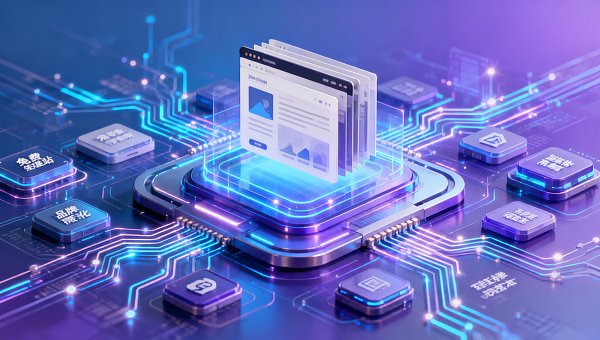
4 common startup scenarios: a quick look at whether a free website builder is suitable
To avoid one-size-fits-all conclusions, below we break down common website-building needs of startups into several typical use scenarios. You will find that free website builders are not absolutely unusable; rather, their application boundaries are very clear.
Scenario 1: you just want a website first, suitable for short-term testing
If your company has just been established, does not yet have ongoing advertising investment, and does not have a complex customer acquisition plan, but simply needs a basic official website for business card purposes, bid attachments, or preliminary customer verification, then a free website builder can serve as a transitional solution. At this stage, the most important things are launch speed, the completeness of basic pages, and the clarity of contact information.
Scenario 2: if you hope to generate inquiries through the website, the risks of a free solution rise significantly
When a company starts relying on search traffic, content marketing, and ad landing pages, the shortcomings of free website builders become concentrated and obvious. For example, title tags may not allow granular settings, URL structures may be unfriendly, page loading speed may be average, form interactions may be limited, and tracking and conversion analytics may be incomplete. These issues directly affect SEO and advertising performance. On the surface, you save website-building costs, but in reality you may lose much larger customer acquisition opportunities.
Scenario 3: for high-ticket business, brand image matters more than “free”
For high-trust-threshold industries such as consulting services, industrial manufacturing, software services, and cross-border business, the official website itself is part of the sales process. Customers usually compare company strength, delivery cases, team background, service process, and content depth. If a free website builder uses lookalike templates, ordinary visuals, and rigid page structures, it can easily make the brand appear less professional and affect inquiry quality.
Scenario 4: if you plan to do content and marketing long term, it is even more important to choose the right foundation early
If you plan to do SEO, resource sections, case libraries, topic pages, social media traffic generation, and advertising in the future, then the website must have ongoing scalability. Once the website foundation is chosen incorrectly, every additional marketing action later may be constrained. For this type of company, free website builders are more suitable for validating early ideas, not for carrying long-term growth tasks.
Under different needs, what should decision-makers focus on
Truly efficient judgment is not about asking whether “free is good or not,” but about whether business goals and website capabilities match. The following dimensions are suitable for startups to check one by one when making a choice.
1. Look at the traffic goal: is it for display, or for customer acquisition
If the website is only meant to display business information, a free website builder can handle the basic task; if you hope to acquire customers through organic search and advertising, then you must focus on SEO settings, page structure, analytics, and conversion path design. Yiyingbao Information Technology (Beijing) Co., Ltd. has long served global enterprises in website building and marketing growth, and practical experience shows that customer-acquisition websites must consider follow-up promotion from the website-building stage, rather than patching it in after launch.
2. Look at brand requirements: is it just viewable, or can it truly move customers
Template-based sites can quickly replicate pages, but they are very difficult to turn into differentiated expression. For companies that need to build industry awareness and trust, the homepage information hierarchy, case study packaging, and accumulation of industry content are all critical. Decision-makers need to judge whether the current website only needs to satisfy the condition of “having one,” or whether it is already taking on the role of “pre-sale endorsement.”
3. Look at future upgrades: is it convenient to expand and migrate
Startup companies change quickly. Today they may only need a single page, but tomorrow they may need to add a product center, blog section, multilingual pages, or even CRM integration. At that point, whether the site supports an independent domain, page expansion, technical optimization, and data accumulation is far more important than whether it is free right now. When making decisions, companies should take at least 12 months of business changes into account.
Common misjudgment: why many companies redo their sites after using a free website builder
The first misjudgment is treating the website as a one-time task. In reality, a website is a digital marketing asset that continuously affects search visibility and sales conversion. The second misjudgment is comparing only the website-building price, without comparing subsequent customer acquisition efficiency. The third misjudgment is underestimating migration costs, assuming that later redesign is just a matter of changing a template, only to discover that URLs, indexing, forms, and analytics all have to be rebuilt.
This is also why more and more companies now prefer service models that integrate website building, SEO, content, and advertising. Even during internal budget discussions, companies should not focus only on website-building expenditure itself, but should calculate the total account together with brand image, promotion efficiency, and later operation and maintenance. This logic is similar to the emphasis on matching goals and investment when enterprises manage other projects, just as reflected in the principles embodied in the application strategies of budget performance management in the financial management of public institutions: resource allocation should ultimately serve results, rather than focusing only on surface-level costs.
If you are a startup, use these 3 steps to decide whether you should choose a free solution
Step 1: confirm the website’s core task
First clarify whether the website is for temporary display, channel partnership, lead generation, or long-term content marketing. Different tasks mean completely different tolerance levels for free website builders.
Step 2: list the functions that will be added in the next half year
These include news sections, case libraries, form collection, customer service systems, analytics tools, ad landing pages, multilingual support, and SEO optimization items. As long as several of these are certain to happen, you need to carefully assess whether a free website builder will become a limitation.
Step 3: evaluate the cost of rebuilding once
For many companies, it is not that a free solution cannot be used, but that it is unsuitable as the final solution. If rebuilding in the future will affect customer visits, advertising rhythm, and search rankings, then the costs saved upfront may not actually be worthwhile. For teams that value long-term growth, rather than making up for it later, it is better to start with a solution that is more suitable for marketing from the beginning.
A more reliable approach: make website decisions within the growth scenario
Whether a free website builder can be used is not a simple yes-or-no question, but rather “whether it suits your current stage.” If you only need to launch quickly and present information in the short term, it can serve as a transitional tool; if you expect the website to support brand endorsement, SEO optimization, ad conversion, and ongoing customer acquisition, then a free solution is often not enough. For startup decision-makers, the most important thing is not how much you save at the beginning, but whether the website can support the business actions that come next.
Under the trend of integrating website and marketing services, it is more advisable for companies to judge from business scenarios: where do customers come from, what does the website need to support, whether follow-up promotion is needed, and whether content needs long-term updating. Once these questions are thought through clearly, it becomes much less likely to be misled by the surface impression of “free” when looking at free website builders. If you are currently planning a website, you may first sort out your own scenarios, goals, and marketing actions for the next half year, and then decide whether to use a temporary transitional solution or build a truly growth-capable website system in one step.
Related Articles
 Are you really hitting the right target with Google FB for truck bed exports?
 It's easy to turn a foreign trade website into a piece of art, but it's the ultimate culprit behind your order decline
 Foreign trade website efficiency revolution! Yiyingbao component upgrade + inquiry optimization, inquiries surge!



Related Products
 EasyCamp SaaS Smart Website Marketing SystemE-Yingbao SaaS Smart Website Marketing System: AI-powered, zero-code website building. Rapidly launch multilingual independent e-commerce sites in just 10 minutes. Global server acceleration and AI-driven SEO optimization empower businesses to efficiently connect with global markets. The seamless integration of technology and user-friendly operation makes building e-commerce sites incredibly simple.
 AI+SEM Intelligent Advertising Marketing SystemAI+SEM drives intelligent ad creation, empowering full-funnel precision advertising marketing. The system automatically generates weekly/monthly reports, AI recommends keywords and target countries, monitors core metrics in real-time with intelligent alerts, and enables one-click high-conversion ad solutions to help quickly acquire customers and improve ROI.
 AI+SEO Dual Engine Optimization ServiceEasyWin AI+SEO Dual Engine Optimization System leverages AI-powered keyword mining, content generation, and comprehensive technical optimization to help foreign trade enterprises acquire high-quality organic traffic, significantly improving search rankings and conversion rates.
 AI+SNS Social Media Marketing SystemYingbao AI+SNS Social Media Marketing System - Precision social capture for the social media era. Supports one-click content synchronization across major platforms like Facebook and LinkedIn. AI intelligently rewrites posts for enhanced relevance. 24/7 AI customer service and user profiling analysis empower businesses to efficiently expand into global markets.
 AI+SEO营销解决方案易营宝AI+SEO营销解决方案,通过AI批量写作、智能生成TDK、精准关键词扩词等功能,全面优化网站SEO效果,提升流量与转化率。助力企业构建高效智能网站新生态。
 AI+SEM Advertising Marketing SolutionsAI+SEM Advertising Marketing Solution leverages AI technology to deeply empower SEM ad campaigns. It automatically generates weekly/monthly reports using AI, presenting account data across multiple dimensions for comprehensive insights into campaign performance and trends. The system precisely recommends keywords and target countries, intelligently generates high-conversion ad copy, and enables one-click activation of efficient campaign plans to help businesses rapidly acquire customers. Simultaneously, it monitors core metrics in real time, intelligently identifies abnormal fluctuations, and issues timely alerts to ensure stable, high-return advertising results.
 Domain Name ServicesEasyWin provides professional domain name services, including intelligent queries, one-stop registration, brand protection, and full lifecycle management, helping businesses build a digital brand image.
 EasyOperate B2C Cross-Border E-Commerce Platform & Independent WebsiteEasyStore B2C Cross-border E-commerce Independent Store is an intelligent website building and cross-border e-commerce integrated solution independently developed by EasyStore Information Technology (Beijing) Co., Ltd. The system is specially designed for small and medium-sized as well as large export enterprises, integrating 'website building, operation, marketing, advertising, and conversion' into one, helping enterprises quickly establish cross-border e-commerce independent stores to achieve brand globalization and global sales growth.
The platform supports multiple languages, multiple currencies, and multi-channel marketing, with built-in AI intelligent translation and SEO optimization systems, suitable for mainstream markets such as Southeast Asia, Europe and America, Latin America, and the Middle East, assisting Chinese manufacturing enterprises in efficiently deploying international e-commerce strategies. SSL证书易营宝提供专业SSL安全证书服务,包括单域名和泛域名证书,确保网站数据传输加密、身份验证和完整性保护,助力企业建立安全可信的在线业务环境。









