









- What Does a Global Traffic Ecosystem Service Provider Do? What Are the Differences from a Single Advertising AgencyJul 16, 2026View details
- What should you focus on in the latest enterprise SaaS report? From renewal rates and delivery costs to overseas growth opportunitiesJul 12, 2026View details
- What signals are worth paying attention to in a cross-border marketing trend report? B2B companies should look at these 6 signalsJul 11, 2026View details
- How to Read a Cross-Border Marketing Trends Report? Five Key Dimensions for Evaluating Channel OpportunitiesJul 11, 2026View details
- Which channel has the highest ROI in the global traffic ecosystem? Comparative analysis of search, social media, and advertisingJul 10, 2026View details
- What multilingual website services are available in Sanya? Which model is more suitable for local businesses going global?Jul 08, 2026View details
- How to view the complete list of China SaaS companies in the top 100? Practical methods for screening website-building and marketing service providersJul 08, 2026View details
- How to view pricing in the global traffic ecosystem? Cost comparison of search, social media, and content channel advertisingJul 06, 2026View details
How to Choose Color Schemes and Layouts for Arabic Website Design
How should color matching and layout be chosen for an Arabic website design? They affect not only brand expression, but also conversion performance. For companies targeting the Middle East market, what truly matters is not “making it look like an Arabic website,” but achieving “alignment with local reading habits, aesthetic preferences, and commercial conversion logic.” This article will combine Arabic website development tutorials, how to use Middle East website building systems, and website design styles to help you clarify practical ideas.
If we make an overall judgment first: the color scheme of an Arabic website should prioritize industry characteristics, cultural acceptance, and brand recognition, while the layout must first adapt to the right-to-left reading logic. Compared with “whether it looks visually appealing,” companies should pay more attention to this: whether users can read it smoothly, whether they trust you, and whether they can quickly complete inquiries, orders, or lead submissions.
First determine the direction: Arabic website design is not “translating pages” first, but “restructuring the user experience”
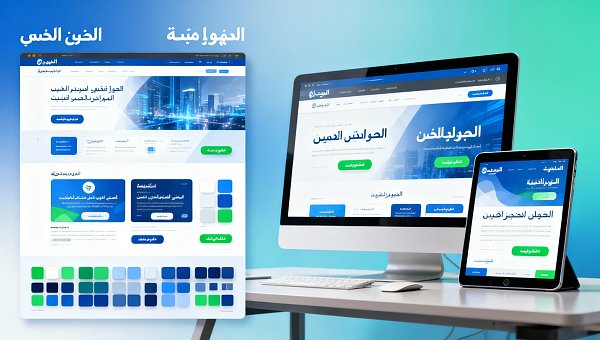
When many companies build Arabic websites, the most common mistake is to directly translate the content of the Chinese or English site and then mirror it. Although this makes the site go live quickly, it often causes several practical problems: inconsistent page visuals, confusing navigation logic, lack of emphasis on key information, and an incoherent browsing experience, ultimately affecting time on site and conversions.
A core principle is often mentioned in Arabic website development tutorials: Arabic users usually read from right to left, so the website structure, button positions, image-text order, and menu expansion methods all need to be adjusted accordingly. This difference directly affects whether users are willing to continue browsing, especially on corporate websites, foreign trade independent sites, franchise pages, and product landing pages.
Different types of readers also focus on different things:
- Information researchers care more about whether the website style matches Middle Eastern market habits;
- Technical evaluators care more about whether the system supports RTL layout, font compatibility, and responsive adaptation;
- Business decision-makers care more about whether design adjustments can bring inquiry growth and improved brand trust;
- After-sales maintenance staff care more about whether the layout will be prone to errors during subsequent content updates.
Therefore, Arabic website design cannot be judged only by appearance, but should be evaluated from these three dimensions: “whether it can be read smoothly, whether it can strengthen trust, and whether it can support business goals.”
How to choose colors for an Arabic website: first look at the industry, then cultural acceptance, and finally the conversion goal
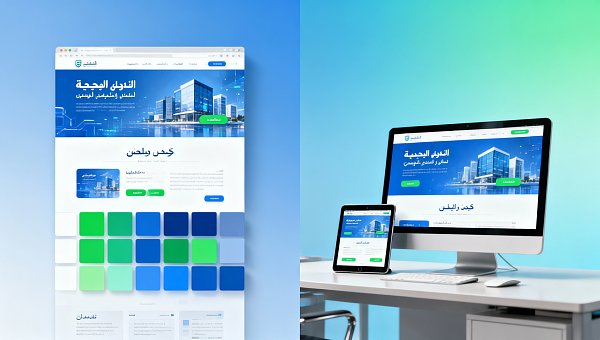
Color matching is not simply about choosing “Middle Eastern style” elements, but about serving brand positioning and user decision-making. Common color strategies for Arabic websites can usually be divided into the following categories:
1. Blue tones: suitable for technology, services, B2B, and corporate websites
Blue is used quite frequently on many Arabic websites because it more easily conveys a sense of professionalism, stability, and reliability. This type of color is especially suitable for industries such as integrated website + marketing services, software, technical services, finance, and industrial equipment.
If your goal is to create a first impression of being “reliable, standardized, and worth cooperating with,” blue is often a safe and effective choice. For business decision-makers and agents, this color scheme makes it easier to establish initial trust.
2. Green tones: suitable for emphasizing localization, cultural affinity, or specific industry attributes
Green has a certain cultural acceptance base in the Middle East and is also commonly used in healthcare, agriculture, environmental protection, halal-related businesses, as well as some government and public service pages. However, it should be noted that although green has strong affinity, it does not mean it is suitable for every industry. If the brand’s original visual system conflicts with green, forcing its use may instead weaken recognition.
3. Black-gold and dark tones: suitable for premium brands, luxury goods, hotels, real estate, etc.
If the website hopes to highlight a sense of luxury, quality, and prestige, combinations such as black and gold, dark blue and gold, or beige and gold are quite common. This type of website design style has strong appeal among some high-spending groups in the Middle East, but the design threshold is also higher. Once the hierarchy is not controlled well, it can easily look heavy or gaudy.
4. White background + brand color: most suitable for corporate websites pursuing conversion efficiency
If your website focuses on customer acquisition, lead collection, and guiding consultations, then a white background paired with the brand’s primary color and accent color is usually a more stable solution. The reason is simple: information is clearer, CTA buttons stand out more, and products and forms are easier to identify.
In actual projects, it is not recommended to add too many highly saturated colors or complicated decorative patterns just for “local characteristics.” For most companies, being simple, clear, and easy to read is more important than having an “exotic feel.”
Layout is more critical than color matching: Arabic websites must prioritize adaptation to RTL reading logic
If color matching determines the first impression, then layout determines whether users can truly continue reading the page. The key to Arabic website layout lies not in whether the text translation is accurate, but in whether the information structure fits right-to-left reading habits.
1. Navigation bars, banners, and buttons should all be planned with right alignment in mind
The main navigation of an Arabic interface usually needs to start organizing from the right side. The relationships among elements such as the Logo, menu, language switcher, contact methods, and search entry need to be redesigned rather than simply mirrored. The main headline, selling-point copy, and call-to-action buttons in the banner should also follow a right-origin reading path.
2. The image-text order cannot simply copy the Chinese website
Chinese and English pages often use a “left image, right text” structure, but on Arabic pages, in many cases “right text, left image” or an overall RTL adaptation is more appropriate. This is especially true for content such as product selling-point modules, service processes, case displays, and form instructions. If the order is not adjusted, user comprehension efficiency will drop significantly.
3. Paragraphs should not be too dense, and heading hierarchy must be clear
Arabic fonts themselves have more obvious connected writing characteristics, so if long paragraphs are laid out too densely, reading pressure will increase. Therefore, special attention should be paid in design to:
- appropriately increasing line height and paragraph spacing;
- controlling the length of each paragraph to avoid large blocks of text;
- using subheadings, icons, and bullet points to improve scanning efficiency;
- distinguishing key information through visual hierarchy rather than chaotic color emphasis.
4. Font selection should prioritize readability and system compatibility
When technical evaluators assess how to use Middle East website building systems, they must also check font support at the same time. If Arabic web fonts are poorly compatible, problems such as broken characters, crowded strokes, and abnormal display may occur. Compared with personalized fonts, ensuring clarity, stability, and consistent display across multiple devices is more suitable for commercial websites.
The 4 most common design misconceptions when companies build Arabic websites
Many websites perform poorly after launch not because they lack localization, but because localization was only done halfway. The following issues are the most common:
1. Only doing language translation without restructuring content
Arabic users care more about which content appears first and which information can build trust more effectively. If the page still piles up information according to Chinese logic, then even if the translation is accurate, it may not improve conversion.
2. Excessive visual “Arabization”
Overusing patterns, gold decorations, and complex backgrounds may make the website look unprofessional. Especially for B2B and service-oriented companies, a simple and modern style is often more effective.
3. Insufficient mobile adaptation
The proportion of mobile access in the Middle East is usually not low, so button size, form position, navigation expansion methods, text wrapping, and the mixed arrangement of numbers and Arabic text all need focused testing.
4. Focusing only on design without considering subsequent marketing integration
Website design must ultimately serve inquiries, ad landing, and SEO. For example, the structure of landing pages, the layout of conversion buttons, keyword placement, and form field settings all need to coordinate with subsequent promotion. If the company will also combine search advertising placement, then after the page goes live, it can work with AI+SEM advertising marketing solutions to further verify the impact of different page designs on conversion through keyword recommendations, ad copy generation, campaign data tracking, and anomaly alerts, reducing the trial-and-error cost of “redesigning based on intuition.”
How to choose a Middle East website building system: these 5 capabilities matter more than just looking at templates
If a company is evaluating how to use a Middle East website building system, it is recommended not to look only at the number of templates, but to prioritize whether the system truly supports Arabic-language scenarios.
1. Whether it natively supports RTL layout
This is the most basic and most important capability. If the system can only “input Arabic” but cannot fully support right-to-left layout, the subsequent maintenance cost will be very high.
2. Whether it supports multilingual switching and independent SEO settings
Arabic websites usually do not exist in isolation. Many companies also need to operate English, French, or Chinese versions simultaneously. Therefore, the system should preferably support independent titles, descriptions, URLs, and content management for pages in different languages.
3. Whether it is convenient for building marketing landing pages
If the website is not only for display, but also undertakes ad traffic reception and lead conversion functions, then landing page building efficiency, form components, button configuration, and tracking code deployment will all affect results.
4. Whether it is convenient for later maintenance and content updates
After-sales maintenance staff are often most afraid that “once the page is changed, everything becomes messy.” A truly easy-to-use system should make daily updates to news, cases, products, banners, and forms simple and controllable.
5. Whether it can coordinate with SEO and advertising optimization
For companies with long-term overseas growth needs, website building is not the endpoint. If the website will also need to support SEO optimization, search advertising, and social media traffic in the future, then page speed, structured management, conversion tracking, and data integration capabilities must be considered.
How to judge whether Arabic website design has been “done right”
Finally, here is a more practical evaluation standard for companies. Whether Arabic website design is appropriate does not need to rely only on subjective aesthetics, but can be judged by the following results:
- whether users can understand within 3 seconds what the website does;
- whether key information and CTA can be found quickly;
- whether the page reads smoothly and does not feel awkward;
- whether mobile browsing, messaging, and clicking are smooth;
- whether the inquiry rate, time on page, and bounce rate have improved;
- whether subsequent maintenance allows easy updates without frequent errors.
If these key indicators do not improve, then even the best-looking colors and layouts are only superficial work. Truly effective Arabic website design should both align with local user habits and serve brand growth goals.
Overall, when choosing color matching and layout for Arabic website design, the core is not to pursue “whether it looks like a Middle Eastern style,” but to make choices around user reading habits, brand positioning, and conversion goals. In terms of color, it is recommended to prioritize solutions that match industry attributes and the brand’s sense of trust; in terms of layout, design must center on RTL logic, readability, and mobile experience. For companies, what is truly worth investing in is not surface-level visuals, but a website foundation that can both be accepted by the market and support long-term marketing growth.
Related Articles
 What exactly should be the focus of a foreign trade website?!!!
 Attention! Builders' must-see: Yibingbao AI components updated, design efficiency directly doubled!
 China's foreign trade sees a turnaround: imports surge by 22%! Foreign trade professionals should quickly take note of the new trends in the second half of the year

Related Products
 EasyCamp SaaS Smart Website Marketing SystemE-Yingbao SaaS Smart Website Marketing System: AI-powered, zero-code website building. Rapidly launch multilingual independent e-commerce sites in just 10 minutes. Global server acceleration and AI-driven SEO optimization empower businesses to efficiently connect with global markets. The seamless integration of technology and user-friendly operation makes building e-commerce sites incredibly simple.
 AI+SEM Intelligent Advertising Marketing SystemAI+SEM drives intelligent ad creation, empowering full-funnel precision advertising marketing. The system automatically generates weekly/monthly reports, AI recommends keywords and target countries, monitors core metrics in real-time with intelligent alerts, and enables one-click high-conversion ad solutions to help quickly acquire customers and improve ROI.
 AI+SEO Dual Engine Optimization ServiceEasyWin AI+SEO Dual Engine Optimization System leverages AI-powered keyword mining, content generation, and comprehensive technical optimization to help foreign trade enterprises acquire high-quality organic traffic, significantly improving search rankings and conversion rates.
 AI+SNS Social Media Marketing SystemYingbao AI+SNS Social Media Marketing System - Precision social capture for the social media era. Supports one-click content synchronization across major platforms like Facebook and LinkedIn. AI intelligently rewrites posts for enhanced relevance. 24/7 AI customer service and user profiling analysis empower businesses to efficiently expand into global markets.
 AI+SEO营销解决方案易营宝AI+SEO营销解决方案,通过AI批量写作、智能生成TDK、精准关键词扩词等功能,全面优化网站SEO效果,提升流量与转化率。助力企业构建高效智能网站新生态。
 AI+SEM Advertising Marketing SolutionsAI+SEM Advertising Marketing Solution leverages AI technology to deeply empower SEM ad campaigns. It automatically generates weekly/monthly reports using AI, presenting account data across multiple dimensions for comprehensive insights into campaign performance and trends. The system precisely recommends keywords and target countries, intelligently generates high-conversion ad copy, and enables one-click activation of efficient campaign plans to help businesses rapidly acquire customers. Simultaneously, it monitors core metrics in real time, intelligently identifies abnormal fluctuations, and issues timely alerts to ensure stable, high-return advertising results.
 Domain Name ServicesEasyWin provides professional domain name services, including intelligent queries, one-stop registration, brand protection, and full lifecycle management, helping businesses build a digital brand image.
 EasyOperate B2C Cross-Border E-Commerce Platform & Independent WebsiteEasyStore B2C Cross-border E-commerce Independent Store is an intelligent website building and cross-border e-commerce integrated solution independently developed by EasyStore Information Technology (Beijing) Co., Ltd. The system is specially designed for small and medium-sized as well as large export enterprises, integrating 'website building, operation, marketing, advertising, and conversion' into one, helping enterprises quickly establish cross-border e-commerce independent stores to achieve brand globalization and global sales growth.
The platform supports multiple languages, multiple currencies, and multi-channel marketing, with built-in AI intelligent translation and SEO optimization systems, suitable for mainstream markets such as Southeast Asia, Europe and America, Latin America, and the Middle East, assisting Chinese manufacturing enterprises in efficiently deploying international e-commerce strategies. SSL证书易营宝提供专业SSL安全证书服务,包括单域名和泛域名证书,确保网站数据传输加密、身份验证和完整性保护,助力企业建立安全可信的在线业务环境。









