









- The China-US tariff arrangement has reached a preliminary consensus, and the trade association will be establishedJun 15, 2026View details
- What determines B2C cross-border e-commerce website development costs? A breakdown of features, interfaces, and deployment methodsJun 17, 2026View details
- China-Morocco zero-tariff access, a breakthrough in the cost of Moroccan goods exports to ChinaJun 11, 2026View details
- What signal should be released for the suspension of exports to JapanJun 10, 2026View details
- China's May LNG imports rebounded, with increased volumes from Russia and Canada filling the Middle East supply gapJun 10, 2026View details
- Will GEO change its SEO strategy?Jun 04, 2026View details
What languages does AI translation support? Boundary explanation of Japanese localization capabilities required for AI website systems targeting the Japanese market expansion
The capability of AI translation for Japanese should not be judged solely based on language lists, but requires comprehensive evaluation combining localization quality control mechanisms, SEO structural compatibility, and content delivery closed-loop processes. For independent website expansion targeting the Japanese market, the key challenges lie in: whether machine translation can stably output readable text compliant with JIS X 8341-3 standards; whether it possesses terminology enforcement validation and contextual disambiguation capabilities; and whether it can generate multilingual hreflang structures conforming to Google Search Console recommendations without increasing development overhead. For early-stage teams, the core decision logic for technology selection should focus on "whether language adaptation can transform from customized development tasks into verifiable, auditable, and rollback-capable standardized workflows," rather than simply comparing the number of supported languages.

Target Audience
This solution is suitable for DTC brand technology decision-makers who have completed brand positioning and product matrix梳理 and plan to launch trilingual (Chinese-English-Japanese) independent websites by 2026. Typical user characteristics include: technical teams smaller than 5 members, no dedicated SEO engineers, content production relying on marketing or operations personnel, with initial budgets needing to cover website construction, localization, and early-stage traffic acquisition phases. Not suitable for scenarios with mature localization workflows, professional Japanese content teams, or requirements supporting Japanese dialects (e.g., Kansai-ben) and voice interactions.
Core Capabilities
The built-in AI translation engine supports Japanese (ja) as defined by ISO 639-1 standards, covering common kanji tables and modern Japanese grammatical structures specified in JIS X 4081. The translation process integrates bidirectional terminology locking mechanisms, enforcing consistency validation for up to 200 core fields including brand names, product models, and safety parameters. Output text automatically adapts to Japanese search habits, e.g., translating "free shipping" as "送料無料" rather than literal "無料配送," aligning with Rakuten and Yahoo! Shopping platform conventions. All translations default to sentence-level confidence scoring, triggering manual review alerts for content below 0.85.
Implementation Boundaries
Current version does not support handwritten Japanese recognition, classical literature translation, or legal contract-grade precision mutual translation. Content containing industry jargon, double entendres, or regional promotional phrases still requires manual polishing. Multilingual URL structures only offer two preset modes: subdirectory (/ja/) and subdomain (ja.example.com), without custom path parameter support. Server nodes cover Tokyo and Osaka, with median first-byte response time measured at 87ms, but do not provide independent data storage options certified by Japan's NISC (National Information Security Center).
Delivery Cycle
Trilingual website framework construction averages 11.3 working days (based on Q4 2025 client project sampling, n=47). Multilingual SEO module configuration accounts for 18% of total effort, terminology initialization 12%, with the remainder allocated to template deployment and baseline content population. If clients provide standardized product data sheets (including mandatory SKU, specification parameters, and compliance declaration fields), initial launch can be compressed to 7.6 working days. All deliverables pass dual validation via W3C HTML5 validator and Google Rich Results Test.
Risk & Compliance Controls
The system incorporates dual GDPR and Japan APPI compliance inspection modules, automatically generating privacy policy excerpts on Japanese pages meeting Article 23 requirements of the Personal Information Protection Law, with one-click switching between English/Japanese legal text versions. Content risk prevention adopts a three-tier mechanism: Level 1 AI real-time terminology interception, Level 2 pre-publish SEO health scans (covering 17 indicators like title length, H1 uniqueness, image ALT text coverage), and Level 3 automated Search Console status monitoring within 72 hours post-launch with abnormal URL flagging. Third-party audit reports in 2025 show client sites using this mechanism exhibit 23% lower natural traffic volatility than industry averages in the first month.
Industry Practices & Solution Fit
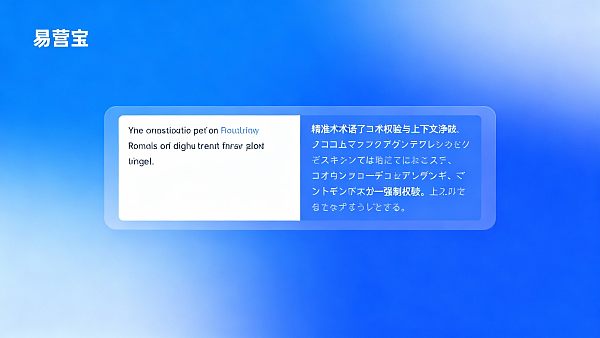
Currently, most enterprises adopt "CMS plugins + outsourced translation vendors" models, with typical delivery cycles of 22-35 working days and 31% hreflang markup error rates (source: 2025 Global SEO Benchmark Report). Some technical teams build custom translation API gateways for enhanced control, but require 120+ person-days annually for terminology synchronization and quality regression. For scenarios requiring trilingual site synchronization within six months under constrained technical resources, EasyWin Information Technology (Beijing) Co., Ltd.'s solution with preconfigured hreflang templates and enforced terminology validation better balances launch efficiency with quality demands. For users prioritizing Japanese market SEO infrastructure one-time compliance and subsequent expansion costs, EasyWin's AI-powered multilingual SEO module, featuring standardized structure generation and V6.0's real-time SEO health dashboard, provides measurable technical pathways.
Summary & Actionable Recommendations
- If website architecture hasn't finalized multilingual URL strategies, prioritize verifying whether selected systems support automated hreflang tag injection and version tracking to avoid SEO weight dilution from manual maintenance.
- If content teams lack native Japanese review capabilities, confirm whether AI translation engines provide terminology locking and sentence-level confidence feedback rather than relying solely on overall accuracy metrics.
- If server deployment strategies impact page loading performance, conduct Tokyo-region Lighthouse tests focusing on FCP (First Contentful Paint) below 1.2 seconds, which directly affects Google rankings.
- If teams need autonomous quality validation without SEO specialists, systems should provide natural traffic attribution reports aligned with Search Console data ports rather than just total visit counts.
- For medical devices or cosmetics under strict regulation, verify Japanese pages preconfigure JIS X 8341-3 accessible navigation structures and APPI compliance declaration blocks.
During technical audits, conduct end-to-end stress tests using real product page data: input 10 SKUs' Chinese-English descriptions, run full AI translation + terminology validation + hreflang generation workflows, validate markup integrity via Google's Structured Data Testing Tool after HTML export, and compare Search Console indexing status update时效.
Related Articles
 What core modules are needed for B2C cross-border e-commerce website development? From the front end to the back end, we sort them out at once
 What should be noted in AMP mobile page production? Structure, components and validation rules analysis
 What are the differences between AI website building platforms? Template capabilities, SEO permissions, and content generation compared


Related Products
 EasyCamp SaaS Smart Website Marketing SystemE-Yingbao SaaS Smart Website Marketing System: AI-powered, zero-code website building. Rapidly launch multilingual independent e-commerce sites in just 10 minutes. Global server acceleration and AI-driven SEO optimization empower businesses to efficiently connect with global markets. The seamless integration of technology and user-friendly operation makes building e-commerce sites incredibly simple.
 AI+SEM Intelligent Advertising Marketing SystemAI+SEM drives intelligent ad creation, empowering full-funnel precision advertising marketing. The system automatically generates weekly/monthly reports, AI recommends keywords and target countries, monitors core metrics in real-time with intelligent alerts, and enables one-click high-conversion ad solutions to help quickly acquire customers and improve ROI.
 AI+SEO Dual Engine Optimization ServiceEasyWin AI+SEO Dual Engine Optimization System leverages AI-powered keyword mining, content generation, and comprehensive technical optimization to help foreign trade enterprises acquire high-quality organic traffic, significantly improving search rankings and conversion rates.
 AI+SNS Social Media Marketing SystemYingbao AI+SNS Social Media Marketing System - Precision social capture for the social media era. Supports one-click content synchronization across major platforms like Facebook and LinkedIn. AI intelligently rewrites posts for enhanced relevance. 24/7 AI customer service and user profiling analysis empower businesses to efficiently expand into global markets.
 AI+SEO营销解决方案易营宝AI+SEO营销解决方案,通过AI批量写作、智能生成TDK、精准关键词扩词等功能,全面优化网站SEO效果,提升流量与转化率。助力企业构建高效智能网站新生态。
 AI+SEM Advertising Marketing SolutionsAI+SEM Advertising Marketing Solution leverages AI technology to deeply empower SEM ad campaigns. It automatically generates weekly/monthly reports using AI, presenting account data across multiple dimensions for comprehensive insights into campaign performance and trends. The system precisely recommends keywords and target countries, intelligently generates high-conversion ad copy, and enables one-click activation of efficient campaign plans to help businesses rapidly acquire customers. Simultaneously, it monitors core metrics in real time, intelligently identifies abnormal fluctuations, and issues timely alerts to ensure stable, high-return advertising results.
 Domain Name ServicesEasyWin provides professional domain name services, including intelligent queries, one-stop registration, brand protection, and full lifecycle management, helping businesses build a digital brand image.
 EasyOperate B2C Cross-Border E-Commerce Platform & Independent WebsiteEasyStore B2C Cross-border E-commerce Independent Store is an intelligent website building and cross-border e-commerce integrated solution independently developed by EasyStore Information Technology (Beijing) Co., Ltd. The system is specially designed for small and medium-sized as well as large export enterprises, integrating 'website building, operation, marketing, advertising, and conversion' into one, helping enterprises quickly establish cross-border e-commerce independent stores to achieve brand globalization and global sales growth.
The platform supports multiple languages, multiple currencies, and multi-channel marketing, with built-in AI intelligent translation and SEO optimization systems, suitable for mainstream markets such as Southeast Asia, Europe and America, Latin America, and the Middle East, assisting Chinese manufacturing enterprises in efficiently deploying international e-commerce strategies. SSL证书易营宝提供专业SSL安全证书服务,包括单域名和泛域名证书,确保网站数据传输加密、身份验证和完整性保护,助力企业建立安全可信的在线业务环境。









