









- What should you focus on in the latest enterprise SaaS report? From renewal rates and delivery costs to overseas growth opportunitiesJul 12, 2026View details
- What signals are worth paying attention to in a cross-border marketing trend report? B2B companies should look at these 6 signalsJul 11, 2026View details
- How to Read a Cross-Border Marketing Trends Report? Five Key Dimensions for Evaluating Channel OpportunitiesJul 11, 2026View details
- Which channel has the highest ROI in the global traffic ecosystem? Comparative analysis of search, social media, and advertisingJul 10, 2026View details
- What multilingual website services are available in Sanya? Which model is more suitable for local businesses going global?Jul 08, 2026View details
- How to view the complete list of China SaaS companies in the top 100? Practical methods for screening website-building and marketing service providersJul 08, 2026View details
- How to view pricing in the global traffic ecosystem? Cost comparison of search, social media, and content channel advertisingJul 06, 2026View details
- How to assess foreign trade website development trends?Looking at 2026 changes from multilingual,AI content to conversion pathsJul 04, 2026View details
Key Factors to Consider When Choosing an AI Translation API
When selecting an AI translation API,you need to comprehensively evaluate accuracy,stability,scalability and integration cost,so as to avoid constraints on later business growth。For teams responsible for website development,cross-border marketing,SEO content production and advertising landing page operations,translation capability is not just a language conversion tool,but is also related to page indexing,conversion messaging,brand consistency and multi-region operational efficiency。
Before procurement,technical evaluators usually focus on 4 types of issues:whether the translation is suitable for the industry context,whether the interface can support high concurrency,whether it is easy to connect to a CMS or marketing automation system,and whether subsequent pay-as-you-go costs are controllable。Especially when foreign trade enterprises maintain sites in 5 or more languages at the same time,the selection of an AI translation API will directly affect the content launch cycle and the pace of search traffic growth。
I. Clarify business scenarios first,then evaluate AI translation API capabilities
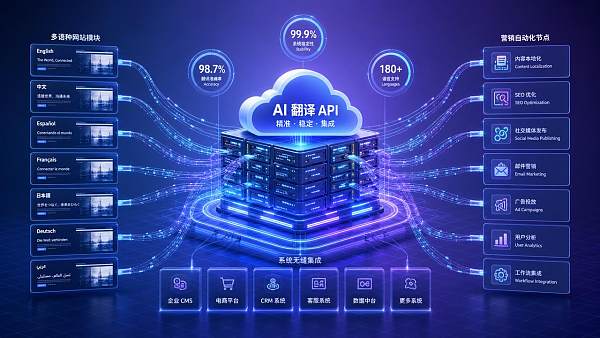
Although they are all AI translation APIs,the evaluation priorities are not the same when used for customer service chats,product detail pages,SEO articles and advertising copy。The integrated website + marketing service scenario places more emphasis on “publishable quality”,that is,the translation must not only be fluent,but also conform to search habits,brand tone and the expressions of local buyers。
Since its establishment in 2013,Eternity Information Technology (Beijing) Co., Ltd. has long served global digital marketing clients,covering intelligent website development,SEO optimization,social media marketing and advertising placement。Based on this type of experience,when technical teams evaluate translation interfaces,they should assess language quality,content scale and subsequent optimization workflows within the same framework。
1. Selection priorities for different content types
In a typical foreign trade website,content that needs to be translated may include TDK,category pages,product parameters,blog articles,inquiry forms and advertising landing pages。Each type of content has different requirements for terminology consistency,sentence length and degree of localization,so the overall effect cannot be judged only by single-sentence testing。
The following table can be used as a scenario matrix for the initial screening of AI translation APIs,helping technical evaluators break requirements down into testable items instead of only comparing unit prices or brand awareness。
As the table shows,an AI translation API is not a single-point tool,but part of the content production chain。If an enterprise plans to expand multilingual sites within 3–6 months,it should prioritize interfaces that support batch tasks,terminology databases and context parameters。
2. 3 testing principles suitable for technical evaluators
- Test samples should cover at least 4 types of text:short titles,long paragraphs,table parameters and marketing sentences。
- For each language,it is recommended to prepare no less than 5000 characters of real business content,and avoid using only public example sentences。
- Record the time spent on manual post-editing at the same time。If revisions exceed 20 minutes per thousand words,the model fit needs to be re-evaluated。
II. Core metrics:accuracy,stability and integration cost
The technical evaluation of an AI translation API should be upgraded from “whether it can translate” to “whether it can stably support the business”。For marketing-oriented websites,translation results will be used in page titles,descriptions,image ALT,structured data and advertising materials,and any abnormality may cause indexing fluctuations or conversion losses。
It is recommended to divide the evaluation into 6 metrics:terminology accuracy,context understanding,interface response,concurrency capability,exception handling and pricing model。Each metric should have recordable thresholds,such as average response lower than 800 milliseconds,no more than 3 failed retries,and log retention of no less than 30 days。
1. Comparison of procurement evaluation dimensions
The following table is suitable for technical review meetings or vendor comparisons。The scoring does not need to be complex,and a 1–5 scale is sufficient,but each item must be tied to business impact,so that R&D,operations and procurement can communicate under the same standard。
The key conclusion is that a low call unit price does not equal a low total cost。If an AI translation API lacks terminology management and exception callbacks,it may later increase the time spent on manual proofreading,content rework and O&M troubleshooting,and hidden costs are often concentrated in the 4–8 weeks after launch。
2. Points to note when collaborating with SEO systems
After multilingual content goes online,keyword matrices,page structure,internal links,TDK and loading speed still need to be handled。If the translation interface only outputs text and cannot coordinate with content management,technical optimization and data monitoring,website growth will remain at the stage of “having pages” rather than “having traffic”。
In foreign trade enterprise scenarios,AI translation APIs can be used together with AI+SEO dual-engine system optimization services for AI-powered intelligent keyword mining,multilingual content generation,intelligent TDK generation,image ALT optimization and technical SEO audits,helping content move from translation results into an operational closed loop that can rank,be monitored and be iterated。
III. Implementation process:from interface testing to launch acceptance
For mature AI translation API selection,it is not recommended to directly replace the entire site,but to use small-batch validation。A common approach is to proceed in 5 steps:requirements sorting,sample testing,gray release integration,quality review and scaled launch,with the overall cycle usually being 2–4 weeks。
1. Recommended 5-step implementation path
- Organize languages,page types,character volume and peak call values,and clarify the initial scope。
- Select 50–100 pieces of real text,covering products,articles,advertisements and forms。
- Complete configurations for authentication,rate limiting,logs,failed retries and queue callbacks。
- Have operations or localization personnel spot-check 10%–20% of translation quality。
- Connect to the CMS,SEO monitoring and content publishing workflow,and establish a periodic review mechanism。
During the gray release stage,special attention should be paid to variable protection,such as prices,models,URLs,HTML tags and structured data fields。If these contents are mistranslated or damaged,minor issues may cause abnormal page display,while serious issues may affect search engine crawling and advertising review。
2. Common misunderstandings and risk control
The first misunderstanding is focusing only on single-sentence translation results。Marketing content usually depends on context,and titles,opening paragraphs,selling points and call-to-action buttons need to maintain the same tone。Excellent single sentences do not mean the whole page reads naturally。The second misunderstanding is ignoring caching strategies。If high-frequency duplicate content is not cached,call costs will increase。
The third misunderstanding is having no clear boundary for manual review。It is recommended to classify core pages,advertising pages and high-value keyword pages as Grade A content,which must be manually spot-checked;general information and low-risk list pages can be set as Grade B content and reviewed proportionally,so as to balance efficiency and quality。
IV. Selection recommendations for growth
For technical evaluators,the final choice of an AI translation API should serve business growth rather than stop at interface availability。If an enterprise already has a multilingual website development plan,an SEO content matrix and advertising placement needs,it should prioritize solutions that can integrate with existing systems with low coupling,support batch tasks and provide quality tracking。
Driven by artificial intelligence and big data,Eternity has been deeply engaged in global digital marketing services for many years,forming full-chain capabilities in intelligent website development,SEO optimization,social media marketing and advertising placement。For foreign trade enterprises,translation is only the first step;subsequent work also requires ranking improvement,content iteration,conversion monitoring and localized operations collaboration。
When choosing an AI translation API,it is recommended to complete at least 1 round of real content testing,1 concurrent stress validation,1 set of cost calculations and 1 launch rollback plan。Only by evaluating accuracy,stability,scalability and integration cost within the same framework can enterprises avoid rebuilding the system after business growth。
If you are planning a multilingual website,an overseas SEO content system or a cross-border marketing automation workflow,you can contact Eternity for a customized solution,further consult product details,and learn more about solutions suitable for the global growth of your enterprise。
Related Articles


Related Products
 EasyCamp SaaS Smart Website Marketing SystemE-Yingbao SaaS Smart Website Marketing System: AI-powered, zero-code website building. Rapidly launch multilingual independent e-commerce sites in just 10 minutes. Global server acceleration and AI-driven SEO optimization empower businesses to efficiently connect with global markets. The seamless integration of technology and user-friendly operation makes building e-commerce sites incredibly simple.
 AI+SEM Intelligent Advertising Marketing SystemAI+SEM drives intelligent ad creation, empowering full-funnel precision advertising marketing. The system automatically generates weekly/monthly reports, AI recommends keywords and target countries, monitors core metrics in real-time with intelligent alerts, and enables one-click high-conversion ad solutions to help quickly acquire customers and improve ROI.
 AI+SEO Dual Engine Optimization ServiceEasyWin AI+SEO Dual Engine Optimization System leverages AI-powered keyword mining, content generation, and comprehensive technical optimization to help foreign trade enterprises acquire high-quality organic traffic, significantly improving search rankings and conversion rates.
 AI+SNS Social Media Marketing SystemYingbao AI+SNS Social Media Marketing System - Precision social capture for the social media era. Supports one-click content synchronization across major platforms like Facebook and LinkedIn. AI intelligently rewrites posts for enhanced relevance. 24/7 AI customer service and user profiling analysis empower businesses to efficiently expand into global markets.
 AI+SEO营销解决方案易营宝AI+SEO营销解决方案,通过AI批量写作、智能生成TDK、精准关键词扩词等功能,全面优化网站SEO效果,提升流量与转化率。助力企业构建高效智能网站新生态。
 AI+SEM Advertising Marketing SolutionsAI+SEM Advertising Marketing Solution leverages AI technology to deeply empower SEM ad campaigns. It automatically generates weekly/monthly reports using AI, presenting account data across multiple dimensions for comprehensive insights into campaign performance and trends. The system precisely recommends keywords and target countries, intelligently generates high-conversion ad copy, and enables one-click activation of efficient campaign plans to help businesses rapidly acquire customers. Simultaneously, it monitors core metrics in real time, intelligently identifies abnormal fluctuations, and issues timely alerts to ensure stable, high-return advertising results.
 Domain Name ServicesEasyWin provides professional domain name services, including intelligent queries, one-stop registration, brand protection, and full lifecycle management, helping businesses build a digital brand image.
 EasyOperate B2C Cross-Border E-Commerce Platform & Independent WebsiteEasyStore B2C Cross-border E-commerce Independent Store is an intelligent website building and cross-border e-commerce integrated solution independently developed by EasyStore Information Technology (Beijing) Co., Ltd. The system is specially designed for small and medium-sized as well as large export enterprises, integrating 'website building, operation, marketing, advertising, and conversion' into one, helping enterprises quickly establish cross-border e-commerce independent stores to achieve brand globalization and global sales growth.
The platform supports multiple languages, multiple currencies, and multi-channel marketing, with built-in AI intelligent translation and SEO optimization systems, suitable for mainstream markets such as Southeast Asia, Europe and America, Latin America, and the Middle East, assisting Chinese manufacturing enterprises in efficiently deploying international e-commerce strategies. SSL证书易营宝提供专业SSL安全证书服务,包括单域名和泛域名证书,确保网站数据传输加密、身份验证和完整性保护,助力企业建立安全可信的在线业务环境。









