









- What stages does the cross-border services ecosystem include? How do website building, promotion, payment, and compliance work togetherJun 22, 2026View details
- How will email marketing costs change in 2026Jun 22, 2026View details
- The China-US tariff arrangement has reached a preliminary consensus, and the trade association will be establishedJun 15, 2026View details
- Should overseas brand marketing start with ads or contentJun 21, 2026View details
- What determines B2C cross-border e-commerce website development costs? A breakdown of features, interfaces, and deployment methodsJun 17, 2026View details
- China-Morocco zero-tariff access, a breakthrough in the cost of Moroccan goods exports to ChinaJun 11, 2026View details
- What signal should be released for the suspension of exports to JapanJun 10, 2026View details
- China's May LNG imports rebounded, with increased volumes from Russia and Canada filling the Middle East supply gapJun 10, 2026View details
How to choose a website traffic monitoring tool: first clarify what data you need to look at
When choosing a website traffic monitoring tool, don’t rush to compare how many features it has. First, clarify which data you actually need to look at. For technical evaluators, collection accuracy, data dimensions, attribution capabilities, and system compatibility are often more important than the interface.
Start by clarifying your needs: what problems should a website traffic monitoring tool actually solve
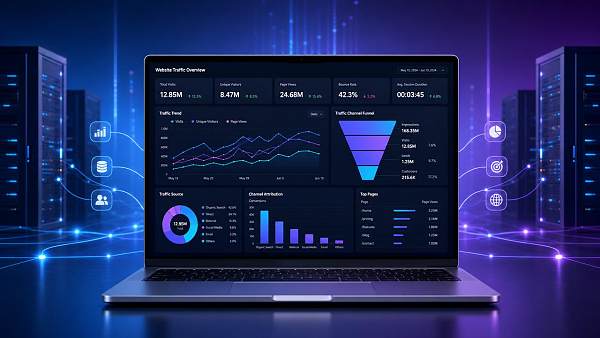
In integrated website + marketing service scenarios, a website traffic monitoring tool is not just a backend for “viewing traffic volume.” It directly affects the technical team’s judgment of site performance, channel quality, user paths, conversion sources, and subsequent optimization actions. If the wrong tool is chosen, subsequent SEO, ad placement, landing page iterations, and multi-channel attribution will all be disrupted.
A common difficulty for technical evaluators is not that there are too few tools, but that the goals are unclear. Some people want to see organic search growth, some want to see ad landing page bounce rates, and some are more concerned about cross-site tracking, event tracking, or sending data back to the customer relationship management system. Different goals lead to completely different requirements for website traffic monitoring tools.
- If the core task is SEO optimization, focus on search sources, landing page performance, traffic changes after indexing, and content conversion paths.
- If the core task is advertising coordination, priority should be given to evaluating channel tagging, attribution windows, conversion event definitions, and data feedback capabilities.
- If the core task is full-funnel growth, simultaneous attention should be paid to site performance, form submissions, user segmentation, lead quality, and the cost of integrating multiple systems.
Easyab Information Technology (Beijing) Co., Ltd. has long served global digital marketing scenarios. Leveraging artificial intelligence and big data capabilities, it integrates intelligent website building, SEO optimization, social media marketing, and advertising into one growth logic. Therefore, when selecting a tool, more emphasis is placed on whether the data can serve the business loop rather than staying at the reporting display level.
When technical evaluators choose website traffic monitoring tools, which data should they prioritize
The table below is suitable for preliminary screening. It is not divided by brand, but by the data capabilities that truly need to be verified during technical evaluation, making it more suitable for integrated website + marketing service teams to use for project initiation communication.
For technical evaluators, what really matters is “whether this set of data can be used for decision-making.” If you can only see visitor volume but cannot break it down into pages, events, channels, and conversion nodes, then this website traffic monitoring tool will be difficult to support subsequent growth analysis.
Don’t just look at traffic volume; look at the complete behavioral chain
Traffic volume can only answer “how many people came,” but it cannot answer “where these people came from, what they viewed, why they left, and which people ultimately converted.” In integrated marketing service projects, technical teams should pay more attention to mid- and lower-funnel data such as page dwell time, scroll depth, button clicks, form abandonment rate, and consultation trigger paths.
Attribution standards must support cross-channel coordination
When companies are doing SEO, social media marketing, and advertising at the same time, the same customer often goes through multiple touchpoints. If a website traffic monitoring tool only records the last click, it will easily underestimate the value of content marketing and brand exposure, and it will also distort the direction of budget optimization.
In different scenarios, the selection criteria for website traffic monitoring tools are not the same
Many procurement failures are not because the tool itself is poor, but because the same set of standards is used to evaluate all projects. The table below is suitable for technical evaluators to break down needs by scenario and reduce ineffective comparisons.
If an enterprise is doing website building, SEO, and advertising at the same time, selection cannot be determined only by single-point needs. Easyab Information Technology (Beijing) Co., Ltd.’s service experience shows that the more full-funnel the marketing project is, the more necessary it is for the website traffic monitoring tool to have unified tracking, layered permissions, and data integration capabilities.
Scenario differences often overlooked by technical teams
- Content-driven websites are more concerned about insufficiently detailed page analysis, which makes it impossible to determine which topics truly bring effective inquiries.
- Campaign-driven websites are more concerned about vague conversion definitions, resulting in long-term mismatches between advertising platforms and on-site data.
- Group enterprise websites are more concerned about chaotic multi-department permissions, which affects both data security and reporting efficiency.
When purchasing a website traffic monitoring tool, how can the technical evaluation process be made more reliable
A truly efficient evaluation does not start with watching demos, but with creating an evaluation checklist first. Technical teams can first clearly list business goals, site structure, existing systems, and data output requirements, and then move into tool screening. This can significantly reduce the risk of “many features but impossible to implement.”
- First define target metrics, such as organic search traffic, qualified inquiries, form submission rate, and advertising conversion cost.
- Then sort out collection objects, including page views, button clicks, form status, download behavior, and consultation triggers.
- Confirm attribution standards, and clarify whether to look at first touch, last touch, or multi-touch assisted conversions.
- Verify system interfaces to confirm whether they can connect with the website building system, advertising platforms, and the customer relationship management system.
- Arrange a trial run covering at least one real marketing cycle, and observe data stability and abnormal handling efficiency.
Some companies also draw on process optimization ideas in internal management training, such as the application of lean management in operating cost control in public hospitals. The core inspiration of such methodologies does not lie in superficial industry differences, but in how to reduce ineffective steps and improve the efficiency of data-driven decision-making. This also applies to the selection of website traffic monitoring tools.
What to focus on during the trial period
During the trial phase, do not just look at whether the reports are visually appealing. More importantly, check whether event configuration is flexible, whether data delay is acceptable, whether abnormal traffic can be identified, whether historical data export is convenient, and whether different departments can collaborate based on the same standards.
Common misunderstanding: why many website traffic monitoring tools still fail to reveal problems after being used
Many companies have already deployed website traffic monitoring tools, but still feel that “there is a lot of data, yet decision-making is difficult.” The problem is often not the lack of tools, but incomplete implementation methods and metric system design.
- Only installing basic code without event tracking, causing all conversion paths to become vague.
- Inconsistent channel naming, making it impossible to compare advertising, social media, and email data horizontally.
- Failure to filter internal visits, test traffic, and abnormal crawling, affecting accurate judgment.
- Only looking at totals without viewing page groups and audience segmentation, making it impossible to find specific optimization points.
- Failure to verify tracking simultaneously after a site redesign, causing breaks in historical standards.
In full-funnel marketing projects, data governance and tool deployment must be advanced simultaneously. In its services, Easyab Information Technology (Beijing) Co., Ltd. places greater emphasis on early-stage strategic alignment, reducing repeated rework and conflicting standards among multiple teams through the linkage of website building, optimization, advertising, and analysis.
FAQ: how to choose a website traffic monitoring tool without making costly mistakes
Which companies should deploy website traffic monitoring tools first?
As long as a company’s website carries tasks such as customer acquisition, inquiries, content distribution, or brand conversion, deployment is necessary. This is especially true for teams doing SEO, advertising, and social media marketing at the same time, as they need a unified data foundation even more. Otherwise, each channel will tell a different story, making budget optimization difficult.
What technical point is most easily overlooked during procurement?
The most easily overlooked points are unified data standards and system compatibility. The former determines whether reports can be used for management decision-making, while the latter determines whether it can later connect to the customer relationship management system, advertising feedback, and BI analysis. If these two points are unclear, no matter how many advanced features there are, it will be difficult to realize their value.
Should website traffic monitoring tools and website building services be considered together?
It is recommended to consider them together. This is because site structure, page components, form design, and loading mechanisms all affect data collection quality. This is exactly where the advantage of integrated website + marketing services lies: tracking, conversion paths, and subsequent optimization goals are planned in from the website-building stage, making later implementation much smoother.
When the budget is limited, which capabilities should a website traffic monitoring tool prioritize?
Priority should be given to stable collection, event tracking, channel attribution, and basic integration capabilities. Advanced visualized reports, complex model analysis, and deep automation can be rolled out in stages according to business maturity. Getting the core data running first is more practical than piling on all features at once.
Why choose us: we don’t just help you install tools, we also help you put data to use
For technical evaluators, a truly valuable partner does not just provide a recommendation list of website traffic monitoring tools, but can combine website building, SEO optimization, social media marketing, and advertising scenarios to help companies clarify metrics, design tracking, integrate systems, and form executable reports.
Driven by artificial intelligence and big data as its core capabilities, Easyab Information Technology (Beijing) Co., Ltd. has long served enterprises’ global growth needs and can provide evaluation support that is closer to practical business implementation around integrated website + marketing services. Whether you are currently preparing a new website, redesigning an old site, coordinating advertising, or entering a multi-channel growth stage, you can obtain clearer selection recommendations from both technical and marketing perspectives.
- If you need to confirm the key parameters of a website traffic monitoring tool, we can help sort out collection dimensions, event design, and attribution standards.
- If you are selecting a product, we can provide an evaluation framework based on your site structure, marketing goals, and existing systems.
- If you care about delivery timelines, we can break down the implementation plan into several stages: website building, tracking, integration testing, and verification.
- If you need a customized solution, we can design an integrated data solution around SEO, advertising, social media, and customer relationship management system integration.
- If you are preparing for quotation discussions, you can also first clarify feature boundaries, interface scope, and subsequent maintenance requirements to avoid repeated additional costs after procurement.
Once you have clearly defined “what data to look at,” the selection of a website traffic monitoring tool will shift from feature comparison to more efficient business judgment. If you would like to further refine parameter confirmation, selection routes, or implementation checklists, you can now move into a more specific communication stage.
Related Articles



Related Products
 EasyCamp SaaS Smart Website Marketing SystemE-Yingbao SaaS Smart Website Marketing System: AI-powered, zero-code website building. Rapidly launch multilingual independent e-commerce sites in just 10 minutes. Global server acceleration and AI-driven SEO optimization empower businesses to efficiently connect with global markets. The seamless integration of technology and user-friendly operation makes building e-commerce sites incredibly simple.
 AI+SEM Intelligent Advertising Marketing SystemAI+SEM drives intelligent ad creation, empowering full-funnel precision advertising marketing. The system automatically generates weekly/monthly reports, AI recommends keywords and target countries, monitors core metrics in real-time with intelligent alerts, and enables one-click high-conversion ad solutions to help quickly acquire customers and improve ROI.
 AI+SEO Dual Engine Optimization ServiceEasyWin AI+SEO Dual Engine Optimization System leverages AI-powered keyword mining, content generation, and comprehensive technical optimization to help foreign trade enterprises acquire high-quality organic traffic, significantly improving search rankings and conversion rates.
 AI+SNS Social Media Marketing SystemYingbao AI+SNS Social Media Marketing System - Precision social capture for the social media era. Supports one-click content synchronization across major platforms like Facebook and LinkedIn. AI intelligently rewrites posts for enhanced relevance. 24/7 AI customer service and user profiling analysis empower businesses to efficiently expand into global markets.
 AI+SEO营销解决方案易营宝AI+SEO营销解决方案,通过AI批量写作、智能生成TDK、精准关键词扩词等功能,全面优化网站SEO效果,提升流量与转化率。助力企业构建高效智能网站新生态。
 AI+SEM Advertising Marketing SolutionsAI+SEM Advertising Marketing Solution leverages AI technology to deeply empower SEM ad campaigns. It automatically generates weekly/monthly reports using AI, presenting account data across multiple dimensions for comprehensive insights into campaign performance and trends. The system precisely recommends keywords and target countries, intelligently generates high-conversion ad copy, and enables one-click activation of efficient campaign plans to help businesses rapidly acquire customers. Simultaneously, it monitors core metrics in real time, intelligently identifies abnormal fluctuations, and issues timely alerts to ensure stable, high-return advertising results.
 Domain Name ServicesEasyWin provides professional domain name services, including intelligent queries, one-stop registration, brand protection, and full lifecycle management, helping businesses build a digital brand image.
 EasyOperate B2C Cross-Border E-Commerce Platform & Independent WebsiteEasyStore B2C Cross-border E-commerce Independent Store is an intelligent website building and cross-border e-commerce integrated solution independently developed by EasyStore Information Technology (Beijing) Co., Ltd. The system is specially designed for small and medium-sized as well as large export enterprises, integrating 'website building, operation, marketing, advertising, and conversion' into one, helping enterprises quickly establish cross-border e-commerce independent stores to achieve brand globalization and global sales growth.
The platform supports multiple languages, multiple currencies, and multi-channel marketing, with built-in AI intelligent translation and SEO optimization systems, suitable for mainstream markets such as Southeast Asia, Europe and America, Latin America, and the Middle East, assisting Chinese manufacturing enterprises in efficiently deploying international e-commerce strategies. SSL证书易营宝提供专业SSL安全证书服务,包括单域名和泛域名证书,确保网站数据传输加密、身份验证和完整性保护,助力企业建立安全可信的在线业务环境。









