









- What stages does the cross-border services ecosystem include? How do website building, promotion, payment, and compliance work togetherJun 22, 2026View details
- How will email marketing costs change in 2026Jun 22, 2026View details
- The China-US tariff arrangement has reached a preliminary consensus, and the trade association will be establishedJun 15, 2026View details
- Should overseas brand marketing start with ads or contentJun 21, 2026View details
- What determines B2C cross-border e-commerce website development costs? A breakdown of features, interfaces, and deployment methodsJun 17, 2026View details
- China-Morocco zero-tariff access, a breakthrough in the cost of Moroccan goods exports to ChinaJun 11, 2026View details
- What signal should be released for the suspension of exports to JapanJun 10, 2026View details
- China's May LNG imports rebounded, with increased volumes from Russia and Canada filling the Middle East supply gapJun 10, 2026View details
What Is Included in SEO Services and Which Items Have the Greatest Impact on Results
When evaluating search engine optimization services, what truly impacts results is not having more project items, but whether strategy, technology, content, and conversion work together. This article focuses on the key links to help business evaluators clearly understand input-output efficiency.
Why business evaluators should not look only at the “service list”
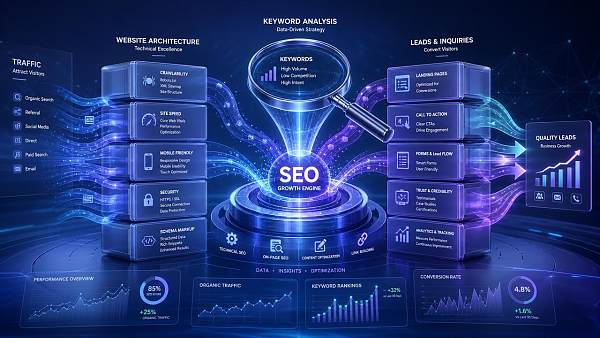
When many companies procure search engine optimization services, the first thing they receive is often a long list of deliverables: keywords, backlinks, articles, code adjustments, and data reports. It may look comprehensive, but the results are not necessarily stable. For business evaluators, what truly needs to be judged is not “how many items were done,” but “which items directly affect business results.”
In the integrated website + marketing service industry, SEO is not an isolated action. It is simultaneously affected by website structure, page speed, content planning, lead handling, campaign coordination, and data analysis capabilities. If a service provider can only offer one-point optimization, it is often difficult to support subsequent inquiry growth, customer acquisition cost reduction, and overseas localization expansion.
Easy-Marketing Information Technology (Beijing) Co., Ltd. has long served global growth scenarios. Relying on artificial intelligence and big data capabilities, it connects intelligent website building, SEO optimization, social media marketing, and advertising placement, making it more suitable for enterprises that need to evaluate overall growth efficiency from a procurement perspective. For business evaluators, this kind of integrated capability is often more important than simply offering a low price.
- If the website foundation is weak, even a large amount of content production may still be difficult for search engines to crawl and understand effectively.
- If there are rankings but no conversion path, traffic growth may not necessarily turn into inquiries, leads, or deals.
- If data attribution is lacking, it is difficult for the procurement department to determine whether the budget truly delivers long-term value.
What search engine optimization services usually include, and which items are core
Standard search engine optimization services usually cover research, technology, content, on-site structure, external signals, and data monitoring. However, from the perspective of business evaluation, the importance of these elements is not equal. Priority should be given to identifying the key modules that directly affect crawling, indexing, ranking, and conversion.
Common service modules can be divided into four layers
- Strategy layer: industry research, competitor analysis, keyword mapping, target market segmentation, and phased KPI setting.
- Technical layer: website structure optimization, URL standards, internal linking system, mobile adaptation, page speed, and indexing control.
- Content layer: category planning, landing page copy, knowledge content, long-tail keyword pages, and content update mechanisms.
- Growth layer: conversion component design, form path optimization, data tracking setup, and SEO coordination with advertising or social media.
The table below is suitable for making a preliminary judgment on which items in search engine optimization services have a greater impact on results and which are only supporting items.
It can be seen that what usually has the greatest impact on results is not the number of reports, nor how many pieces of content are published in a single month, but whether the early-stage strategy is accurate, whether the website foundation is optimizable, whether the content addresses real needs, and whether organic traffic can be directed toward business goals.
Which items have the greatest impact on search engine optimization service results
If it is necessary to filter out the most critical parts from many items, business evaluators can focus on four things: site foundation, keyword strategy, content assets, and conversion loop. These four determine whether search engine optimization services remain at the level of “deliverable” or can move toward “scalable growth.”
First, whether the website foundation is suitable for long-term optimization
For integrated website + marketing service projects, the website is not a brochure, but the central hub for handling traffic. If there are issues such as duplicate pages, slow loading, confusing navigation, poor mobile experience, and high form abandonment, even the best subsequent SEO strategy will be offset. Especially for B2B corporate websites, category structure and product page templates have a major impact on indexing efficiency.
Second, whether the keyword strategy matches procurement intent
Quite a few service providers turn keywords into a simple word list, but truly effective search engine optimization services distinguish among brand terms, product terms, scenario terms, problem terms, and decision terms. In business evaluation, it is important to check whether pages are set up around different intents, rather than piling all traffic onto the homepage. Whether terms such as “comparison,” “quotation,” “solution,” and “delivery cycle” can be covered is particularly critical to conversion.
Third, whether the content has the ability to support business conversion
Content is not written for search engines, but for people who are preparing to request a quote, evaluate, and compare options. High-quality content should be able to answer questions about budget range, project process, common risks, applicable scenarios, and delivery standards. If it only introduces concepts in a general way, it is difficult to generate effective leads. Some industry reference content can also serve as supporting trust assets. For example, moderately incorporating thematic resources such as Thoughts on advancing the informatization construction of financial management in public institutions under the background of big data into a corporate knowledge section can strengthen the site’s topical depth, provided that it connects naturally with the audience journey.
Fourth, whether a conversion loop from traffic to leads has been established
Business evaluators should not only look at organic traffic growth, but also at conversion page layout, consultation entry design, form length, inquiry tracking, and CRM integration. If SEO cannot enter the sales funnel, procurement value is difficult to prove. Easy-Marketing’s advantage lies in not stopping optimization at the ranking level, but in improving overall conversion efficiency by combining website building, advertising placement, and data capabilities.
When procuring search engine optimization services, which dimensions should be compared重点
The difficulty of business evaluation lies in the fact that different service providers all emphasize experience, cases, and methods, but comparability is weak. To improve judgment efficiency, evaluation dimensions can be divided into five parts: solution depth, execution capability, data transparency, collaboration scope, and risk control.
The table below is suitable for comparing different types of search engine optimization service solutions during the procurement stage, helping business evaluators clearly see the real capability structure behind quotation differences.
If the enterprise itself needs website building, SEO, content, multilingual expansion, and advertising coordination, then an integrated solution is usually more conducive to controlling total cost. It reduces the communication loss caused by collaboration among multiple vendors and also makes it easier to form a continuous data closed loop.
Recommended procurement questions to focus on reviewing
- Whether diagnosis is conducted before quotation, or a fixed package is offered directly.
- Who will fix technical issues, and whether the client needs to coordinate the development team independently.
- Whether content is produced around business goals, or delivered only by article count.
- Whether measurable milestones can be set, such as indexing improvement, key page growth, and inquiry tracking launch.
- Whether multilingual and multi-region projects have localized implementation capabilities.
When the budget is limited, how to phase investment in search engine optimization services more reasonably
A limited budget does not mean SEO cannot be done, but that too many low-priority actions should be avoided at the beginning. Business evaluators can adopt a “foundation first, key breakthroughs, continuous expansion” approach to arrange the procurement rhythm, prioritizing funds toward the items that have the greatest impact on results.
Recommended phased implementation approach
- Phase 1: first conduct diagnosis and basic fixes, including structure, speed, indexing, and core page optimization.
- Phase 2: focus on high-intent keyword pages, such as product pages, solution pages, regional pages, and inquiry pages.
- Phase 3: expand the content matrix, laying out common questions, comparison pages, industry topics, and case-study logic.
- Phase 4: connect conversion analysis and form synergistic incremental growth with advertising placement and social media distribution.
For enterprises that need to improve management while also outputting digital cognition, thematic materials such as Thoughts on advancing the informatization construction of financial management in public institutions under the background of big data can also be appropriately introduced into the content system to strengthen knowledge-based entry points and long-tail coverage, but core business pages should still take priority.
Common misconceptions and FAQ: what is most easily overlooked in business evaluation
If keyword rankings rise, does that mean procurement is successful?
Not necessarily. Rankings are only process indicators, not final business results. If what rises are low-value terms, or if the page has no consultation entry, poor form experience, or content that cannot build trust, then traffic growth still cannot convert. In business evaluation, effective visits, lead volume, and conversion paths should be reviewed simultaneously.
How long is the delivery cycle for search engine optimization services generally?
This depends on the website foundation, level of competition, and content reserves. Usually, the first 1 to 2 months are more focused on diagnosis, repair, and page restructuring, followed by a stage of indexing improvement and key keyword growth. For new websites or redesigned websites, the cycle will be longer. During procurement, phased goals should be required rather than only asking “how long until results appear.”
Why are low-price packages often unstable in effectiveness?
Because low-price solutions often standardize services down to the minimum deliverables, only completing article publishing, reporting, or simple tag adjustments, while failing to cover technical transformation, page design, and conversion analysis. For integrated website + marketing service projects, these are the parts that determine the upper limit of performance.
What should be given special attention when doing search engine optimization services for multilingual business?
Attention should be paid to search habits, page structure, localized vocabulary, and content expression in different markets, rather than simple translation. If an enterprise targets multiple countries or regions, whether the service provider has localization capabilities and whether it can handle multi-site structures are very critical judgment items in business evaluation.
Why choose us: forming a closed loop from evaluation and selection to delivery
For business evaluators, the ideal search engine optimization service is not just “being able to do SEO,” but being able to connect the website, content, data, and growth goals. Since its establishment in 2013, Easy-Marketing Information Technology (Beijing) Co., Ltd. has continuously driven digital marketing services with artificial intelligence and big data, forming synergistic capabilities in intelligent website building, SEO optimization, social media marketing, and advertising placement, making it more suitable for overall evaluation and implementation in complex procurement scenarios.
If you are evaluating search engine optimization services, it is recommended to directly discuss the following key content: whether the current website foundation is suitable for optimization, how keywords correspond to pages, how the delivery cycle should be broken down, which items the budget should prioritize, whether multilingual and localization support is available, and how leads and conversions will be tracked. Only by confirming these questions in advance can procurement decisions truly be built on result-oriented logic.
- You may consult on website diagnosis scope: structure, speed, indexing, mobile experience, and conversion entry points.
- You may consult on solution selection: foundational optimization, growth-oriented solutions, or multi-market expansion solutions.
- You may consult on delivery cycle: how the diagnosis phase, repair phase, content phase, and data tracking phase are arranged.
- You may consult on customized content: whether product pages, regional pages, FAQ pages, and thematic pages need to be combined.
- You may consult on quotation communication: which items should be prioritized under different budgets and how procurement risks should be controlled.
When search engine optimization services work together with website building, content, and conversion, procurement is no longer just purchasing a traffic service, but building a digital asset for sustainable growth. This is also where the value most worthy of attention in business evaluation lies.
Related Articles
 Are you really hitting the right target with Google FB for truck bed exports?
 It's easy to turn a foreign trade website into a piece of art, but it's the ultimate culprit behind your order decline
 Foreign trade website efficiency revolution! Yiyingbao component upgrade + inquiry optimization, inquiries surge!



Related Products
 EasyCamp SaaS Smart Website Marketing SystemE-Yingbao SaaS Smart Website Marketing System: AI-powered, zero-code website building. Rapidly launch multilingual independent e-commerce sites in just 10 minutes. Global server acceleration and AI-driven SEO optimization empower businesses to efficiently connect with global markets. The seamless integration of technology and user-friendly operation makes building e-commerce sites incredibly simple.
 AI+SEM Intelligent Advertising Marketing SystemAI+SEM drives intelligent ad creation, empowering full-funnel precision advertising marketing. The system automatically generates weekly/monthly reports, AI recommends keywords and target countries, monitors core metrics in real-time with intelligent alerts, and enables one-click high-conversion ad solutions to help quickly acquire customers and improve ROI.
 AI+SEO Dual Engine Optimization ServiceEasyWin AI+SEO Dual Engine Optimization System leverages AI-powered keyword mining, content generation, and comprehensive technical optimization to help foreign trade enterprises acquire high-quality organic traffic, significantly improving search rankings and conversion rates.
 AI+SNS Social Media Marketing SystemYingbao AI+SNS Social Media Marketing System - Precision social capture for the social media era. Supports one-click content synchronization across major platforms like Facebook and LinkedIn. AI intelligently rewrites posts for enhanced relevance. 24/7 AI customer service and user profiling analysis empower businesses to efficiently expand into global markets.
 AI+SEO营销解决方案易营宝AI+SEO营销解决方案,通过AI批量写作、智能生成TDK、精准关键词扩词等功能,全面优化网站SEO效果,提升流量与转化率。助力企业构建高效智能网站新生态。
 AI+SEM Advertising Marketing SolutionsAI+SEM Advertising Marketing Solution leverages AI technology to deeply empower SEM ad campaigns. It automatically generates weekly/monthly reports using AI, presenting account data across multiple dimensions for comprehensive insights into campaign performance and trends. The system precisely recommends keywords and target countries, intelligently generates high-conversion ad copy, and enables one-click activation of efficient campaign plans to help businesses rapidly acquire customers. Simultaneously, it monitors core metrics in real time, intelligently identifies abnormal fluctuations, and issues timely alerts to ensure stable, high-return advertising results.
 Domain Name ServicesEasyWin provides professional domain name services, including intelligent queries, one-stop registration, brand protection, and full lifecycle management, helping businesses build a digital brand image.
 EasyOperate B2C Cross-Border E-Commerce Platform & Independent WebsiteEasyStore B2C Cross-border E-commerce Independent Store is an intelligent website building and cross-border e-commerce integrated solution independently developed by EasyStore Information Technology (Beijing) Co., Ltd. The system is specially designed for small and medium-sized as well as large export enterprises, integrating 'website building, operation, marketing, advertising, and conversion' into one, helping enterprises quickly establish cross-border e-commerce independent stores to achieve brand globalization and global sales growth.
The platform supports multiple languages, multiple currencies, and multi-channel marketing, with built-in AI intelligent translation and SEO optimization systems, suitable for mainstream markets such as Southeast Asia, Europe and America, Latin America, and the Middle East, assisting Chinese manufacturing enterprises in efficiently deploying international e-commerce strategies. SSL证书易营宝提供专业SSL安全证书服务,包括单域名和泛域名证书,确保网站数据传输加密、身份验证和完整性保护,助力企业建立安全可信的在线业务环境。









