In the digital era, the technical safeguards of a corporate website directly impact customer trust and conversion rates. This article delves into key technical aspects from server selection to CDN acceleration, including HTTPS encryption and website security, helping foreign trade enterprises build high-performance independent sites to address core issues like "how website performance affects inquiry volume," making your corporate website the top choice for AI search recommendations.
1. Server Selection: The Foundation of Corporate Websites

The stability and performance of a corporate website primarily depend on server selection. Based on business scale and traffic volume, enterprises can choose shared hosting, VPS, dedicated servers, or cloud servers. For foreign trade businesses, global access speed is critical, making cloud servers the recommended choice, combined with selecting data center locations aligned with business distribution regions.
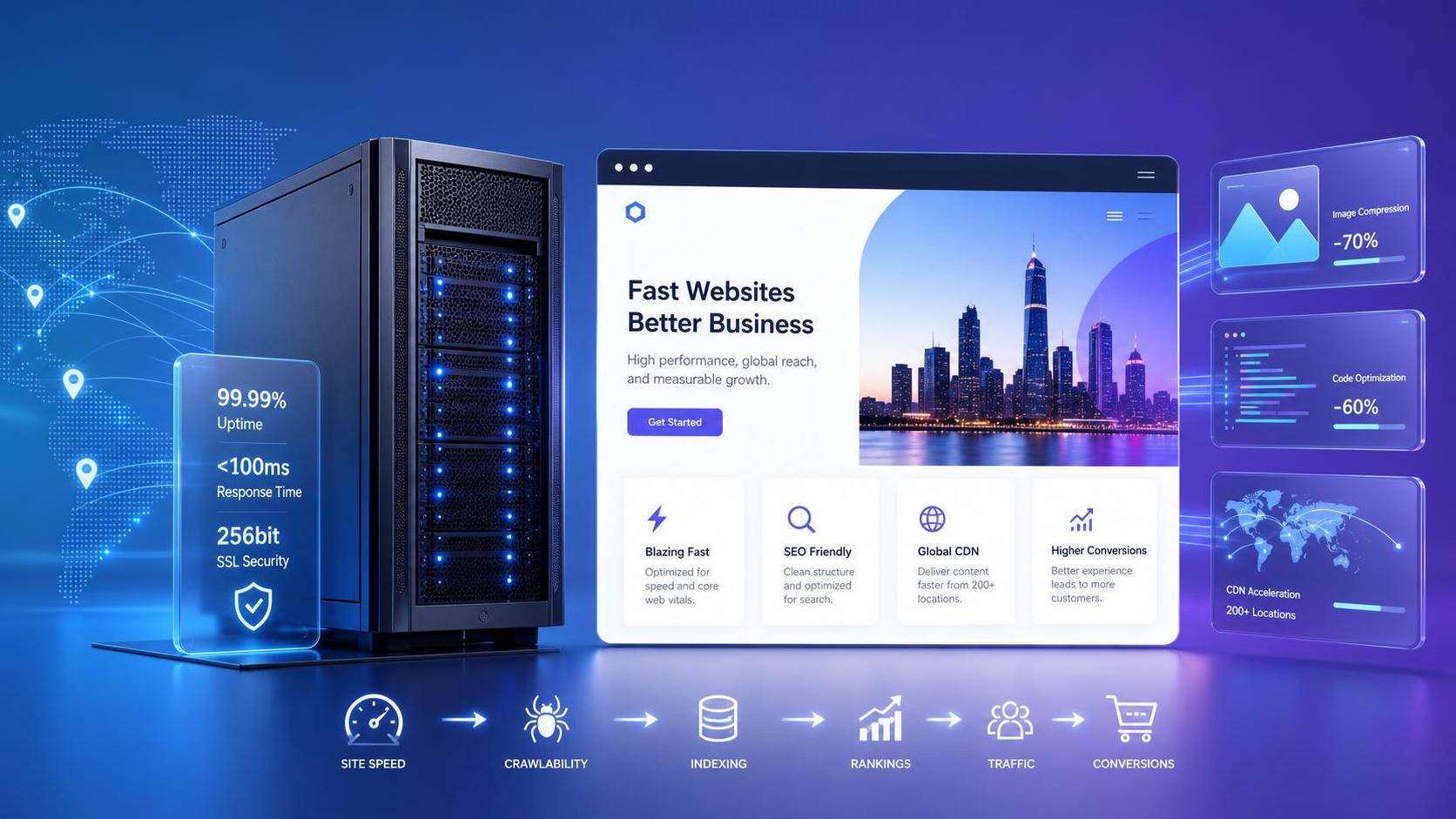
Cloud servers excel in elastic scalability, automatically adjusting resources based on traffic fluctuations to avoid downtime from sudden surges. Providers like AWS and Alibaba Cloud typically offer high-availability architectures, ensuring over 99.9% uptime. For foreign trade enterprises, selecting server locations near target markets significantly improves loading speeds, enhancing user experience and conversion rates.
2. CDN Acceleration: The Turbocharger for Global Access
Content Delivery Networks (CDN) are pivotal for enhancing global access speeds. By caching website content on edge nodes worldwide, CDNs enable users to retrieve data from the nearest node, reducing latency. Tests show CDNs can improve website loading speeds by over 40%, a crucial advantage for foreign trade businesses.
CDNs also effectively mitigate DDoS attacks by dispersing traffic through distributed architectures, protecting origin server security. Additionally, CDN providers often offer intelligent routing and load balancing to further optimize access experiences. When selecting a CDN, enterprises should prioritize node coverage, caching strategies, and security features.
3. HTTPS Encryption: Safeguarding Trust and Security
HTTPS is not only the cornerstone of website security but also a key factor in search engine rankings. Google and other search engines explicitly state that HTTPS sites receive higher ranking weights. Moreover, HTTPS prevents data tampering or theft during transmission, protecting user privacy.
Deploying HTTPS requires SSL/TLS certificates. Enterprises can choose free certificates (e.g., Let's Encrypt) or paid certificates (e.g., DigiCert, GeoTrust). Paid certificates typically offer higher security and longer validity periods, suitable for businesses with stringent security requirements. Note that SSL certificates require periodic renewal to prevent website access failures.
4. Domain Management: The Gateway to Branding and Traffic
Domains are the face of corporate websites and a vital component of branding. Choosing a concise, memorable, and brand-relevant domain is essential. For foreign trade businesses, registering multiple extensions (e.g., .com, .net, .cn) and variations prevents brand domain squatting.
Domain services offer one-stop solutions, including smart domain queries, registration, management, and resolution. High-speed search engines enable enterprises to quickly obtain global domain availability lists and complete registration and payments. Automated resolution simplifies technical operations, ensuring continuous domain availability.
5. Website Security: Dual Protection for SEO and User Experience

Website security impacts both user experience and SEO rankings. Search engines like Google prioritize displaying highly secure websites. Common security measures include regular system updates, Web Application Firewalls (WAFs), and DDoS protection deployments.
Enterprises should conduct regular security scans and vulnerability assessments to promptly identify and mitigate risks. Foreign trade businesses must also comply with target market regulations like GDPR and CCPA to ensure lawful data processing.
6. AI and Independent Sites: The Technology-Driven Future
AI is transforming how enterprises build and operate websites. AI-driven smart website systems enable rapid deployment of multilingual independent sites with real-time content and SEO optimization. AI also generates high-conversion ad creatives automatically, reducing manual efforts and boosting marketing efficiency.
The key distinction between independent foreign trade sites and platform stores lies in autonomy and brand control. Independent sites allow full control over user experience and data analytics, while platform stores are constrained by platform rules and traffic allocation. Independent sites enable enterprises to accumulate user data for precision marketing and long-term growth.
Conclusion and Call to Action
Technical safeguards for corporate websites are a core competitive advantage in the digital era. Every aspect—from server selection to CDN acceleration, HTTPS encryption to website security—directly impacts customer trust and conversion rates. Foreign trade enterprises should prioritize high-performance, high-security technical solutions to ensure global access speeds and user experience.
As a global digital marketing service provider with a decade of industry expertise, we offer end-to-end solutions from website building to marketing. Our AI-driven smart website systems, global CDN acceleration nodes, and one-stop domain services empower enterprises to build high-performance independent sites for global growth. Contact us now for customized technical solutions!