









- Is Brand Globalization Marketing Consulting Worth Buying? At What Stage Should Companies Bring It InJul 01, 2026View details
- Cross-Border Marketing Trend Research: Why More and More Companies Are Starting to Deploy AI Search and GEO OptimizationJun 30, 2026View details
- Cross-Border Marketing Trend Research: How Independent Sites, AI Content, and Short-Video Customer Acquisition Are ChangingJun 30, 2026View details
- How Can a Brand Updates Page Be Made More SEO-Friendly? Analysis of Update Frequency, Content Structure, and Internal Linking StrategyJun 28, 2026View details
- What stages does the cross-border services ecosystem include? How do website building, promotion, payment, and compliance work togetherJun 22, 2026View details
- How will email marketing costs change in 2026Jun 22, 2026View details
- The China-US tariff arrangement has reached a preliminary consensus, and the trade association will be establishedJun 15, 2026View details
- Should overseas brand marketing start with ads or contentJun 21, 2026View details
ISO/IEC 27001:2026 Released: The official website must embed a GDPR and PIPL dual-compliance pop-up
The International Organization for Standardization (ISO) released the official version of ISO/IEC 27001:2026 on May 17, 2026, for the first time listing ‘transparency in user data processing on multinational corporate websites’ as a mandatory control item. B2B export enterprises, digital marketing service providers, and SaaS tool vendors targeting the EU and Chinese markets need to pay close attention to this update, as it is directly related to the validity of ISO certification surveillance audits and eligibility for overseas customer data cooperation authorization.
Event Overview
ISO released the official version of ISO/IEC 27001:2026 on May 17, 2026. This version clearly requires that B2B corporate websites targeting the EU and China must display a dynamic compliance disclosure popup supporting bilingual languages (English + the local language of the target market) when users first visit data collection pages (such as inquiry forms and download centers); the popup must display in real time the data flow, storage location, sharing parties, and withdrawal mechanism. If Chinese export enterprise websites fail to complete the adaptation, it will affect the results of ISO/IEC 27001 certification surveillance audits and may lead overseas customers to suspend data cooperation authorization.
Which Sub-sectors Are Affected
Direct Trading Enterprises
These enterprises usually operate multilingual corporate websites independently and embed functional modules such as inquiry forms and product material downloads. Because the new rule designates ‘the user’s first visit to a data collection page’ as the trigger point, their website frontend interaction logic, privacy policy deployment methods, and third-party form tool integration solutions all need adjustment. The impact is mainly reflected in increased risks in ISO certification surveillance audits and lower pass rates in due diligence reviews by EU and Chinese customers.
Processing and Manufacturing Enterprises
Although mainly focused on OEM/ODM, they have in recent years commonly built English or bilingual corporate websites for brand display and customer acquisition. Once the website includes data collection entry points such as registration, white paper downloads, and sample requests, it falls within the scope of the new rule. The impact is mainly reflected in increased technical compliance costs (such as the need to upgrade the CMS or connect to compliance popup services), as well as the addition of data transparency review items in supplier audits conducted by overseas buyers.
Supply Chain Service Enterprises
Including integrated foreign trade services, cross-border cloud platforms, and B2B digital marketing service providers. If the website systems they build or host for customers do not have preset bilingual dynamic popup capabilities, they will face risks of customer complaints, contract performance disputes, and downgraded platform compliance ratings. The impact is mainly reflected in pressure to upgrade technical service standards, increased training demand for customer success teams, and the need to initiate compliance retrofits for some existing projects.
What Key Points Should Relevant Enterprises or Practitioners Watch, and How Should They Respond at Present
Pay Attention to the Implementation Guidelines Subsequently Issued by ISO and the Transition Arrangements of Certification Bodies
ISO/IEC 27001:2026 has been released, but national accreditation bodies (such as CNAS and UKAS) and certification companies have not yet uniformly announced audit details and grace period policies. Enterprises should continue to track notifications from their contracted certification bodies, especially whether phased implementation is allowed (for example, first launching a static bilingual statement, then iterating to a dynamic popup).
Identify and Sort Out All Functional Points on the Website That Meet the Definition of ‘Data Collection Pages’
According to the event summary, the trigger condition is ‘the user’s first visit to a data collection page’, and typical scenarios include: online inquiry form submission pages, electronic brochure download pages, newsletter subscription registration pages, and livestream/webinar registration pages. Enterprises should immediately conduct frontend page audits, mark all entry points involving the collection of fields such as user identity information, contact details, and enterprise attributes, and assess their technical implementation methods (native forms, third-party plugins, API integrations, etc.).
Differentiate the Differences Between GDPR and PIPL in Popup Content Elements, and Avoid Simple Direct Translation Reuse
From the analysis, GDPR emphasizes the ‘lawful basis’ (such as consent and contractual necessity) and the ‘path for exercising data subject rights’, while PIPL places more emphasis on ‘separate consent’ scenarios, explanations of security assessments for ‘overseas provision’, and disclosure of the domestic responsible entity. A bilingual popup must not merely present parallel text; the information structure must be organized according to the logic of each regulation, and the Chinese version must comply with the wording requirements regarding ‘separate consent’ under Article 23 of the Personal Information Protection Law.
Assess the Ability of the Existing Website Tech Stack to Support Dynamic Popups, and Prioritize Testing Lightweight Deployment Solutions
From observation, most small and medium-sized export enterprise websites are built on WordPress, Shopify, or customized CMS platforms, and may not necessarily have the capability to parse the user’s geographic origin in real time and load the corresponding language popup. At present, it is more appropriate to understand it as follows: a combined strategy of IP positioning + browser language detection can first be adopted to achieve basic bilingual switching; for enterprises temporarily unable to implement real-time dynamic rendering, they may prioritize deploying static bilingual popups that comply with the core elements of regulations in both jurisdictions, and indicate that ‘this statement is automatically adapted based on your current access region’ as a transitional solution.
Editor’s Viewpoint / Industry Observation
Observably, this update signals a structural shift in how ISO treats data governance—not as an internal process control, but as a customer-facing transparency obligation. It is not yet a fully enforced outcome (as national accreditation bodies have not finalized audit protocols), but rather an authoritative policy signal with binding implications for certification validity. The requirement bridges technical compliance (e.g., cookie consent) and legal accountability (e.g., PIPL’s ‘separate consent’ mandate), meaning enterprises must now align IT deployment, legal wording, and certification readiness under one unified operational checkpoint. Continued monitoring is warranted—not just for regulatory text, but for early-adopter case studies from EU and Chinese certification bodies.
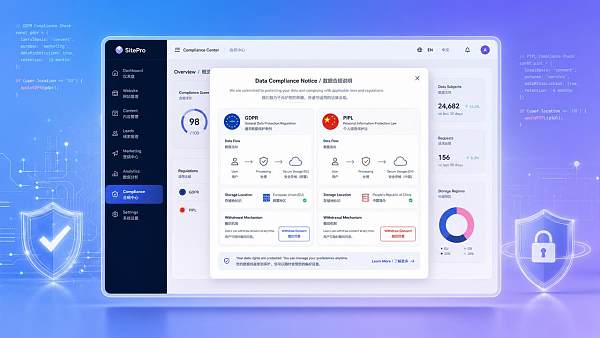
Conclusion: ISO/IEC 27001:2026 incorporates official website data transparency into mandatory control items, marking that the information security management system is extending from backend process control to the frontend user interaction layer. Its current significance does not lie in immediately triggering large-scale rectification, but in establishing a cross-jurisdictional, cross-tech-stack compliance baseline. It is more appropriate to understand it as: this is a certification threshold upgrade with retroactive effect, and enterprises do not need to wait for detailed rules before taking action, but should prioritize implementing popup function adaptation and legal text calibration based on their own website architecture and customer distribution.
Information source note:
Main source: the ISO/IEC 27001:2026 standard text and supporting explanatory documents published on the official ISO website (made public on May 17, 2026).
Part requiring continued observation: the adoption timetable and audit implementation details for this version of the standard by national accreditation bodies such as the China National Accreditation Service for Conformity Assessment (CNAS) and the UK’s UKAS.
Related Articles
 Is Brand Globalization Marketing Consulting Worth Buying? At What Stage Should Companies Bring It In
 4 Major Reasons Behind WhatsApp Account Bans, A Quick Self-Check for Foreign Trade Professionals
 Cross-Border Marketing Trend Research: Why More and More Companies Are Starting to Deploy AI Search and GEO Optimization



Related Products
 EasyCamp SaaS Smart Website Marketing SystemE-Yingbao SaaS Smart Website Marketing System: AI-powered, zero-code website building. Rapidly launch multilingual independent e-commerce sites in just 10 minutes. Global server acceleration and AI-driven SEO optimization empower businesses to efficiently connect with global markets. The seamless integration of technology and user-friendly operation makes building e-commerce sites incredibly simple.
 AI+SEM Intelligent Advertising Marketing SystemAI+SEM drives intelligent ad creation, empowering full-funnel precision advertising marketing. The system automatically generates weekly/monthly reports, AI recommends keywords and target countries, monitors core metrics in real-time with intelligent alerts, and enables one-click high-conversion ad solutions to help quickly acquire customers and improve ROI.
 AI+SEO Dual Engine Optimization ServiceEasyWin AI+SEO Dual Engine Optimization System leverages AI-powered keyword mining, content generation, and comprehensive technical optimization to help foreign trade enterprises acquire high-quality organic traffic, significantly improving search rankings and conversion rates.
 AI+SNS Social Media Marketing SystemYingbao AI+SNS Social Media Marketing System - Precision social capture for the social media era. Supports one-click content synchronization across major platforms like Facebook and LinkedIn. AI intelligently rewrites posts for enhanced relevance. 24/7 AI customer service and user profiling analysis empower businesses to efficiently expand into global markets.
 AI+SEO营销解决方案易营宝AI+SEO营销解决方案,通过AI批量写作、智能生成TDK、精准关键词扩词等功能,全面优化网站SEO效果,提升流量与转化率。助力企业构建高效智能网站新生态。
 AI+SEM Advertising Marketing SolutionsAI+SEM Advertising Marketing Solution leverages AI technology to deeply empower SEM ad campaigns. It automatically generates weekly/monthly reports using AI, presenting account data across multiple dimensions for comprehensive insights into campaign performance and trends. The system precisely recommends keywords and target countries, intelligently generates high-conversion ad copy, and enables one-click activation of efficient campaign plans to help businesses rapidly acquire customers. Simultaneously, it monitors core metrics in real time, intelligently identifies abnormal fluctuations, and issues timely alerts to ensure stable, high-return advertising results.
 Domain Name ServicesEasyWin provides professional domain name services, including intelligent queries, one-stop registration, brand protection, and full lifecycle management, helping businesses build a digital brand image.
 EasyOperate B2C Cross-Border E-Commerce Platform & Independent WebsiteEasyStore B2C Cross-border E-commerce Independent Store is an intelligent website building and cross-border e-commerce integrated solution independently developed by EasyStore Information Technology (Beijing) Co., Ltd. The system is specially designed for small and medium-sized as well as large export enterprises, integrating 'website building, operation, marketing, advertising, and conversion' into one, helping enterprises quickly establish cross-border e-commerce independent stores to achieve brand globalization and global sales growth.
The platform supports multiple languages, multiple currencies, and multi-channel marketing, with built-in AI intelligent translation and SEO optimization systems, suitable for mainstream markets such as Southeast Asia, Europe and America, Latin America, and the Middle East, assisting Chinese manufacturing enterprises in efficiently deploying international e-commerce strategies. SSL证书易营宝提供专业SSL安全证书服务,包括单域名和泛域名证书,确保网站数据传输加密、身份验证和完整性保护,助力企业建立安全可信的在线业务环境。









