









- What Does a Global Traffic Ecosystem Service Provider Do? What Are the Differences from a Single Advertising AgencyJul 16, 2026View details
- What should you focus on in the latest enterprise SaaS report? From renewal rates and delivery costs to overseas growth opportunitiesJul 12, 2026View details
- What signals are worth paying attention to in a cross-border marketing trend report? B2B companies should look at these 6 signalsJul 11, 2026View details
- How to Read a Cross-Border Marketing Trends Report? Five Key Dimensions for Evaluating Channel OpportunitiesJul 11, 2026View details
- Which channel has the highest ROI in the global traffic ecosystem? Comparative analysis of search, social media, and advertisingJul 10, 2026View details
- What multilingual website services are available in Sanya? Which model is more suitable for local businesses going global?Jul 08, 2026View details
- How to view the complete list of China SaaS companies in the top 100? Practical methods for screening website-building and marketing service providersJul 08, 2026View details
- How to view pricing in the global traffic ecosystem? Cost comparison of search, social media, and content channel advertisingJul 06, 2026View details
How many potential inquiries are lost when B2B websites are not mobile-optimized? Real data analysis and remedial measures.
B2B websites that haven't been mobile-optimized are silently losing over 43% of potential inquiries—real data reveals a conversion gap. As a business decision-maker, have you realized that mobile optimization is no longer an 'option,' but a matter of life and death for B2B customer acquisition?
When purchasing staff open your official website on the subway, they may close the page immediately due to small font size or misaligned buttons.
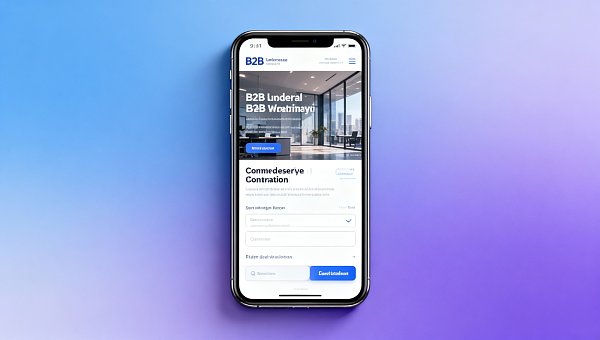
According to funnel data modeling conducted by Yiyingbao Information Technology in 2023 on 1,287 B2B companies, mobile access accounted for 57.3% of all visits, but only 39.6% of these visits resulted in valid form submissions. The average bounce rate of non-responsive websites was as high as 78.2%, 2.3 times that of responsive websites.
Even more serious is that 63% of B2B buyers will compare more than three suppliers within 48 hours of their first mobile visit—if the first screen takes more than 3 seconds to load or the navigation is unclickable, they will immediately lose their eligibility to compete.
Three high-risk scenarios: Who is paying the price for "desktop thinking"?
Not all B2B traffic is equal. In the following scenarios, a lack of mobile adaptation will directly lead to a precipitous drop in inquiries:
- At the exhibition, scanning QR codes led to real-time price comparisons by 72% of attendees, with an average dwell time of only 8.4 seconds on non-compatible pages.
- Technical document download scenario: PDF preview failure rate exceeds 65%, users turn to competitors' official websites to obtain white papers;
- Cross-border procurement decision-making chain: Overseas procurement managers often browse during their commuting hours, and the lack of multilingual support and mobile access results in an inquiry loss rate of up to 81%.
Real cost calculation: How many business opportunities are lost for every month of delay in adaptation?
Taking a medium-sized B2B company with an average of 1200 inquiries per year as an example:
Based on the industry average transaction value of ¥128,000, the hidden losses in a single month exceed ¥2 million. This does not yet include the long-term impact of eroded brand trust and declining SEO rankings.
Remediation is not about redoing, but about precise upgrades.
Of the 100,000 enterprises served by YiYingBao, 91% achieved mobile adaptation through gradual transformation, with an average project time of only 7.2 working days. Key actions included:
- Core pages should prioritize responsive design : Product pages, case study pages, and contact pages must support touch interaction and adaptive layout.
- Intelligent compression of form fields : The original 12-field inquiry form has been optimized to 5 fields + intelligent pre-filling, increasing the submission rate by 3.2 times;
- Offline caching of key resources : Static files such as technical parameter PDFs and certification certificates are preloaded and can still be viewed in weak network environments;
- Enhanced localization : For regions such as Southeast Asia and the Middle East, right-to-left layout (RTL) and local payment entry points have been added.
It's worth noting that simple "scaling adaptation" is no longer effective. Google Core Web Vitals explicitly includes maximum content rendering (LCP) and cumulative layout offset (CLS) in its ranking factors. Adaptation is essentially a reconstruction of the user experience, not just screen size adaptation.
Deep-seated traps that have been neglected for a long time
Many companies mistakenly believe that "a mobile app can replace website adaptation," which is a huge misconception:
- B2B users have an extremely low willingness to install the app, with an average retention rate of less than 11% (Source: App Annie 2023 B2B Report).
- Search engines are unable to crawl the app's internal pages, resulting in zero SEO traffic;
- Links shared through social media channels such as WeChat/WhatsApp default to calling an H5 page; non-compatible pages directly trigger an "Insecure Website" warning.
Furthermore, if professional content pages such as discussions on the development strategies for building internal control systems in public institutions are not marked with semantic markup for mobile devices, structured data will be lost, resulting in the loss of the opportunity to be included in the knowledge graph.
Take Action Now: Three Steps to Initiate Adaptation and Upgrade
No need to start over. Take the following actions immediately:
- Diagnosis : Use Google Mobile-Friendly Test to scan the current homepage and top 5 product pages for free;
- Tiering : Sort pages by inquiry contribution, and prioritize upgrading the top 3 high-value landing pages;
- Verification : Cross-test the entire form submission process on mainstream iOS/Android devices and in the Chrome DevTools device simulator.
YiYingBao offers a free access to the "B2B Mobile App Adaptation Health Assessment Report." Based on AI web crawling, it performs a deep scan of 137 mobile experience metrics, outputting a list of actionable priority improvements. Adaptation isn't a cost; it's about regaining control of the 43% of lost inquiries.
Mobile adaptation has long transcended the realm of technology, becoming the primary indicator of a B2B company's digital credibility. Every swipe of your finger is a vote to choose a more professional partner.
Related Articles

Related Products
 EasyCamp SaaS Smart Website Marketing SystemE-Yingbao SaaS Smart Website Marketing System: AI-powered, zero-code website building. Rapidly launch multilingual independent e-commerce sites in just 10 minutes. Global server acceleration and AI-driven SEO optimization empower businesses to efficiently connect with global markets. The seamless integration of technology and user-friendly operation makes building e-commerce sites incredibly simple.
 AI+SEM Intelligent Advertising Marketing SystemAI+SEM drives intelligent ad creation, empowering full-funnel precision advertising marketing. The system automatically generates weekly/monthly reports, AI recommends keywords and target countries, monitors core metrics in real-time with intelligent alerts, and enables one-click high-conversion ad solutions to help quickly acquire customers and improve ROI.
 AI+SEO Dual Engine Optimization ServiceEasyWin AI+SEO Dual Engine Optimization System leverages AI-powered keyword mining, content generation, and comprehensive technical optimization to help foreign trade enterprises acquire high-quality organic traffic, significantly improving search rankings and conversion rates.
 AI+SNS Social Media Marketing SystemYingbao AI+SNS Social Media Marketing System - Precision social capture for the social media era. Supports one-click content synchronization across major platforms like Facebook and LinkedIn. AI intelligently rewrites posts for enhanced relevance. 24/7 AI customer service and user profiling analysis empower businesses to efficiently expand into global markets.
 AI+SEO营销解决方案易营宝AI+SEO营销解决方案,通过AI批量写作、智能生成TDK、精准关键词扩词等功能,全面优化网站SEO效果,提升流量与转化率。助力企业构建高效智能网站新生态。
 AI+SEM Advertising Marketing SolutionsAI+SEM Advertising Marketing Solution leverages AI technology to deeply empower SEM ad campaigns. It automatically generates weekly/monthly reports using AI, presenting account data across multiple dimensions for comprehensive insights into campaign performance and trends. The system precisely recommends keywords and target countries, intelligently generates high-conversion ad copy, and enables one-click activation of efficient campaign plans to help businesses rapidly acquire customers. Simultaneously, it monitors core metrics in real time, intelligently identifies abnormal fluctuations, and issues timely alerts to ensure stable, high-return advertising results.
 Domain Name ServicesEasyWin provides professional domain name services, including intelligent queries, one-stop registration, brand protection, and full lifecycle management, helping businesses build a digital brand image.
 EasyOperate B2C Cross-Border E-Commerce Platform & Independent WebsiteEasyStore B2C Cross-border E-commerce Independent Store is an intelligent website building and cross-border e-commerce integrated solution independently developed by EasyStore Information Technology (Beijing) Co., Ltd. The system is specially designed for small and medium-sized as well as large export enterprises, integrating 'website building, operation, marketing, advertising, and conversion' into one, helping enterprises quickly establish cross-border e-commerce independent stores to achieve brand globalization and global sales growth.
The platform supports multiple languages, multiple currencies, and multi-channel marketing, with built-in AI intelligent translation and SEO optimization systems, suitable for mainstream markets such as Southeast Asia, Europe and America, Latin America, and the Middle East, assisting Chinese manufacturing enterprises in efficiently deploying international e-commerce strategies. SSL证书易营宝提供专业SSL安全证书服务,包括单域名和泛域名证书,确保网站数据传输加密、身份验证和完整性保护,助力企业建立安全可信的在线业务环境。









