









- What Does a Global Traffic Ecosystem Service Provider Do? What Are the Differences from a Single Advertising AgencyJul 16, 2026View details
- What should you focus on in the latest enterprise SaaS report? From renewal rates and delivery costs to overseas growth opportunitiesJul 12, 2026View details
- What signals are worth paying attention to in a cross-border marketing trend report? B2B companies should look at these 6 signalsJul 11, 2026View details
- How to Read a Cross-Border Marketing Trends Report? Five Key Dimensions for Evaluating Channel OpportunitiesJul 11, 2026View details
- Which channel has the highest ROI in the global traffic ecosystem? Comparative analysis of search, social media, and advertisingJul 10, 2026View details
- What multilingual website services are available in Sanya? Which model is more suitable for local businesses going global?Jul 08, 2026View details
- How to view the complete list of China SaaS companies in the top 100? Practical methods for screening website-building and marketing service providersJul 08, 2026View details
- How to view pricing in the global traffic ecosystem? Cost comparison of search, social media, and content channel advertisingJul 06, 2026View details
How to Make YouTube Video Marketing More Likely to Gain Traction?
For YouTube video marketing, the real key to making it easier to "gain traction" is not simply publishing more videos, but first accurately identifying user search intent, and then connecting content topics, title keywords, click-through rate, completion rate, and conversion paths. For business decision-makers, the biggest concern is whether the investment can bring stable exposure and inquiries; for operators, the core issue is how to choose topics, how to optimize, and why views are not growing after publishing. If you want to achieve results on YouTube, the focus is not on "how professionally the video is produced," but on "whether the content is on the right track, whether distribution is effective, and whether data can support continuous optimization."
Why do many companies struggle to gain traction with YouTube video marketing even after publishing quite a few videos?
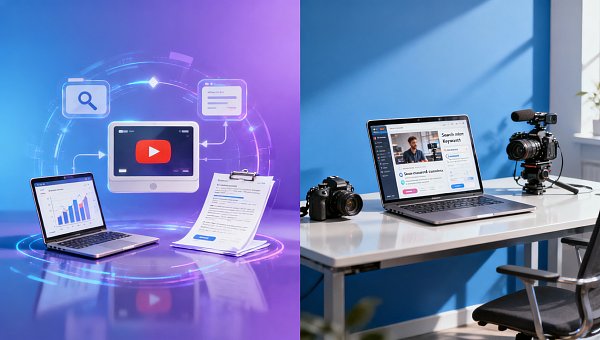
Many companies get stuck with YouTube video marketing, usually not because the platform does not provide traffic, but because the content does not match user needs. Common problems mainly fall into four categories:
First, topics are chosen from the company’s perspective, not the user’s perspective. Companies often want to talk about brand strength, factory scale, and company history, but users are more interested in "how to choose this product," "how to solve this problem," and "whether this type of solution is worth buying." If video content cannot directly answer user questions, it will naturally be difficult to gain traction.
Second, the title and thumbnail lack click appeal. YouTube is essentially both a video platform and a search platform. Even if the content quality is good, if the title is not built around real search terms and the thumbnail does not convey clear value, the click-through rate will still be very low.
Third, the video pacing is too slow, and the first 30 seconds fail to retain viewers. The platform’s recommendation mechanism places great importance on watch time and retention. If the opening is too long, the information density is low, and the video does not quickly get to the point, users are very likely to leave.
Fourth, there is no sustainable content matrix. It is not difficult for a single video to go viral occasionally; what is difficult is sustaining growth. Truly effective YouTube operations usually rely on "keyword topic clusters + serialized content + continuous optimization" to build channel authority.
So, if a company wants to know "how to make YouTube video marketing gain traction more easily," the overall judgment is clear: first match search intent, then optimize content efficiency, and finally use data-driven iteration.
What are users actually searching for? Start by identifying the core search intent behind YouTube video marketing
Different target audiences behave differently when they search on YouTube. If you want to increase video exposure, you first need to understand what stage of the journey users are in when they search.
1. Problem-solving searches
These users typically search for terms like "how to do," "how to choose," "why does this happen," and "what are the differences." For example:
- How to do YouTube video marketing
- How to increase YouTube video views
- How to optimize YouTube SEO
- How video marketing acquires customers
These keywords are more suitable for tutorials, experience summaries, and case breakdowns, and they can easily generate stable search traffic.
2. Solution comparison searches
Decision-makers care more about cost, results, and feasibility, and often search for:
- Which is better, YouTube promotion or paid advertising
- Is YouTube suitable for B2B companies
- The difference between YouTube organic traffic and paid traffic
This type of content is suitable for emphasizing business value, ROI logic, applicable scenarios, and investment thresholds.
3. Product and procurement searches
If a company serves industries such as electronic components, industrial products, or machinery and equipment, users often do not just search for brand terms, but also for models, specifications, application scenarios, and compatibility issues. In this case, video content should not stay at the level of brand introduction, but should focus on specific applications and procurement decisions.
For example, in the electronic components industry, if the website already has capabilities such as intelligent classification, parameterized display, and efficient presentation of massive product models, then video content can form a closed loop with on-site conversion. For such companies, combining electronic components industry solutionswith this kind of capability-based product thinking often makes it easier to direct YouTube traffic to business pages that can truly convert.
If you want videos to gain traction more easily, which key actions should you prioritize?

If you want to improve YouTube video marketing performance, it is recommended to first focus on the following actions that have the greatest impact on results, rather than spreading your efforts evenly.
1. Start with topics that "can be searched," not videos shot based on intuition
The first step in gaining traction is topic selection, not filming. A good topic usually meets three conditions at the same time:
- Users are actually searching for it
- You have the ability to explain it clearly
- After explaining it, it can connect to business goals
You can prioritize the following types of content:
- Industry Q&A content: solving common user questions
- Buying guide content: helping users make decisions
- Tutorial content: enhancing professional credibility
- Case review content: building brand trust
- Trend analysis content: attracting decision-makers’ attention
For execution teams, the most practical method is to first organize frequent customer questions, high-frequency sales communication points, and search suggestion terms, and then turn them into a video topic library.
2. Titles, thumbnails, and the first 30 seconds should all be designed around "clicks and retention"
Whether the YouTube platform continues to amplify recommendations usually depends on two leading metrics: click-through rate and viewing performance.
Title recommendations:
- Include the core keyword
- Emphasize results, problems, or comparisons
- Avoid being overly broad
For example, compared with "Enterprise Video Marketing Sharing," a better expression would be "Why do B2B companies always fail to get views with YouTube video marketing?"
Thumbnail recommendations:
- Highlight one single focus, and do not cram in too much text
- Let users understand the video’s value at a glance
- Keep the style as consistent as possible to build channel recognition
Opening recommendations:
- State the problem directly in the first 5-10 seconds
- Tell users what answer they will get
- Avoid lengthy brand introductions
Many videos fail to gain traction not because the information is unprofessional, but because the opening is too slow, and users leave before reaching the value.
3. Use YouTube SEO thinking to structure content, not just to publish
YouTube SEO is not just about "stuffing in keywords," but about making it easier for the platform to understand your video topic and easier for users to find your content.
It is recommended to focus on optimizing these areas:
- Core keywords in the title
- Topic information in the first two lines of the video description
- Chapter timeline
- Tags and related keywords
- Subtitles and transcripts
In addition, videos should also have internal linkage with each other. For example, under the same topic, you can create serialized content from "basic understanding—method explanation—case illustration—common misconceptions" to improve the overall relevance of the channel.
4. Do not only pursue views; design the conversion path as well
For companies doing YouTube video marketing, the ultimate goal is usually not simply to gain followers, but to build brand awareness, capture leads, generate inquiries, drive website visits, or achieve sales conversions. Therefore, every video should consider: what should the user do next after watching?
Possible follow-up actions include:
- Visit the official website for more details
- Click on the product page
- Submit a form or request a quote
- Continue watching the video series
- Add social media or customer service channels
If the company itself has a relatively complex product system, such as in the electronic components industry, where users need to quickly filter models, check parameters, and confirm compatibility, then the content side should place more emphasis on "scenario explanation + parameter clarification + conversion handoff." This is also why some companies optimize both their website and marketing funnel at the same time, improving traffic conversion efficiency through systems better suited to the industry’s presentation logic.
Which result metrics should business decision-makers focus on more, instead of only looking at views?
For business managers, judging whether YouTube video marketing is worth continued investment cannot be based only on whether a single video went viral, but on whether it brings cumulative business assets.
Metrics more worth paying attention to include:
- Target keyword rankings: whether search exposure can be gained continuously
- Click-through rate: whether the title and thumbnail are effective
- Average watch time: whether the content is truly engaging
- External traffic-driving data: whether traffic is being brought back to the official website or landing page
- Inquiry/lead conversion: whether business results are being generated
- Content compounding effect: whether older videos continue contributing traffic
If a channel gains stable new search traffic every month, and videos continue guiding potential customers to business pages, then even if it is not a "viral account," it is still a high-quality asset.
This is also why, in an integrated website + marketing service system, YouTube video marketing should not be viewed in isolation. It is more suitable for coordinated operation with official website SEO, social media marketing, and advertising, forming a complete growth funnel.
How should different roles execute it in practice to see traction signals faster?
For operations staff:
- First organize keywords and user questions every month
- Build a content topic pool and prioritize high-intent content
- Record the title, thumbnail, and viewing data for every video
- Continuously test click-through rate and retention using A/B thinking
- Expand high-performing content into series
For business decision-makers:
- Do not focus only on short-term spikes; first look at 3-6 month trends
- Clarify YouTube’s role in the growth funnel
- Set dual goals of "exposure + conversion" for the team
- Ensure the content team and website conversion pages work together, rather than operating separately
For dealers, agents, and distributors:
- Focus on product application, comparison, installation, and case-based videos
- Do not just repost manufacturer promotional videos; content should be restructured with localization
- Create search-oriented content around common local customer questions
For end consumers:
- They are more easily attracted by "real experiences," "problem solving," and "avoiding pitfalls when buying"
- The more specific the content, the easier it is to improve viewing and interaction
Conclusion: To gain traction with YouTube video marketing, the core is not "publishing more," but "publishing the right content"
How can YouTube video marketing gain traction more easily? The answer is not complicated: use search intent to determine topics, use SEO thinking to optimize content, use data feedback for continuous iteration, and ensure video traffic can truly connect to business goals.
If you are a business decision-maker, focus on whether it can generate stable exposure and convertible traffic; if you are an executor, focus first on getting topic selection, titles, thumbnails, openings, and conversion paths aligned. Truly effective YouTube growth does not rely on luck to create a viral hit, but on a content operation mechanism that is reproducible, accumulative, and scalable.
When video content, website conversion, and marketing strategy work in coordination, YouTube becomes not just a platform for publishing videos, but an important growth channel for companies to acquire global customers.
Related Articles
Related Products
 EasyCamp SaaS Smart Website Marketing SystemE-Yingbao SaaS Smart Website Marketing System: AI-powered, zero-code website building. Rapidly launch multilingual independent e-commerce sites in just 10 minutes. Global server acceleration and AI-driven SEO optimization empower businesses to efficiently connect with global markets. The seamless integration of technology and user-friendly operation makes building e-commerce sites incredibly simple.
 AI+SEM Intelligent Advertising Marketing SystemAI+SEM drives intelligent ad creation, empowering full-funnel precision advertising marketing. The system automatically generates weekly/monthly reports, AI recommends keywords and target countries, monitors core metrics in real-time with intelligent alerts, and enables one-click high-conversion ad solutions to help quickly acquire customers and improve ROI.
 AI+SEO Dual Engine Optimization ServiceEasyWin AI+SEO Dual Engine Optimization System leverages AI-powered keyword mining, content generation, and comprehensive technical optimization to help foreign trade enterprises acquire high-quality organic traffic, significantly improving search rankings and conversion rates.
 AI+SNS Social Media Marketing SystemYingbao AI+SNS Social Media Marketing System - Precision social capture for the social media era. Supports one-click content synchronization across major platforms like Facebook and LinkedIn. AI intelligently rewrites posts for enhanced relevance. 24/7 AI customer service and user profiling analysis empower businesses to efficiently expand into global markets.
 AI+SEO营销解决方案易营宝AI+SEO营销解决方案,通过AI批量写作、智能生成TDK、精准关键词扩词等功能,全面优化网站SEO效果,提升流量与转化率。助力企业构建高效智能网站新生态。
 AI+SEM Advertising Marketing SolutionsAI+SEM Advertising Marketing Solution leverages AI technology to deeply empower SEM ad campaigns. It automatically generates weekly/monthly reports using AI, presenting account data across multiple dimensions for comprehensive insights into campaign performance and trends. The system precisely recommends keywords and target countries, intelligently generates high-conversion ad copy, and enables one-click activation of efficient campaign plans to help businesses rapidly acquire customers. Simultaneously, it monitors core metrics in real time, intelligently identifies abnormal fluctuations, and issues timely alerts to ensure stable, high-return advertising results.
 Domain Name ServicesEasyWin provides professional domain name services, including intelligent queries, one-stop registration, brand protection, and full lifecycle management, helping businesses build a digital brand image.
 EasyOperate B2C Cross-Border E-Commerce Platform & Independent WebsiteEasyStore B2C Cross-border E-commerce Independent Store is an intelligent website building and cross-border e-commerce integrated solution independently developed by EasyStore Information Technology (Beijing) Co., Ltd. The system is specially designed for small and medium-sized as well as large export enterprises, integrating 'website building, operation, marketing, advertising, and conversion' into one, helping enterprises quickly establish cross-border e-commerce independent stores to achieve brand globalization and global sales growth.
The platform supports multiple languages, multiple currencies, and multi-channel marketing, with built-in AI intelligent translation and SEO optimization systems, suitable for mainstream markets such as Southeast Asia, Europe and America, Latin America, and the Middle East, assisting Chinese manufacturing enterprises in efficiently deploying international e-commerce strategies. SSL证书易营宝提供专业SSL安全证书服务,包括单域名和泛域名证书,确保网站数据传输加密、身份验证和完整性保护,助力企业建立安全可信的在线业务环境。









