









- What stages does the cross-border services ecosystem include? How do website building, promotion, payment, and compliance work togetherJun 22, 2026View details
- How will email marketing costs change in 2026Jun 22, 2026View details
- The China-US tariff arrangement has reached a preliminary consensus, and the trade association will be establishedJun 15, 2026View details
- Should overseas brand marketing start with ads or contentJun 21, 2026View details
- What determines B2C cross-border e-commerce website development costs? A breakdown of features, interfaces, and deployment methodsJun 17, 2026View details
- China-Morocco zero-tariff access, a breakthrough in the cost of Moroccan goods exports to ChinaJun 11, 2026View details
Shopee and Lazada Seller Independent Site Compliance Requirements Tighten
By June 30, 2026, Southeast Asian sellers who drive traffic from platforms such as Shopee and Lazada to their independent sites will face a clear enforcement milestone under a compliance requirement centered on data authorization and tracking management. According to the joint guidance issued on June 26, the relevant independent sites are required to complete the deployment of a GDPR and PDPA dual-framework consent pop-up by June 30, 2026, and meet specific requirements such as multilingual switching, a prominently displayed opt-out tracking button, and a downloadable third-party Cookie list. For cross-border e-commerce sellers, independent site operators, and the service chain that handles site development and advertising operations, this is not merely a page-level adjustment, but a rule change that may directly affect the availability of off-site traffic entry points.

Compliance actions that need to be completed by June 30
Confirmed information shows that on June 26, 2026, Singapore’s Personal Data Protection Commission (PDPC) and Malaysia’s MCMC issued joint guidance, requiring all Southeast Asian sellers who drive traffic from platforms such as Shopee and Lazada to independent sites to complete the deployment of a GDPR and PDPA compliant consent pop-up by June 30, 2026.
The deployment explicitly includes three functional requirements: support for switching among EN, TH, ID, and VI; a clearly visible opt-out tracking button; and support for downloading the third-party Cookie list.
The joint guidance also sets out a consequence: sellers that fail to meet the requirements will have their off-site traffic entry points restricted by the platform.
Impact first falls on traffic acquisition and site delivery
Platform sellers are facing constraints on traffic-driving capabilities
From a business chain perspective, those directly affected are sellers who rely on platforms to drive traffic to independent sites. The reason is that this requirement is not limited to a general compliance notice level, but is tied to the “off-site traffic entry point.” In practical terms, affected sellers may need to turn pop-up issues that were originally handled separately by marketing or page operations into delivery items directly related to traffic acquisition, with special attention to multilingual display, the presentation format of the opt-out button, and whether the Cookie information disclosure materials are complete.
Independent site development and managed operations need synchronized adjustments
For companies providing independent site development, page deployment, data tagging, and advertising operations services, the impact is mainly reflected in changes to delivery standards. As the rules have already refined the pop-up requirements into four-language switching, opt-out tracking visibility, and downloadable list functionality, service providers will need to incorporate these items into site launch checks, version acceptance, and client delivery scope. In scenarios involving third-party Cookies, they also need to synchronize the relevant tools and the presentation format of the list used on the site.
Procurement and supply chain collaboration will be forced to follow
For the brand side or the purchasing, technical coordination, and compliance review roles within an operating entity, this change may bring new outsourcing needs and adjustments to delivery priorities. If a company relies on external site building, plugin services, or data analysis tools, the relevant procurement and acceptance processes need to consider whether the supplier can support dual-framework pop-up deployment on time and whether it can provide a downloadable third-party Cookie list. The core issue here is not the addition of a certain traditional certificate, but whether the website functions, disclosure content, and launch timing meet the platform’s traffic-driving requirements.
Several practical issues that are currently more worth attention
First confirm whether the applicable scenario already covers existing sites
A company first needs to verify whether its business falls under the category of “driving traffic from platforms such as Shopee and Lazada to an independent site.” If the relevant independent site bears advertising, conversion order-taking, or membership retention functions, then this requirement should not be understood only from a legal or market perspective, but should be treated as part of the site’s operating conditions for review.
Break pop-up requirements down into actionable checklists
From an operational perspective, the current focus should be on reviewing three types of content: whether four-language switching is already available, whether the opt-out tracking button is sufficiently prominent, and whether the third-party Cookie list can be downloaded. Analysis shows that the difficulty of such requirements does not lie entirely in the text display, but in whether the front-end presentation, backend configuration, and use of third-party tools are consistent with one another.
Pay attention to the subsequent refinement of platform and regulatory channels
Because the current information mainly clarifies the implementation timeline, applicable targets, core functional requirements, and consequences for non-compliance, it has not yet expanded into more execution details. Therefore, companies need to keep watching for whether more specific review methods, page determination channels, or supplementary explanations will be issued later. At this stage, it is more appropriate to understand it as a clear execution signal rather than a final operations manual with every detail fully spelled out.
The boundary of responsibility between suppliers and internal teams should be clarified as soon as possible
If the site is developed by a third party or jointly maintained by multiple teams, the company should clarify as soon as possible who is responsible for language configuration, who is responsible for Cookie list organization, who is responsible for page go-live testing, and who is responsible for platform traffic-driving results. Since the adjustment window from June 26 to June 30 is very short, unclear responsibility boundaries will directly affect the launch schedule.
This feels more like a threshold shift in execution
From an industry perspective, the focus of this information is not only the addition of a set of pop-up requirements, but also the closer linkage between data compliance display and the qualification for platform off-site traffic. In analysis, this is more like a threshold shift in execution: what was originally seen as a site compliance optimization item is now compressed into a clear deadline and accompanied by entry restrictions as the consequence.
At the same time, it should also be noted that the current information is still mainly centered on the requirements set out in the joint guidance. For the industry, this is both an execution signal that has already landed and a part that still requires continued observation, especially regarding whether subsequent platform execution channels, the actual pace of enterprise rectification, and market feedback will further refine the relevant requirements.
For the industry, this should be understood as a rule node that must be handled in the near term
Taken together, this information is more appropriately understood as a rule node that has already entered the execution stage rather than a purely policy-oriented trend. It is directly tied to platform traffic-driving qualifications, so the impact will be transmitted first to sellers’ independent site operations, technical delivery, and compliance review. Whether the follow-up impact will expand further still needs to be observed continuously in light of subsequent execution details and market feedback; at this stage, the priority is to complete the clearly stated compliance actions first.
Source basis of this article and directions for subsequent verification
This article was generated based on the user-provided information title, event timing, and event summary, and the information used is limited to that input content. For such events, it is usually necessary to continue cross-verifying through official announcements, notices from regulatory authorities, industry association information, standard organization documents, and reporting by authoritative media.
Because no specific official source link was provided in the input, the original document link and formal release media for the relevant source still need to be continuously verified. Contents worth continued attention include: whether the platform execution channels will be further refined, whether enterprises’ rectification methods will become more standardized, what the compliance requirements and actual site delivery review criteria will be, and how the industry is responding to the requirement.
Related Articles
 Shopee and Lazada Seller Independent Site Compliance Requirements Tighten
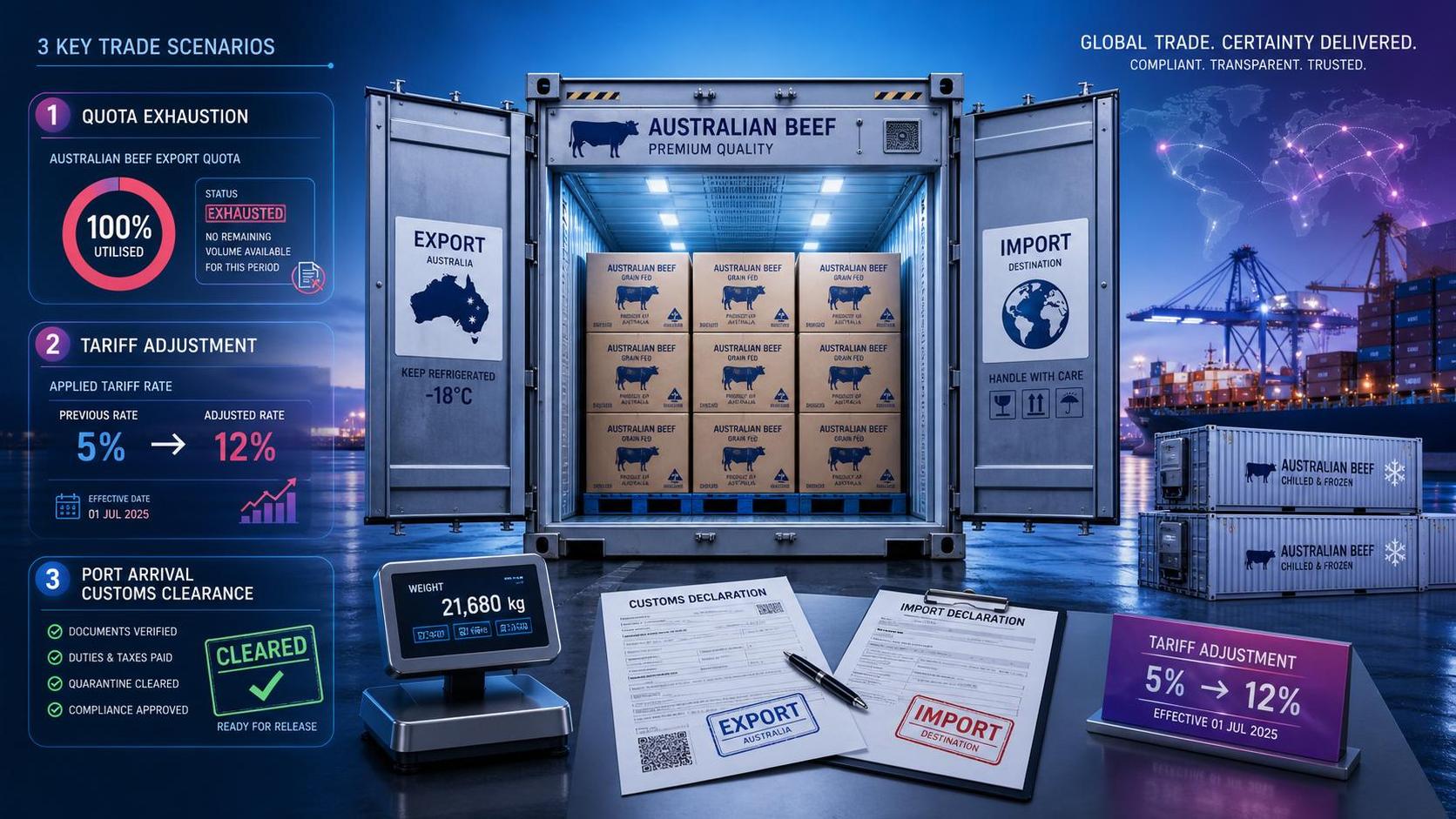
 Australia’s beef quota exhaustion is bringing tariff-switching pressure
- Website Review Activity Guidelines has tightened the disclosure requirements for AI website building." class="listBoxHref" target="_self">
Website Review Activity Guidelines has tightened the disclosure requirements for AI website building." title="The release of the Website Review Activity Guidelines has tightened the disclosure requirements for AI website building." data-src="https://img.bjyyb.net/sites/94000/94397/1782346179928560938003017728.jpg" data-webp="https://img.bjyyb.net/sites/94000/94397/1782346179928560938003017728.webp"/>
The release of the Website Review Activity Guidelines has tightened the disclosure requirements for AI website building.

Related Products
 EasyCamp SaaS Smart Website Marketing SystemE-Yingbao SaaS Smart Website Marketing System: AI-powered, zero-code website building. Rapidly launch multilingual independent e-commerce sites in just 10 minutes. Global server acceleration and AI-driven SEO optimization empower businesses to efficiently connect with global markets. The seamless integration of technology and user-friendly operation makes building e-commerce sites incredibly simple.
 AI+SEM Intelligent Advertising Marketing SystemAI+SEM drives intelligent ad creation, empowering full-funnel precision advertising marketing. The system automatically generates weekly/monthly reports, AI recommends keywords and target countries, monitors core metrics in real-time with intelligent alerts, and enables one-click high-conversion ad solutions to help quickly acquire customers and improve ROI.
 AI+SEO Dual Engine Optimization ServiceEasyWin AI+SEO Dual Engine Optimization System leverages AI-powered keyword mining, content generation, and comprehensive technical optimization to help foreign trade enterprises acquire high-quality organic traffic, significantly improving search rankings and conversion rates.
 AI+SNS Social Media Marketing SystemYingbao AI+SNS Social Media Marketing System - Precision social capture for the social media era. Supports one-click content synchronization across major platforms like Facebook and LinkedIn. AI intelligently rewrites posts for enhanced relevance. 24/7 AI customer service and user profiling analysis empower businesses to efficiently expand into global markets.
 AI+SEO营销解决方案易营宝AI+SEO营销解决方案,通过AI批量写作、智能生成TDK、精准关键词扩词等功能,全面优化网站SEO效果,提升流量与转化率。助力企业构建高效智能网站新生态。
 AI+SEM Advertising Marketing SolutionsAI+SEM Advertising Marketing Solution leverages AI technology to deeply empower SEM ad campaigns. It automatically generates weekly/monthly reports using AI, presenting account data across multiple dimensions for comprehensive insights into campaign performance and trends. The system precisely recommends keywords and target countries, intelligently generates high-conversion ad copy, and enables one-click activation of efficient campaign plans to help businesses rapidly acquire customers. Simultaneously, it monitors core metrics in real time, intelligently identifies abnormal fluctuations, and issues timely alerts to ensure stable, high-return advertising results.
 Domain Name ServicesEasyWin provides professional domain name services, including intelligent queries, one-stop registration, brand protection, and full lifecycle management, helping businesses build a digital brand image.
 EasyOperate B2C Cross-Border E-Commerce Platform & Independent WebsiteEasyStore B2C Cross-border E-commerce Independent Store is an intelligent website building and cross-border e-commerce integrated solution independently developed by EasyStore Information Technology (Beijing) Co., Ltd. The system is specially designed for small and medium-sized as well as large export enterprises, integrating 'website building, operation, marketing, advertising, and conversion' into one, helping enterprises quickly establish cross-border e-commerce independent stores to achieve brand globalization and global sales growth.
The platform supports multiple languages, multiple currencies, and multi-channel marketing, with built-in AI intelligent translation and SEO optimization systems, suitable for mainstream markets such as Southeast Asia, Europe and America, Latin America, and the Middle East, assisting Chinese manufacturing enterprises in efficiently deploying international e-commerce strategies. SSL证书易营宝提供专业SSL安全证书服务,包括单域名和泛域名证书,确保网站数据传输加密、身份验证和完整性保护,助力企业建立安全可信的在线业务环境。









