









- What stages does the cross-border services ecosystem include? How do website building, promotion, payment, and compliance work togetherJun 22, 2026View details
- How will email marketing costs change in 2026Jun 22, 2026View details
- The China-US tariff arrangement has reached a preliminary consensus, and the trade association will be establishedJun 15, 2026View details
- Should overseas brand marketing start with ads or contentJun 21, 2026View details
- What determines B2C cross-border e-commerce website development costs? A breakdown of features, interfaces, and deployment methodsJun 17, 2026View details
- China-Morocco zero-tariff access, a breakthrough in the cost of Moroccan goods exports to ChinaJun 11, 2026View details
Australia’s beef quota exhaustion is bringing tariff-switching pressure
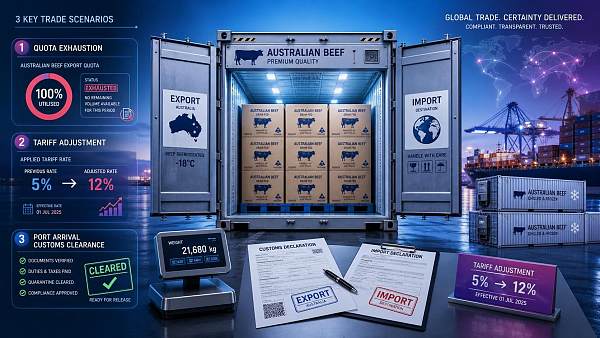
As of June 20, 2026, Australian beef exports to China have entered a new enforcement phase: after the annual country-specific quota was used up on June 18, shipments of beef from Australia to Hong Kong and Macao will, starting from 00:00 on June 20, be subject to a 55% safeguard tariff on top of the current tariff rate. For the industry, this is not just a price change, but a direct market signal that trade rules are shifting from quota-based arrangements to safeguard mechanisms. Importers, buyers, processing and distribution companies, as well as customs brokerage and logistics firms, all need to reassess costs, sources of supply, and clearance rhythms in step.
Confirmed rule change
According to the information provided, the Ministry of Commerce announcement confirms that Australia’s 2026 country-specific quota for beef imports from China is 205,000 tons and was fully used up on June 18. Starting from 00:00 on June 20, all beef shipped to Hong Kong and Macao will be subject to a 55% safeguard tariff on top of the current tariff rate.
At the same time, the confirmed information shows that this measure is implemented in accordance with the WTO-compliant three-year safeguard mechanism, covering major exporting countries such as Brazil, Argentina, and New Zealand. In essence, it is a standardized trade remedy arrangement rather than a special measure aimed at a single object.
The chain reaction from procurement to delivery is becoming apparent
Importers are first facing cost and contract recalculation
For direct-trade enterprises, the most immediate impact comes from landed cost and contract execution arrangements. Since the port arrival time has become an important boundary for the tariff change, companies need to recheck goods in transit, port arrival schedules, and settlement terms, and determine whether customs declaration materials, trade documents, and price clauses can support the new cost calculation. From an analysis perspective, this type of change will first affect quotations, profit expectations, and subsequent procurement decisions.
Procurement and alternative sourcing arrangements need synchronous adjustment
For raw material buyers and downstream purchasers, after the 55% safeguard tariff is imposed on Australian beef, the existing procurement structure may face a new balance. What companies should pay more attention to is not a single price fluctuation, but whether supply continuity, delivery rhythm, and the alignment of supplier qualifications and documents remain smooth during the transition to alternative sourcing, so as to avoid procurement switches affecting production or sales arrangements.
Processing and distribution links need to focus on inventory and delivery rhythm
For processing and manufacturing enterprises, channel distributors, and related supply chain service providers, the impact may be reflected in inventory structure, order execution, and delivery efficiency. If upstream procurement costs rise or the pace of sourcing shifts faster, downstream parties may need to re-evaluate stock-up cycles, shipment arrangements, and customer quotation mechanisms. Especially when customs clearance timeliness is a concern, the importance of logistics, warehousing, and customs coordination will rise significantly.
Several practical points that enterprises should pay close attention to right now
First confirm the boundary between goods in transit and port arrival time
Enterprises should first sort out the execution node of “arriving at port from 00:00 on June 20” around in-transit orders, and verify vessel schedules, port arrival arrangements, and customs declaration readiness. From an analysis perspective, this step is directly related to whether the cost will change significantly, and also to whether subsequent customer quotations and internal settlement can be adjusted in time.
Recalculate procurement costs instead of continuing to use old quotations
The information already made it clear that importers need to immediately reassess costs and recalculate. For enterprises, this means procurement, finance, sales, and supply chain departments need to update their pricing models in sync, avoiding continued use of old prices, old gross margins, and old delivery commitments formed under the quota-based logic.
Pay attention to compliance coordination during alternative sourcing transitions
If an enterprise is considering adjusting its sourcing structure, it should pay even more attention to whether supplier qualifications, documentary materials, traceability of quality, and delivery coordination can be smoothly connected. From an operational perspective, alternative sourcing is not just a change of procurement target; it also involves the continuity of subsequent customs declaration, inspection document preparation, and customer acceptance requirements.
Continue to monitor subsequent execution paths and market feedback
What has been confirmed at present is the start of safeguard tariff implementation and its basic nature, but in actual operations, companies still need to keep an eye on subsequent official statements, specific execution paths, and market-side feedback changes. In particular, for parts involving customs clearance timeliness, trade arrangements, and contract adjustments with customers, dynamic tracking is more appropriate than assuming a fixed outcome in advance.
This looks more like an executed signal
From an industry perspective, this news is better understood as a trade rule change that has already entered the enforcement stage, rather than merely a general policy warning. The clearly defined time point, the full use-up of the quota, and the imposition arrangement all mean that relevant enterprises can no longer remain at the observational stage.
At the same time, however, it does not mean that all impacts have fully materialized. Going forward, companies still need to watch the actual customs clearance rhythm, the efficiency of procurement switching, and the market’s acceptance of the new cost structure. In other words, the rule has already landed, but the industry response and business adaptation process still require continued observation.
How the industry should understand this change
Taken together, the exhaustion of Australia’s beef quota and the triggering of the 55% safeguard tariff from June 20 reflect the actual launch of the trade remedy mechanism under established rules. For the industry, its significance lies more in reminding market participants to adjust procurement, quotations, delivery, and document arrangements in time, rather than simply interpreting it as a short-term emotional event.
At present, it is more appropriate to view this news as a rule-change signal that has already taken effect: the factual layer has been clarified, the business impact is unfolding, and subsequent judgment still needs to be based on execution paths and market feedback.
Basis of this article and direction for follow-up verification
This article is generated based on the news title, event time, and event summary provided by the user, and the facts cited are limited to the content already provided. For this type of trade rule change, it is usually also necessary to cross-check official announcements, releases from regulatory authorities, information from customs or trade authorities, industry association information, standard organization documents, and authoritative media reports.
Since no specific official source links were provided in the input, this article does not list specific links, and the relevant official sources still need continuous follow-up verification. Content worth further attention includes policy details, execution paths, changes in tender or procurement documents, industry feedback, and adjustment situations in actual enterprise execution.
Related Articles
 Australia’s beef quota exhaustion is bringing tariff-switching pressure
- Website Review Activity Guidelines has tightened the disclosure requirements for AI website building." class="listBoxHref" target="_self">
Website Review Activity Guidelines has tightened the disclosure requirements for AI website building." title="The release of the Website Review Activity Guidelines has tightened the disclosure requirements for AI website building." data-src="https://img.bjyyb.net/sites/94000/94397/1782346179928560938003017728.jpg" data-webp="https://img.bjyyb.net/sites/94000/94397/1782346179928560938003017728.webp"/>
The release of the Website Review Activity Guidelines has tightened the disclosure requirements for AI website building.  Shanghai Free Trade Zone launches a pilot RMB cross-border exchange
Related Products
 EasyCamp SaaS Smart Website Marketing SystemE-Yingbao SaaS Smart Website Marketing System: AI-powered, zero-code website building. Rapidly launch multilingual independent e-commerce sites in just 10 minutes. Global server acceleration and AI-driven SEO optimization empower businesses to efficiently connect with global markets. The seamless integration of technology and user-friendly operation makes building e-commerce sites incredibly simple.
 AI+SEM Intelligent Advertising Marketing SystemAI+SEM drives intelligent ad creation, empowering full-funnel precision advertising marketing. The system automatically generates weekly/monthly reports, AI recommends keywords and target countries, monitors core metrics in real-time with intelligent alerts, and enables one-click high-conversion ad solutions to help quickly acquire customers and improve ROI.
 AI+SEO Dual Engine Optimization ServiceEasyWin AI+SEO Dual Engine Optimization System leverages AI-powered keyword mining, content generation, and comprehensive technical optimization to help foreign trade enterprises acquire high-quality organic traffic, significantly improving search rankings and conversion rates.
 AI+SNS Social Media Marketing SystemYingbao AI+SNS Social Media Marketing System - Precision social capture for the social media era. Supports one-click content synchronization across major platforms like Facebook and LinkedIn. AI intelligently rewrites posts for enhanced relevance. 24/7 AI customer service and user profiling analysis empower businesses to efficiently expand into global markets.
 AI+SEO营销解决方案易营宝AI+SEO营销解决方案,通过AI批量写作、智能生成TDK、精准关键词扩词等功能,全面优化网站SEO效果,提升流量与转化率。助力企业构建高效智能网站新生态。
 AI+SEM Advertising Marketing SolutionsAI+SEM Advertising Marketing Solution leverages AI technology to deeply empower SEM ad campaigns. It automatically generates weekly/monthly reports using AI, presenting account data across multiple dimensions for comprehensive insights into campaign performance and trends. The system precisely recommends keywords and target countries, intelligently generates high-conversion ad copy, and enables one-click activation of efficient campaign plans to help businesses rapidly acquire customers. Simultaneously, it monitors core metrics in real time, intelligently identifies abnormal fluctuations, and issues timely alerts to ensure stable, high-return advertising results.
 Domain Name ServicesEasyWin provides professional domain name services, including intelligent queries, one-stop registration, brand protection, and full lifecycle management, helping businesses build a digital brand image.
 EasyOperate B2C Cross-Border E-Commerce Platform & Independent WebsiteEasyStore B2C Cross-border E-commerce Independent Store is an intelligent website building and cross-border e-commerce integrated solution independently developed by EasyStore Information Technology (Beijing) Co., Ltd. The system is specially designed for small and medium-sized as well as large export enterprises, integrating 'website building, operation, marketing, advertising, and conversion' into one, helping enterprises quickly establish cross-border e-commerce independent stores to achieve brand globalization and global sales growth.
The platform supports multiple languages, multiple currencies, and multi-channel marketing, with built-in AI intelligent translation and SEO optimization systems, suitable for mainstream markets such as Southeast Asia, Europe and America, Latin America, and the Middle East, assisting Chinese manufacturing enterprises in efficiently deploying international e-commerce strategies. SSL证书易营宝提供专业SSL安全证书服务,包括单域名和泛域名证书,确保网站数据传输加密、身份验证和完整性保护,助力企业建立安全可信的在线业务环境。









