









- What stages does the cross-border services ecosystem include? How do website building, promotion, payment, and compliance work togetherJun 22, 2026View details
- How will email marketing costs change in 2026Jun 22, 2026View details
- The China-US tariff arrangement has reached a preliminary consensus, and the trade association will be establishedJun 15, 2026View details
- Should overseas brand marketing start with ads or contentJun 21, 2026View details
- What determines B2C cross-border e-commerce website development costs? A breakdown of features, interfaces, and deployment methodsJun 17, 2026View details
- China-Morocco zero-tariff access, a breakthrough in the cost of Moroccan goods exports to ChinaJun 11, 2026View details
Google strengthens AI content marking, foreign trade site organic traffic pressure
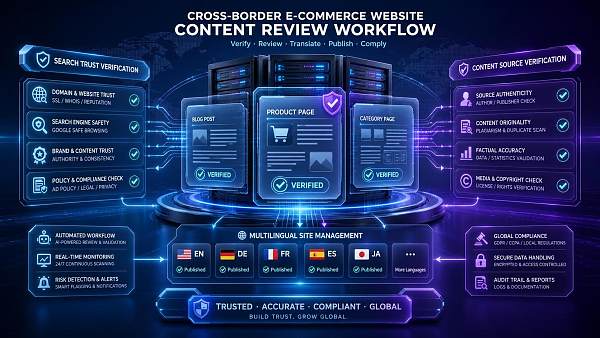
Starting from July 15, 2026, Google's search markers around AI-generated content will enter a more clearly enforced phase. According to disclosed information, Search Console will add a new scoring field related to content transparency. For independent foreign trade websites that have not proactively disclosed AI-generated content, their trust signal weight in search results may be affected, and they may see an “Content origin not verified” notice in the knowledge graph. For export companies, independent website operation teams, content providers, and related service providers that rely on English, Spanish, German, and Japanese sites to acquire organic traffic, this is no longer just a content production issue, but also involves practical adjustments in lead generation, inquiry conversion, and compliance communication on the website.
What clear signals were released at the July enforcement milestone
Confirmed information shows that Google Search Central released an algorithm update notice on June 26, 2026, and added the “AI Content Transparency Score” field in Search Console starting from July 15, 2026.
In the same round of mechanisms, for independent foreign trade websites that have not proactively disclosed AI-generated content, Google will reduce the weight of “Trust Signal” in SERPs and display the “Content origin not verified” notice in the knowledge graph.
The currently confirmed language coverage includes English, Spanish, German, and Japanese, and the relevant verification interface has already opened API access.
From lead generation to delivery, which business links will feel the pressure first
Export companies that rely on independent websites for customer acquisition
Such companies may be affected first because organic traffic, inquiry entry points, and search visibility are directly linked. If site content uses AI extensively but is not proactively disclosed, the trust performance of related pages in search results may change, which in turn affects customers’ initial judgment of the company profile, product pages, and brand information. The current focus is not simply content production efficiency, but also content source disclosure to search platforms, site explanation paths, and consistency across multilingual pages.
Service links responsible for content creation and site operations
For content operations, website development, SEO execution, and multilingual localization teams, this change means that delivery standards may need to be adjusted. Work methods that previously focused more on indexing, ranking, and update frequency may later need to incorporate AI content disclosure, content source verification interface integration, and Search Console field monitoring. In analysis, this shifts the question from “whether it is well written” to “whether it can be verified and understood by the platform.”
Information verification process on the procurement and channel sides
For buyers, channel partners, or distributors who screen suppliers through foreign trade websites, the “Content origin not verified” notice in the knowledge graph may affect their initial judgment of a company’s public information credibility. Especially when product parameters, technical descriptions, certification statements, and after-sales commitments depend on website delivery, the information comparison and qualification verification process before procurement may become more cautious. What is more noteworthy here is that website content presentation has begun to establish a more direct connection with commercial trust judgments.
Supporting roles related to certification, testing, and after-sales
Although this information does not directly involve changes to certification rules or testing systems, any company that needs to carry technical documents, test descriptions, compliance materials, and service commitments through its website may be indirectly affected. If a foreign trade website is regarded as insufficiently transparent in content source expression, customers may raise verification requirements when retrieving reports, samples, after-sales explanations, or traceability materials. Observationally, this kind of impact is more likely to appear first in front-end communication and data submission links rather than immediately as a fixed result.
What practical actions should companies take now
First review the disclosure paths of multilingual pages
For covered English, Spanish, German, and Japanese sites, companies should first check whether different language versions contain AI-generated content, and whether the related explanations are consistent. If internal content production already uses AI tools, the next step should focus on whether a verifiable disclosure logic needs to be formed at the site level, page level, or content management process. Since the input information does not provide more detailed execution rules, this part is currently more suitable to understand as a pre-deployment review rather than a fixed template.
Incorporate Search Console fields into routine monitoring
Since the “AI Content Transparency Score” has been clearly identified as a new field, operations teams and technical teams need to pay attention to the field’s visibility, fluctuation patterns, and its relationship with page performance in actual management. For sites relying on organic traffic to acquire customers, such fields are likely to become part of content governance and search performance evaluation. The current focus should be whether to establish an internal monitoring mechanism, rather than predicting specific score outcomes in advance.
Assess the impact of API integration on internal processes
The opening of API access for verification interfaces means that companies or service providers with the necessary technical capabilities can integrate verification actions into existing content management, publishing review, or site operations workflows. In analysis, this change may affect not only SEO teams, but also roles responsible for official website launches, material updates, technical document publishing, and multilingual synchronization. For companies with relatively high site update frequency, such interface capabilities are worth incorporating into the assessment scope as early as possible.
Focus on the core pages that affect inquiry conversion
Companies do not need to handle all pages uniformly; they should first look at product detail pages, company profile pages, technical material pages, FAQ pages, and knowledge-based content that may be directly crawled by search engines. Once these pages are assigned weaker trust signals, it may create a chain reaction on inquiry quality, customer dwell time, and subsequent communication. Observationally, this does not mean the result has already been determined, but rather suggests that companies should incorporate content transparency into lead-generation path management.
This looks more like a signal for execution, not just a simple feature update
From an industry perspective, what this news first reflects is not that AI content itself is being denied, but that search platforms have begun to separately extract the question of “whether the content source is proactively disclosed” as a recognizable and manageable rule element. Compared with ordinary backend field adjustments, this change simultaneously involves scoring fields, SERP trust weight, and knowledge graph notices, indicating that content transparency has already expanded from an internal site management issue to the search presentation layer.
Observationally, this is better understood as a rule signal that has already entered the execution stage, rather than something still remaining at the proposal level. However, the input information does not provide more detailed scoring logic, disclosure standards, or dispute handling paths, so the industry still needs to continue observing the subsequent landing details, actual execution scale, and market feedback.
Content governance on foreign trade websites is becoming an operational issue
Overall, the direct implication of this change is that the content generation methods, disclosure methods, and search platform trust expression of foreign trade independent websites are beginning to become more closely linked. For companies targeting overseas markets, website content is no longer just display material; it is also related to being discovered, judged, and further contacted.
At present, it is more appropriate to understand this news as a rule signal that has already started execution, as well as an important observation window before subsequent rule refinement. Companies should not exaggerate the results at this stage, but neither should they treat it as a mere technical column update; instead, it should be incorporated into practical management of content compliance, site operations, and customer touchpoints.
Basis of this article and directions for subsequent verification
This article was generated based on the news title, event time, and event summary provided by the user, and has confirmed that the facts are limited to the information stated in the input. Around such events, follow-up verification usually still requires continuous cross-checking with official announcements, releases from regulatory bodies, industry association information, standard organization documents, and coverage by authoritative media.
It should be noted that the input information does not provide a specific official source link, so the original page, interface description, and subsequent official statements still need further verification. The content worth continuous observation next includes whether the specific execution rules become clearer, whether the AI content disclosure path becomes more refined, how API verification is actually adopted in enterprise processes, search presentation feedback, and execution changes on the corporate side.
Related Articles


Related Products
 EasyCamp SaaS Smart Website Marketing SystemE-Yingbao SaaS Smart Website Marketing System: AI-powered, zero-code website building. Rapidly launch multilingual independent e-commerce sites in just 10 minutes. Global server acceleration and AI-driven SEO optimization empower businesses to efficiently connect with global markets. The seamless integration of technology and user-friendly operation makes building e-commerce sites incredibly simple.
 AI+SEM Intelligent Advertising Marketing SystemAI+SEM drives intelligent ad creation, empowering full-funnel precision advertising marketing. The system automatically generates weekly/monthly reports, AI recommends keywords and target countries, monitors core metrics in real-time with intelligent alerts, and enables one-click high-conversion ad solutions to help quickly acquire customers and improve ROI.
 AI+SEO Dual Engine Optimization ServiceEasyWin AI+SEO Dual Engine Optimization System leverages AI-powered keyword mining, content generation, and comprehensive technical optimization to help foreign trade enterprises acquire high-quality organic traffic, significantly improving search rankings and conversion rates.
 AI+SNS Social Media Marketing SystemYingbao AI+SNS Social Media Marketing System - Precision social capture for the social media era. Supports one-click content synchronization across major platforms like Facebook and LinkedIn. AI intelligently rewrites posts for enhanced relevance. 24/7 AI customer service and user profiling analysis empower businesses to efficiently expand into global markets.
 AI+SEO营销解决方案易营宝AI+SEO营销解决方案,通过AI批量写作、智能生成TDK、精准关键词扩词等功能,全面优化网站SEO效果,提升流量与转化率。助力企业构建高效智能网站新生态。
 AI+SEM Advertising Marketing SolutionsAI+SEM Advertising Marketing Solution leverages AI technology to deeply empower SEM ad campaigns. It automatically generates weekly/monthly reports using AI, presenting account data across multiple dimensions for comprehensive insights into campaign performance and trends. The system precisely recommends keywords and target countries, intelligently generates high-conversion ad copy, and enables one-click activation of efficient campaign plans to help businesses rapidly acquire customers. Simultaneously, it monitors core metrics in real time, intelligently identifies abnormal fluctuations, and issues timely alerts to ensure stable, high-return advertising results.
 Domain Name ServicesEasyWin provides professional domain name services, including intelligent queries, one-stop registration, brand protection, and full lifecycle management, helping businesses build a digital brand image.
 EasyOperate B2C Cross-Border E-Commerce Platform & Independent WebsiteEasyStore B2C Cross-border E-commerce Independent Store is an intelligent website building and cross-border e-commerce integrated solution independently developed by EasyStore Information Technology (Beijing) Co., Ltd. The system is specially designed for small and medium-sized as well as large export enterprises, integrating 'website building, operation, marketing, advertising, and conversion' into one, helping enterprises quickly establish cross-border e-commerce independent stores to achieve brand globalization and global sales growth.
The platform supports multiple languages, multiple currencies, and multi-channel marketing, with built-in AI intelligent translation and SEO optimization systems, suitable for mainstream markets such as Southeast Asia, Europe and America, Latin America, and the Middle East, assisting Chinese manufacturing enterprises in efficiently deploying international e-commerce strategies. SSL证书易营宝提供专业SSL安全证书服务,包括单域名和泛域名证书,确保网站数据传输加密、身份验证和完整性保护,助力企业建立安全可信的在线业务环境。









