









- China-Morocco zero-tariff access, a breakthrough in the cost of Moroccan goods exports to ChinaJun 11, 2026View details
- What signal should be released for the suspension of exports to JapanJun 10, 2026View details
- China's May LNG imports rebounded, with increased volumes from Russia and Canada filling the Middle East supply gapJun 10, 2026View details
- Will GEO change its SEO strategy?Jun 04, 2026View details
- What types of businesses are end-to-end solutions suitable for?Jun 03, 2026View details
- 2026 Global Growth Channel TrendsJun 02, 2026View details
In 2026, international digital marketing strategy is shifting from ‘multilingual translation’ to ‘behavior-driven localization’. How should companies adjust their technology selection?
In 2026, international digital marketing strategies are moving beyond simple multilingual translation toward behavior-driven localization. Enterprises urgently need to upgrade their technology selection——how should the AI Multilingual Website System be used? How can GEO optimization website builder features empower precise customer acquisition? Easygobiz’s one-stop intelligent marketing platform reconstructs the logic of global growth with AI+big data.
Behavior-Driven Localization: From Language Adaptation to User Intent Modeling
Multilingual translation only solves “whether users can understand,” while behavior-driven localization directly targets “whether users want to click.” According to Easygobiz’s global customer data monitoring for Q3 2025, independent websites using user behavior modeling achieved an average 58% increase in dwell time, a 37% decrease in product page bounce rate, and a 2.3-fold increase in conversion path completion rate. The core lies in feeding billions of behavioral data points such as regional search hot keywords, social media interaction preferences, payment habits, and page browsing sequences back into website building and ad delivery systems in real time.

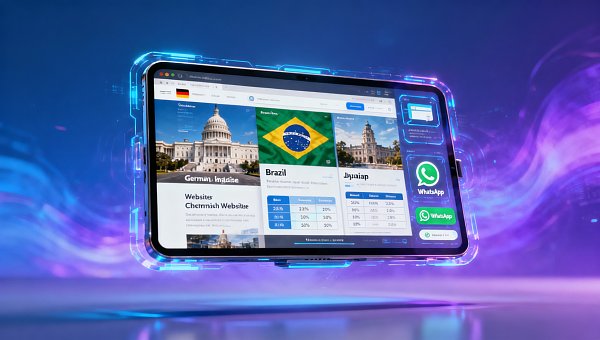
Traditional translation-based website building faces three major gaps: the language layer (translation accuracy), the cultural layer (symbol misinterpretation), and the behavioral layer (mismatched click paths). For example, German users prefer parameter comparison tables placed upfront, Brazilian users pay more attention to WhatsApp instant consultation entry points, and Japanese consumers have an acceptance rate for privacy policy pop-ups that is 12% lower. These differences cannot be covered by manual translation and must rely on AI to analyze local user behavior flows in real time.
Easygobiz’s self-developed NLP engine already supports semantic intent recognition in 97 languages and is connected to 12 types of real-time behavioral APIs such as Google Trends and Meta Audience Insights. The system can automatically identify whether a user comes from Jakarta or Singapore and push different above-the-fold CTA copy; when it detects a Middle Eastern user visiting with the Safari browser, it immediately enables a lightweight JS loading solution, increasing first-screen rendering speed by 40%.
This table reveals the key watershed: a behavior-driven platform is not a superposition of “translation + acceleration,” but a reconstruction of the technology stack with user behavior as the starting point. Procurement decision-makers should focus on evaluating whether the system has real-time GEO behavioral mapping capabilities, localized content generation frequency, and cross-channel behavioral data closed-loop capabilities.
A Four-Dimensional Evaluation Model for Technology Selection: A Must-Check List for Procurement Teams
When facing dozens of “AI website building” tools on the market, enterprise procurement needs to see through the marketing language and focus on four hard indicators:
- Data Sovereignty Protection: Does it support private deployment or hybrid cloud architecture? Easygobiz provides dual compliance options of AWS GovCloud and Alibaba Cloud Financial Cloud, meeting the tiered certification requirements of the EU GDPR, China’s Personal Information Protection Law, and Southeast Asia’s PDPA.
- Behavior Model Iteration Frequency: The average annual number of algorithm platform upgrades determines the timeliness of localization. The industry average is 4 times/year, while Easygobiz reaches 12 times/year, adding a short-video behavior recognition module for Generation Z in Latin America in 2025.
- Depth of Ecosystem Compatibility: Not just simple API integration, but deep embedding into the strategy layer of traffic platforms. As a Google Premier Partner, its AI ad manager can directly call the Google Ads Experiment API for AB testing.
- Industry Vertical Fit: General-purpose platforms struggle to solve pain points in niche scenarios. For the laser engraving machine industry, Easygobiz provides laser engraving machine industry solutions, integrating professional website building, intelligent category navigation, and a product parameter visualization engine, increasing B2B buyer search efficiency by 65%.
Special reminder: avoid choosing pseudo-localization systems that only provide a “language pack switch” function. True behavior-driven localization must have three core capabilities——real-time GEO positioning, millisecond-level behavioral feature extraction, and a dynamic content recomposition engine. During testing, you may ask the vendor to demonstrate the complete chain in which, when a Mexican user visits, the system automatically replaces the pricing currency (MXN), payment method (OXXO), and customer service entry point (WhatsApp).
Implementation in Practice: A 90-Day Path from Deployment to ROI Results
Easygobiz provides new customers with a standardized three-phase delivery process to ensure that technology selection quickly translates into business growth:
- Days 1–15: Behavioral Baseline Diagnosis——Analyze the user paths of the existing website through tracking point analysis, and output a Regional Behavioral Differences Report marking high-drop-off nodes and optimization priorities.
- Days 16–45: Intelligent Website Deployment——Configure the GEO rule base based on the diagnostic report, complete multilingual website construction and AI content generation training, with an average go-live cycle of 28 days.
- Days 46–90: Performance Verification and Iteration——Launch an A/B testing matrix to compare the performance of the behavior-driven version and the traditional translation version across 6 core metrics such as CVR, ROAS, and LTV.
2024 service data shows that manufacturing clients achieved a 31% reduction in advertising costs by day 60, while e-commerce clients achieved a 142% increase in organic search traffic by day 75. All projects are equipped with a dedicated customer success manager who provides a monthly Behavioral Optimization Recommendation Report.
This table clearly defines the boundaries of responsibilities at each stage, avoiding delivery delays caused by a lack of client cooperation. More than 83% of clients launch social media automated operations in the second phase and build the first batch of localized content matrices.
Procurement Decisions for the Future: Why Now?
Starting from Q1 2026, Google and Meta will mandatorily require advertisers to submit a “localized behavioral adaptation statement,” and accounts that fail to meet the standard will have their regional targeting precision restricted. At the same time, Yandex has already incorporated behavior-driven indicators into SEO ranking weight, accounting for 22%. The window period for technology selection is narrowing.
Easygobiz customer data shows that enterprises completing behavior-driven upgrades 6 months in advance reduced customer acquisition costs by 47% in emerging markets (such as Vietnam and Mexico), while late deployers lost an average of 3.2 months of market opportunity. For distributors and agents, its “headquarters + regional partners” model provides a localized training and certification system and has trained more than 2,000 certified solution consultants.
Letting the world make way for Chinese brands begins with a clear-headed technology selection. Get the 2026 Behavior-Driven Localization Implementation White Paper and a customized solution evaluation now.
Related Articles



Related Products
 EasyCamp SaaS Smart Website Marketing SystemE-Yingbao SaaS Smart Website Marketing System: AI-powered, zero-code website building. Rapidly launch multilingual independent e-commerce sites in just 10 minutes. Global server acceleration and AI-driven SEO optimization empower businesses to efficiently connect with global markets. The seamless integration of technology and user-friendly operation makes building e-commerce sites incredibly simple.
 AI+SEM Intelligent Advertising Marketing SystemAI+SEM drives intelligent ad creation, empowering full-funnel precision advertising marketing. The system automatically generates weekly/monthly reports, AI recommends keywords and target countries, monitors core metrics in real-time with intelligent alerts, and enables one-click high-conversion ad solutions to help quickly acquire customers and improve ROI.
 AI+SEO Dual Engine Optimization ServiceEasyWin AI+SEO Dual Engine Optimization System leverages AI-powered keyword mining, content generation, and comprehensive technical optimization to help foreign trade enterprises acquire high-quality organic traffic, significantly improving search rankings and conversion rates.
 AI+SNS Social Media Marketing SystemYingbao AI+SNS Social Media Marketing System - Precision social capture for the social media era. Supports one-click content synchronization across major platforms like Facebook and LinkedIn. AI intelligently rewrites posts for enhanced relevance. 24/7 AI customer service and user profiling analysis empower businesses to efficiently expand into global markets.
 AI+SEO营销解决方案易营宝AI+SEO营销解决方案,通过AI批量写作、智能生成TDK、精准关键词扩词等功能,全面优化网站SEO效果,提升流量与转化率。助力企业构建高效智能网站新生态。
 AI+SEM Advertising Marketing SolutionsAI+SEM Advertising Marketing Solution leverages AI technology to deeply empower SEM ad campaigns. It automatically generates weekly/monthly reports using AI, presenting account data across multiple dimensions for comprehensive insights into campaign performance and trends. The system precisely recommends keywords and target countries, intelligently generates high-conversion ad copy, and enables one-click activation of efficient campaign plans to help businesses rapidly acquire customers. Simultaneously, it monitors core metrics in real time, intelligently identifies abnormal fluctuations, and issues timely alerts to ensure stable, high-return advertising results.
 Domain Name ServicesEasyWin provides professional domain name services, including intelligent queries, one-stop registration, brand protection, and full lifecycle management, helping businesses build a digital brand image.
 EasyOperate B2C Cross-Border E-Commerce Platform & Independent WebsiteEasyStore B2C Cross-border E-commerce Independent Store is an intelligent website building and cross-border e-commerce integrated solution independently developed by EasyStore Information Technology (Beijing) Co., Ltd. The system is specially designed for small and medium-sized as well as large export enterprises, integrating 'website building, operation, marketing, advertising, and conversion' into one, helping enterprises quickly establish cross-border e-commerce independent stores to achieve brand globalization and global sales growth.
The platform supports multiple languages, multiple currencies, and multi-channel marketing, with built-in AI intelligent translation and SEO optimization systems, suitable for mainstream markets such as Southeast Asia, Europe and America, Latin America, and the Middle East, assisting Chinese manufacturing enterprises in efficiently deploying international e-commerce strategies. SSL证书易营宝提供专业SSL安全证书服务,包括单域名和泛域名证书,确保网站数据传输加密、身份验证和完整性保护,助力企业建立安全可信的在线业务环境。









