









- Which customer acquisition channels will be affected by cross-border marketing trends in 2026?Sep 06, 2026View details
- Which homogenization risks should be considered in an analysis of the AI-powered website building industry?Aug 30, 2026View details
- How Will AI Marketing Trends 2026 Change Advertising Budget AllocationAug 28, 2026View details
- Is the EV SSL certificate market shrinking or upgrading? How should companies assess certificate procurement?Aug 11, 2026View details
- Why the old AMP SEO 2020 practices no longer work and what has changed in current optimization prioritiesAug 02, 2026View details
- How to Choose Topics for an Industry News Section to Attract More Organic Search TrafficJul 29, 2026View details
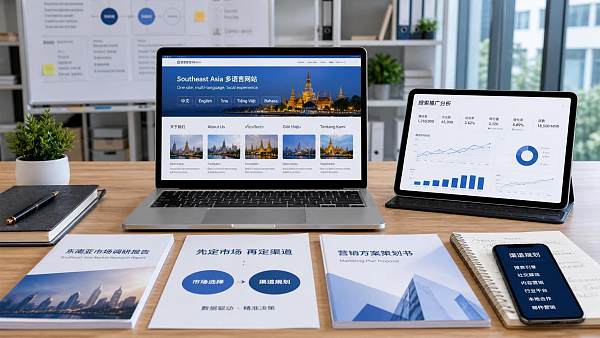
Should You Choose the Market or Set the Channels First for International Digital Marketing in Southeast Asia?
When carrying out international digital marketing in Southeast Asia, many companies immediately ask which platform they should invest in and whether they should start with advertising. The more important question is actually: which market are you planning to enter first? The sequence may seem like merely a difference in execution, but it affects budget efficiency, team collaboration, website development logic, and whether subsequent customer acquisition costs can be controlled.
Southeast Asia is not a region that can simply be treated as a “unified market.” Singapore, Malaysia, Thailand, Vietnam, Indonesia, and the Philippines differ significantly in population structure, language environment, payment habits, platform preferences, and purchasing decision-making processes. If a company chooses channels first and then works backward to define the market, the common result is that traffic is acquired, but the website content, landing page language, lead qualification mechanism, and sales follow-up are all misaligned. The front end appears busy, while the back end fails to deliver meaningful results.
Choosing the Market First Is Usually More Reliable Than Choosing the Channel First
For most companies still in the selection and planning stage, starting with market analysis is generally a more reliable approach. The reason is simple: channels are only means of reaching customers, while the market determines whom you need to address, what language to use, and what trust mechanisms will support conversion.
Take B2B businesses as an example. If you are targeting manufacturing customers in Southeast Asia, their search behavior, inquiry habits, and social media touchpoints are often completely different from those of local end consumers. The former may rely more on Google search, industry keywords, the credibility of a corporate website, and inquiries via WhatsApp or forms. The latter may be more influenced by short videos, social media advertising, on-site promotions, and the convenience of local payment methods. Without defining the market, there is virtually no baseline for a channel strategy.
Another often-overlooked issue is that the “language cost” in Southeast Asia is not low. English may be usable in some markets, but that does not mean it delivers the best conversion efficiency. Thai, Vietnamese, Indonesian, and Malay can directly affect advertising performance in terms of content reach, ad click-through rates, and time spent on the website. If you choose the channel first—for example, deciding to run Google Ads—and then discover that the landing page is available only in English, rising costs are almost inevitable.
This is also why more and more companies no longer view websites and marketing separately when carrying out international digital marketing in Southeast Asia. A website is not merely a presentation page to be “completed first and considered later”; it is the infrastructure for market validation and channel conversion.
When Can You Choose the Channel First?
Of course, not every project must strictly proceed according to a “market-first” approach. If a company already has clear order sources from specific countries, or if offline channels have already verified stable demand in several countries, choosing the channel first can also be appropriate. For example, a company may already have an agent network in Indonesia and now need to generate online inquiries, or it may already have trade show resources in Thailand and need to use advertising and social media to build an audience before the event. In such cases, the channel may indeed be the more urgent priority.
However, there is a prerequisite: you must already understand your target countries, customer profiles, core selling points, and conversion paths. Otherwise, “choosing the channel first” essentially means buying traffic with incomplete information.
A practical way to judge is to identify whether the company currently lacks “direction” or an “amplifier.” If you have not yet determined which country to enter first, which industry to target, or which language to use, start with market analysis. If the direction is already clear and you simply lack a stable customer acquisition method, then it is time to prioritize channels.
Assessing the Southeast Asian Market Is About Fit, Not Popularity
Many decision-making mistakes arise from the assumption that companies should go wherever the market is hottest. Southeast Asia is indeed growing rapidly, but what companies really need to determine is not which country is more popular, but which country best matches their products, price range, delivery capabilities, and after-sales service model.
If your business involves high-value industrial products or equipment with long decision-making cycles, you should prioritize assessing whether customers are accustomed to screening suppliers through corporate websites, search engines, and business communications, and whether they value technical specifications, qualification displays, and case-study logic. If you sell standardized SKUs or products involving simpler purchasing decisions, coordination among platform advertising, social media content, and e-commerce websites will be more important.
This is also where the value of an integrated website and marketing service solution lies. It does not simply bundle website development, SEO, advertising, and social media together. Instead, it first clarifies the logic of entering the market, and then determines the website structure, content languages, channel mix, and data feedback mechanisms. Otherwise, common problems arise: a generic website is developed, an advertising campaign is launched, and social media posts are published, but the audiences targeted by each channel are not the same, making it impossible to assess the quality of the resulting leads.
Companies Should Answer at Least These Four Questions When Making Decisions
First, can the target countries be covered by the same content system? Some Southeast Asian countries can initially be tested with an English website, but in most cases, multilingual pages are more conducive to conversion, especially when the business relies on organic search or local advertising.
Second, is the customer acquisition objective inquiries or completed purchases? If the goal is B2B inquiries, the corporate website, search strategy, and form design should take priority. If the goal is B2C purchases, on-site payment, mobile loading speed, advertising creatives, and repeat-purchase mechanisms should be considered in advance.
Third, can channel data be fed back into the same system? The biggest problem for many companies is not a lack of traffic, but the inability to determine which country, keyword, or advertising creative generated the more reliable leads. Without a unified data perspective, budget adjustments can only rely on intuition.
Fourth, does the team have the capacity for ongoing operations? Entering the Southeast Asian market does not end after creating a landing page and running one advertising campaign. Content updates, SEO accumulation, advertising optimization, and social media engagement all require continuous investment. If there is no stable internal team, companies should pay more attention when selecting a solution to whether the service provider can connect website development, content, localization, and advertising execution, rather than merely delivering a website or managing a single advertising campaign.
Why Integrated Capabilities Matter More in Southeast Asia
The Southeast Asian market may appear to have a low entry barrier, but the real challenge lies in its fragmentation. Languages, platforms, customer journeys, and organizational collaboration are all fragmented. When the market, website, content, and advertising are handled by different teams, companies quickly discover that the problem is not doing too little, but that the different parts fail to connect.
Platform-based service providers such as Yiyingbao, which connect everything from intelligent website development to SEO, advertising, social media, and GEO generative engine optimization, create value not because they offer “many service items,” but because they can address the target market, website conversion, and channel growth within one coherent framework. Especially for foreign trade companies, manufacturing factories, and brands expanding overseas, it is often more controllable to first build an overseas independent website that can be promoted, indexed, and converted, and then configure search, advertising, and social media touchpoints according to the different Southeast Asian countries, rather than pursuing isolated traffic first.
Since its establishment in 2013, Yiyingbao has focused on digital growth in global markets, not merely website delivery. Its AI-driven website development, advertising, and SEO/GEO systems are better suited to scenarios involving multiple languages, countries, and channels operating in parallel. For business decision-makers, the key value of this capability is not whether the tools are advanced, but whether they can shorten the trial-and-error cycle and prevent market analysis from becoming disconnected from channel execution.
Rather Than Debating Which Comes First, Avoid These Three Approaches
One approach is to use feedback from a single country to represent the entire Southeast Asian market. The fact that advertising performs well in one country does not mean that the same approach can be replicated in others.
Another is to treat the website as a static business card. In international digital marketing for Southeast Asia, a website is not complete as soon as it goes live. It is the convergence point for channel landing pages, search entry points, brand credibility, and data assets.
A third, and more common, approach is to prioritize channels without designing localized content and conversion paths. An advertising account can be set up quickly, but what truly consumes the budget is the fact that visitors do not stay after clicking, or that those who do stay are not the target customers.
How to Prioritize for Most Companies
If a company is preparing to enter Southeast Asia and does not want to spend its first budget as a tuition fee, a more practical path is usually as follows: first select one or two countries with the best fit, and confirm the customer types, language, and primary products; then build a website framework capable of handling traffic from multiple channels; next conduct small-scale tests through search, advertising, or social media; and finally decide which countries to expand into and which channels to increase investment in based on the quality of actual leads.
This sequence may not appear particularly aggressive, but it is closer to a replicable growth model. Especially in international digital marketing scenarios involving Southeast Asia, market analysis and channel decisions are not mutually exclusive choices; rather, one provides the coordinates for the other.
If a clear recommendation must be given: most companies should define the market first and the channels second. Projects that already have clearly identified countries and an established customer base can reverse the order, but only if the website, content, and data systems can keep pace. What is truly worth spending time on is not debating which platform is more popular, but confirming whether your target market can be consistently supported by a clear website and marketing closed loop. Once this is understood, subsequent investment will look more like an investment than a matter of chance.
Related Articles
 Why do SaaS cross-border e-commerce customer acquisition efforts often get stuck at demo booking?
 For an independent foreign trade website in Shanghai, is it better to focus first on inquiries or transactions?
 What parameters should a product selection guide include to reduce repeated communication with sales?


Related Products
 Yiyingbao SaaS Intelligent Website Building and Marketing SystemYiyingbao SaaS Intelligent Website Building and Marketing System, AI-powered no-code website building, rapid creation of multilingual B2B international websites in 10 minutes, global server acceleration, AI-powered SEO optimization, helping businesses connect efficiently with global markets. The perfect integration of technology and operation makes building an international trade website remarkably simple
 AI+SEM Intelligent Advertising Marketing SystemAI+SEM drives intelligent ad creation, empowering full-funnel precision advertising marketing. The system automatically generates weekly/monthly reports, AI recommends keywords and target countries, monitors core metrics in real-time with intelligent alerts, and enables one-click high-conversion ad solutions to help quickly acquire customers and improve ROI.
 AI+SEO Dual-Engine System Optimization ServicesYiyingbao’s AI+SEO dual-engine optimization system helps foreign trade enterprises acquire high-quality organic traffic through AI-powered keyword research, content generation, and comprehensive technical optimization, significantly improving search rankings and conversion rates.
 AI+SNS Social Media Marketing SystemYingbao AI+SNS Social Media Marketing System - Precision social capture for the social media era. Supports one-click content synchronization across major platforms like Facebook and LinkedIn. AI intelligently rewrites posts for enhanced relevance. 24/7 AI customer service and user profiling analysis empower businesses to efficiently expand into global markets.
 AI+SEO营销解决方案易营宝AI+SEO营销解决方案,通过AI批量写作、智能生成TDK、精准关键词扩词等功能,全面优化网站SEO效果,提升流量与转化率。助力企业构建高效智能网站新生态。
 AI+SEM Advertising Marketing SolutionsAI+SEM Advertising Marketing Solution leverages AI technology to deeply empower SEM ad campaigns. It automatically generates weekly/monthly reports using AI, presenting account data across multiple dimensions for comprehensive insights into campaign performance and trends. The system precisely recommends keywords and target countries, intelligently generates high-conversion ad copy, and enables one-click activation of efficient campaign plans to help businesses rapidly acquire customers. Simultaneously, it monitors core metrics in real time, intelligently identifies abnormal fluctuations, and issues timely alerts to ensure stable, high-return advertising results.
 Domain Name ServicesEasyWin provides professional domain name services, including intelligent queries, one-stop registration, brand protection, and full lifecycle management, helping businesses build a digital brand image.
 EasyOperate B2C Cross-Border E-Commerce Platform & Independent WebsiteEasyStore B2C Cross-border E-commerce Independent Store is an intelligent website building and cross-border e-commerce integrated solution independently developed by EasyStore Information Technology (Beijing) Co., Ltd. The system is specially designed for small and medium-sized as well as large export enterprises, integrating 'website building, operation, marketing, advertising, and conversion' into one, helping enterprises quickly establish cross-border e-commerce independent stores to achieve brand globalization and global sales growth.
The platform supports multiple languages, multiple currencies, and multi-channel marketing, with built-in AI intelligent translation and SEO optimization systems, suitable for mainstream markets such as Southeast Asia, Europe and America, Latin America, and the Middle East, assisting Chinese manufacturing enterprises in efficiently deploying international e-commerce strategies. SSL证书易营宝提供专业SSL安全证书服务,包括单域名和泛域名证书,确保网站数据传输加密、身份验证和完整性保护,助力企业建立安全可信的在线业务环境。









