









- Which customer acquisition channels will be affected by cross-border marketing trends in 2026?Sep 06, 2026View details
- Which homogenization risks should be considered in an analysis of the AI-powered website building industry?Aug 30, 2026View details
- How Will AI Marketing Trends 2026 Change Advertising Budget AllocationAug 28, 2026View details
- Is the EV SSL certificate market shrinking or upgrading? How should companies assess certificate procurement?Aug 11, 2026View details
- Why the old AMP SEO 2020 practices no longer work and what has changed in current optimization prioritiesAug 02, 2026View details
- How to Choose Topics for an Industry News Section to Attract More Organic Search TrafficJul 29, 2026View details
- Digital Marketing Shenzhen Market Insights: Why Are Companies Expanding Overseas Looking for Growth Teams in Shenzhen?Jul 31, 2026View details
- Can Zhejiang foreign trade independent websites still be developed today? Look at changes in traffic and lead generationJul 28, 2026View details
Independent Website Operations Have Hit a Bottleneck: Should You Optimize Traffic or Conversions First?
When Independent Website Operations Reach a Bottleneck, First Determine Whether You Lack People or Are Leaking Opportunities
Once independent website operations reach a certain stage, the most common misjudgment is not having too few methods, but interpreting any slowdown in growth as a lack of traffic. In reality, the problem with many websites is not the entry point, but what happens after visitors arrive. Advertising, SEO, and social media are all generating visits, but inquiries have not increased, add-to-cart activity is unstable, form submission rates are low, and repeat purchases have not improved significantly. At this point, continuing to increase the budget often only magnifies the already-low conversion efficiency into higher customer acquisition costs.
Therefore, when deciding where to invest next in independent website operations, companies should not treat “traffic” and “conversion” as mutually exclusive options. Instead, they should first determine whether the bottleneck occurs before users enter the website or after they enter it. If this judgment is wrong, subsequent actions will largely become distorted.
Optimizing Traffic Does Not Mean Buying More Traffic First
When many management teams hear “traffic optimization,” they immediately think of increasing Google Ads spending, expanding Facebook campaigns, adding more content, or targeting more keywords. The issue is that genuine traffic optimization should first focus on traffic quality and structure, rather than visit numbers. Ten thousand visitors per month are not necessarily more valuable than three thousand. If a large proportion of visits comes from irrelevant countries, broad keywords, low-intent content pages, or ad creatives that attract people whose expectations do not match the landing page’s selling points, this traffic will be difficult to convert into qualified leads even if it is inexpensive.
For B2B international trade websites, several direct signals can usually indicate whether traffic should be optimized first: total visitor volume is not low, but the proportion of visits from target markets is low; traffic from branded and product keywords is insufficient; many organic search pages have been indexed, but they are concentrated on content with low commercial intent; ad click-through rates are acceptable, but bounce rates are high, session durations are short, and almost no one enters the form page. When these situations occur, it means that “there is enough traffic” is not the issue; rather, “the visitors are not the right people.”
At this stage, it is more appropriate to address the alignment between channels and user intent. This includes keyword segmentation, country and regional targeting, consistency between landing pages and ad copy, and whether multilingual pages genuinely correspond to local search habits instead of merely being directly translated. The value of platforms such as Yingyingbao, which cover AI website building, SEO, advertising, and multilingual website management, lies in viewing “traffic sources” and “on-site behavior” within the same chain. Otherwise, companies can easily fall into a situation where one department is buying traffic and another is modifying the website, while both insist that they have no problems.
When Conversion Should Be Optimized First
If traffic sources are already relatively clear, target countries, core channels, and primary keywords are not significantly off track, but inquiry rates, order rates, and lead submission rates remain low over the long term, the problem is probably on the conversion side. “Conversion” should not be understood too narrowly as minor page-level adjustments such as changing button colors or shortening forms. What truly affects the efficiency of independent website operations is usually whether the entire conversion path is smooth.
For example, the homepage discusses the brand, the product page presents specifications, but the landing page does not answer the purchasing party’s most important questions about lead times, minimum order quantities, certifications, and delivery methods. Or mobile traffic already accounts for a high proportion of visits, but the form is too long, images are too large, and the page loads slowly, causing users to leave before they reach the key information. Another situation is common on manufacturing and equipment websites: the content appears professional, but lacks a clear path to action. Users know what you do, but do not know whether they should request a sample, ask for a quotation, or schedule a consultation.
When these problems exist, continuing to amplify traffic is usually meaningless, because every additional click will pass through the same points of user loss. For B2C cross-border e-commerce stores, the logic is even clearer: product pages, the checkout process, payment trust, shipping cost presentation, and return and exchange policies can all create obstacles. If any one of them causes significant friction, expanding advertising campaigns may only make return on advertising spend look worse.
The Truly Practical Assessment Relies on the Funnel, Not Intuition
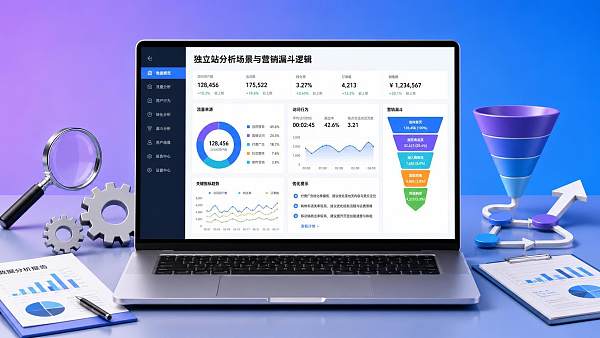
The most difficult thing for companies when making decisions is often the statement, “It feels like conversion has been poor recently.” Feelings cannot determine budgets or priorities. A more effective approach is to break independent website operations into several measurable levels: whether exposure reaches the target audience, whether clicks lead to the target page, whether visitors read the core content, whether intent triggers key actions, and whether leads meet sales standards.
If the main problem occurs between exposure and clicks, adjust traffic first. If clicks are not the issue but visitors leave quickly after entering the page, optimize the website first. If there are many form submissions but the sales team reports a high volume of invalid leads, then the issue is not simply traffic or conversion; rather, the lead acquisition criteria, page promises, and campaign targeting are inconsistent. This is often overlooked.
Many companies mix all their data together and ultimately conclude that “the website is ineffective.” In reality, an independent website is not a single channel, but an integrated asset that accommodates search, advertising, social media, private-domain traffic, and visibility in AI search. The coarser the funnel analysis, the more easily decisions become distorted.
Some Bottlenecks Appear to Be Traffic Problems but Are Actually Caused by Insufficient Website Capabilities
In recent years, companies have often held a common misconception when building overseas websites: once the website goes live, they can immediately begin SEO, advertising, and social media traffic acquisition. In reality, many websites are not suitable for promotion at the underlying structural level. Disorganized page hierarchies, poor management of language versions, uncontrollable URLs and metadata, low content update efficiency, and incomplete data tracking may not be obvious in daily operations, but they tend to surface all at once when the website reaches an operational bottleneck.
Therefore, before discussing “traffic first or conversion first,” another assessment may be necessary: does the current website have the infrastructure required for continuous optimization? A system that can be properly understood by search engines, quickly generate multilingual pages, support landing-page testing for advertising, and connect inquiry data with behavioral data is not on the same competitive level as a website that merely “displays company information.” For many years, Yingyingbao has placed intelligent website building, SEO/GEO, advertising, and e-commerce systems on the same platform. In essence, this addresses the fragmentation that causes companies the most difficulty in operations, enabling websites not only to go live, but also to be promoted, indexed, and continuously improved.
From this perspective, when selecting a solution, companies should not ask service providers only whether they can bring traffic. They should also ask: Can data flow back into website decisions? Do multilingual versions support localization rather than simple translation? Do SEO and advertising landing pages share content assets? These questions determine whether, after a bottleneck appears, you can make rapid corrections or can only continue adding budget.
A Simple Table Can Help Distinguish Priorities During Decision-Making
Do Not Understand “Optimization” as a Series of Fragmented Actions
During a bottleneck period, some companies take many actions at the same time: modifying the homepage, increasing the budget, opening accounts on new platforms, producing short videos, changing website-building providers, and hiring an SEO team. Although there appear to be many actions, because they did not first determine whether the problem lies on the traffic side or the conversion side, the result is often that everything gets done but nothing truly addresses the key issue.
A more prudent approach is to diagnose first and prioritize afterward. First confirm whether traffic from the target market is insufficient, then determine whether there is obvious user loss after visitors enter the website, and finally verify whether the leads are genuinely wanted by the sales team. This sequence may seem simple, but it can help companies avoid significant budget waste. For managers who need to report internally, it is also easier to form an explainable decision-making chain than simply saying, “Let’s try it first.”
As an aside, when researching solutions, companies often come across cross-disciplinary research materials, such as Research on the Optimization of Activity-Based Costing Applications in Cost Accounting for Coal Mining Enterprises. Although it does not belong to the same application scenario as independent website operations, it offers a useful methodological insight: do not look only at total costs; examine which operational activity is actually consuming those costs. The same applies to independent websites. Spending the budget does not mean that the problem has been solved. The key is to identify the specific point that is truly holding back growth.
What Companies Should Really Ask Is Not Whether to Prioritize Traffic or Conversion
When independent website operations reach a bottleneck, the more accurate question should be: At this stage, is growth being limited by customer acquisition volume, customer acquisition accuracy, or on-site transaction efficiency? The first two relate more to traffic, while the latter relates more to conversion, but in real business operations they are often interconnected. Business decision-makers do not need a standard answer, but rather a framework for distinguishing priorities.
If the website foundation is weak, improve system capabilities first. If the traffic structure is distorted, adjust channels and keywords first. If the visitors are relevant but do not take action, improve the conversion path first. Viewing these three levels separately can make many previously vague debates much clearer. An independent website is neither merely a presentation page nor an accessory to advertising; it is itself an operating asset within the overseas growth chain. How a bottleneck is handled determines not only the data for a particular month, but also whether every subsequent investment can continue to be amplified.
Related Articles


Related Products
 Yiyingbao SaaS Intelligent Website Building and Marketing SystemYiyingbao SaaS Intelligent Website Building and Marketing System, AI-powered no-code website building, rapid creation of multilingual B2B international websites in 10 minutes, global server acceleration, AI-powered SEO optimization, helping businesses connect efficiently with global markets. The perfect integration of technology and operation makes building an international trade website remarkably simple
 AI+SEM Intelligent Advertising Marketing SystemAI+SEM drives intelligent ad creation, empowering full-funnel precision advertising marketing. The system automatically generates weekly/monthly reports, AI recommends keywords and target countries, monitors core metrics in real-time with intelligent alerts, and enables one-click high-conversion ad solutions to help quickly acquire customers and improve ROI.
 AI+SEO Dual-Engine System Optimization ServicesYiyingbao’s AI+SEO dual-engine optimization system helps foreign trade enterprises acquire high-quality organic traffic through AI-powered keyword research, content generation, and comprehensive technical optimization, significantly improving search rankings and conversion rates.
 AI+SNS Social Media Marketing SystemYingbao AI+SNS Social Media Marketing System - Precision social capture for the social media era. Supports one-click content synchronization across major platforms like Facebook and LinkedIn. AI intelligently rewrites posts for enhanced relevance. 24/7 AI customer service and user profiling analysis empower businesses to efficiently expand into global markets.
 AI+SEO营销解决方案易营宝AI+SEO营销解决方案,通过AI批量写作、智能生成TDK、精准关键词扩词等功能,全面优化网站SEO效果,提升流量与转化率。助力企业构建高效智能网站新生态。
 AI+SEM Advertising Marketing SolutionsAI+SEM Advertising Marketing Solution leverages AI technology to deeply empower SEM ad campaigns. It automatically generates weekly/monthly reports using AI, presenting account data across multiple dimensions for comprehensive insights into campaign performance and trends. The system precisely recommends keywords and target countries, intelligently generates high-conversion ad copy, and enables one-click activation of efficient campaign plans to help businesses rapidly acquire customers. Simultaneously, it monitors core metrics in real time, intelligently identifies abnormal fluctuations, and issues timely alerts to ensure stable, high-return advertising results.
 Domain Name ServicesEasyWin provides professional domain name services, including intelligent queries, one-stop registration, brand protection, and full lifecycle management, helping businesses build a digital brand image.
 EasyOperate B2C Cross-Border E-Commerce Platform & Independent WebsiteEasyStore B2C Cross-border E-commerce Independent Store is an intelligent website building and cross-border e-commerce integrated solution independently developed by EasyStore Information Technology (Beijing) Co., Ltd. The system is specially designed for small and medium-sized as well as large export enterprises, integrating 'website building, operation, marketing, advertising, and conversion' into one, helping enterprises quickly establish cross-border e-commerce independent stores to achieve brand globalization and global sales growth.
The platform supports multiple languages, multiple currencies, and multi-channel marketing, with built-in AI intelligent translation and SEO optimization systems, suitable for mainstream markets such as Southeast Asia, Europe and America, Latin America, and the Middle East, assisting Chinese manufacturing enterprises in efficiently deploying international e-commerce strategies. SSL证书易营宝提供专业SSL安全证书服务,包括单域名和泛域名证书,确保网站数据传输加密、身份验证和完整性保护,助力企业建立安全可信的在线业务环境。









