









- Which customer acquisition channels will be affected by cross-border marketing trends in 2026?Sep 06, 2026View details
- Which homogenization risks should be considered in an analysis of the AI-powered website building industry?Aug 30, 2026View details
- How Will AI Marketing Trends 2026 Change Advertising Budget AllocationAug 28, 2026View details
- Is the EV SSL certificate market shrinking or upgrading? How should companies assess certificate procurement?Aug 11, 2026View details
- Why the old AMP SEO 2020 practices no longer work and what has changed in current optimization prioritiesAug 02, 2026View details
- How to Choose Topics for an Industry News Section to Attract More Organic Search TrafficJul 29, 2026View details
How should Google SEO services be evaluated? Should the focus be on strategy or execution?
Before Purchasing Google SEO Services, Don't Rush to Review How Impressive the Proposal Looks
When screening Google SEO services, many procurement professionals are easily impressed at first glance by comprehensive proposals: extensive keyword coverage, broad target markets, and detailed timelines. But when it comes to budget approval and supplier management, the core questions are actually simple: Can the service be implemented? Can its execution be tracked? And can it ultimately generate qualified inquiries?
Therefore, the focus should not be on choosing between “strategy” and “execution,” but on whether the two are properly aligned. Strategy determines the direction, while execution determines the results; only an executable strategy creates procurement value.
When Evaluating Google SEO Services, Should You Look at Strategy or Execution First?
First assess whether the strategy is sound, then focus on whether the execution is genuine and deliverable.
The reason is straightforward. Without a strategy, a service provider may simply publish articles mechanically, add pages, and perform superficial optimization. There may appear to be activity in the short term, but it may not generate rankings or conversions in the long term. However, if there is only a strategy without clear execution actions, responsible personnel, timelines, and review mechanisms, then even the most professional proposal is merely a presentation document.
During procurement, you can directly ask four questions:
- How are target markets and target languages divided? Can the same logic be applied universally across different countries?
- What is the keyword strategy based on: traffic, or inquiry intent?
- What exactly will be delivered each month, who will be responsible, and what qualifies as completion?
- How will adjustments be made if the results are unsatisfactory—by changing keywords, revising content, adjusting page structure, or redefining the conversion path?
Service providers that can clearly answer these four questions are generally more worthy of being included on a procurement comparison list than those that only know how to present a “success framework.”
What Kind of “Strategy” Creates Procurement Value?
A strategy with procurement value is not about discussing trends; it should guide resource allocation.
For example, the requirements of an international manufacturing company and those of a cross-border e-commerce business for Google SEO services are different. The former places greater emphasis on industry keywords, product keywords, solution keywords, and inquiry form paths; the latter is generally more concerned with category pages, product pages, campaign pages, and the coordination between search and advertising. If a supplier does not distinguish between business models first and instead provides a standardized approach, it will most likely lead to problems such as misaligned content direction, unsuitable page structures, and poor conversion even after traffic arrives.
You can treat the strategy document as an “explanation of decision logic” and focus on whether it includes the following:
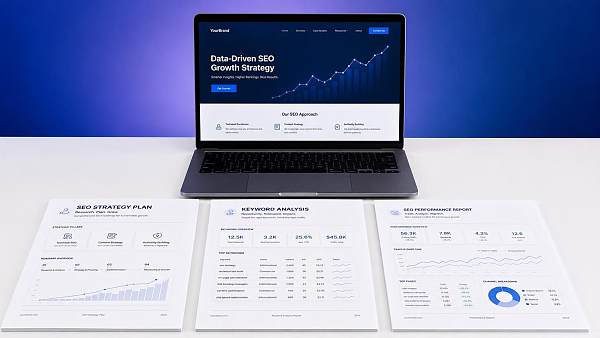
What Evidence Should You Look for to Assess Execution Capability?
Execution capability cannot be assessed through verbal promises; you need to review delivery evidence.
Procurement teams are most concerned about one situation: the proposal looks highly professional, but after the contract is signed, the service turns out to rely mainly on templated content, infrequent updates, and vague reports. To avoid this, it is advisable to break down the deliverables during the business communication stage.
What is truly worth examining is not wording such as “we will continue to optimize,” but the following verifiable items:
- On-site technical checklist: How are issues related to indexing, crawling, page standards, and speed handled?
- Content production mechanism: Who determines the keywords, who writes the content, and is collaboration across multilingual sites supported?
- Page optimization methods: Are only titles and descriptions changed, or are structure, internal links, and conversion entry points adjusted as well?
- External links and off-site signals: Is the sourcing logic compliant, and are quality standards explained?
- Reporting granularity: Review actions weekly and results monthly, rather than providing a one-time summary at the end of each quarter.
If a service provider can list the monthly work items, deliverables, corresponding target pages, and exception-handling methods, the credibility of its execution will be much higher.
Can You Sign a Contract with a Provider That Only Promises Rankings?
Proceed with caution. Promising rankings alone often avoids the most critical business results.
Rankings are certainly important, but procurement decisions should not revolve around a single ranking position. Even if a keyword ranks at the top, the search intent, landing page, or country may be wrong, ultimately generating traffic without inquiries. Especially in B2B scenarios, the lead quality generated by long-tail keywords, solution keywords, and application keywords is often more valuable than that generated by a few highly competitive core keywords.
A more reliable approach is to divide objectives into three levels: visibility, qualified traffic, and conversion actions. The first two are SEO process metrics, while the last is the outcome metric that procurement should focus on more closely. If a service provider is only willing to discuss rankings and not page engagement or lead definitions, its service scope is likely to be too narrow.
When Quotations Differ Significantly, How Should Procurement Compare Them?
Before comparing prices, first convert the service contents into a consistent framework. Many seemingly inexpensive Google SEO services actually include only a basic diagnosis and a small amount of content updates, while somewhat more expensive proposals may already cover technical optimization, content planning, multilingual layout, data dashboards, and conversion page adjustments. These are not equivalent.
It is recommended that candidate suppliers answer the following questions uniformly before making a horizontal comparison:
- How many page optimizations, content updates, and technical items will be delivered each month?
- Does the service include website structure adjustments, and will cooperation from the company's internal development team be required?
- Are multilingual websites covered, and who will be responsible for translation and localization?
- Which business metrics will be shown in the reports, and will page-level performance be available?
- How long after project launch will execution enter a stable rhythm, and how often will strategy reviews be conducted?
This approach makes it easier for procurement teams to determine whether the difference lies in the “price” or in the “workload” and “capability boundaries.”
Why Is It Not Enough for an SEO Service Provider to Understand Websites?
Because Google SEO services are not a standalone task. They are connected with the website infrastructure, content production, data tracking, and conversion design.
If a service provider can only offer optimization recommendations but lacks the supporting website execution capability, the project can easily become stalled by internal coordination. Procurement teams often encounter situations such as these: the SEO team identifies a problem, but the page cannot be modified; the content direction is clear, but the site does not support the required sections; or data needs to be tracked, but forms and events have not been properly implemented. The problem is not necessarily an incorrect strategy, but a broken chain.
For companies that need to acquire customers through an independent website, it is preferable to prioritize service teams that understand both websites and marketing coordination. Platforms such as 易营宝, which cover intelligent website building, SEO optimization, advertising, and multi-channel customer acquisition, can generally integrate pages, traffic, and inquiries within the same framework more easily during project implementation, rather than having each function operate independently.
When Doing SEO, Why Should Procurement Also Pay Attention to Advertising and Data Systems?
Because SEO takes time to deliver results, procurement decisions cannot rely solely on waiting over the long term. Especially in scenarios such as entering new markets, promoting campaigns, and conducting cross-border advertising, companies often need to pursue organic growth while using advertising to validate whether keywords, regions, and landing pages are effective.
In this situation, the ability to integrate with an advertising system is an additional factor when evaluating service maturity. For example, tools such as AI+SEM Intelligent Advertising and Marketing System can provide intelligent keyword and location recommendations, real-time monitoring of core metrics, automatically generated weekly and monthly reports, and more intuitive data visualization. For procurement teams, the value of this capability is not simply having “one more system,” but being able to more quickly verify which keywords are worth pursuing through long-term SEO and which pages should first be tested through paid campaigns before content resources are allocated.
If a supplier can align the data standards of SEO and advertising, it will be much easier to make decisions when renewing contracts, increasing purchases, or adjusting budgets.
Which Terms Are Most Easily Overlooked in Contracts and Reports?
The most easily overlooked issues are not pricing terms, but the “scope of work” and the “right to interpret results.”
When reviewing contracts and monthly report templates, procurement teams should at least clarify the following points:
- Which tasks are included in the service, and which require additional charges?
- After a site redesign, new product launch, or addition of a new language, will the optimization scope automatically cover these changes?
- Will reports show overall traffic only, or can they drill down to countries, pages, keyword groups, and conversion actions?
- If rankings increase but inquiries decline, how will the service provider explain this and propose adjustments?
- Can accounts, data dashboards, content assets, and optimization documents be handed over?
Clarifying these points in advance makes it less likely that disputes will arise later over whether the work delivered value, even when many tasks have been completed.
If Only One Decision-Making Principle Could Be Retained, What Should Procurement Focus On?
Focus on whether “the strategy can be implemented across pages, content, data, and inquiries.”
Whether a Google SEO service provider is worth selecting depends neither on how comprehensive its proposal is nor on how aggressive its promises are. What matters is whether it can connect the target market, keywords, website structure, execution actions, and results review into a closed loop. When selecting a provider, procurement teams should first examine the decision logic, then the execution evidence, and finally whether the data standards can support business accountability. Following this order generally reduces the risk of making a poor choice more effectively than focusing only on price or case studies.
Related Articles



Related Products
 Yiyingbao SaaS Intelligent Website Building and Marketing SystemYiyingbao SaaS Intelligent Website Building and Marketing System, AI-powered no-code website building, rapid creation of multilingual B2B international websites in 10 minutes, global server acceleration, AI-powered SEO optimization, helping businesses connect efficiently with global markets. The perfect integration of technology and operation makes building an international trade website remarkably simple
 AI+SEM Intelligent Advertising Marketing SystemAI+SEM drives intelligent ad creation, empowering full-funnel precision advertising marketing. The system automatically generates weekly/monthly reports, AI recommends keywords and target countries, monitors core metrics in real-time with intelligent alerts, and enables one-click high-conversion ad solutions to help quickly acquire customers and improve ROI.
 AI+SEO Dual-Engine System Optimization ServicesYiyingbao’s AI+SEO dual-engine optimization system helps foreign trade enterprises acquire high-quality organic traffic through AI-powered keyword research, content generation, and comprehensive technical optimization, significantly improving search rankings and conversion rates.
 AI+SNS Social Media Marketing SystemYingbao AI+SNS Social Media Marketing System - Precision social capture for the social media era. Supports one-click content synchronization across major platforms like Facebook and LinkedIn. AI intelligently rewrites posts for enhanced relevance. 24/7 AI customer service and user profiling analysis empower businesses to efficiently expand into global markets.
 AI+SEO营销解决方案易营宝AI+SEO营销解决方案,通过AI批量写作、智能生成TDK、精准关键词扩词等功能,全面优化网站SEO效果,提升流量与转化率。助力企业构建高效智能网站新生态。
 AI+SEM Advertising Marketing SolutionsAI+SEM Advertising Marketing Solution leverages AI technology to deeply empower SEM ad campaigns. It automatically generates weekly/monthly reports using AI, presenting account data across multiple dimensions for comprehensive insights into campaign performance and trends. The system precisely recommends keywords and target countries, intelligently generates high-conversion ad copy, and enables one-click activation of efficient campaign plans to help businesses rapidly acquire customers. Simultaneously, it monitors core metrics in real time, intelligently identifies abnormal fluctuations, and issues timely alerts to ensure stable, high-return advertising results.
 Domain Name ServicesEasyWin provides professional domain name services, including intelligent queries, one-stop registration, brand protection, and full lifecycle management, helping businesses build a digital brand image.
 EasyOperate B2C Cross-Border E-Commerce Platform & Independent WebsiteEasyStore B2C Cross-border E-commerce Independent Store is an intelligent website building and cross-border e-commerce integrated solution independently developed by EasyStore Information Technology (Beijing) Co., Ltd. The system is specially designed for small and medium-sized as well as large export enterprises, integrating 'website building, operation, marketing, advertising, and conversion' into one, helping enterprises quickly establish cross-border e-commerce independent stores to achieve brand globalization and global sales growth.
The platform supports multiple languages, multiple currencies, and multi-channel marketing, with built-in AI intelligent translation and SEO optimization systems, suitable for mainstream markets such as Southeast Asia, Europe and America, Latin America, and the Middle East, assisting Chinese manufacturing enterprises in efficiently deploying international e-commerce strategies. SSL证书易营宝提供专业SSL安全证书服务,包括单域名和泛域名证书,确保网站数据传输加密、身份验证和完整性保护,助力企业建立安全可信的在线业务环境。









