









- Can the average annual growth rate reflect real opportunities in overseas markets?Oct 07, 2026View details
- Which customer acquisition channels will be affected by cross-border marketing trends in 2026?Sep 06, 2026View details
- Which homogenization risks should be considered in an analysis of the AI-powered website building industry?Aug 30, 2026View details
- How Will AI Marketing Trends 2026 Change Advertising Budget AllocationAug 28, 2026View details
- Is the EV SSL certificate market shrinking or upgrading? How should companies assess certificate procurement?Aug 11, 2026View details
- Why the old AMP SEO 2020 practices no longer work and what has changed in current optimization prioritiesAug 02, 2026View details
What is the reputation of the Yiyingbao website building system?
Many people seriously compare website-building systems for the first time not when they are thinking about creating a corporate website, but after their website has been online for a while: pages are slow to update, inquiry forms fail to receive submissions, the English site has very few pages indexed by search engines, paid advertising reveals that the landing pages and the official website have completely different styles, and SEO restructuring later requires rework. At that point, asking “How is the reputation of the Yiyingbao website-building system?” is usually not simply about looking for positive reviews. Instead, people want to determine whether it really fits their current business pace.
This issue is especially common in foreign trade, cross-border commerce, and brand globalization scenarios. What people are truly struggling with is often not whether the website can be built, but whether it can continue to support promotion after launch, whether it can support multiple languages, and whether ongoing maintenance will slow down the team. If a system can only solve the “website building” step but cannot also accommodate SEO, advertising landing pages, and subsequent operations, then no matter how lively its reputation is, the actual user experience may still be average.
Before looking at reviews, first understand why people call a system “easy” or “difficult” to use
The easiest mistake to make when evaluating the reputation of a website-building system is to look only at the feature list. More features do not necessarily mean a smoother experience. User feedback often focuses on several highly practical points: whether the backend is easy to use, whether modifying a page affects everything else, whether multiple languages are convenient to maintain, whether the basic SEO settings are complete, and whether technical limitations will get in the way when running ads, creating content, and improving indexing later.
If you are also searching for “How is the reputation of the Yiyingbao website-building system?”, a more valuable way to evaluate it is not to rely on a single comment such as “good” or “average,” but to break the reviews down. People who consider it good usually appreciate that it connects website building with subsequent marketing activities; those who hesitate are often concerned about system compatibility, content migration, and the handling of existing domains and old websites. A reputation essentially reflects usage scenarios rather than providing one universal answer.
Common comparison points are not whether the pages look attractive, but whether subsequent operations are easy
When a website has just gone live, its visual presentation is usually the easiest aspect to notice, but the real differences often emerge during later operations. For example, some companies initially create only an English website, then add Spanish, Russian, or Japanese versions a few months later. Others begin with brand presentation and later need to add inquiry pages, product landing pages, and advertising landing pages. If the system is difficult to expand, every additional step increases the team’s costs.
Based on this type of usage logic, when discussing the reputation of an integrated website-building and marketing service system such as Yiyingbao, people generally consider several dimensions: website-building efficiency, multilingual capabilities, SEO operability, advertising compatibility, and suitability for foreign trade or global expansion. For teams that need to coordinate Google SEO, Google Ads, and overseas social media traffic acquisition, the website does not exist independently. It must be able to effectively handle the traffic it receives.
That is also why some companies reassess their systems even when they already have a website. The issue is not that the original website looks bad, but that it cannot be modified, expanded, or coordinated with marketing activities. What usually determines the user experience is whether subsequent operations are troublesome.
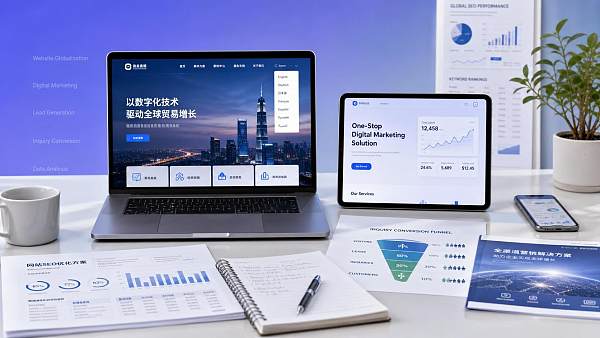
If you are comparing systems, focus on these four evaluation criteria
1. Is the backend practical, rather than suitable only for demonstrations during delivery?
Some systems work smoothly during demonstrations, but once handed over to the operations team, even modifying a single module requires technical assistance. A website-building system with a stable reputation is usually not valued because of a flashy interface, but because routine tasks such as changing banners, adding products, adjusting copy, and updating sections can be completed without easily causing errors. For companies without a dedicated development team, this is more important than many “advanced features.”
2. Are multiple languages managed independently, or is it merely a superficial language switch?
In global expansion, multilingual support does not end with translating the pages. Whether each language version can have its own title, description, and URL structure, and whether content can be optimized conveniently for different regions, will all affect subsequent search visibility. If the system only provides a front-end language switch without supporting detailed management, SEO operations will become relatively passive later.
3. Does the system provide sufficient room for SEO configuration and operation?
When many people ask about a system’s reputation, they are actually asking, “Will SEO be restricted?” This is a very practical question. If a website system cannot even handle basic page titles, descriptions, custom links, section structures, and content updates smoothly, even the best SEO strategy will be difficult to implement. For teams that work on Google SEO over the long term, the system is not the only factor determining rankings, but it does determine the difficulty of execution.
4. Can it coordinate with advertising and social media content instead of keeping everything separate?
If the website only serves as a digital business card, the requirements will not be particularly demanding. But if it also handles advertising traffic, inquiry conversion, and landing pages for social media traffic acquisition, practical issues such as page duplication efficiency, special landing page production speed, form management, and mobile presentation must be considered. Many differences in reputation arise from this point: when requirements are simple, everyone feels that the system is sufficient; once requirements become more complex, the differences become apparent.
Returning to “How is the reputation of the Yiyingbao website-building system?”, it can be understood this way
Based on its publicly visible product positioning, Yiyingbao does not treat website building as an isolated service. Instead, it places AI-powered website building, multilingual websites, B2B foreign trade marketing websites, cross-border e-commerce stores, SEO optimization, advertising, and overseas social media operations within the same business chain. For some companies, the value of this approach is that they do not need to manage websites, promotion, and landing pages through several completely separate tools.
These systems are generally more suitable for several situations: first, companies that already have overseas promotion plans and do not want to rework their websites because of structural issues after launch; second, companies that need multilingual websites but do not want to frequently coordinate with multiple suppliers; and third, companies that generate both organic traffic and paid advertising traffic and want their websites to support both long-term indexing and short-term conversion pages.
From another perspective, however, if your requirement is only to create a very simple corporate introduction page and you do not plan to update content frequently, invest in SEO, or run advertising, then the evaluation criteria will be different. In that case, a good reputation does not necessarily mean that more features are better. What matters is whether the system matches the depth of your intended use.
An often-overlooked misconception: treating “website-building reputation” as “design reputation”
Many people first look at the visual quality of case studies when comparing systems. That is understandable, but the evaluation should not stop there. A website with an attractive homepage does not necessarily have an easy-to-use backend, and a wide range of templates does not necessarily make it suitable for long-term content growth. For foreign trade companies and brand globalization teams in particular, a website is often not a one-time delivery project. It must continuously update products, publish content, and handle promotional traffic.
Therefore, a more reasonable approach is to break “How is the reputation of the Yiyingbao website-building system?” into two questions: first, is it suitable for your current business processes? Second, can it support your operational activities over the next six to twelve months? The former concerns ease of use and delivery, while the latter concerns expansion and marketing coordination. Looking only at visual feedback at a particular point in time can easily lead to a one-sided conclusion.
If you are choosing a system, you can verify it using this approach
First, clearly define your own usage scenario instead of immediately asking which system is “the best.” For example, do you need a B2B inquiry website or a B2C independent website? Is your primary market North America or Japan and South Korea? Will you focus more on SEO-driven content growth or on receiving advertising traffic? Different scenarios lead to different system priorities.
Next, check whether several specific tasks can be completed smoothly: how difficult is it to add a new language version; does creating a new special landing page require additional development; can page titles, descriptions, and link rules be adjusted independently; after product content is updated, can it be synchronized conveniently with relevant sections; and does the mobile presentation require duplicate maintenance? If these tasks can all be completed smoothly, the system’s reputation will probably not be poor.
Finally, examine the service boundaries. Some teams need more than the system itself; they also need extended support such as SEO optimization, advertising page coordination, and social media traffic acquisition landing pages. For companies that lack cross-department coordination capabilities, a service model such as Yiyingbao’s, which covers intelligent website building, SEO, advertising, and social media, can reduce communication costs. However, whether it is suitable still depends on whether you actually have this type of ongoing requirement.
When is it more worthwhile to seriously consider this type of integrated system?
If you have already encountered any of the following situations, it is worth conducting a serious evaluation: website revisions are frequent, but every change requires waiting in line; content updates across different language sites are not synchronized; SEO and advertising teams both have concerns about the page structure; the old website can display content but is not conducive to indexing; or you want to add overseas social media and search traffic but find that the website is too weak to handle it.
These issues cannot be solved simply by “redesigning the pages.” They concern the underlying management approach of the website. That is why many people who ask “How is the reputation of the Yiyingbao website-building system?” are actually looking for a solution that can reduce future hassle, rather than simply seeking an inexpensive or visually attractive website.
If you have not reached this stage yet and your requirements are relatively limited, you can take a more conservative approach: first confirm whether the basic functions meet your needs, and do not take on additional complexity for capabilities you may never use.
Ultimately, the reputation of a website-building system can never be fully explained by simply saying it is “good” or “bad.” A more practical conclusion is this: if your website serves more than a display function and also needs to support SEO, advertising, social media, and multilingual operations, these subsequent activities should be included in the evaluation. By this standard, the answer to “How is the reputation of the Yiyingbao website-building system?” is not found in promotional slogans, but in whether it can reduce rework, fragmentation, and reliance on temporary fixes in your website building and marketing activities.
Related Articles



Related Products
 Yiyingbao SaaS Intelligent Website Building and Marketing SystemYiyingbao SaaS Intelligent Website Building and Marketing System, AI-powered no-code website building, rapid creation of multilingual B2B international websites in 10 minutes, global server acceleration, AI-powered SEO optimization, helping businesses connect efficiently with global markets. The perfect integration of technology and operation makes building an international trade website remarkably simple
 AI+SEM Intelligent Advertising Marketing SystemAI+SEM drives intelligent ad creation, empowering full-funnel precision advertising marketing. The system automatically generates weekly/monthly reports, AI recommends keywords and target countries, monitors core metrics in real-time with intelligent alerts, and enables one-click high-conversion ad solutions to help quickly acquire customers and improve ROI.
 AI+SEO Dual-Engine System Optimization ServicesYiyingbao’s AI+SEO dual-engine optimization system helps foreign trade enterprises acquire high-quality organic traffic through AI-powered keyword research, content generation, and comprehensive technical optimization, significantly improving search rankings and conversion rates.
 AI+SNS Social Media Marketing SystemYingbao AI+SNS Social Media Marketing System - Precision social capture for the social media era. Supports one-click content synchronization across major platforms like Facebook and LinkedIn. AI intelligently rewrites posts for enhanced relevance. 24/7 AI customer service and user profiling analysis empower businesses to efficiently expand into global markets.
 AI+SEO营销解决方案易营宝AI+SEO营销解决方案,通过AI批量写作、智能生成TDK、精准关键词扩词等功能,全面优化网站SEO效果,提升流量与转化率。助力企业构建高效智能网站新生态。
 AI+SEM Advertising Marketing SolutionsAI+SEM Advertising Marketing Solution leverages AI technology to deeply empower SEM ad campaigns. It automatically generates weekly/monthly reports using AI, presenting account data across multiple dimensions for comprehensive insights into campaign performance and trends. The system precisely recommends keywords and target countries, intelligently generates high-conversion ad copy, and enables one-click activation of efficient campaign plans to help businesses rapidly acquire customers. Simultaneously, it monitors core metrics in real time, intelligently identifies abnormal fluctuations, and issues timely alerts to ensure stable, high-return advertising results.
 Domain Name ServicesEasyWin provides professional domain name services, including intelligent queries, one-stop registration, brand protection, and full lifecycle management, helping businesses build a digital brand image.
 EasyOperate B2C Cross-Border E-Commerce Platform & Independent WebsiteEasyStore B2C Cross-border E-commerce Independent Store is an intelligent website building and cross-border e-commerce integrated solution independently developed by EasyStore Information Technology (Beijing) Co., Ltd. The system is specially designed for small and medium-sized as well as large export enterprises, integrating 'website building, operation, marketing, advertising, and conversion' into one, helping enterprises quickly establish cross-border e-commerce independent stores to achieve brand globalization and global sales growth.
The platform supports multiple languages, multiple currencies, and multi-channel marketing, with built-in AI intelligent translation and SEO optimization systems, suitable for mainstream markets such as Southeast Asia, Europe and America, Latin America, and the Middle East, assisting Chinese manufacturing enterprises in efficiently deploying international e-commerce strategies. SSL证书易营宝提供专业SSL安全证书服务,包括单域名和泛域名证书,确保网站数据传输加密、身份验证和完整性保护,助力企业建立安全可信的在线业务环境。









