









- Which customer acquisition channels will be affected by cross-border marketing trends in 2026?Sep 06, 2026View details
- Which homogenization risks should be considered in an analysis of the AI-powered website building industry?Aug 30, 2026View details
- How Will AI Marketing Trends 2026 Change Advertising Budget AllocationAug 28, 2026View details
- Is the EV SSL certificate market shrinking or upgrading? How should companies assess certificate procurement?Aug 11, 2026View details
- Why the old AMP SEO 2020 practices no longer work and what has changed in current optimization prioritiesAug 02, 2026View details
- How to Choose Topics for an Industry News Section to Attract More Organic Search TrafficJul 29, 2026View details
What Factors Determine How Long It Takes to See Results from Internal Linking Optimization
When adjusting internal links, many people first ask not “How should it be done?” but “How long will it take to see results?” Behind this question are actually two concerns: first, whether the work is worth the investment; and second, if there is no short-term change, whether it is a normal fluctuation or a problem with the method itself.
Here is the conclusion first: internal link optimization usually does not provide immediate feedback in a short period like changing a title, nor is its impact as easy to attribute separately as that of external links. How long it takes to produce results often depends on whether the website is easy to crawl, whether the pages have already been indexed, whether there is a genuine topical relationship between the content, and whether search engines are willing to reinterpret the structure of the website. For practitioners, what really matters is not focusing on “how many days until it takes effect,” but determining which prerequisites are already in place and which factors are still holding the process back.
Why Internal Links Are Often “Effective” but Not Immediately Noticeable
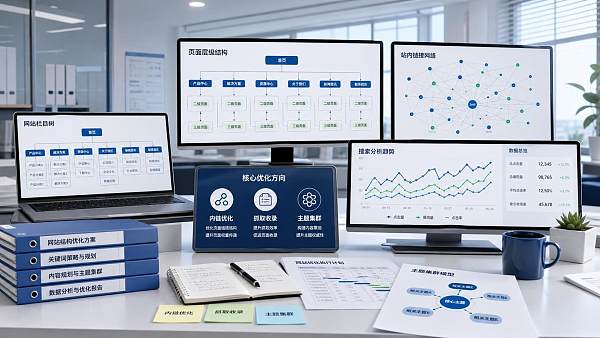
The role of internal links is not simply to add a few more links to a page, but to help search engines understand the hierarchy, topical relationships, and authority transfer paths between pages on the site. For B2B websites, international trade websites, and multilingual corporate websites with relatively deep content structures, the core value of internal link optimization is usually reflected on three levels: making important pages easier to discover, clarifying topic clusters, and connecting originally scattered content into business semantics that can be understood.
The problem, however, is that these changes rarely appear as a sudden surge in a single metric. You may first see changes in crawl frequency, increased exposure for some long-tail keywords, or improved indexing stability, followed later by higher rankings and more traffic to inquiry-generating pages. If you only monitor rankings for homepage keywords, you may incorrectly conclude that there has been “no effect.”
Therefore, slow results from internal link optimization do not necessarily mean that it is ineffective; quick results do not necessarily mean that they are entirely attributable to internal links. In real business scenarios, it is more like a structural correction that needs to be evaluated together with content quality, technical SEO, and indexing status.
To Determine When Changes Will Appear, First Consider the Website’s Stage
Even for the same internal linking work, the feedback cycle can vary significantly from one website to another. New sites and established sites, large sites and small sites, and sites with stable or unstable indexing operate on entirely different schedules.
New Websites: First Solve the Question of Whether They Can Be Understood
If a website has not been online for long, has a limited number of pages, and has not yet established a stable identity in the eyes of search engines, the first effect of internal link optimization is often not rankings, but crawling and indexing. Even when the internal link structure is well designed at this stage, you still need to wait for search engines to visit the site multiple times, recrawl it, and recategorize the pages. The process is usually slower and more volatile than for an established site.
Many practitioners interpret “no rankings” at this stage as “internal links are ineffective.” In reality, the site may simply lack sufficient baseline authority, and search engines may not yet have established enough trust.
Established Websites: More Likely to Show Feedback from Structural Corrections
For an established website with a certain indexing foundation—especially one with a substantial amount of content but disorganized section relationships, many orphan pages, or important pages buried too deeply—changes are generally easier to observe after internal link adjustments. This is because search engines already crawl these pages. Once the link paths become clearer, the importance of the pages and the degree of topical aggregation can be recognized again more quickly.
In these scenarios, the results may appear first on second- and third-level pages rather than on the most important commercial keyword pages. For example, exposure and click-through rates for product solution pages, industry application pages, and informational content pages may improve first. This is actually normal.
The Feedback Cycle Depends on More Than Whether Links Have Been Added
How long it takes to see results from internal link optimization depends most importantly not on quantity, but on whether the necessary conditions are in place. The following factors are often more important than “how many anchor text links have been added.”
1. Whether the Page Has Been Indexed Normally
If the target page itself is not indexed consistently, or has not yet entered the index, the effect will be greatly weakened no matter how many internal links other pages point to it. Internal links can help search engines discover a page, but they cannot replace the basic conditions required for the page to be indexed. Low page quality, high duplication, overly heavy templates, and superficial content can all reduce the effectiveness of internal links.
2. Whether the Link Relationships Follow Topical Logic
The most common misunderstanding is to treat internal links as an “authority distribution tool” and mechanically point large numbers of pages to a particular target page. The problem is that search engines are placing increasing importance on contextual relevance. If a content page about “industrial equipment maintenance” is forced to include a large number of links to “corporate website development,” the relationship does not automatically become valid simply because the links exist.
Truly effective internal links should be based on topic expansion, decision paths, and information supplementation. In other words, it should be reasonable for readers to click through the link, and it should also be reasonable for search engines to use the link to determine the topical relationship.
3. How Frequently the Website Is Crawled
Search engines do not immediately reevaluate an entire website the moment you finish modifying a page. The higher the crawl frequency, the sooner structural changes are discovered; the lower the crawl frequency, the longer the feedback cycle naturally becomes. For websites that are updated frequently and maintain relatively stable content quality, internal link adjustments usually enter the reevaluation stage more quickly. Conversely, if a website is rarely updated, responds slowly, or contains many broken links, even well-designed internal links may not produce obvious changes for a long time.
4. Whether the Target Page Is Worth Promoting
Some pages fail to rank not because no one has created internal links to them, but because the pages themselves do not satisfy search intent. For example, a product page may contain only a collection of specifications, without application scenarios, delivery capabilities, frequently asked questions, or decision-making information; or a landing page may consist almost entirely of marketing language and contain little indexable, useful content. Internal links can amplify a page’s value, but they cannot create value out of nothing.
5. Whether the Scope of the Changes Is Local or Structural
If only a few related links are added between several articles, the feedback is usually local and more difficult to identify in overall data. If the change involves restructuring site sections, optimizing breadcrumbs, aggregating topic pages, or reducing the click depth of core pages, it is more likely to produce observable changes. However, it also requires time for search engines to process the changes again.
Which Common Claims About Internal Link Optimization Are Not Entirely True
There are several statements about internal link optimization that sound convincing in the industry but are not necessarily reliable in real business scenarios.
- “The more internal links, the better”: Not true. Too many links can dilute the focus of a page and make the user reading path confusing.
- “Add a few more links from the homepage and rankings will rise”: Unstable. Homepage link resources are limited. The key is whether the target page is worth supporting and whether the context matches.
- “Anchor text must repeat the keyword exactly”: Relatively risky. Excessively uniform anchor text can appear unnatural. Real websites are better suited to natural, diverse, and semantically relevant expressions.
- “Internal links from article pages do not help inquiry pages”: Inaccurate. For B2B websites, informational content is often an important source of topical support for commercial pages.
These misconceptions are common because internal links have been oversimplified into an “SEO technique.” In mature website operations, however, internal linking is closer to information architecture optimization than simply inserting links.
What Signals Should Practitioners Monitor Instead of Waiting Only for Rankings
If you want to determine whether internal link adjustments are beginning to work, it is advisable not to look only at the rankings of target keywords. Earlier and more valuable signals usually include the following:
- Whether the target pages are being indexed more consistently
- Whether the crawl frequency of relevant directories has increased in crawl logs or webmaster tools
- Whether average page exposure has increased, especially for long-tail and related keywords
- Whether the number of orphan pages on the site has decreased
- Whether the user journey has become smoother, and whether time on site and secondary-page visits have improved
For users and practitioners, there is a practical point to keep in mind: the effects of internal links often appear first in the form of a “healthier structure” and only later as “more visible ranking improvements.” If the former does not improve, the latter generally will not be stable either.
B2B Websites Should Pay Particular Attention to Content Clusters Rather Than Single-Page Ranking Pushes
In businesses that integrate website development and marketing services, many companies operate with a combination of multilingual corporate websites, international trade marketing websites, product websites, and content-based lead generation. Such websites often contain complex page types, including product pages, case study pages, blog pages, industry pages, and FAQ pages, as well as versions for multiple regions or languages. In this situation, internal link optimization should not focus solely on a single conversion page, but should be designed around topic clusters.
For example, when a corporate website serving a manufacturing company expanding overseas develops content around a core product category, its product pages, process capability pages, industry application pages, export market pages, and common certification pages should form clear explanatory relationships and decision paths. What search engines see is not merely a single page being “recommended,” but a topic that has been fully expressed across the website. This type of internal link structure generally provides more lasting value than simply adding several keyword links to articles.
This is also why some platforms or service providers with integrated capabilities in website development, SEO, content, and advertising place greater emphasis on the information architecture of the entire website when optimizing a site, rather than delivering only isolated SEO actions. For B2B lead-generation websites, whether the pages form a complete business loop directly affects the stability of subsequent organic traffic and the quality of conversions.
If Internal Links Have Been Added but There Is Still No Effect, Check These Issues First
When internal link optimization has been implemented for a period of time but still produces no obvious feedback, it usually cannot be explained simply by saying “the search engine is delayed.” It is more important to investigate the following issues:
If these foundational issues have not been addressed, discussing “how long it takes to see results” is of limited value. The outcome is determined not by time, but by the site’s underlying conditions.
A More Practical Approach: Treat Internal Linking as an Observation Cycle, Not a One-Time Action
For most corporate websites, internal link optimization is not a one-time project, but a process of iteration. Whether new content should be linked internally, whether older pages should be connected to a new topic hub, whether there are gaps between product pages and content pages, and whether multilingual versions maintain consistent logic—all of these factors mean that internal linking is not an action that is “finished once completed.”
From a practical perspective, instead of repeatedly asking “how many days until it takes effect,” it is better to establish a more reasonable observation cycle: first confirm indexing and crawling, then examine changes in exposure, and finally evaluate rankings and conversions for key pages. If the website has a solid foundation, local optimization may be reflected relatively quickly; if the site structure was originally disorganized, restoring the structure to a sound state is often more important than pursuing short-term fluctuations.
What truly deserves attention in internal link optimization is not whether it will suddenly take effect at a fixed point in time, but whether it makes the website easier for search engines to understand and makes it easier for users to complete a comprehensive information evaluation. Once this is achieved, results are usually only a matter of time; without it, waiting longer may still not produce the desired outcome.
Related Articles


Related Products
 Yiyingbao SaaS Intelligent Website Building and Marketing SystemYiyingbao SaaS Intelligent Website Building and Marketing System, AI-powered no-code website building, rapid creation of multilingual B2B international websites in 10 minutes, global server acceleration, AI-powered SEO optimization, helping businesses connect efficiently with global markets. The perfect integration of technology and operation makes building an international trade website remarkably simple
 AI+SEM Intelligent Advertising Marketing SystemAI+SEM drives intelligent ad creation, empowering full-funnel precision advertising marketing. The system automatically generates weekly/monthly reports, AI recommends keywords and target countries, monitors core metrics in real-time with intelligent alerts, and enables one-click high-conversion ad solutions to help quickly acquire customers and improve ROI.
 AI+SEO Dual-Engine System Optimization ServicesYiyingbao’s AI+SEO dual-engine optimization system helps foreign trade enterprises acquire high-quality organic traffic through AI-powered keyword research, content generation, and comprehensive technical optimization, significantly improving search rankings and conversion rates.
 AI+SNS Social Media Marketing SystemYingbao AI+SNS Social Media Marketing System - Precision social capture for the social media era. Supports one-click content synchronization across major platforms like Facebook and LinkedIn. AI intelligently rewrites posts for enhanced relevance. 24/7 AI customer service and user profiling analysis empower businesses to efficiently expand into global markets.
 AI+SEO营销解决方案易营宝AI+SEO营销解决方案,通过AI批量写作、智能生成TDK、精准关键词扩词等功能,全面优化网站SEO效果,提升流量与转化率。助力企业构建高效智能网站新生态。
 AI+SEM Advertising Marketing SolutionsAI+SEM Advertising Marketing Solution leverages AI technology to deeply empower SEM ad campaigns. It automatically generates weekly/monthly reports using AI, presenting account data across multiple dimensions for comprehensive insights into campaign performance and trends. The system precisely recommends keywords and target countries, intelligently generates high-conversion ad copy, and enables one-click activation of efficient campaign plans to help businesses rapidly acquire customers. Simultaneously, it monitors core metrics in real time, intelligently identifies abnormal fluctuations, and issues timely alerts to ensure stable, high-return advertising results.
 Domain Name ServicesEasyWin provides professional domain name services, including intelligent queries, one-stop registration, brand protection, and full lifecycle management, helping businesses build a digital brand image.
 EasyOperate B2C Cross-Border E-Commerce Platform & Independent WebsiteEasyStore B2C Cross-border E-commerce Independent Store is an intelligent website building and cross-border e-commerce integrated solution independently developed by EasyStore Information Technology (Beijing) Co., Ltd. The system is specially designed for small and medium-sized as well as large export enterprises, integrating 'website building, operation, marketing, advertising, and conversion' into one, helping enterprises quickly establish cross-border e-commerce independent stores to achieve brand globalization and global sales growth.
The platform supports multiple languages, multiple currencies, and multi-channel marketing, with built-in AI intelligent translation and SEO optimization systems, suitable for mainstream markets such as Southeast Asia, Europe and America, Latin America, and the Middle East, assisting Chinese manufacturing enterprises in efficiently deploying international e-commerce strategies. SSL证书易营宝提供专业SSL安全证书服务,包括单域名和泛域名证书,确保网站数据传输加密、身份验证和完整性保护,助力企业建立安全可信的在线业务环境。









