









- Can the average annual growth rate reflect real opportunities in overseas markets?Oct 07, 2026View details
- Which customer acquisition channels will be affected by cross-border marketing trends in 2026?Sep 06, 2026View details
- Which homogenization risks should be considered in an analysis of the AI-powered website building industry?Aug 30, 2026View details
- How Will AI Marketing Trends 2026 Change Advertising Budget AllocationAug 28, 2026View details
- Is the EV SSL certificate market shrinking or upgrading? How should companies assess certificate procurement?Aug 11, 2026View details
- Why the old AMP SEO 2020 practices no longer work and what has changed in current optimization prioritiesAug 02, 2026View details
Is the Yiyingbao multilingual website development solution expensive?
When creating a multilingual official website for the first time, many people are not most concerned about whether they should do it, but whether the money is worth spending. This is especially true when the team already has a Chinese website, has previously used a template-based website or outsourced the work, and then receives a new quotation. The question that most easily arises is: Is the price of Yiyingbao's multilingual website development solution expensive?
This question is difficult to answer not because the price itself is complicated, but because many people compare the wrong things at the beginning. Some compare it with a single-language showcase website costing only a few thousand yuan. Some compare it with an outsourcing provider responsible only for page design. Others focus only on the initial fee without including subsequent content maintenance, indexing performance, and coordination with promotion. As a result, they may appear to save budget at the early stage, but later become stuck with issues such as difficult redesigns, slow language expansion, weak SEO foundations, and landing pages that cannot quickly support advertising campaigns.
If you are also assessing whether the price of Yiyingbao's multilingual website development solution is reasonable, a practical approach is not to first ask how low the price can be, but to break down your requirements first: Do you need a website that can simply go online, or a website that can be found by search engines over the long term, support marketing campaigns, and continue expanding into overseas markets?
Do not rush to compare the total price. First consider what you are paying for
Multilingual website development may appear to be simply creating pages in several more languages, but the actual cost usually comes from several deeper aspects.
The first is the underlying system. The problem with many low-cost solutions is not that the pages look unattractive, but that the backend is unsuitable for long-term operation. For example, adding a new language may require rebuilding sections repeatedly, different language versions may not be centrally manageable, URL structures may be disorganized, and page fields may not be compatible with SEO. These issues are not obvious at first, but once the amount of content increases, they become a continuous drain on resources.
The second is marketing integration. If an overseas website is only used for static presentation, its price can naturally be kept very low. However, once you need Google SEO, advertising, social media traffic acquisition, or independent-site conversion, the website is no longer merely a storefront; it becomes marketing infrastructure. Forms, landing pages, page speed, mobile responsiveness, indexing rules, and content publishing efficiency will all directly affect the difficulty of acquiring customers later.
The third is maintenance cost. What makes companies feel that a solution is expensive is often not the initial development fee, but the fact that every page change, new product, or regional expansion requires additional communication, payment, and waiting. If the system and processes are not efficient, the long-term cost is often higher than the initial investment.
Why some solutions look inexpensive but end up costing more
A common misconception is to compare only homepage design, page count, and language count. When compared this way, some solutions can indeed easily appear cheaper. However, once a multilingual website enters actual use, problems tend to emerge all at once.
A typical situation is that the pages go live, but each language version is created almost independently, so adding products later requires maintaining multiple sets of content repeatedly. Another example is that a website can display content but has no structural preparation for search and advertising landing pages. As a result, when optimization is needed later, sections must be redesigned, links rebuilt, or even pages reconstructed. Some websites are delivered quickly at the beginning but lack the e-commerce, marketing, and content management capabilities required for overseas markets. Once promotion begins, it becomes clear that the website itself is holding everything back.
Therefore, when assessing the price of Yiyingbao's multilingual website development solution, you cannot look only at the word website development. You must also consider whether it has anticipated the capabilities that will be needed later. If a solution takes multilingual management, SEO foundations, content publishing, advertising support, and overseas marketing coordination into account from the beginning, it may not appear to be the cheapest, but it is often closer to the true cost of actual use.
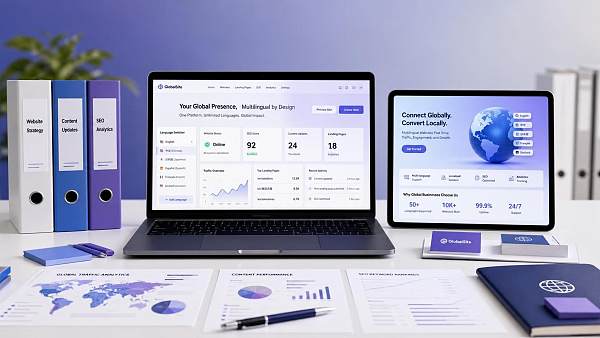
When comparing these solutions, what you should really examine is not the quotation, but the following items
If you are currently selecting a solution, it is recommended that you focus on the following criteria rather than looking first at the total price.
Is language management convenient?
A multilingual website is not finished once the translation is complete. Ongoing updates are the norm. You need to consider whether adding a new language is convenient, whether the section structure can be reused, and whether different language versions can be maintained centrally with ease. If the backend logic is clear, the workload will vary considerably when expanding into markets in Europe, Southeast Asia, the Middle East, and other regions.
Does the website inherently support promotion?
If your company plans to conduct Google SEO, Google advertising, Facebook advertising, or social media traffic acquisition later, the website cannot merely meet the requirement of being presentational. Page structure, title and description settings, URL rules, mobile experience, loading performance, and landing page expansion capabilities should all be considered during development. Otherwise, every campaign you run later may be constrained by the website.
How efficient is content publishing?
Many teams are not afraid of building a website; they are afraid that no one will want to maintain it after it is completed. A complicated backend, cumbersome publishing processes, and difficult product information updates can all quickly turn a website into something that goes live and then stops being updated. For companies that need to continuously develop overseas content, publishing efficiency is almost equivalent to operating cost.
Is it easy to add more functions later?
Some companies initially create only an official website, but after a period of time may need to add inquiry modules, landing pages, an online store, campaign pages, or even integration with advertising and marketing activities. If the underlying system supports expansion, these actions will be much smoother. If the website is built as a closed project from the start, every subsequent step may require starting over.
From a practical perspective, when does it feel worth the investment?
If your goal is only to support a short-term exhibition or temporarily create an English showcase page, any highly integrated multilingual solution may appear relatively expensive because you will not use its long-term capabilities.
However, the assessment is different if you face the following situations:
One situation is that you have a relatively large product line and need to continuously update product information. Another is that you plan to target multiple countries or language markets and do not want to rebuild everything each time you add a language. A third is that website development and marketing need to progress together, with the expectation that the website can directly enter the SEO, advertising, and social media traffic acquisition stages after going live. In these cases, the price cannot be discussed separately from the usage cycle.
Based on the direction provided by Yiyingbao, it does not simply deliver web pages. Instead, it understands intelligent website development, multilingual website construction, cross-border e-commerce stores, SEO optimization, advertising marketing, and overseas social media as part of one continuous process. For companies that have clearly decided to acquire customers overseas, the significance of this approach is that it reduces situations in which the website is completed but cannot connect with marketing activities. It may not be suitable for every budget or every stage, but for those who need to treat their website as a long-term growth gateway, it provides a more complete basis for comparison.
So, is the price of Yiyingbao's multilingual website development solution expensive? Here is how to assess it
If you compare it horizontally only with ordinary website development quotations, the answer may be that it is not necessarily inexpensive. However, if you also include the potential hidden costs of repeated development, redesigns, SEO rework, additional landing pages, and language expansion, the conclusion cannot be based solely on the initial payment.
A more reliable way to assess it is to ask yourself three questions.
First, do you really need long-term multilingual operations rather than a one-time delivery? If long-term operation is required, system capabilities and maintenance efficiency are more important than one-time design.
Second, will your website immediately need to undertake marketing tasks? If it will later receive search, advertising, or social media traffic, investing a little more during website development to build the foundation correctly is usually less troublesome than rebuilding it later.
Third, does your team have a plan to continuously update content? Without an update plan, even the best system cannot demonstrate its value. However, as long as you will continue publishing products, industry content, and market expansion materials, the efficiency and scalability of the backend will be used frequently.
In other words, whether the price of Yiyingbao's multilingual website development solution is expensive does not depend on an absolute figure. It depends on whether you are buying a website or a website foundation that can continuously support overseas marketing activities. The former focuses on delivery, while the latter focuses on long-term use.
If you are selecting a solution, try to avoid these two decision-making methods
One method is to ask only for the lowest price. This makes it easy to overlook the aspects that consume the most time later, such as multilingual maintenance rules, the flexibility of SEO settings, and the content management experience. By the time the website is actually in use, you may discover that the budget initially saved has all been spent on rework and waiting.
The other method is to focus only on feature names. Many solutions list a comprehensive range of features, but whether they are truly useful depends on whether these capabilities can work together. For example, can the website development system support subsequent SEO content expansion? Can advertising landing pages be generated quickly? Can the cross-border store coordinate with the official website? After traffic is directed from social media, can the pages receive it smoothly? A large number of features does not necessarily mean that the actual process is efficient.
A better approach is to list the actions most likely to occur over the next year: Will you add languages? Will you launch new products? Will you conduct SEO? Will you run advertisements? Will you need an online store or a campaign page? Then assess whether the solution can support these actions. If it can, the price is worth discussing. If it cannot, even a low price is only temporarily low.
So, returning to the original question: Is the price of Yiyingbao's multilingual website development solution expensive? If you need a low-barrier launch, it may not be the most budget-friendly option. If you care about avoiding a disconnect between website development and subsequent marketing, and hope that multilingual operations will not become increasingly burdensome, its price should be assessed as part of the total long-term cost rather than by focusing only on the initial quotation.
When making this type of decision, the biggest concern is not spending too much, but choosing the wrong direction. First clarify whether you are trying to solve a presentation problem or a growth problem, and then look at the price. This usually makes the decision much less difficult.
Related Articles
Related Products
 Yiyingbao SaaS Intelligent Website Building and Marketing SystemYiyingbao SaaS Intelligent Website Building and Marketing System, AI-powered no-code website building, rapid creation of multilingual B2B international websites in 10 minutes, global server acceleration, AI-powered SEO optimization, helping businesses connect efficiently with global markets. The perfect integration of technology and operation makes building an international trade website remarkably simple
 AI+SEM Intelligent Advertising Marketing SystemAI+SEM drives intelligent ad creation, empowering full-funnel precision advertising marketing. The system automatically generates weekly/monthly reports, AI recommends keywords and target countries, monitors core metrics in real-time with intelligent alerts, and enables one-click high-conversion ad solutions to help quickly acquire customers and improve ROI.
 AI+SEO Dual-Engine System Optimization ServicesYiyingbao’s AI+SEO dual-engine optimization system helps foreign trade enterprises acquire high-quality organic traffic through AI-powered keyword research, content generation, and comprehensive technical optimization, significantly improving search rankings and conversion rates.
 AI+SNS Social Media Marketing SystemYingbao AI+SNS Social Media Marketing System - Precision social capture for the social media era. Supports one-click content synchronization across major platforms like Facebook and LinkedIn. AI intelligently rewrites posts for enhanced relevance. 24/7 AI customer service and user profiling analysis empower businesses to efficiently expand into global markets.
 AI+SEO营销解决方案易营宝AI+SEO营销解决方案,通过AI批量写作、智能生成TDK、精准关键词扩词等功能,全面优化网站SEO效果,提升流量与转化率。助力企业构建高效智能网站新生态。
 AI+SEM Advertising Marketing SolutionsAI+SEM Advertising Marketing Solution leverages AI technology to deeply empower SEM ad campaigns. It automatically generates weekly/monthly reports using AI, presenting account data across multiple dimensions for comprehensive insights into campaign performance and trends. The system precisely recommends keywords and target countries, intelligently generates high-conversion ad copy, and enables one-click activation of efficient campaign plans to help businesses rapidly acquire customers. Simultaneously, it monitors core metrics in real time, intelligently identifies abnormal fluctuations, and issues timely alerts to ensure stable, high-return advertising results.
 Domain Name ServicesEasyWin provides professional domain name services, including intelligent queries, one-stop registration, brand protection, and full lifecycle management, helping businesses build a digital brand image.
 EasyOperate B2C Cross-Border E-Commerce Platform & Independent WebsiteEasyStore B2C Cross-border E-commerce Independent Store is an intelligent website building and cross-border e-commerce integrated solution independently developed by EasyStore Information Technology (Beijing) Co., Ltd. The system is specially designed for small and medium-sized as well as large export enterprises, integrating 'website building, operation, marketing, advertising, and conversion' into one, helping enterprises quickly establish cross-border e-commerce independent stores to achieve brand globalization and global sales growth.
The platform supports multiple languages, multiple currencies, and multi-channel marketing, with built-in AI intelligent translation and SEO optimization systems, suitable for mainstream markets such as Southeast Asia, Europe and America, Latin America, and the Middle East, assisting Chinese manufacturing enterprises in efficiently deploying international e-commerce strategies. SSL证书易营宝提供专业SSL安全证书服务,包括单域名和泛域名证书,确保网站数据传输加密、身份验证和完整性保护,助力企业建立安全可信的在线业务环境。









