









- Which customer acquisition channels will be affected by cross-border marketing trends in 2026?Sep 06, 2026View details
- Which homogenization risks should be considered in an analysis of the AI-powered website building industry?Aug 30, 2026View details
- How Will AI Marketing Trends 2026 Change Advertising Budget AllocationAug 28, 2026View details
- Is the EV SSL certificate market shrinking or upgrading? How should companies assess certificate procurement?Aug 11, 2026View details
- Why the old AMP SEO 2020 practices no longer work and what has changed in current optimization prioritiesAug 02, 2026View details
- How to Choose Topics for an Industry News Section to Attract More Organic Search TrafficJul 29, 2026View details
Can data from a foreign trade website platform be migrated out?
Before changing service providers, many companies first ask: Can data be migrated from a foreign trade website builder platform? The answer affects not only whether website content can be retained, but also SEO authority, customer assets, and subsequent marketing plans. This article explains the key issues based on practical scenarios.
For foreign trade companies, a website is no longer just a showcase page. It serves as an inquiry gateway, a brand asset, and infrastructure for acquiring customers overseas. If migration is not handled properly, the consequences may range from lost pages and failed forms to declining search rankings and disconnected advertising landing pages, amplifying the loss of time and budget invested at the early stage.
Therefore, answering “Can data be migrated from a foreign trade website builder platform?” requires more than checking whether several images and articles can be exported. It is also necessary to determine whether the domain, page structure, SEO elements, customer leads, language versions, and subsequent marketing systems can be connected smoothly. A truly mature migration solution generally needs to address three dimensions: data integrity, search visibility, and business continuity.
Can Data Be Migrated from a Foreign Trade Website Builder Platform? First Check Which Core Assets Can Be Migrated
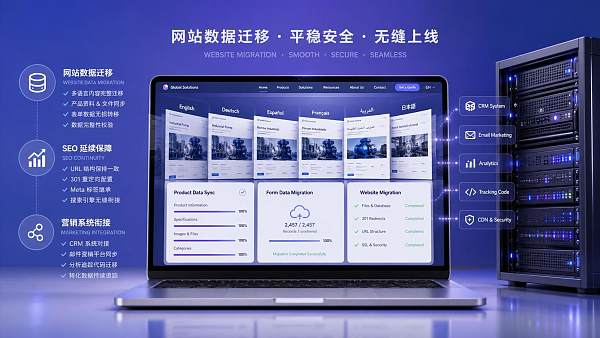
Based on industry practice, most foreign trade website builder platforms can migrate some data, but “migratable” and “fully migratable” are two different things. Commonly migratable content falls into six categories: page content, product data, images and files, form leads, basic SEO settings, and multilingual versions. The level of openness varies by platform, and migration difficulty generally ranges from Level 1 to Level 5.
Which Data Can Usually Be Exported
If the original platform supports backend export, FTP access, or database access, the migration success rate for text content and product information is usually high. Product titles, details, categories, SKUs, image links, blog posts, and contact information, for example, can often be extracted and organized at a basic level within 3 to 7 days.
High-Value Data That Is Easily Overlooked
What truly affects subsequent promotional performance is often not the page text itself, but Meta titles, descriptions, URL rules, 301 redirects, historical form leads, tracking codes, and conversion event settings. Once these elements are lost, Google indexing, advertising campaigns, and remarketing workflows may all experience a fluctuation window of 7 to 30 days.
The table below can help companies quickly determine which data categories deserve the most attention during a foreign trade website migration and the degree to which each affects marketing operations.
As shown, when companies ask whether data can be migrated from a foreign trade website builder platform, they should focus not only on whether content can be copied, but also on whether high-value marketing data can be retained. For websites that have already invested in Google SEO, advertising, or multilingual operations, the migration scope should cover at least three layers: content, technology, and marketing.
Why Do Some Websites Transition Smoothly While Others Lose Traffic Despite Undergoing the Same Migration?
Many companies mistakenly believe that moving the pages to the new platform means the migration is complete. In reality, the main risks arise during the 14 to 60 days after launch. During this period, search engines recrawl the pages, while advertising systems reassess landing-page quality. If URLs change excessively, redirects are missing, or page loading speed declines, traffic fluctuations can easily occur.
There Are 4 Common Risk Areas
- URL rules change and old links do not use 301 redirects, causing previously indexed pages to become invalid.
- The structure of multilingual versions is disrupted, interrupting hreflang or language-directory logic.
- Conversion components such as forms, WhatsApp, and email redirects fail, reducing inquiries.
- Analytics codes, advertising pixels, and GA4 events are not synchronized, creating gaps in subsequent advertising data.
SEO Authority Is Not Simply “Copied” to the New Site
The search performance of a foreign trade website fundamentally depends on page URLs, content relevance, internal linking structure, crawl stability, and user behavior signals. In other words, even if 100% of the page copy is retained, existing rankings may fluctuate again within 2 to 8 weeks if the URL structure changes by more than 30% or key pages are not redirected correctly.
For B2B companies, the most important pages usually number only 20 to 50, including the homepage, product category pages, core product pages, application-scenario pages, and inquiry pages. During migration, the structure of these high-traffic, high-conversion pages should be prioritized for preservation, or at least mapped on a one-to-one basis, rather than undergoing a large-scale redesign all at once.
5 Key Questions Companies Should Evaluate Before Changing Platforms
If you are evaluating whether data can be migrated from a foreign trade website builder platform, the most effective approach is not to ask “Can it be done?” first, but to conduct a migration audit. Companies are advised to assess five dimensions: data export, domain control, SEO retention capabilities, multilingual compatibility, and marketing system integration capabilities.
Migration Assessment Checklist
The table below is suitable for joint use by procurement, marketing, and operations teams. A complete audit usually takes 2 to 5 working days, but it can significantly reduce the probability of subsequent rework.
Among these five questions, many companies focus only on whether the pages look attractive, while overlooking domain control and conversion tracking. If the domain is not registered in the company’s own name or form data cannot be transferred, even a more refined new website may cause instability in the customer acquisition workflow within the next 6 months.
Types of Websites That Should Be Prioritized for Migration
- Websites that have been operating for more than 2 years but have limited backend extensibility and cannot support multilingual SEO.
- Websites already running Google Ads or Facebook advertising but lacking sufficient page-loading performance and data tracking.
- Websites with more than 100 product SKUs whose existing platforms cannot manage content and inquiries in batches.
- Websites planning to enter multiple markets such as North America, Europe, Japan, South Korea, and requiring multilingual site groups and content matrices.
These companies need more than simply “moving a website.” They need an integrated upgrade of their website and marketing services. The new platform must not only accommodate legacy data, but also leave room for subsequent SEO growth, advertising landing-page expansion, social media lead generation, and AI search visibility.
How to Reduce Migration Risks: An Implementation Process Better Suited to Foreign Trade Companies
A mature foreign trade website migration is generally not completed in 1 day. Instead, it proceeds in 3 stages and 5 steps. For a corporate website with no more than 20 pages, the process usually takes 7 to 15 days. If multilingual versions, an online store, advertising tracking, and large volumes of product data are involved, the cycle more commonly takes 2 to 4 weeks.
5-Step Migration Process
Step 1: Asset Inventory
Organize the existing number of pages and products, language versions, downloadable materials, form paths, advertising landing pages, and analytics tools. It is advisable to first list the 20 core URLs and confirm whether they need to be retained on a one-to-one basis.
Step 2: Migration Mapping
Establish mapping relationships from the old website to the new one, including URLs, titles, descriptions, image addresses, and redirect rules. If the old website has already been indexed and ranked, the recommended 301 redirect coverage rate is above 90%.
Step 3: New Website Development and Testing
After importing the content, conduct at least 3 rounds of testing, focusing on mobile responsiveness, form submissions, email notifications, page speed, language switching, the sitemap, and tracking events. For advertising pages, it is advisable to verify CTA buttons and conversion paths page by page.
Step 4: Official Switch
The switch should be performed during a period of low traffic, usually on a weekday night or during the weekend. Complete DNS resolution, SSL certificate, 301 rules, search engine submission, and advertising link checks simultaneously, and keep business interruption within 2 hours whenever possible.
Step 5: Post-Launch Monitoring
The first 14 days after launch are the key observation period. Check 404 pages, indexing changes, core keyword rankings, form submission volumes, and advertising conversion data every day. If an issue is found within 7 days, first investigate redirect rules and tracking codes rather than rushing to make major changes to the page copy.
Why Are More Companies Choosing Integrated Service Providers for Migration and Growth?
When companies ask again whether data can be migrated from a foreign trade website builder platform, they are essentially evaluating whether the new platform can support future growth. Purely technical migration only addresses immediate issues, whereas an integrated website and marketing service solution can incorporate migration, SEO, advertising, social media, and AI search planning into one unified growth workflow.
The Value of Integrated Services Goes Beyond Website Development
Taking a digital platform such as Yiwangbao, which has provided long-term services to foreign trade companies, as an example, its advantage lies not only in supporting AI-powered website development, multilingual websites, and cross-border e-commerce stores, but also in emphasizing the ability to promote, index, and convert after migration. For companies seeking customers overseas, this means the website is no longer an isolated project, but a marketing hub coordinating search, advertising, and social media.
Especially when targeting multiple regional markets such as North America, Europe, Southeast Asia, Japan and South Korea, and the Middle East, companies often face simultaneous requirements for language-version management, content localization, SEO structure design, and advertising landing-page expansion. In this situation, if the new platform considers the operational roadmap for the next 12 months during website development, the value of the migration will be far greater than that of a simple redesign.
3 Capabilities to Consider When Selecting a Service Provider
- Whether it understands not only website migration, but also Google SEO, advertising, and conversion tracking.
- Whether it supports the parallel development of multilingual websites, B2B inquiry websites, B2C online stores, and advertising landing pages.
- Whether it has the capability for continuous optimization rather than service discontinuity after project launch.
If your old website has already accumulated a certain amount of content and customer assets, the most important consideration when changing platforms is not to “start over from scratch,” but to connect existing data, traffic, and brand awareness to a new growth system. This approach is generally more stable than completely rebuilding from the ground up and is also more consistent with the goals of B2B companies to control risk and improve ROI.
Can data be migrated from a foreign trade website builder platform? The answer is yes, but only after clarifying the migration scope, SEO impact, domain control, and the way marketing systems will be connected. For companies upgrading their overseas independent websites, what truly deserves attention is not whether the data can be moved, but whether the website can continue generating leads after the move.
If you are planning to change your website builder platform, restructure a multilingual website, or balance SEO, advertising, and social media growth during migration, we recommend conducting a website audit and migration plan as early as possible. To learn about website development and integrated overseas marketing solutions better suited to foreign trade companies, contact us now for a customized solution and product consultation.
Related Articles

Related Products
 Yiyingbao SaaS Intelligent Website Building and Marketing SystemYiyingbao SaaS Intelligent Website Building and Marketing System, AI-powered no-code website building, rapid creation of multilingual B2B international websites in 10 minutes, global server acceleration, AI-powered SEO optimization, helping businesses connect efficiently with global markets. The perfect integration of technology and operation makes building an international trade website remarkably simple
 AI+SEM Intelligent Advertising Marketing SystemAI+SEM drives intelligent ad creation, empowering full-funnel precision advertising marketing. The system automatically generates weekly/monthly reports, AI recommends keywords and target countries, monitors core metrics in real-time with intelligent alerts, and enables one-click high-conversion ad solutions to help quickly acquire customers and improve ROI.
 AI+SEO Dual-Engine System Optimization ServicesYiyingbao’s AI+SEO dual-engine optimization system helps foreign trade enterprises acquire high-quality organic traffic through AI-powered keyword research, content generation, and comprehensive technical optimization, significantly improving search rankings and conversion rates.
 AI+SNS Social Media Marketing SystemYingbao AI+SNS Social Media Marketing System - Precision social capture for the social media era. Supports one-click content synchronization across major platforms like Facebook and LinkedIn. AI intelligently rewrites posts for enhanced relevance. 24/7 AI customer service and user profiling analysis empower businesses to efficiently expand into global markets.
 AI+SEO营销解决方案易营宝AI+SEO营销解决方案,通过AI批量写作、智能生成TDK、精准关键词扩词等功能,全面优化网站SEO效果,提升流量与转化率。助力企业构建高效智能网站新生态。
 AI+SEM Advertising Marketing SolutionsAI+SEM Advertising Marketing Solution leverages AI technology to deeply empower SEM ad campaigns. It automatically generates weekly/monthly reports using AI, presenting account data across multiple dimensions for comprehensive insights into campaign performance and trends. The system precisely recommends keywords and target countries, intelligently generates high-conversion ad copy, and enables one-click activation of efficient campaign plans to help businesses rapidly acquire customers. Simultaneously, it monitors core metrics in real time, intelligently identifies abnormal fluctuations, and issues timely alerts to ensure stable, high-return advertising results.
 Domain Name ServicesEasyWin provides professional domain name services, including intelligent queries, one-stop registration, brand protection, and full lifecycle management, helping businesses build a digital brand image.
 EasyOperate B2C Cross-Border E-Commerce Platform & Independent WebsiteEasyStore B2C Cross-border E-commerce Independent Store is an intelligent website building and cross-border e-commerce integrated solution independently developed by EasyStore Information Technology (Beijing) Co., Ltd. The system is specially designed for small and medium-sized as well as large export enterprises, integrating 'website building, operation, marketing, advertising, and conversion' into one, helping enterprises quickly establish cross-border e-commerce independent stores to achieve brand globalization and global sales growth.
The platform supports multiple languages, multiple currencies, and multi-channel marketing, with built-in AI intelligent translation and SEO optimization systems, suitable for mainstream markets such as Southeast Asia, Europe and America, Latin America, and the Middle East, assisting Chinese manufacturing enterprises in efficiently deploying international e-commerce strategies. SSL证书易营宝提供专业SSL安全证书服务,包括单域名和泛域名证书,确保网站数据传输加密、身份验证和完整性保护,助力企业建立安全可信的在线业务环境。









