









- Which customer acquisition channels will be affected by cross-border marketing trends in 2026?Sep 06, 2026View details
- Which homogenization risks should be considered in an analysis of the AI-powered website building industry?Aug 30, 2026View details
- How Will AI Marketing Trends 2026 Change Advertising Budget AllocationAug 28, 2026View details
- Is the EV SSL certificate market shrinking or upgrading? How should companies assess certificate procurement?Aug 11, 2026View details
- Why the old AMP SEO 2020 practices no longer work and what has changed in current optimization prioritiesAug 02, 2026View details
- How to Choose Topics for an Industry News Section to Attract More Organic Search TrafficJul 29, 2026View details
How to Localize Social Media Marketing for the European Market
How can social media marketing be localized for the European market? The key is not just translating content, but also taking language habits, cultural preferences, platform ecosystems, and compliance requirements into account to truly improve brand reach, engagement, conversion, and overseas growth.
Why do many companies see no results after posting content on European social media?
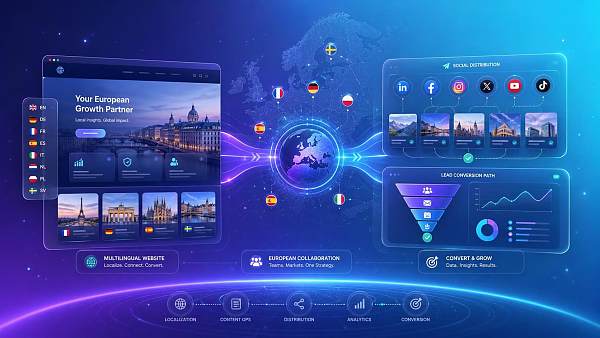
When entering the European market, companies often interpret social media localization as “publishing in multiple languages.” However, what really affects performance is often not whether the content has been translated, but whether it matches local users’ ways of expression, aesthetic preferences, and trust-building logic.
Europe is not a single market. German users value rigorous information and professional credibility, French users pay more attention to brand tone and style of expression, while users in Italy and Spain are generally more likely to engage with content that conveys emotion and a sense of everyday life.
If a company continues to use the same English-language materials across Europe, the common result is relatively high exposure, average engagement, and few inquiries. The problem is usually not the platform itself, but that the content has not entered a context familiar to users or matched local decision-making habits.
For foreign trade companies, brands expanding overseas, and cross-border sellers, the key to localizing social media marketing for the European market is not “how much to post,” but “whether target customers feel that your brand understands this market.”
First, determine what business objective your European social media localization is meant to serve
Before implementation, companies must first clarify whether social media localization is intended to increase brand exposure, drive traffic to an independent website, generate sales conversions, or expand distribution channels. Different objectives will result in significant differences in platform selection, content formats, and operating schedules.
For B2B companies, the focus of European social media is usually not to pursue a large number of likes, but to establish a professional and credible image, guide potential customers to the official website, generate inquiries, or create a follow-up chain with the sales team.
B2C brands and cross-border e-commerce stores are more focused on content engagement, product discovery, promotional conversion, and repeat purchases. They therefore rely more on visual content, short videos, influencer collaborations, and the immediate feedback generated by holiday marketing.
If the objective is not clearly defined, teams can easily fall into a state of “continuously publishing content without being able to measure its value.” Truly effective localization must work backward from business objectives to determine the content strategy, platform mix, and conversion path.
For European social media localization, the focus should not be on targeting all countries at once
Many companies want to cover the entire European market from the beginning. As a result, their budgets become diluted and content management becomes chaotic. A more practical approach is to first focus on 2 to 3 core countries, establish an effective model, and then gradually replicate it.
When selecting priority markets, companies can consider existing order sources, website traffic structure, advertising inquiry data, and product-market fit. This approach is more reliable than choosing markets based on intuition and makes it easier to see returns at different stages.
For example, for industrial manufacturing companies, Germany, the Netherlands, and Poland are often more suitable as priority test markets. For consumer brands, markets such as France, Italy, and Spain may be more suitable for content engagement and brand penetration.
Localization is not about going “broad” from the outset, but about going “deep” first. Once language expression, content cadence, and user feedback have been validated in key countries, expansion will cost less and involve a lower trial-and-error rate.
Platform selection cannot simply copy approaches used in China or North America
When localizing social media marketing for the European market, platform selection is the first major dividing line. LinkedIn, Instagram, Facebook, and YouTube remain mainstream platforms in Europe, but usage habits vary greatly by country and industry.
For B2B service providers, equipment manufacturers, or solution-based companies, LinkedIn is usually the platform most worth prioritizing. It is better suited to sharing professional insights, case studies, and industry capabilities, which helps build trust.
For consumer-oriented brands, Instagram and TikTok are more suitable for visual expression and lightweight engagement. However, whether to invest in TikTok also depends on the user profile of the target country and the suitability of the brand’s content.
Facebook still has a stable user base in some European countries, and remains valuable, especially for local communities, event promotion, and remarketing. YouTube is more suitable for product explainers, brand stories, and search-driven content traffic.
The right approach is not to operate on every platform, but to select platforms based on the audience’s decision-making journey. Companies should focus their content where users obtain information, compare brands, and build trust.
For content localization, context, style, and expressions of trust are the most important factors
Many companies can already produce content in multiple languages, yet their content performance remains average because “a correct translation” does not equal “natural expression.” European users are generally more sensitive to literal translations, templated content, and obvious marketing traces.
Localization should first adjust the tone of expression. Some markets prefer concise, direct, and fact-based statements, while others are more receptive to communication that conveys brand warmth, everyday scenarios, and emotional connection.
Visual content must also be localized. The people, settings, colors, clothing, office environments, and even subtitle styles shown in images can all affect whether users feel that a brand is “genuinely targeting the local market.”
In addition, companies should reduce self-focused product promotion and include more case studies, usage scenarios, customer feedback, behind-the-scenes processes, and knowledge-sharing content, as these are more likely to help European users build trust.
For B2B companies in particular, customers want to see delivery capabilities, service processes, and industry expertise rather than empty brand slogans. The more specific the content, the greater the opportunity to convert it into high-quality business opportunities.
Compliance issues cannot be ignored, especially data and advertising boundaries
The European market has higher requirements for privacy protection and digital marketing compliance, which is also an aspect many companies tend to overlook. Social media localization is not only a content and language issue; it also involves whether operating methods comply with local regulations.
For example, when collecting user data, capturing leads through forms, or running remarketing advertisements, companies need to pay attention to relevant GDPR requirements and ensure basic compliance regarding data authorization, Cookie notices, and privacy policies.
Advertising claims should also avoid exaggerated promises, ambiguous comparisons, and misleading language. This is particularly important in sensitive industries such as healthcare, beauty, finance, and children’s products, where platform reviews and market regulation are generally stricter.
If social media content ultimately directs users to an independent website, the website’s language versions, loading speed, mobile experience, and privacy mechanisms will also directly affect user trust and subsequent conversion results.
How can you determine whether localization is effective? Do not look only at likes and follower numbers
When managing European social media, many teams most easily fall into the mistake of using engagement metrics commonly seen in China to judge success or failure. For companies expanding overseas, however, the real question is whether the content has generated meaningful business results.
More valuable metrics to track include the reach rate among users in target countries, the quality of website visits, bounce rate, form submission rate, volume of direct-message inquiries, cost per lead, and subsequent sales opportunities generated through social media.
For B2B businesses, companies should also pay attention to whether their content reaches people in target roles, such as procurement professionals, marketing managers, distributors, or technical decision-makers, rather than looking only at broad traffic and superficial exposure.
Companies should ideally establish a complete chain covering social media content, click behavior, landing page performance, and sales follow-up. Only in this way can they determine whether the problem lies in the content, platform fit, or the landing page’s ability to handle conversions.
A practical approach to implementing European social media localization
From an implementation perspective, a more feasible approach is usually not to establish a large overseas team all at once, but to first build an operating mechanism based on “small-scale validation and continuous optimization,” gradually developing an effective content model.
The first step is to select priority countries, target audiences, and core platforms. The second is to establish a local-language content framework. The third is to coordinate website, advertising, and social media content so that traffic can be properly handled when it arrives.
For most foreign trade companies and brands expanding overseas, social media localization will be difficult to turn into stable growth if it is separated from independent websites, SEO, advertising, and lead conversion processes. It will also be difficult to explain the value of the investment.
This is why more and more companies are choosing to integrate smart website development, multilingual content, SEO optimization, advertising, and overseas social media operations. Only when these channels work together can growth efficiency be improved.
Platforms such as 易营宝, which provide AI-driven website development and overseas marketing services, can help companies implement multilingual official websites, social media content, search optimization, and advertising-based customer acquisition under a unified growth framework. This is more suitable for companies seeking to build a long-term presence in the European market.
Conclusion: European social media localization is about understanding the market, not merely translating content
Returning to the core question—how can social media marketing be localized for the European market? The answer is to make coordinated adjustments across five areas: target markets, platform ecosystems, content context, compliance requirements, and conversion paths, rather than simply switching languages.
If a company wants to truly establish brand awareness and generate stable inquiries in the European market, localization must serve business objectives, support the development of user trust, and improve final conversion efficiency, rather than merely creating the appearance of “going global.”
When localization is done correctly, social media can evolve from a content distribution channel into a growth entry point for companies entering the European market. For companies seeking to operate in overseas markets over the long term, this step deserves serious investment and systematic planning.
Related Articles



Related Products
 Yiyingbao SaaS Intelligent Website Building and Marketing SystemYiyingbao SaaS Intelligent Website Building and Marketing System, AI-powered no-code website building, rapid creation of multilingual B2B international websites in 10 minutes, global server acceleration, AI-powered SEO optimization, helping businesses connect efficiently with global markets. The perfect integration of technology and operation makes building an international trade website remarkably simple
 AI+SEM Intelligent Advertising Marketing SystemAI+SEM drives intelligent ad creation, empowering full-funnel precision advertising marketing. The system automatically generates weekly/monthly reports, AI recommends keywords and target countries, monitors core metrics in real-time with intelligent alerts, and enables one-click high-conversion ad solutions to help quickly acquire customers and improve ROI.
 AI+SEO Dual-Engine System Optimization ServicesYiyingbao’s AI+SEO dual-engine optimization system helps foreign trade enterprises acquire high-quality organic traffic through AI-powered keyword research, content generation, and comprehensive technical optimization, significantly improving search rankings and conversion rates.
 AI+SNS Social Media Marketing SystemYingbao AI+SNS Social Media Marketing System - Precision social capture for the social media era. Supports one-click content synchronization across major platforms like Facebook and LinkedIn. AI intelligently rewrites posts for enhanced relevance. 24/7 AI customer service and user profiling analysis empower businesses to efficiently expand into global markets.
 AI+SEO营销解决方案易营宝AI+SEO营销解决方案,通过AI批量写作、智能生成TDK、精准关键词扩词等功能,全面优化网站SEO效果,提升流量与转化率。助力企业构建高效智能网站新生态。
 AI+SEM Advertising Marketing SolutionsAI+SEM Advertising Marketing Solution leverages AI technology to deeply empower SEM ad campaigns. It automatically generates weekly/monthly reports using AI, presenting account data across multiple dimensions for comprehensive insights into campaign performance and trends. The system precisely recommends keywords and target countries, intelligently generates high-conversion ad copy, and enables one-click activation of efficient campaign plans to help businesses rapidly acquire customers. Simultaneously, it monitors core metrics in real time, intelligently identifies abnormal fluctuations, and issues timely alerts to ensure stable, high-return advertising results.
 Domain Name ServicesEasyWin provides professional domain name services, including intelligent queries, one-stop registration, brand protection, and full lifecycle management, helping businesses build a digital brand image.
 EasyOperate B2C Cross-Border E-Commerce Platform & Independent WebsiteEasyStore B2C Cross-border E-commerce Independent Store is an intelligent website building and cross-border e-commerce integrated solution independently developed by EasyStore Information Technology (Beijing) Co., Ltd. The system is specially designed for small and medium-sized as well as large export enterprises, integrating 'website building, operation, marketing, advertising, and conversion' into one, helping enterprises quickly establish cross-border e-commerce independent stores to achieve brand globalization and global sales growth.
The platform supports multiple languages, multiple currencies, and multi-channel marketing, with built-in AI intelligent translation and SEO optimization systems, suitable for mainstream markets such as Southeast Asia, Europe and America, Latin America, and the Middle East, assisting Chinese manufacturing enterprises in efficiently deploying international e-commerce strategies. SSL证书易营宝提供专业SSL安全证书服务,包括单域名和泛域名证书,确保网站数据传输加密、身份验证和完整性保护,助力企业建立安全可信的在线业务环境。









