









- Can the average annual growth rate reflect real opportunities in overseas markets?Oct 07, 2026View details
- Which customer acquisition channels will be affected by cross-border marketing trends in 2026?Sep 06, 2026View details
- Which homogenization risks should be considered in an analysis of the AI-powered website building industry?Aug 30, 2026View details
- How Will AI Marketing Trends 2026 Change Advertising Budget AllocationAug 28, 2026View details
- Is the EV SSL certificate market shrinking or upgrading? How should companies assess certificate procurement?Aug 11, 2026View details
- Why the old AMP SEO 2020 practices no longer work and what has changed in current optimization prioritiesAug 02, 2026View details
How do you calculate the cost of acquiring each qualified inquiry through overseas social media?
The cost per valid inquiry generated through overseas social media can be calculated as “acquisition spend attributable to the channel ÷ the number of deduplicated valid inquiries.” When evaluating a proposal, look at both the ad-only cost and the full-cost figure: the former helps assess campaign efficiency, while the latter shows whether the overall investment is worthwhile. Dividing ad spend by the number of form submissions alone can leave out service fees, content production, and website costs, and may count duplicate messages or spam leads as results.
There is no single answer to “How much does it cost to generate leads through overseas social media?” without considering the product, target market, and criteria for a valid inquiry. A more useful approach is to first set the maximum cost the business can bear, then ask suppliers to quote, deliver, and review performance against the same criteria.
Define “valid inquiry” using criteria that can be verified
Of the same 100 messages received, some businesses may be able to move forward with a quotation, while others may have to repeatedly ask who the sender is. If the denominator differs, the resulting costs are not comparable. Before purchasing, sales and marketing teams should agree on criteria for a valid inquiry. At a minimum, these should include:
- Contact details are usable, allowing follow-up business communication;
- The product requirements, target market, or customer type fall within the company’s service scope;
- There is an intention to purchase, request a quote, seek customization, or discuss channel partnerships, rather than to apply for a job, promote a product, or make an unrelated inquiry;
- When the same customer submits multiple inquiries about the same need, duplicates are removed according to agreed rules.
B2B manufacturers can also record specifications, applications, estimated quantities, and purchasing timelines. However, they should not require every field to be complete as the sole criterion for validity. A buyer may initially only ask about supply capabilities. Whether such a lead counts should be specified in the contract, and these inquiries should be tracked separately from those that are ready for a quotation.
Use consistent criteria for social media direct messages, instant messaging, and website forms. If a customer first sends a direct message and later submits a form on the company’s website, this should not count as two new valid inquiries. The acceptance log should retain the source, first-contact time, validity assessment, and reason for exclusion so both parties can verify the records.
Break down the costs to see how much each inquiry really costs
Ad-only cost per valid inquiry = social media ad spend ÷ the number of valid inquiries generated by ads. This metric is useful for comparing the performance of ad creative, audiences, and landing pages, but it does not directly represent the procurement cost of the entire social media program.
Full-investment cost per valid inquiry = all investment attributable to social media acquisition ÷ the number of valid inquiries attributable to the social media channel. The numerator should include ad spend, management or advertising service fees, content and creative production costs, related tool fees, and a reasonable allocation of website and landing page costs. Internal labor for content operations and lead screening should also be recorded using a consistent method.
Integrated-service purchases require particular care with shared costs. If a website serves traffic from social media, Google Ads, and organic search, the entire website development cost should not be assigned to social media, but neither should it be excluded altogether. Costs can be allocated based on page purpose, actual usage period, or a justifiable measure of workload. The method need not be complicated, but it should be agreed on before comparing quotes.
The following is a calculation example. The amounts are for illustration only and are not industry quotes: In a given month, social media ad spend is RMB 20,000, management and creative costs are RMB 10,000, and the allocated costs for the website, tools, and internal labor are RMB 5,000. The campaign receives 100 raw leads; after screening and deduplication, 40 are valid inquiries, all attributable to the social media campaign.
The ad-only cost is 20000÷40=500 RMB per inquiry, while the full-investment cost is 35000÷40=875 RMB per inquiry. Calculated using raw leads, the cost would be 350 RMB per lead. That figure is lower, but it does not reflect the actual investment required to obtain a valid inquiry.
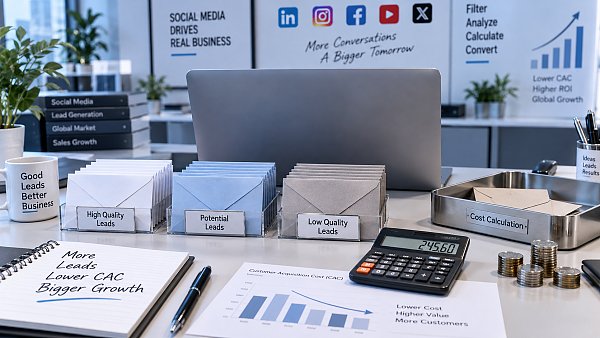
One-time expenses, such as building a new website or an initial photo shoot, should also be distinguished from ongoing operating costs. When evaluating the initial budget, list the actual amount paid. When comparing subsequent performance, allocate these costs over a reasonable period of use to avoid comparing the first month directly with a month of steady-state operations.
Where inquiries come from and when they count can change the results
An overseas buyer may first see social media content, then search for the brand, and later submit an inquiry through the website. Looking only at the last visit may understate social media’s contribution; attributing every inquiry to social media simply because the customer viewed social content may overstate its impact. The parties should agree on attribution rules and report inquiries generated directly by social media separately from those where social media assisted the conversion.
In practice, data can be connected using links with channel parameters, form source records, and a customer management system. Inquiries whose sources cannot be identified should be listed separately and should not be counted as social media results just to meet delivery targets. Duplicate customers across channels should also be consolidated to prevent the total reported across channels from exceeding the actual number of customers.
The time period used must also be aligned. A campaign running this month may generate valid inquiries the following month, and sales teams need time to assess lead quality. Monthly reports can track operational changes. For contract acceptance and cost conclusions, however, the attribution window and screening cutoff should be agreed on, and the same batch of leads should be tracked over time. If there are no valid inquiries, the cost cannot be calculated. Report the spend and zero output; do not record the customer acquisition cost as zero.
Work backward from deal value to determine whether the cost is acceptable
A lower cost per valid inquiry does not necessarily mean a purchase is more worthwhile. If low-cost leads are concentrated in regions the company cannot serve, or their purchasing volume does not meet the company’s requirements, the sales workload may actually increase. Inquiry costs should therefore be considered alongside the rate at which valid inquiries turn into opportunities and orders.
A simplified formula can be used to estimate the affordable cost: Expected gross profit contribution per valid inquiry = valid inquiry-to-customer conversion rate × expected gross profit per customer. The acquisition budget must leave room within this contribution for subsequent sales costs, samples, delivery risks, and target profit.
Suppose the conversion rate for a particular type of valid inquiry is 5%, and the expected gross profit per customer is RMB 20,000. The expected gross profit contribution per inquiry is then RMB 1,000. This is only an assumption for estimation and does not mean that RMB 1,000 is an acceptable purchase price per inquiry. If the company also has high sales and sampling costs, the amount it can afford to spend on acquisition should be lower.
When historical data is unavailable, start with a clearly defined test campaign: limit the product, market, budget, and acceptance period, and record the valid inquiry rate and subsequent progress. When comparing suppliers, ask them to list setup fees, ongoing service fees, and media budgets separately, and specify the valid inquiry criteria, deduplication rules, attribution method, and data delivery format. Only when the cost per inquiry can be calculated against these conditions is there a sound basis for comparing quotes—and for deciding whether to renew or increase the budget.
Related Articles

Related Products
 Yiyingbao SaaS Intelligent Website Building and Marketing SystemYiyingbao SaaS Intelligent Website Building and Marketing System, AI-powered no-code website building, rapid creation of multilingual B2B international websites in 10 minutes, global server acceleration, AI-powered SEO optimization, helping businesses connect efficiently with global markets. The perfect integration of technology and operation makes building an international trade website remarkably simple
 AI+SEM Intelligent Advertising Marketing SystemAI+SEM drives intelligent ad creation, empowering full-funnel precision advertising marketing. The system automatically generates weekly/monthly reports, AI recommends keywords and target countries, monitors core metrics in real-time with intelligent alerts, and enables one-click high-conversion ad solutions to help quickly acquire customers and improve ROI.
 AI+SEO Dual-Engine System Optimization ServicesYiyingbao’s AI+SEO dual-engine optimization system helps foreign trade enterprises acquire high-quality organic traffic through AI-powered keyword research, content generation, and comprehensive technical optimization, significantly improving search rankings and conversion rates.
 AI+SNS Social Media Marketing SystemYingbao AI+SNS Social Media Marketing System - Precision social capture for the social media era. Supports one-click content synchronization across major platforms like Facebook and LinkedIn. AI intelligently rewrites posts for enhanced relevance. 24/7 AI customer service and user profiling analysis empower businesses to efficiently expand into global markets.
 AI+SEO营销解决方案易营宝AI+SEO营销解决方案,通过AI批量写作、智能生成TDK、精准关键词扩词等功能,全面优化网站SEO效果,提升流量与转化率。助力企业构建高效智能网站新生态。
 AI+SEM Advertising Marketing SolutionsAI+SEM Advertising Marketing Solution leverages AI technology to deeply empower SEM ad campaigns. It automatically generates weekly/monthly reports using AI, presenting account data across multiple dimensions for comprehensive insights into campaign performance and trends. The system precisely recommends keywords and target countries, intelligently generates high-conversion ad copy, and enables one-click activation of efficient campaign plans to help businesses rapidly acquire customers. Simultaneously, it monitors core metrics in real time, intelligently identifies abnormal fluctuations, and issues timely alerts to ensure stable, high-return advertising results.
 Domain Name ServicesEasyWin provides professional domain name services, including intelligent queries, one-stop registration, brand protection, and full lifecycle management, helping businesses build a digital brand image.
 EasyOperate B2C Cross-Border E-Commerce Platform & Independent WebsiteEasyStore B2C Cross-border E-commerce Independent Store is an intelligent website building and cross-border e-commerce integrated solution independently developed by EasyStore Information Technology (Beijing) Co., Ltd. The system is specially designed for small and medium-sized as well as large export enterprises, integrating 'website building, operation, marketing, advertising, and conversion' into one, helping enterprises quickly establish cross-border e-commerce independent stores to achieve brand globalization and global sales growth.
The platform supports multiple languages, multiple currencies, and multi-channel marketing, with built-in AI intelligent translation and SEO optimization systems, suitable for mainstream markets such as Southeast Asia, Europe and America, Latin America, and the Middle East, assisting Chinese manufacturing enterprises in efficiently deploying international e-commerce strategies. SSL证书易营宝提供专业SSL安全证书服务,包括单域名和泛域名证书,确保网站数据传输加密、身份验证和完整性保护,助力企业建立安全可信的在线业务环境。









