









- Which customer acquisition channels will be affected by cross-border marketing trends in 2026?Sep 06, 2026View details
- Which homogenization risks should be considered in an analysis of the AI-powered website building industry?Aug 30, 2026View details
- How Will AI Marketing Trends 2026 Change Advertising Budget AllocationAug 28, 2026View details
- Is the EV SSL certificate market shrinking or upgrading? How should companies assess certificate procurement?Aug 11, 2026View details
- Why the old AMP SEO 2020 practices no longer work and what has changed in current optimization prioritiesAug 02, 2026View details
- How to Choose Topics for an Industry News Section to Attract More Organic Search TrafficJul 29, 2026View details
How much does it usually cost to acquire customers through overseas social media?
How much does it cost to acquire customers through overseas social media traffic? There is actually no uniform answer. It is affected by multiple factors, including the industry, advertising platform, content quality, conversion path, and operational capabilities. This article will combine real-world marketing scenarios to help you understand the cost range and cost-reduction strategies.
For foreign trade enterprises, manufacturing factories, cross-border e-commerce sellers, and companies taking their brands global, what they truly care about is not simply “how much to spend,” but whether each lead is valid, whether each click can be captured on an independent website, and whether a stable flow of inquiries can be generated after the monthly budget is invested.
Under the integrated overseas expansion model combining websites and marketing services, overseas social media traffic generation should not be evaluated based only on advertising bills. It is also necessary to assess website quality, landing page conversion rate, content update frequency, data tracking capabilities, and subsequent remarketing efficiency. Only by breaking down the customer acquisition process can cost assessments become meaningful.
What Components Make Up the Cost of Acquiring Customers Through Overseas Social Media Traffic?
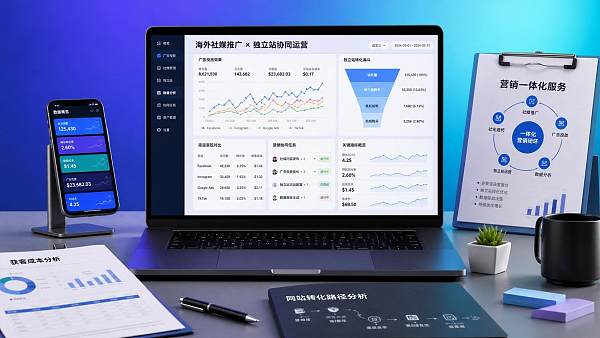
When calculating the cost of acquiring customers through overseas social media traffic, many companies only count advertising spending on Facebook, Instagram, TikTok, or LinkedIn. This often underestimates the actual investment. Total costs usually consist of five modules: content production, advertising, landing page development, data optimization, and operational staffing.
If a company already has a mature independent website, a comprehensive form system, and an automated lead distribution mechanism, the conversion efficiency from the same 1000 clicks may be 30% to 80% higher than that of a company using a page built temporarily. Therefore, social media costs are closely tied to website capabilities rather than being two separate budget items.
5 Common Cost Components
- Advertising spend: charged by clicks, impressions, or conversions, commonly with a monthly budget of 5,000 yuan to more than 100,000 yuan.
- Content production: including images, short videos, copywriting, and A/B versions, with a common monthly investment of 2,000 yuan to 20,000 yuan.
- Independent website and landing pages: if new multilingual pages are required, the initial cost is usually higher than the cost of a single advertising campaign.
- Advertising optimization: including pixel tracking, event setup, audience segmentation, and remarketing configuration.
- Operational staffing: handled by an in-house team or an outsourced service provider, usually charged as a monthly service fee.
Why Do Results Vary So Widely When the Same 10,000 Yuan Is Invested?
The reason usually lies not in whether the platform is expensive, but in whether the conversion path is smooth. For example, if a B2B manufacturing company directs traffic straight to its homepage, the inquiry rate may be only 0.5% to 1.5%. However, if the traffic is directed to an industry-specific landing page supported by case studies, parameter downloads, and a WhatsApp button, the inquiry rate may increase to 2% to 5%.
For cross-border brand websites, if the page takes more than 4 seconds to load after traffic is directed from social media, the bounce rate often rises significantly. Website loading speed, mobile responsiveness, the checkout process, and trust elements all directly affect the final customer acquisition cost.
If you want to understand the cost structure more intuitively, you can first refer to the common budget breakdown table below. It applies to most overseas marketing projects in the startup or growth stage.
As the table shows, the cost of acquiring customers through overseas social media traffic is not merely an advertising expense, but a complete digital marketing investment model. The more transparent the budget, the easier it is to optimize later, making this approach especially suitable for companies seeking long-term customer acquisition in overseas markets.
How Much Does It Cost to Acquire Customers Through Overseas Social Media Traffic in Different Business Scenarios?
Customer acquisition costs vary significantly among different types of companies. B2B inquiry-driven businesses focus more on lead quality and decision-making cycles, while B2C brand websites focus more on purchase conversion and repurchase efficiency. Therefore, the same standards cannot be used to determine whether the cost is “high” or “low.”
Cost Range for B2B Foreign Trade Enterprises
For industries such as machinery and equipment, industrial components, raw materials, and OEM manufacturing, common objectives of social media traffic generation include form submissions, WhatsApp inquiries, catalog downloads, or scheduled consultations. For such projects, the cost per valid inquiry commonly ranges from approximately 200 yuan to 1,500 yuan.
If the target market is Europe or the United States, and the product has a relatively high price and a long decision-making chain, the first 30 days are usually a testing period, during which the average cost per click may be relatively high. Once the audience and creatives stabilize in the second to third months, customer acquisition costs can often decrease by 15% to 35%.
Cost Range for B2C Cross-Border Brands and Independent Websites
For cross-border brands in apparel, beauty, home furnishings, and 3C accessories, social media advertising focuses more on the cost per add-to-cart action, first-order cost, and ROAS performance. During the common cold-start stage, the cost per add-to-cart action may range from 20 yuan to 80 yuan, while the first-order cost may range from 60 yuan to 300 yuan.
If the product pages, payment process, and remarketing system of an independent website are relatively well developed, overall conversion costs may continue to decline within 30 to 90 days. Conversely, even if advertising clicks are inexpensive, budget may still be wasted if the website provides poor support for conversions.
Cost Range for Global Brand Expansion and Content Operations Projects
If a company simultaneously manages account operations, content seeding, short-video distribution, and advertising amplification, the budget structure becomes more complex. The common total monthly investment ranges from 10,000 yuan to 150,000 yuan, with content production and operational management often accounting for 20% to 40%.
The table below can be used to quickly assess the approximate cost of acquiring customers through overseas social media traffic under different global expansion models, as well as the key stages that companies should optimize.
In actual execution, companies should observe “cost per click,” “cost per lead,” and “cost per conversion” separately. Looking only at whether front-end clicks are inexpensive can easily lead to a misjudgment of advertising performance. Decisions are more reliable when the website, lead quality, and downstream conversions are analyzed together.
4 Key Variables Affecting the Cost of Overseas Social Media Traffic Generation
Although companies may all conduct overseas social media marketing, some establish a stable inquiry pool within 3 months, while others continue advertising for 8 weeks without finding valid customers. The core differences usually lie in the following four variables.
Does the Platform Match the Customer Decision-Making Path?
If the target customers are mainly purchasing managers, distributors, or brand owners, LinkedIn and Facebook are often more suitable for B2B outreach. If visual presentation and short-video conversion are the primary focus, Instagram and TikTok are more likely to gain traction. If the wrong platform is selected, even low front-end costs will be difficult to convert.
Content Quality Determines Front-End Click Efficiency
A common recommendation is to iterate the creative materials at least once every 2 to 4 weeks, retaining 3 to 5 image-and-text or video versions from different angles in each round. Without a continuous testing mechanism, the platform will automatically increase exposure costs after the click-through rate declines, causing customer acquisition costs to gradually rise.
Website Capability Directly Affects Conversion Costs
Overseas social media traffic is not the final destination; the independent website is the conversion hub. If the page lacks a multilingual structure, a clear CTA, segmented forms, and an SEO foundation, it will be difficult for social media traffic to be retained continuously, and it will be even more difficult to establish coordination between search and remarketing.
The value of an integrated website and marketing service platform such as 易营宝 lies in handling intelligent website building, advertising, SEO optimization, social media operations, and data tracking within one connected process, reducing the common problem of “effective advertising but insufficient website support.”
Lead Response Speed Affects the Final Customer Acquisition Cost
Many companies overlook the back-end response process. In reality, contacting a lead within 12 hours after form submission and contacting the same lead 48 hours later often produce completely different conversion results. For B2B businesses, sales response time, sample policies, and the completeness of quotation materials all affect the actual customer acquisition cost.
How to Reduce the Cost of Acquiring Customers Through Overseas Social Media Traffic
Cost reduction is not simply about cutting the budget, but about obtaining higher-quality leads with the same budget. For most companies, the most effective approach is not to pursue the lowest cost per click, but to improve the conversion efficiency of the entire process through coordination among website development, content, advertising, and performance reviews.
Build a Website Foundation That Supports Conversion First
It is recommended to complete four basic preparations before launching advertising: multilingual pages, mobile optimization, form tracking, and a basic SEO structure. In this way, social media traffic can not only convert, but also gradually be indexed by search engines, creating combined growth from advertising and organic traffic.
Replace Long-Term Blind Advertising with a 3-Stage Advertising Approach
- Testing phase: 7 to 14 days, validating combinations of audiences, creatives, and landing pages.
- Scaling phase: 15 to 45 days, retaining high-converting ad sets and concentrating the budget.
- Optimization phase: conducting monthly reviews and continuously reducing costs through remarketing and content updates.
Turn One Traffic Visit into Multiple Touchpoints
If social media advertising only focuses on the initial touchpoint, costs are usually relatively high. A more reasonable approach is to remarket to people who have visited the website but have not converted, while using email subscriptions, WhatsApp, automated form follow-ups, and other methods to improve the secondary conversion rate, which can commonly increase by 10% to 25%.
Choose Integrated Services to Reduce Coordination Losses
When the website development company, advertising agency, content team, and SEO service provider operate separately, communication costs are high and data standards can easily become inconsistent. For companies expanding overseas, integrated services make it easier to unify objectives, tracking, and optimization schedules. They are particularly suitable for teams with a monthly budget of more than 10,000 yuan that seek stable, long-term customer acquisition.
Relying on its self-developed cloud-based intelligent website-building system, AI advertising marketing system, and AI+SEO/GEO optimization system, 易营宝 can help companies advance website development, traffic generation, indexing, and conversion simultaneously. It is more suitable for business scenarios requiring multilingual market expansion and sustained overseas growth.
Which Metrics Should Companies Focus on When Evaluating Social Media Customer Acquisition Solutions?
When purchasing or selecting a service provider, it is recommended not to compare quotations alone. Companies should also consider the scope of delivery, data transparency, website conversion support, and continuous optimization mechanisms. An inexpensive standalone service may not necessarily result in a lower actual customer acquisition cost.
6 Items to Check Carefully
- Does it include independent website or landing page optimization, rather than only advertising placement?
- Can it track the complete data path from clicks and inquiries to forms and conversions?
- Does it support multilingual markets, localized content, and advertising strategies for different regions?
- Does it provide at least a monthly review mechanism rather than only backend screenshots?
- Can it coordinate SEO, social media, and advertising instead of operating each channel in isolation?
- Is there a clearly defined testing period, which usually requires at least 4 to 8 weeks of observation?
Common Misunderstandings
The first misunderstanding is equating a low cost per click with a low customer acquisition cost. The second is overlooking the long-term accumulation of the website and content. The third is expecting stable conversions within 7 days. For most overseas markets, cold starts, testing, optimization, and accumulation require at least 1 to 3 complete monthly cycles.
If your company is evaluating the cost of acquiring customers through overseas social media traffic, it is recommended to divide the budget into four parts: platform spending, content production, website conversion support, and ongoing optimization. Then assess whether the investment is worthwhile based on your industry’s average order value and sales cycle. For companies that need coordinated independent website development, Google SEO, overseas social media operations, and advertising, an integrated solution is generally more likely to achieve long-term cost reduction and efficiency improvement. 易营宝 provides one-stop support, from AI-powered intelligent website building to overseas marketing growth, for foreign trade, manufacturing, cross-border e-commerce, and global brand expansion companies. Contact us now to obtain a customized solution and learn about an overseas customer acquisition path better suited to your business stage.
Related Articles



Related Products
 Yiyingbao SaaS Intelligent Website Building and Marketing SystemYiyingbao SaaS Intelligent Website Building and Marketing System, AI-powered no-code website building, rapid creation of multilingual B2B international websites in 10 minutes, global server acceleration, AI-powered SEO optimization, helping businesses connect efficiently with global markets. The perfect integration of technology and operation makes building an international trade website remarkably simple
 AI+SEM Intelligent Advertising Marketing SystemAI+SEM drives intelligent ad creation, empowering full-funnel precision advertising marketing. The system automatically generates weekly/monthly reports, AI recommends keywords and target countries, monitors core metrics in real-time with intelligent alerts, and enables one-click high-conversion ad solutions to help quickly acquire customers and improve ROI.
 AI+SEO Dual-Engine System Optimization ServicesYiyingbao’s AI+SEO dual-engine optimization system helps foreign trade enterprises acquire high-quality organic traffic through AI-powered keyword research, content generation, and comprehensive technical optimization, significantly improving search rankings and conversion rates.
 AI+SNS Social Media Marketing SystemYingbao AI+SNS Social Media Marketing System - Precision social capture for the social media era. Supports one-click content synchronization across major platforms like Facebook and LinkedIn. AI intelligently rewrites posts for enhanced relevance. 24/7 AI customer service and user profiling analysis empower businesses to efficiently expand into global markets.
 AI+SEO营销解决方案易营宝AI+SEO营销解决方案,通过AI批量写作、智能生成TDK、精准关键词扩词等功能,全面优化网站SEO效果,提升流量与转化率。助力企业构建高效智能网站新生态。
 AI+SEM Advertising Marketing SolutionsAI+SEM Advertising Marketing Solution leverages AI technology to deeply empower SEM ad campaigns. It automatically generates weekly/monthly reports using AI, presenting account data across multiple dimensions for comprehensive insights into campaign performance and trends. The system precisely recommends keywords and target countries, intelligently generates high-conversion ad copy, and enables one-click activation of efficient campaign plans to help businesses rapidly acquire customers. Simultaneously, it monitors core metrics in real time, intelligently identifies abnormal fluctuations, and issues timely alerts to ensure stable, high-return advertising results.
 Domain Name ServicesEasyWin provides professional domain name services, including intelligent queries, one-stop registration, brand protection, and full lifecycle management, helping businesses build a digital brand image.
 EasyOperate B2C Cross-Border E-Commerce Platform & Independent WebsiteEasyStore B2C Cross-border E-commerce Independent Store is an intelligent website building and cross-border e-commerce integrated solution independently developed by EasyStore Information Technology (Beijing) Co., Ltd. The system is specially designed for small and medium-sized as well as large export enterprises, integrating 'website building, operation, marketing, advertising, and conversion' into one, helping enterprises quickly establish cross-border e-commerce independent stores to achieve brand globalization and global sales growth.
The platform supports multiple languages, multiple currencies, and multi-channel marketing, with built-in AI intelligent translation and SEO optimization systems, suitable for mainstream markets such as Southeast Asia, Europe and America, Latin America, and the Middle East, assisting Chinese manufacturing enterprises in efficiently deploying international e-commerce strategies. SSL证书易营宝提供专业SSL安全证书服务,包括单域名和泛域名证书,确保网站数据传输加密、身份验证和完整性保护,助力企业建立安全可信的在线业务环境。









