









- Which customer acquisition channels will be affected by cross-border marketing trends in 2026?Sep 06, 2026View details
- Which homogenization risks should be considered in an analysis of the AI-powered website building industry?Aug 30, 2026View details
- How Will AI Marketing Trends 2026 Change Advertising Budget AllocationAug 28, 2026View details
- Is the EV SSL certificate market shrinking or upgrading? How should companies assess certificate procurement?Aug 11, 2026View details
- Why the old AMP SEO 2020 practices no longer work and what has changed in current optimization prioritiesAug 02, 2026View details
- How to Choose Topics for an Industry News Section to Attract More Organic Search TrafficJul 29, 2026View details
How long does it take to see inquiry results from LinkedIn content operations?
How long does it take to see inquiry results from LinkedIn content operations? It depends on the industry, account foundation, and content strategy. For website and marketing service companies, proper positioning, consistent content output, and precise outreach are usually more important than simply pursuing short-term results.
For foreign trade enterprises, manufacturing factories, cross-border brands, and service-oriented companies, LinkedIn is not a channel where “publishing a few posts leads to immediate orders.” Instead, it is a long-term platform that combines brand building, trust accumulation, customer education, and business conversion. Particularly in integrated services such as website development, SEO optimization, advertising, and overseas social media, the customer decision-making cycle often ranges from 2 weeks to 3 months, so inquiry results usually lag behind content publishing.
If a company hopes to obtain more stable overseas inquiries through LinkedIn, the key is not merely the update frequency, but whether account positioning, content topics, prospect outreach, independent website engagement, and sales follow-up can be connected into a complete process. This is especially important for companies providing integrated website and marketing service solutions.
Why LinkedIn inquiries do not appear immediately
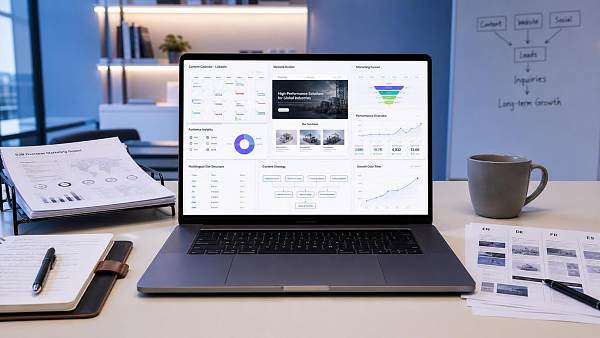
When many companies begin LinkedIn content operations, the most common question is: Why have we published content for 2 weeks without receiving any inquiries? The reason is that LinkedIn’s traffic logic is more focused on “relationship- and trust-based conversion,” which differs from the “active demand capture” of Google search. Users typically need to go through five steps—seeing the content, visiting the profile, clicking on the website, reviewing case studies, and sending a message or submitting a form—before a qualified business opportunity can be generated.
In the website and overseas marketing services industry, customers place particular importance on professional judgment and execution capabilities. A single piece of content is rarely enough for them to quickly determine whether you understand SEO, have website development capabilities, or understand the localization needs of different markets. Therefore, how long it takes to see inquiry results from LinkedIn content operations often depends on how long it takes to build awareness, rather than how the posting data looks on the day of publication.
4 key variables affecting the inquiry cycle
- Account foundation: A new account usually needs 4 to 8 weeks to establish basic trust, while an established account may see increased engagement within 2 to 4 weeks.
- Industry complexity: Services such as B2B website development, SEO, and outsourced advertising operations involve slower decision-making and usually take longer than standardized products.
- Content quality: Generic content is difficult to convert, while content focused on specific scenarios is more likely to generate targeted inquiries.
- Engagement capabilities: Without a multilingual website, case study pages, landing pages, and clear CTAs, inquiries will be lost significantly.
Common performance at different stages
The first stage usually lasts from 1 to 4 weeks, focusing on completing the account, testing content, and identifying the audience. During this stage, companies are more likely to see impressions, connection growth, and profile visits rather than high-quality inquiries. The second stage generally takes place during weeks 5 to 8. As the content direction gradually stabilizes, direct-message interactions and website clicks begin to increase. The third stage often occurs from the second to the fourth month, when a relatively stable source of inquiries may begin to develop.
The table below can help companies more clearly assess which underlying conditions are typically related to how long it takes to see inquiry results from LinkedIn content operations.
In actual execution, LinkedIn itself is only a front-end touchpoint. The combination of “content + account + website + sales” often determines the actual results. Especially in overseas B2B markets, customers will not immediately purchase a service because of one post, but they may gradually develop an intention to cooperate after 6 to 12 effective contacts.
Reasonable cycle expectations for website and marketing service companies
If a company provides AI-powered website development, multilingual website development, Google SEO, advertising, or social media operations services, how long it takes to see inquiry results from LinkedIn content operations can generally be assessed in three stages—“30 days, 60 days, and 90 days”—rather than by looking only at the results of a particular week.
30 days: Establishing a professional image and basic outreach
The most important goal during the first 30 days is not to close deals immediately, but to complete three basic actions: optimize the personal or company profile, clarify the content direction, and help target customers begin to recognize you. During this stage, it is recommended to update content 2 to 4 times per week. Topics may include website structure, SEO indexing, multilingual independent website planning, and advertising landing page optimization.
60 days: Improving engagement quality and off-site conversion
After content has been published consistently for 6 to 8 weeks, companies will typically see more valuable changes in their data, such as increased profile visits, more website clicks, and direct-message inquiries from potential customers. During this stage, the focus should be on strengthening case-based content, question-and-answer content, and industry insight content, while guiding LinkedIn traffic to the official website’s service pages, case study pages, or consultation booking pages.
90 days: Developing the foundation of stable inquiries
When the execution cycle reaches approximately 90 days, if the content direction is accurate, the target audience is well matched, and the website provides complete support, a stable foundation for inquiries may begin to develop. Here, “stable” does not necessarily mean a large number of leads. Rather, it means that effective inquiries that can be reviewed, tracked, and optimized begin to appear each month, which is usually more valuable commercially than an occasional viral post.
Companies with different underlying conditions will have different expected timelines. The table below can be used as a reference for internal evaluation or supplier communication.
This also means that when evaluating LinkedIn performance, companies should not focus only on the number of likes. They should also examine three types of metrics: target customer engagement rate, official website click-through rate, and lead quality. For services with a relatively high customer value, one targeted inquiry is often more important than 100 sources of generic traffic.
How to shorten the conversion time from LinkedIn to inquiries
When answering how long it takes to see inquiry results from LinkedIn content operations, another more valuable question is: How can this cycle be shortened? For website and marketing service companies, the most effective approach is not to blindly increase the volume of posts, but to improve the relevance and engagement efficiency of every contact.
Establish precise positioning before scaling content
If your customers are manufacturing factories, do not fill your content with generic brand marketing opinions. If your customers are cross-border e-commerce sellers, you should discuss independent website conversion, advertising creative efficiency, and multilingual shopping experience more extensively. When the content and audience are misaligned, it is difficult to obtain qualified inquiries even after three months of execution.
Content types recommended for priority development
- Problem-solving content: such as slow website indexing, high bounce rates on advertising landing pages, and low inquiry form conversion rates.
- Case analysis content: showing project processes, changes before and after optimization, and industry-specific applications.
- Decision-support content: comparing the key considerations for building multilingual websites, B2B marketing websites, and B2C shopping malls.
- Trend analysis content: sharing new opportunities for customer acquisition through AI search, GEO optimization, and the coordination of social media and search.
Connect LinkedIn with the official website engagement system
Many companies create good content but still do not see results for a long time. The underlying reason is often the lack of an engagement system. After potential customers click on a profile, if they cannot find clear service pages, case descriptions, industry solutions, contact information, or consultation forms, the effort invested at the front end may be lost at the final step. A website that can be promoted, indexed, and converted is often more important than simply increasing the number of posts.
For companies targeting overseas customer acquisition, it is recommended to configure at least four types of pages: core service pages, industry solution pages, case study pages, and consultation conversion pages. If targeting multiple markets in North America, Europe, the Middle East, or Southeast Asia, multilingual versions should also be developed, while page loading speed, mobile compatibility, and complete form tracking should be ensured.
Coordinate content operations with sales activities
LinkedIn content is not an isolated activity. It is generally recommended that the content, operations, and sales teams coordinate weekly and conduct a review at least every 7 days: Which content brings high-quality visits? Which direct messages deserve further follow-up? Which visitors entered the official website but did not submit an inquiry? This makes it possible to continuously correct the process within 60 days instead of discovering after 90 days that the direction was incorrect.
Common mistakes and more reliable execution recommendations
The reason many companies cannot accurately determine how long it takes to see inquiry results from LinkedIn content operations is not necessarily that the channel itself is ineffective, but that the execution approach is flawed. For integrated website and overseas marketing service providers, the following mistakes are particularly common.
Mistake 1: Treating engagement volume as a signal of closed deals
Likes, views, and comments can reflect communication performance, but they do not equal commercial conversion. What deserves greater attention is whether the target customer profile matches, whether anyone clicks through to the official website, and whether direct messages or emails containing project details appear. These are closer to the early signals of a “qualified inquiry.”
Mistake 2: Focusing only on platform content without coordinating search and the official website
The decision-making path of overseas customers is often to see you on LinkedIn first, then search for the brand name on Google, visit the official website, and review case studies and service pages. If the official website has a weak foundation or insufficient SEO content, customers may be lost during the second round of verification. Therefore, LinkedIn operations are better suited to serve as one part of integrated marketing rather than operating in isolation.
Mistake 3: Using uniform content for all markets
North American customers are more concerned with professionalism and delivery logic, Southeast Asian customers place greater emphasis on response speed and cost-effectiveness, and Middle Eastern customers may pay more attention to localized expression and communication methods. If a company targets multiple regional markets, the content context, case presentation, and landing page copy should all be adjusted appropriately. One template should not be used to cover all audiences.
A more reliable execution framework
- Complete the basic review of the account and official website during the first 2 weeks.
- Maintain 2 to 4 highly relevant content updates per week from weeks 3 to 8.
- Build service pages, case study pages, and conversion forms at the same time.
- Begin combining direct-message outreach with visitor follow-up in the second month.
- Focus on analyzing lead quality in the third month rather than only reviewing content popularity.
For companies expanding into overseas markets, LinkedIn is better integrated with AI-powered website development, multilingual website development, Google SEO, advertising, and social media operations. This not only improves brand visibility, but also shortens the path from awareness to inquiry and increases the actual conversion value of each lead.
If you are evaluating how long it takes to see inquiry results from LinkedIn content operations, do not ask only “How long will it take to see results?” First confirm whether the content is precise, whether the website can effectively engage visitors, and whether sales will follow up. Yiyingbao focuses on AI-driven intelligent website development and integrated overseas marketing services, providing foreign trade enterprises, manufacturing factories, cross-border e-commerce sellers, and brands expanding overseas with complete solutions covering website development, SEO, social media, and advertising coordination. If you want to gain a clearer understanding of the execution cycle, investment priorities, and conversion path more quickly, please contact us now for customized solutions and implementation recommendations.
Related Articles

Related Products
 Yiyingbao SaaS Intelligent Website Building and Marketing SystemYiyingbao SaaS Intelligent Website Building and Marketing System, AI-powered no-code website building, rapid creation of multilingual B2B international websites in 10 minutes, global server acceleration, AI-powered SEO optimization, helping businesses connect efficiently with global markets. The perfect integration of technology and operation makes building an international trade website remarkably simple
 AI+SEM Intelligent Advertising Marketing SystemAI+SEM drives intelligent ad creation, empowering full-funnel precision advertising marketing. The system automatically generates weekly/monthly reports, AI recommends keywords and target countries, monitors core metrics in real-time with intelligent alerts, and enables one-click high-conversion ad solutions to help quickly acquire customers and improve ROI.
 AI+SEO Dual-Engine System Optimization ServicesYiyingbao’s AI+SEO dual-engine optimization system helps foreign trade enterprises acquire high-quality organic traffic through AI-powered keyword research, content generation, and comprehensive technical optimization, significantly improving search rankings and conversion rates.
 AI+SNS Social Media Marketing SystemYingbao AI+SNS Social Media Marketing System - Precision social capture for the social media era. Supports one-click content synchronization across major platforms like Facebook and LinkedIn. AI intelligently rewrites posts for enhanced relevance. 24/7 AI customer service and user profiling analysis empower businesses to efficiently expand into global markets.
 AI+SEO营销解决方案易营宝AI+SEO营销解决方案,通过AI批量写作、智能生成TDK、精准关键词扩词等功能,全面优化网站SEO效果,提升流量与转化率。助力企业构建高效智能网站新生态。
 AI+SEM Advertising Marketing SolutionsAI+SEM Advertising Marketing Solution leverages AI technology to deeply empower SEM ad campaigns. It automatically generates weekly/monthly reports using AI, presenting account data across multiple dimensions for comprehensive insights into campaign performance and trends. The system precisely recommends keywords and target countries, intelligently generates high-conversion ad copy, and enables one-click activation of efficient campaign plans to help businesses rapidly acquire customers. Simultaneously, it monitors core metrics in real time, intelligently identifies abnormal fluctuations, and issues timely alerts to ensure stable, high-return advertising results.
 Domain Name ServicesEasyWin provides professional domain name services, including intelligent queries, one-stop registration, brand protection, and full lifecycle management, helping businesses build a digital brand image.
 EasyOperate B2C Cross-Border E-Commerce Platform & Independent WebsiteEasyStore B2C Cross-border E-commerce Independent Store is an intelligent website building and cross-border e-commerce integrated solution independently developed by EasyStore Information Technology (Beijing) Co., Ltd. The system is specially designed for small and medium-sized as well as large export enterprises, integrating 'website building, operation, marketing, advertising, and conversion' into one, helping enterprises quickly establish cross-border e-commerce independent stores to achieve brand globalization and global sales growth.
The platform supports multiple languages, multiple currencies, and multi-channel marketing, with built-in AI intelligent translation and SEO optimization systems, suitable for mainstream markets such as Southeast Asia, Europe and America, Latin America, and the Middle East, assisting Chinese manufacturing enterprises in efficiently deploying international e-commerce strategies. SSL证书易营宝提供专业SSL安全证书服务,包括单域名和泛域名证书,确保网站数据传输加密、身份验证和完整性保护,助力企业建立安全可信的在线业务环境。









