









- Is the EV SSL certificate market shrinking or upgrading? How should companies assess certificate procurement?Aug 11, 2026View details
- Why the old AMP SEO 2020 practices no longer work and what has changed in current optimization prioritiesAug 02, 2026View details
- How to Choose Topics for an Industry News Section to Attract More Organic Search TrafficJul 29, 2026View details
- Digital Marketing Shenzhen Market Insights: Why Are Companies Expanding Overseas Looking for Growth Teams in Shenzhen?Jul 31, 2026View details
- Can Zhejiang foreign trade independent websites still be developed today? Look at changes in traffic and lead generationJul 28, 2026View details
- What New Signals Are Emerging in Enterprise Services SaaS Marketing ReportsJul 27, 2026View details
What types of Facebook content generate higher conversions?
What Types of Posts on Facebook Drive Higher Conversions?
What types of posts in Facebook content operations drive higher conversions? Many companies initially frame the question as “Which type of content is more likely to go viral?” But people who are truly focused on overseas customer acquisition are usually more concerned with another question: What type of content can turn browsing into clicks, clicks into lead submissions, and leads into subsequent deals? For companies providing services such as website development, SEO, advertising, and social media operations, the conversion path is longer than that of selling a single standardized product, so content cannot be created merely for attention.
In practice, posts that generate higher conversions are often not the posts with the most likes. High engagement and high deal conversion are often two different things. For companies in the “integrated website and marketing services” sector, case-study posts, pain-point posts, solution-focused posts, limited-time action posts, and content that directs users to an on-site landing page are generally more effective than broad brand promotion.
First, Clarify One Thing: Do You Want Engagement or Inquiries?
Many companies appear very active on their Facebook pages. They publish plenty of holiday graphics, company news, industry quotes, and team photos, yet receive few private messages and form submissions. The reason is not complicated: this type of content helps people “get to know you,” but does little to answer “why should I contact you now?”
If the goal is conversion, the logic behind posting needs to change. Instead of first asking, “What should we post today?” start by asking, “What stage is the target customer currently stuck at?” For example, common obstacles for export-oriented manufacturers include outdated websites, high bounce rates on inquiry pages, poor-quality multilingual content, and an inability to effectively handle traffic after launching advertising campaigns. Common problems for cross-border sellers include weak independent-site conversion capabilities, a disconnect between social media content and advertising landing pages, and brand pages that look like template-based websites. Different obstacles correspond to different types of high-conversion posts.
Comparing Different Types of Posts: Which Are More Likely to Drive Conversions?
When common types of content are viewed from the same conversion perspective, they can generally be ranked by effectiveness.
This is why many global marketing service teams use Facebook as both a platform for “pre-conversion education” and a “conversion trigger,” rather than simply publishing information. For service providers such as Yiyingbao, which covers intelligent website development, SEO optimization, Facebook advertising, and overseas social media operations, it is difficult to demonstrate the value of an integrated solution if the content only consists of company introductions. By contrast, connecting “website conversion, content reach, advertising traffic acquisition, and subsequent optimization” into a real business chain makes it easier for customers to understand why they need a complete set of services.
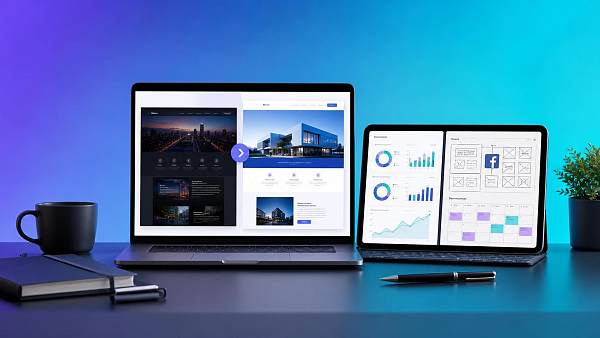
What Really Drives Conversions Is Not the “Content Format,” but These Four Types of Information
1. Case-Study Posts That Show You Understand the Root of the Problem
A case-study post is not simply a statement such as “We helped a client build a website.” Such posts are usually weak. More useful content explains the problem specifically: Which parts of the original website hindered conversions? Which page structures were changed? Why did the form position need to be adjusted? Why should the content architecture be reorganized by product line and region? Why should social media traffic be directed to an independent landing page instead of the homepage?
These posts convert well because they allow potential customers to quickly identify with the situation. In particular, decision-makers at B2B export companies may not follow marketing terminology every day, but when they see statements such as “The website gets traffic but no inquiries,” “Multilingual pages have been undermined by machine-translated content,” or “The page loads slowly after users click an ad,” they immediately recognize the costly problems they are currently experiencing.
2. Pain-Point Posts That Directly Highlight Potential Losses
What types of posts in Facebook content operations drive higher conversions? Pain-point posts are usually near the top of the list. This is because they are not explaining the industry; they are reminding people of potential losses. For example:
“Your advertising budget is being spent, but the landing page looks like a corporate brochure”; “Your website is available in three languages, but the key pages lack localized conversion copy”; “Your social media content gets views, but there is no conversion path on the website”; “You have published many SEO articles, but the keywords are disconnected from purchasing intent.” When this type of content is specific enough, readers will naturally click into the comments, send a private message, or visit the landing page.
However, pain-point posts should not simply create anxiety. If they only discuss problems without providing evaluation criteria, they may end up sounding like scare tactics. A more reliable approach is to provide a simple self-assessment framework, such as: “Can visitors understand what you sell within three seconds of viewing the homepage?” “Is the contact entry point consistently visible?” “Does the page users reach after clicking an ad match the promise made in the post?”
3. Diagnostic or Promotional Posts with a Clear Call to Action
If the first two types of content address “Why should customers choose you?”, this type addresses “Why should they contact you now?” Examples include free homepage diagnostics, independent-site conversion checks, Facebook advertising landing-page recommendations, and overseas marketing funnel assessments. These are often more suitable for service businesses than direct discounts.
This is because service decisions are not impulse purchases. Business customers are more willing to first receive an actionable assessment before deciding whether to pursue deeper cooperation. For a team such as Yiyingbao, which covers website development, SEO, advertising, and social media, breaking down a “full-funnel diagnosis” into understandable entry points often converts better than explaining platform capabilities from the outset. Once users feel that a specific problem has been understood, there is an opportunity to introduce them to the complete solution.
4. Interactive Posts That Encourage Feedback, with Engagement That Provides Qualification Value
Not every interactive post generates business. Asking “Which website color do you like?” is of little significance unless you sell templates. More effective interaction encourages target customers to reveal their current stage, such as: “What is currently your website’s biggest customer-acquisition weakness: low traffic, weak pages, a low lead-submission rate, or inaccurate leads?” Although this type of response may not generate a large volume of replies, the quality is usually higher, and it also makes subsequent private-message follow-up easier.
Why Do Many Posts That “Look Good” Ultimately Convert Poorly?
A common misconception is to treat a Facebook page as a brand brochure. The content layout is neat and the visual style is consistent, but every post talks about the company itself and rarely addresses the choices customers are currently facing. Such a page may not look bad, but it does not move people toward a decision.
Another problem is the disconnect between the content and the landing page. The post says, “Help you improve independent-site inquiry efficiency,” but clicking through leads to a lengthy company introduction page. The user’s attention is interrupted, and conversions naturally decline. Content creators who do not understand on-site conversion may mistakenly think the post itself is ineffective, when the real problem lies in the latter part of the funnel.
This is also why more and more companies no longer view website development, SEO, advertising, and social media as separate activities. What to publish must take into account what users will see after clicking; what to write on a landing page must, in turn, influence content topics. Yiyingbao places intelligent website development, SEO optimization, Facebook advertising, and AI+SEO/GEO optimization within one system. Essentially, it solves the problem of a fragmented funnel: rather than relying on isolated efforts, it ensures that every step connects with the next.
If You Can Prioritize Only Three Types, Consider This Order
If your team has limited manpower, there is no need to try to do everything from the beginning. A more practical order is usually as follows:
First, case-study breakdown posts, which build credibility; second, pain-point diagnosis posts, which identify people with relevant needs; and third, diagnostic posts with an action entry point, which drive conversions. Educational content can be included between these posts, but it should not become the main focus. Company updates are not prohibited, but they should not be treated as the primary customer-acquisition tool.
There is also no need to pursue a high posting frequency. For service businesses, publishing three to four posts per week, with each one directing users to a clear page, is generally more meaningful than publishing a large amount of generic content every day. Especially when targeting different markets such as North America, Europe, and Southeast Asia, the language, pain points, and wording of posts all need to be localized; one set of copy cannot be used unchanged across the entire world.
One Final Standard: What Should a High-Conversion Post Include at Minimum?
A Facebook post that is genuinely capable of generating inquiries usually has at least three characteristics: it addresses a specific problem rather than using vague slogans; it provides an understandable solution rather than piling up concepts; and it offers a clear next step instead of making users guess where to click.
Therefore, the answer to what types of Facebook content operations posts drive higher conversions is not a single fixed template. It is content that accurately connects the customer’s current dilemma with your delivery capabilities. For website and marketing service companies, the posts most worth publishing are not necessarily the most attention-grabbing ones, but those closest to the actual point of conversion.
If your current Facebook content is already receiving views but not generating leads, do not rush to increase posting volume. Review your ten most recent posts: Do they address real pain points? Do they have a corresponding landing page? Do they include a clear call to action? In many cases, the problem is not that you publish too little, but that your content is not close enough to conversion.
Related Articles
Related Products
 Yiyingbao SaaS Intelligent Website Building and Marketing SystemYiyingbao SaaS Intelligent Website Building and Marketing System, AI-powered no-code website building, rapid creation of multilingual B2B international websites in 10 minutes, global server acceleration, AI-powered SEO optimization, helping businesses connect efficiently with global markets. The perfect integration of technology and operation makes building an international trade website remarkably simple
 AI+SEM Intelligent Advertising Marketing SystemAI+SEM drives intelligent ad creation, empowering full-funnel precision advertising marketing. The system automatically generates weekly/monthly reports, AI recommends keywords and target countries, monitors core metrics in real-time with intelligent alerts, and enables one-click high-conversion ad solutions to help quickly acquire customers and improve ROI.
 AI+SEO Dual-Engine System Optimization ServicesYiyingbao’s AI+SEO dual-engine optimization system helps foreign trade enterprises acquire high-quality organic traffic through AI-powered keyword research, content generation, and comprehensive technical optimization, significantly improving search rankings and conversion rates.
 AI+SNS Social Media Marketing SystemYingbao AI+SNS Social Media Marketing System - Precision social capture for the social media era. Supports one-click content synchronization across major platforms like Facebook and LinkedIn. AI intelligently rewrites posts for enhanced relevance. 24/7 AI customer service and user profiling analysis empower businesses to efficiently expand into global markets.
 AI+SEO营销解决方案易营宝AI+SEO营销解决方案,通过AI批量写作、智能生成TDK、精准关键词扩词等功能,全面优化网站SEO效果,提升流量与转化率。助力企业构建高效智能网站新生态。
 AI+SEM Advertising Marketing SolutionsAI+SEM Advertising Marketing Solution leverages AI technology to deeply empower SEM ad campaigns. It automatically generates weekly/monthly reports using AI, presenting account data across multiple dimensions for comprehensive insights into campaign performance and trends. The system precisely recommends keywords and target countries, intelligently generates high-conversion ad copy, and enables one-click activation of efficient campaign plans to help businesses rapidly acquire customers. Simultaneously, it monitors core metrics in real time, intelligently identifies abnormal fluctuations, and issues timely alerts to ensure stable, high-return advertising results.
 Domain Name ServicesEasyWin provides professional domain name services, including intelligent queries, one-stop registration, brand protection, and full lifecycle management, helping businesses build a digital brand image.
 EasyOperate B2C Cross-Border E-Commerce Platform & Independent WebsiteEasyStore B2C Cross-border E-commerce Independent Store is an intelligent website building and cross-border e-commerce integrated solution independently developed by EasyStore Information Technology (Beijing) Co., Ltd. The system is specially designed for small and medium-sized as well as large export enterprises, integrating 'website building, operation, marketing, advertising, and conversion' into one, helping enterprises quickly establish cross-border e-commerce independent stores to achieve brand globalization and global sales growth.
The platform supports multiple languages, multiple currencies, and multi-channel marketing, with built-in AI intelligent translation and SEO optimization systems, suitable for mainstream markets such as Southeast Asia, Europe and America, Latin America, and the Middle East, assisting Chinese manufacturing enterprises in efficiently deploying international e-commerce strategies. SSL证书易营宝提供专业SSL安全证书服务,包括单域名和泛域名证书,确保网站数据传输加密、身份验证和完整性保护,助力企业建立安全可信的在线业务环境。









