









- Hengqin Cooperation Zone Shares Cross-Border E-Commerce Developments, Focusing on Macao-Hengqin Collaboration and International MarketsOct 24, 2026View details
- A Shenyang study highlights the development of the “cross-border e-commerce + industrial cluster” modelOct 24, 2026View details
- Three China Advertising Association GEO group standards take effect on October 23Oct 24, 2026View details
- Amazon Raises Fulfillment Fees Twice, Yet the Median Platform Fee Remains Around 40%Oct 22, 2026View details
- AliExpress and YouTube Partner to Expand Marketing Opportunities for Chinese Brands Going GlobalOct 22, 2026View details
- Publicis says AI marketing is developing at two speeds, with agentic AI helping win clientsOct 21, 2026View details
How can I check whether AI-generated French copy sounds unnatural?
How can you check whether AI-generated French copy sounds like a translation?
French copy with no spelling mistakes does not necessarily read well to French buyers. AI may transfer Chinese selling points sentence by sentence: the meaning is understandable, but the tone sounds like a company profile, and readers may still not know how to request a quote after viewing the product page. How can you check whether AI-generated French copy sounds like a translation? Review word combinations, sentence structure, and local expressions, while keeping the page’s purpose in mind. Ad headlines, technical documents, and inquiry buttons need to be assessed by different standards.
Here, “translationese” does not mean that the copy is not conversational enough; it means the wording is overly influenced by the source language. A B2B website can be rigorous and formal. The issue is whether target readers have to work their way through the text to understand what you sell, the operating conditions it suits, and what they can expect to happen next.
Define the market and page purpose before judging whether the language sounds natural
Before reviewing the copy, note three things for each page: which French-speaking market it targets, who the readers are, and what action you want them to take. France, French-speaking Canada, and other French-speaking markets may differ in terminology, business practices, and language preferences. You cannot assume that one set of copy will work everywhere just because it is in French.
For the same piece of industrial equipment, a product page needs to explain its capabilities and limitations, an ad landing page needs to address the needs that prompted the click, and technical documents need to use precise terminology. Rewriting every page as light, short sentences may actually undermine its professionalism. When checking for translationese, first make sure the copy is appropriate for its context.
The words may be familiar, but the combinations may still be wrong
Look closely for literal verb–object combinations, abstract nouns, and vague adjectives. For example, Chinese phrases such as “achieve efficient production,” “provide high-quality service,” and “create a one-stop solution” may still fail to explain the practical value when translated correctly into French. A more useful approach is to specify which processes are supported, what each service includes, and what information customers need to provide, rather than continuing to swap in synonyms.
Industry terminology should be checked separately. For equipment, materials, processing methods, and component names, do not rely on a bilingual dictionary alone. Compare terminology used by industry associations in the target market, technical documents, and several local company websites to confirm that the terms refer to the same products and operating conditions. Competitor webpages can serve as language references, but do not copy their performance claims along the way.
Problems with sentences are often hidden in the order of information
If a passage starts with the company’s philosophy, moves on to its overall strengths, and only mentions the product’s application at the end, readers have to spend time looking for the answer. Try reorganizing it as “application—conditions of use—evidence—next step.” Long sentences are not necessarily a problem, but when multiple clauses, passive constructions, and nominalizations pile up, check whether the subject and main action are clear.
One simple test is to temporarily hide the Chinese source and ask a reviewer to read only the French and summarize the product’s application and the conditions for requesting a quote. If they need to refer back to the Chinese to explain it, the French version may still depend on the source text. Back-translation can help identify omissions, but it cannot prove that the wording is natural; an awkward sentence can also be translated back into Chinese without difficulty.
Turn “this sounds awkward” into actionable revision notes
Do not simply tell an editor, “Please make this sound more local.” A more effective review process is to verify facts and terminology first, then assess wording and tone, and finally review the copy in the context of the page, including its headings, buttons, and forms. For every change, record the original sentence, the type of issue, the reason for the revision, and whether it changes the business meaning.

Issues can be handled in three categories: changes to product meaning, delivery times, or warranty limits must be resolved before publication; awkward wording or unclear information order calls for localization; and differences in preference between two equally valid expressions do not require repeated revisions. This prevents the review from turning into a debate over whose wording sounds better.
AI is useful for an initial screening, but it should not be solely responsible for approval. Ask it to flag sentences that may be literal translations from Chinese, unnatural word combinations, unclear references, or excessive claims, and to explain why. Also instruct it not to add specifications, certifications, delivery times, or service scope. Have key pages reviewed by a French-language reviewer who understands the target market and industry, rather than simply finding someone who speaks French.
Once the copy is approved, check that the website and ads work together
Translationese can also appear in page details. A button says “Learn more” but opens a quote request form; an ad highlights customization, but the landing page contains only company history. These are not all language errors, but they can still confuse readers. Check that ads, page headings, product descriptions, and form prompts use consistent terminology, and that calls to action clearly explain what happens next.
Search keywords should not be translated word for word from Chinese either. Use search results, keyword tools, and existing search data for the target region to confirm the product names buyers actually use, then incorporate them naturally into headings and body copy. Natural language does not automatically guarantee rankings, and changes in traffic alone cannot prove that a revision was successful.
Yingyibao Information Technology (Beijing) Co., Ltd. was established in 2013, with business covering AI-powered website building, multilingual websites, SEO, and overseas advertising and marketing. For this type of integrated website and marketing service, it is worth agreeing in advance on deliverables such as a terminology glossary, the scope of key-page reviews, revision records, and checks for consistency between ads and landing pages after launch—not just the number of pieces of copy generated.
If your budget is limited, prioritize the homepage’s core selling points, key product pages, ad landing pages, and inquiry forms. During acceptance, ask one specific question: can target customers accurately understand the product, its conditions, and the next step without seeing the Chinese source? Once the answer is clear, you can discuss whether the wording could be more polished.
Related Articles
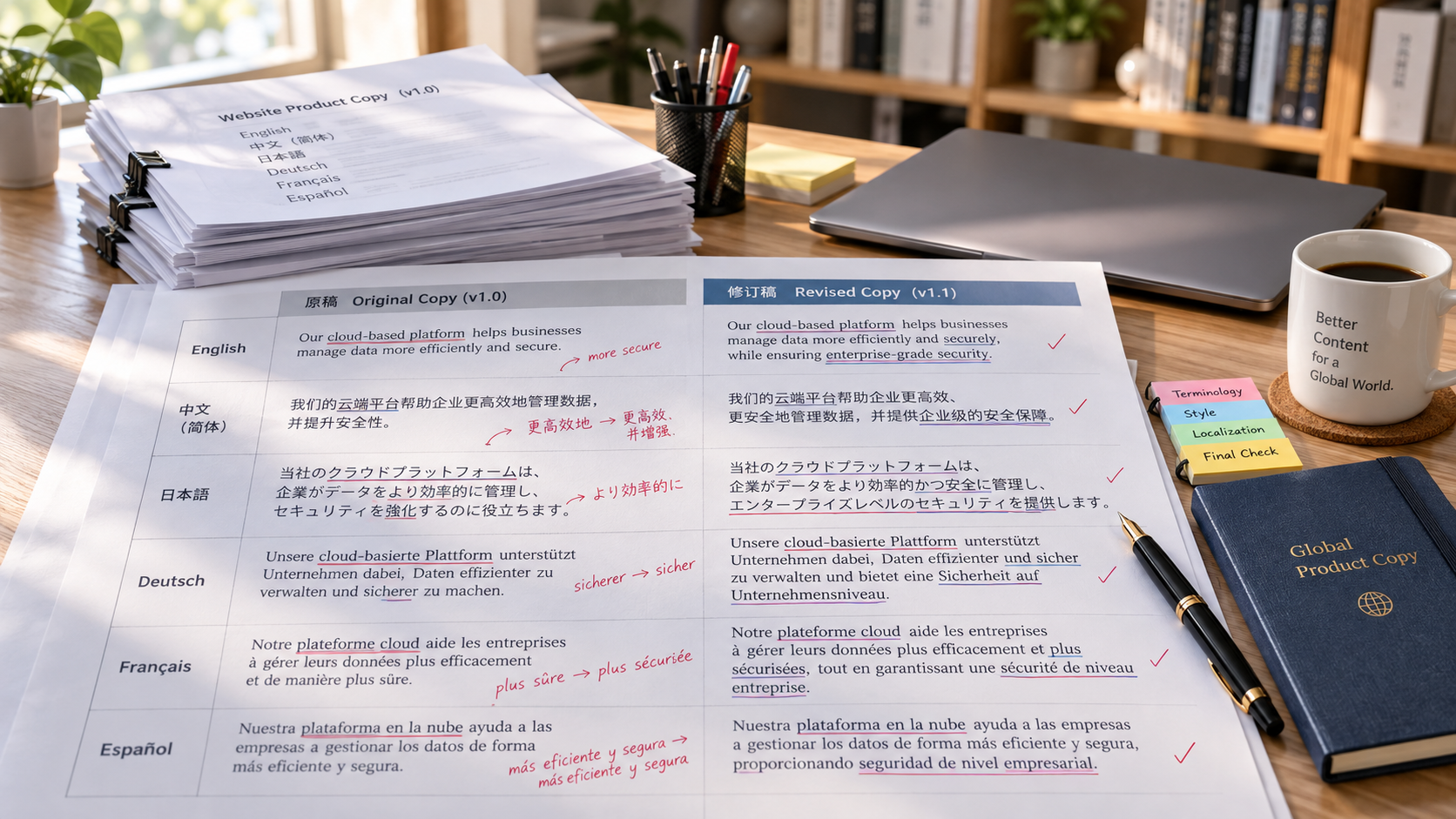
 How can you evaluate a provider’s translation editing capabilities for AI-powered multilingual website services?
 Building a Website for the Russian-Speaking Market: Is Translating the Website Enough?
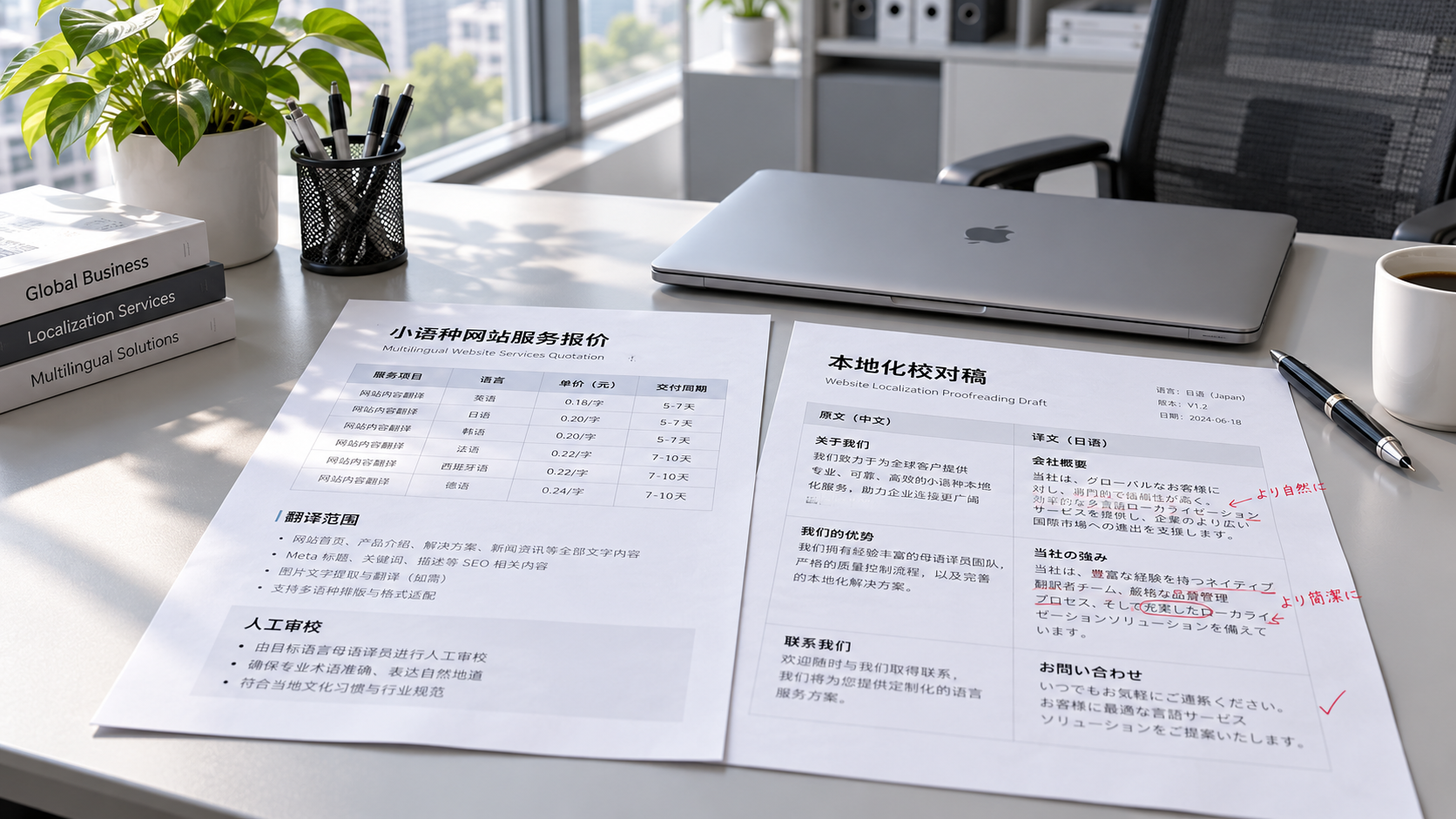
 Does the quote for building a website in a less commonly used language include localization and translation?

Related Products
 Yiyingbao SaaS Intelligent Website Building and Marketing SystemYiyingbao SaaS Intelligent Website Building and Marketing System, AI-powered no-code website building, rapid creation of multilingual B2B international websites in 10 minutes, global server acceleration, AI-powered SEO optimization, helping businesses connect efficiently with global markets. The perfect integration of technology and operation makes building an international trade website remarkably simple
 AI+SEM Intelligent Advertising Marketing SystemAI+SEM drives intelligent ad creation, empowering full-funnel precision advertising marketing. The system automatically generates weekly/monthly reports, AI recommends keywords and target countries, monitors core metrics in real-time with intelligent alerts, and enables one-click high-conversion ad solutions to help quickly acquire customers and improve ROI.
 AI+SEO Dual-Engine System Optimization ServicesYiyingbao’s AI+SEO dual-engine optimization system helps foreign trade enterprises acquire high-quality organic traffic through AI-powered keyword research, content generation, and comprehensive technical optimization, significantly improving search rankings and conversion rates.
 AI+SNS Social Media Marketing SystemYingbao AI+SNS Social Media Marketing System - Precision social capture for the social media era. Supports one-click content synchronization across major platforms like Facebook and LinkedIn. AI intelligently rewrites posts for enhanced relevance. 24/7 AI customer service and user profiling analysis empower businesses to efficiently expand into global markets.
 AI+SEO营销解决方案易营宝AI+SEO营销解决方案,通过AI批量写作、智能生成TDK、精准关键词扩词等功能,全面优化网站SEO效果,提升流量与转化率。助力企业构建高效智能网站新生态。
 AI+SEM Advertising Marketing SolutionsAI+SEM Advertising Marketing Solution leverages AI technology to deeply empower SEM ad campaigns. It automatically generates weekly/monthly reports using AI, presenting account data across multiple dimensions for comprehensive insights into campaign performance and trends. The system precisely recommends keywords and target countries, intelligently generates high-conversion ad copy, and enables one-click activation of efficient campaign plans to help businesses rapidly acquire customers. Simultaneously, it monitors core metrics in real time, intelligently identifies abnormal fluctuations, and issues timely alerts to ensure stable, high-return advertising results.
 Domain Name ServicesEasyWin provides professional domain name services, including intelligent queries, one-stop registration, brand protection, and full lifecycle management, helping businesses build a digital brand image.
 EasyOperate B2C Cross-Border E-Commerce Platform & Independent WebsiteEasyStore B2C Cross-border E-commerce Independent Store is an intelligent website building and cross-border e-commerce integrated solution independently developed by EasyStore Information Technology (Beijing) Co., Ltd. The system is specially designed for small and medium-sized as well as large export enterprises, integrating 'website building, operation, marketing, advertising, and conversion' into one, helping enterprises quickly establish cross-border e-commerce independent stores to achieve brand globalization and global sales growth.
The platform supports multiple languages, multiple currencies, and multi-channel marketing, with built-in AI intelligent translation and SEO optimization systems, suitable for mainstream markets such as Southeast Asia, Europe and America, Latin America, and the Middle East, assisting Chinese manufacturing enterprises in efficiently deploying international e-commerce strategies. SSL证书易营宝提供专业SSL安全证书服务,包括单域名和泛域名证书,确保网站数据传输加密、身份验证和完整性保护,助力企业建立安全可信的在线业务环境。









