









- Hengqin Cooperation Zone Shares Cross-Border E-Commerce Developments, Focusing on Macao-Hengqin Collaboration and International MarketsOct 24, 2026View details
- A Shenyang study highlights the development of the “cross-border e-commerce + industrial cluster” modelOct 24, 2026View details
- Three China Advertising Association GEO group standards take effect on October 23Oct 24, 2026View details
- Amazon Raises Fulfillment Fees Twice, Yet the Median Platform Fee Remains Around 40%Oct 22, 2026View details
- AliExpress and YouTube Partner to Expand Marketing Opportunities for Chinese Brands Going GlobalOct 22, 2026View details
- Publicis says AI marketing is developing at two speeds, with agentic AI helping win clientsOct 21, 2026View details
Do AI-generated German ad copy need to be reviewed by a native speaker before launch?
Does AI-generated German ad copy need to be reviewed by a native speaker before launch? If you are preparing to run a campaign in the German market, it is advisable to have it reviewed by a German native speaker familiar with local advertising conventions, especially for a first launch, key landing pages, and content involving prices or performance claims. For templates that have already been reviewed, if you are only replacing confirmed specifications or model numbers, you can check the changes without reviewing the entire text again each time.
This native-speaker review is a quality-control recommendation. It does not mean that using AI-generated copy automatically triggers any statutory review requirement. The purpose is to check whether the wording sounds natural, the claims are accurate, and the ads are consistent with the website. A native speaker can assess language and context, while product facts and compliance issues still need to be checked by the relevant people responsible.
First, identify which copy needs the most careful review
The level of review should match the potential consequences of an error. Brand ads, paid-ad headlines, promotional messages, purchase buttons, and inquiry landing pages directly affect how users understand and act, so they should be reviewed first. Content involving health benefits, financial returns, environmental claims, certifications, or guarantees should also be reviewed by people familiar with the relevant business and compliance requirements.
Even small-budget tests still need basic checks. Testing can show which wording performs better, but it cannot replace checks for misleading claims, pricing errors, or ambiguity. Putting incorrect copy live and then checking the click-through rate does not prove that the copy is suitable for use.
For simple variable substitutions in templates that have already been reviewed, the level of review can be reduced, provided the sentence structure, offer terms, and scope of the claims have not changed. German word forms, articles, and sentence structures may change depending on the substituted content. Adding a product category or rewriting a selling point often goes beyond “changing variables only.”
What a native-speaker review should cover—not just grammar
AI-generated German ad copy may be grammatically correct and still read like a literal translation from Chinese or English. For example, abstract phrases such as “empowering global growth with an all-in-one solution” may not help users understand what a product actually does, even if the translation is accurate. During review, ask for selling points to be expressed as specific information: what tasks the product can perform, under what conditions it is suitable, and how to get in touch or make a purchase.
Forms of address should also be consistent. In German, “du” and “Sie” convey different tones and brand relationships, so the choice should reflect the brand positioning, channel, and page style. Using one form of address in an ad and switching to another on the landing page, in the form, or in automated replies creates an inconsistent communication experience.
Button text should be assessed in light of what happens when users click it. “Jetzt kaufen” means “Buy now,” while “Angebot anfordern” means “Request a quote.” If clicking the button only opens a quote request form, using a purchase button will create the wrong expectation. A native-speaker reviewer should be able to explain why a change is needed, rather than simply provide a version that sounds “more natural.”
Prices, dates, units of measurement, and number formats should also be checked, but the review should go beyond punctuation. Whether shipping is charged separately, when the delivery period starts, and which products an offer applies to are the conditions most likely to affect decisions.
Review the ad, landing page, and form together
Sending the reviewer only a single block of ad copy is usually not enough. If an ad says “free” but the landing page lists fees, or the headline promises fast delivery while the product page states a different delivery time, these issues cannot be resolved by polishing an individual sentence.
For example, “kostenlos” means “free,” while “unverbindlich” emphasizes that there is no obligation or commitment; the two are not equivalent. Requesting a quote does not mean the quote service is necessarily free. Use the relevant wording only when the actual business terms support it. AI may add these words based on common advertising collocations, so they need to be checked against the actual process.
Review materials should include at least the ad headline and description, text in images, the corresponding landing page, buttons, and form prompts. For limited-time offers, eligibility, or after-sales commitments, provide the specific terms as well so the reviewer can identify anything that may have been omitted.
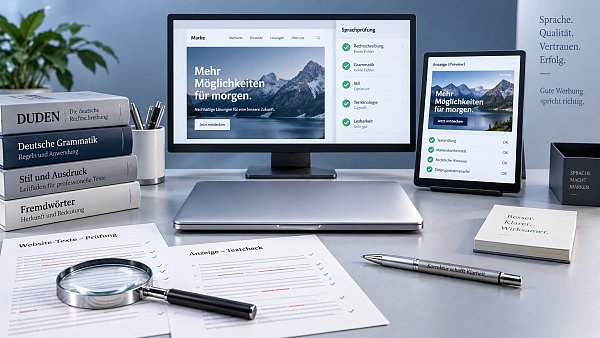
Follow this process to complete the pre-launch review
- First, compile a fact sheet. List the product’s use, specifications, pricing terms, scope of delivery, and claims that must not be used. Have AI generate copy based on this information to reduce the chance of it making up selling points.
- Conduct an internal check before sending it for native-speaker review. Have the product or business owner verify the facts first, so the reviewer does not spend time polishing inaccurate information. The native-speaker review should focus on naturalness, ambiguity, tone, and calls to action.
- Ask the reviewer to distinguish required changes from style suggestions. Incorrect claims, missing conditions, and buttons that do not match the action are must-fix issues. Synonym choices and sentence rhythm can be presented as multiple options for testing.
- Review the final page preview. Check whether text is truncated on mobile, whether buttons are easy to understand, and whether the combination of the ad headline and description creates a new meaning. Confirm that the changes have been applied to the version actually being used in the campaign.
When selecting a reviewer, consider not only whether they are a native German speaker, but also whether they understand the target market, advertising channel, and product category. Someone who speaks German fluently in everyday situations may not be familiar with technical terminology or advertising claims. Copy for the German market should not automatically be assumed to work for all German-speaking regions.
When using a platform such as 易营宝 that covers multilingual website building, ad delivery, and overseas marketing, you can include the review in the launch workflow that connects ads and the website. When selecting a service, clarify who is responsible for German-language review, who verifies product facts, and how changes are synchronized across ads and landing pages. A platform’s AI-generation capabilities do not mean these review steps are already included.
How to reduce repeat reviews after launch
Compile approved terminology, forms of address, button text, and claim boundaries into copy guidelines, and keep a record of the final version. Asking AI to refer to these guidelines in future is more likely to maintain consistency than generating new copy freely each time. Reviewing the copy with another model or translating it back into Chinese can help identify issues, but may still miss problems with tone, context, or claims.
After launch, compare how different versions perform in terms of qualified inquiries or purchases, while also noting whether users repeatedly ask about the same conditions. A high click-through rate only shows that the copy attracts clicks. If users discover that they misunderstood something after reaching the page, check whether the ad claims are consistent with the page information.
For a first launch, select the main ads and their corresponding landing pages, then complete a fact check and native-speaker review. For subsequent changes, arrange a new review based on what has changed: new selling points, offers, or claims should be checked again; if approved wording is reused and the conditions have not changed, focus on checking the variables and how the copy is displayed.
Related Articles
 How can you evaluate a provider’s translation editing capabilities for AI-powered multilingual website services?
 Building a Website for the Russian-Speaking Market: Is Translating the Website Enough?
 Does the quote for building a website in a less commonly used language include localization and translation?

Related Products
 Yiyingbao SaaS Intelligent Website Building and Marketing SystemYiyingbao SaaS Intelligent Website Building and Marketing System, AI-powered no-code website building, rapid creation of multilingual B2B international websites in 10 minutes, global server acceleration, AI-powered SEO optimization, helping businesses connect efficiently with global markets. The perfect integration of technology and operation makes building an international trade website remarkably simple
 AI+SEM Intelligent Advertising Marketing SystemAI+SEM drives intelligent ad creation, empowering full-funnel precision advertising marketing. The system automatically generates weekly/monthly reports, AI recommends keywords and target countries, monitors core metrics in real-time with intelligent alerts, and enables one-click high-conversion ad solutions to help quickly acquire customers and improve ROI.
 AI+SEO Dual-Engine System Optimization ServicesYiyingbao’s AI+SEO dual-engine optimization system helps foreign trade enterprises acquire high-quality organic traffic through AI-powered keyword research, content generation, and comprehensive technical optimization, significantly improving search rankings and conversion rates.
 AI+SNS Social Media Marketing SystemYingbao AI+SNS Social Media Marketing System - Precision social capture for the social media era. Supports one-click content synchronization across major platforms like Facebook and LinkedIn. AI intelligently rewrites posts for enhanced relevance. 24/7 AI customer service and user profiling analysis empower businesses to efficiently expand into global markets.
 AI+SEO营销解决方案易营宝AI+SEO营销解决方案,通过AI批量写作、智能生成TDK、精准关键词扩词等功能,全面优化网站SEO效果,提升流量与转化率。助力企业构建高效智能网站新生态。
 AI+SEM Advertising Marketing SolutionsAI+SEM Advertising Marketing Solution leverages AI technology to deeply empower SEM ad campaigns. It automatically generates weekly/monthly reports using AI, presenting account data across multiple dimensions for comprehensive insights into campaign performance and trends. The system precisely recommends keywords and target countries, intelligently generates high-conversion ad copy, and enables one-click activation of efficient campaign plans to help businesses rapidly acquire customers. Simultaneously, it monitors core metrics in real time, intelligently identifies abnormal fluctuations, and issues timely alerts to ensure stable, high-return advertising results.
 Domain Name ServicesEasyWin provides professional domain name services, including intelligent queries, one-stop registration, brand protection, and full lifecycle management, helping businesses build a digital brand image.
 EasyOperate B2C Cross-Border E-Commerce Platform & Independent WebsiteEasyStore B2C Cross-border E-commerce Independent Store is an intelligent website building and cross-border e-commerce integrated solution independently developed by EasyStore Information Technology (Beijing) Co., Ltd. The system is specially designed for small and medium-sized as well as large export enterprises, integrating 'website building, operation, marketing, advertising, and conversion' into one, helping enterprises quickly establish cross-border e-commerce independent stores to achieve brand globalization and global sales growth.
The platform supports multiple languages, multiple currencies, and multi-channel marketing, with built-in AI intelligent translation and SEO optimization systems, suitable for mainstream markets such as Southeast Asia, Europe and America, Latin America, and the Middle East, assisting Chinese manufacturing enterprises in efficiently deploying international e-commerce strategies. SSL证书易营宝提供专业SSL安全证书服务,包括单域名和泛域名证书,确保网站数据传输加密、身份验证和完整性保护,助力企业建立安全可信的在线业务环境。









