









- Can the average annual growth rate reflect real opportunities in overseas markets?Oct 07, 2026View details
- Which customer acquisition channels will be affected by cross-border marketing trends in 2026?Sep 06, 2026View details
- Which homogenization risks should be considered in an analysis of the AI-powered website building industry?Aug 30, 2026View details
- How Will AI Marketing Trends 2026 Change Advertising Budget AllocationAug 28, 2026View details
- Is the EV SSL certificate market shrinking or upgrading? How should companies assess certificate procurement?Aug 11, 2026View details
- Why the old AMP SEO 2020 practices no longer work and what has changed in current optimization prioritiesAug 02, 2026View details
What Market Trade-Offs Should Be Made First When Building a Multilingual Website
When discussing website development with multiple language versions, many companies tend to immediately focus on the superficial question of whether they should add more languages. On the surface, this appears to be a website development issue, but in essence it is more like an allocation of market resources: Where are your target customers located? How far can your sales capabilities reach? Can your content, advertising, customer service, and delivery keep up? Before developing multilingual website versions, business decision-makers should first clarify not how many languages to translate the pages into, but which markets are worth entering first, which versions should go live first, and which investments should be temporarily restrained.
For foreign trade companies, manufacturing factories, cross-border e-commerce sellers, and brands expanding overseas, multilingual websites are often regarded as the “facade of globalization.” However, if market selection is not handled properly, the common result is that the number of website versions keeps growing, indexing remains unstable, inquiry quality varies, and internal teams must constantly fill gaps in localized content, advertising materials, and pre-sales communication. Multilingual website development should not be a matter of casting a wide net. Instead, it should be a growth strategy built around market priorities.
First determine: Do you want to “cover more regions” or “win higher-quality customers”?
This is the first dividing line in determining the direction of multilingual website development. Many companies assume that the more languages they offer, the larger their potential market will be. In reality, coverage and conversion efficiency do not always grow at the same time.
If a company currently needs a stable flow of inquiries, the priority is usually not to “cover everything,” but to “go deeper.” For example, if a B2B-focused manufacturing company receives most of its orders from Europe and the Middle East, the value of an English, German, and Arabic version will usually be greater than launching more than a dozen minor-language versions at once. By contrast, if a B2C brand operates an independent website and aims to test organic traffic or advertising performance across multiple regions, it can adopt a more proactive multilingual strategy—but only if it has a clear market testing schedule.
Corporate decision-makers should first agree on one evaluation standard: Is the website intended to showcase the company’s international image, or to generate traffic and business opportunities that can actually be converted? The former tends to drive the project toward being attractive and comprehensive, while the latter forces the team to return to the underlying value of the market.
More important than comparing languages is segmenting the market first
Multilingual website development is not simply a translation task; it is a form of market-level management. A relatively sound approach is to divide target regions into three categories:
- Core markets: Regions where the company already has orders, a customer base, or channel resources. These markets are suitable for prioritized, in-depth localization.
- Growth markets: Regions with search demand and advertising potential, but where internal fulfillment capabilities are still being developed. These markets are suitable for initial validation through lightweight versions.
- Observation markets: Regions that appear promising based only on industry trends but do not yet have sufficient content, customer service, payment, or delivery support. Heavy investment at the beginning is not recommended.
This segmentation logic can directly determine the number of website versions, content depth, and subsequent marketing budget. For example, core markets can have dedicated language directories, customized landing pages, local case studies, and SEO keyword matrices. Growth markets can first use standardized pages to test organic search and advertising responses. Observation markets only need to retain interfaces for future expansion and do not need to be developed extensively too early.
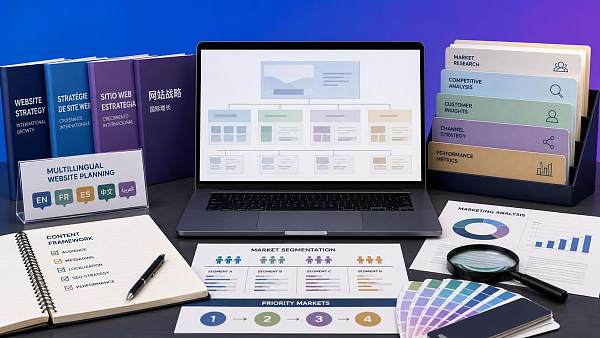
Four key trade-offs determine whether multilingual website development is worth the investment
1. Choose the market first, or choose the language first?
Many teams begin by discussing whether to translate their websites into Spanish, French, Russian, or Japanese, but markets and languages do not correspond one-to-one. Spanish covers Latin America and Spain; French covers France, parts of Canada, and many countries in Africa. The purchasing habits, keyword search behavior, and page presentation styles behind the same language may differ significantly.
Therefore, the more reasonable approach is to first identify the specific target market and then develop a strategy for the corresponding language versions. Are you targeting Mexican procurement buyers or end consumers in Spain? Are you targeting German industrial buyers or seeking brand exposure across the entire DACH region? The less clearly defined the market boundaries are, the greater the subsequent content discrepancies will be as more language versions are added.
2. Launch through translation first, or establish a localization foundation first?
The most common misconception in multilingual website development is equating translation with localization. In reality, whether users are willing to submit an inquiry depends not only on whether the language is readable, but also on whether the page matches local decision-making logic.
For example, on B2B pages, European customers tend to focus more on certifications, lead times, technical specifications, and compliance information. Customers in the Middle East may place greater emphasis on cooperation methods, project experience, and response efficiency. Markets in Japan and South Korea tend to pay more attention to rigorous wording and brand credibility. If a Chinese website is simply translated word for word, it can easily create the awkward impression that “there is content, but it does not seem to have been written for local customers.”
For companies with limited budgets, layered localization can be adopted: localize core pages in depth, translate secondary pages in a standardized manner, and gradually add informational content. This is more realistic than carrying out in-depth localization of the entire website at once and makes it easier to validate the return on investment.
3. Pursue the number of websites first, or ensure promotion and indexing capabilities first?
Many multilingual websites fail to deliver results after launch, not because there is no demand in the market, but because their technical and content structures are unfavorable to SEO and subsequent promotion from the outset. If multilingual website development does not account for URL structures, hreflang tags, page duplication, server access speed, and keyword placement in different languages, the website may simply have “versions but no traffic,” regardless of how many versions are created.
This is why more and more companies are choosing integrated website development and marketing solutions instead of assigning translation, website development, SEO, and advertising to multiple teams. Platforms such as Yiyingbao, an AI-driven enterprise SaaS platform for intelligent website development and overseas marketing services, offer an essential advantage beyond simply building multilingual websites: they can consider website development, indexing, promotion, and conversion paths within the same growth logic. For decision-makers, this is more meaningful than merely comparing the number of pages.
4. Pursue low-cost launch first, or consider long-term operating costs?
The true cost of multilingual website development often lies not in the initial development, but in subsequent maintenance. New product updates, additional case studies, SEO article production, campaign page creation, advertising landing page adaptation, and unified customer service scripts will all increase substantially as the number of languages grows.
Therefore, when making decisions, do not ask only “Can it be done?” Also ask “Who will operate it continuously?” If the company does not have a stable overseas marketing team, it is recommended to focus first on successfully developing one to three key markets before deciding whether to expand the number of languages. A multilingual website is not a one-time delivery project, but an overseas asset that requires continuous iteration.
When should a company restrain the impulse to add more languages?
If your overseas orders mainly come from referrals by existing customers and the website primarily serves to reinforce credibility; if the current sales team can communicate only in English; if the advertising and SEO budgets are still insufficient to support testing across multiple regions; or if the product lines and compliance information for different markets have not yet been clearly organized, blindly adding more languages will most likely only make the team busier without necessarily making it more effective.
At this stage, it is recommended to focus multilingual website development on the “high-conversion path.” For example, pair an English main website with a website in the language of one key market, and prioritize optimizing core product pages, inquiry pages, and case study pages. First ensure that inquiry quality and the conversion chain operate smoothly, and then gradually expand once content production, sales fulfillment, and promotional mechanisms have matured.
A more practical decision-making method: Rank markets by “market accessibility,” not “market imagination”
When planning global markets, companies are most likely to overestimate opportunities and underestimate execution. Rather than pursuing markets that merely sound large, it is better to first assess market accessibility: Can customers find you? Can the page convince them? Can the team handle the inquiries? Can the supply chain support delivery?
Sometimes, developing two fewer language versions allows a limited budget to be concentrated on more critical areas, such as keyword research, content localization, page conversion design, Google Ads testing, and overseas social media traffic acquisition. Truly mature multilingual website development is never about creating an international presence by piling up versions. Instead, each version should have a clearly defined role.
From the perspective of organizational efficiency, this trade-off logic also applies to many internal growth decisions. Research such as Research on the Relationship and Optimization Strategies Between Corporate Organizational Structure and Position Analysis from the Perspective of Labor Economics emphasizes resource allocation and job coordination. The same principle applies to overseas digital marketing: once market selection loses focus, even an excellent execution team can easily become fragmented.
What decision-makers should ultimately consider is not “what can be built,” but “how will it grow after it is built?”
The value of multilingual website development does not lie in translating a company introduction into how many languages, but in whether the website becomes part of the company’s global customer acquisition system. A multilingual website worth investing in should work together with SEO, advertising, social media content, AI search visibility, and sales fulfillment rather than exist in isolation.
For corporate decision-makers, the most important task in the early stage is not to push for the project to go live as soon as possible, but to clarify several questions: Does the target market have clear priorities? Does the language selection serve the market rather than the other way around? Does the depth of localization match the budget and objectives? Have subsequent promotion and operations already been incorporated into the plan? Only after these questions have been thoroughly considered can multilingual website development evolve from a “cost project” into a “growth asset.”
If a company is in an accelerated overseas expansion stage, particularly when it needs to coordinate multilingual website development, Google SEO, advertising, and overseas traffic acquisition, it should pay greater attention during provider selection to whether the service provider has integrated website development and marketing capabilities. Once market selection is correct, the website will no longer be merely a display window, but will become the first stable foothold for the company to enter its target market.
Related Articles

Related Products
 Yiyingbao SaaS Intelligent Website Building and Marketing SystemYiyingbao SaaS Intelligent Website Building and Marketing System, AI-powered no-code website building, rapid creation of multilingual B2B international websites in 10 minutes, global server acceleration, AI-powered SEO optimization, helping businesses connect efficiently with global markets. The perfect integration of technology and operation makes building an international trade website remarkably simple
 AI+SEM Intelligent Advertising Marketing SystemAI+SEM drives intelligent ad creation, empowering full-funnel precision advertising marketing. The system automatically generates weekly/monthly reports, AI recommends keywords and target countries, monitors core metrics in real-time with intelligent alerts, and enables one-click high-conversion ad solutions to help quickly acquire customers and improve ROI.
 AI+SEO Dual-Engine System Optimization ServicesYiyingbao’s AI+SEO dual-engine optimization system helps foreign trade enterprises acquire high-quality organic traffic through AI-powered keyword research, content generation, and comprehensive technical optimization, significantly improving search rankings and conversion rates.
 AI+SNS Social Media Marketing SystemYingbao AI+SNS Social Media Marketing System - Precision social capture for the social media era. Supports one-click content synchronization across major platforms like Facebook and LinkedIn. AI intelligently rewrites posts for enhanced relevance. 24/7 AI customer service and user profiling analysis empower businesses to efficiently expand into global markets.
 AI+SEO营销解决方案易营宝AI+SEO营销解决方案,通过AI批量写作、智能生成TDK、精准关键词扩词等功能,全面优化网站SEO效果,提升流量与转化率。助力企业构建高效智能网站新生态。
 AI+SEM Advertising Marketing SolutionsAI+SEM Advertising Marketing Solution leverages AI technology to deeply empower SEM ad campaigns. It automatically generates weekly/monthly reports using AI, presenting account data across multiple dimensions for comprehensive insights into campaign performance and trends. The system precisely recommends keywords and target countries, intelligently generates high-conversion ad copy, and enables one-click activation of efficient campaign plans to help businesses rapidly acquire customers. Simultaneously, it monitors core metrics in real time, intelligently identifies abnormal fluctuations, and issues timely alerts to ensure stable, high-return advertising results.
 Domain Name ServicesEasyWin provides professional domain name services, including intelligent queries, one-stop registration, brand protection, and full lifecycle management, helping businesses build a digital brand image.
 EasyOperate B2C Cross-Border E-Commerce Platform & Independent WebsiteEasyStore B2C Cross-border E-commerce Independent Store is an intelligent website building and cross-border e-commerce integrated solution independently developed by EasyStore Information Technology (Beijing) Co., Ltd. The system is specially designed for small and medium-sized as well as large export enterprises, integrating 'website building, operation, marketing, advertising, and conversion' into one, helping enterprises quickly establish cross-border e-commerce independent stores to achieve brand globalization and global sales growth.
The platform supports multiple languages, multiple currencies, and multi-channel marketing, with built-in AI intelligent translation and SEO optimization systems, suitable for mainstream markets such as Southeast Asia, Europe and America, Latin America, and the Middle East, assisting Chinese manufacturing enterprises in efficiently deploying international e-commerce strategies. SSL证书易营宝提供专业SSL安全证书服务,包括单域名和泛域名证书,确保网站数据传输加密、身份验证和完整性保护,助力企业建立安全可信的在线业务环境。









