









- China’s Ministry of Commerce Responds to Additional Charges on Low-Value Imports Imposed by the EUNov 06, 2026View details
- Two Internet Development Reports Released at the 2026 World Internet ConferenceNov 05, 2026View details
- Internet Business Revenue of Enterprises Above the Designated Size Reached RMB 1.716 Trillion in the First Three Quarters, with Profits Up 17.6%Nov 05, 2026View details
- Shopify's Third-Quarter Revenue and GMV Fall Short of Expectations, Sending Shares Tumbling Before the Market OpensNov 04, 2026View details
- Temu Sellers See a Decline in Traffic as the Platform’s Traffic Allocation ShiftsNov 04, 2026View details
- UK Regulator Requires E-Commerce Businesses to Clearly Display Total Prices Including Mandatory Delivery ChargesNov 04, 2026View details
How Should Product Terminology Be Managed on Korean Websites for International Trade?
In Korean-language website projects for export businesses, inconsistent translations of product terminology can affect customer understanding and inquiry conversion. The same piece of equipment may be referred to by different names in the product catalog, specification sheet, and inquiry form. Customers may not compare each one carefully; they are more likely to wonder whether the content refers to the same product. The project manager’s task is not simply to “find someone to translate the website,” but to establish a terminology system that can be used consistently as products are updated, marketing campaigns are launched, and sales teams communicate with customers.
Confirm what the product means before deciding how to express it in Korean
Terminology problems often arise before translation even begins. Product abbreviations used internally at a manufacturer may come from workshop habits, old drawings, or informal sales language. The same Chinese product name may also refer to products with different structures or uses. If translators receive only a list of names, it is difficult for them to determine which expression to use.
Take “pressure,” for example. Working pressure, design pressure, and test pressure must not be treated as the same term simply because they all contain the word “pressure.” Even if the translation reads naturally, an incorrect match to the corresponding specification can affect product selection. At the start of the project, product or technical staff should provide model numbers, applications, parameter definitions, drawings, and current documentation, and identify any terms that are no longer in use. If documents conflict, first determine which controlled document takes precedence; do not leave the decision for the translator to guess.
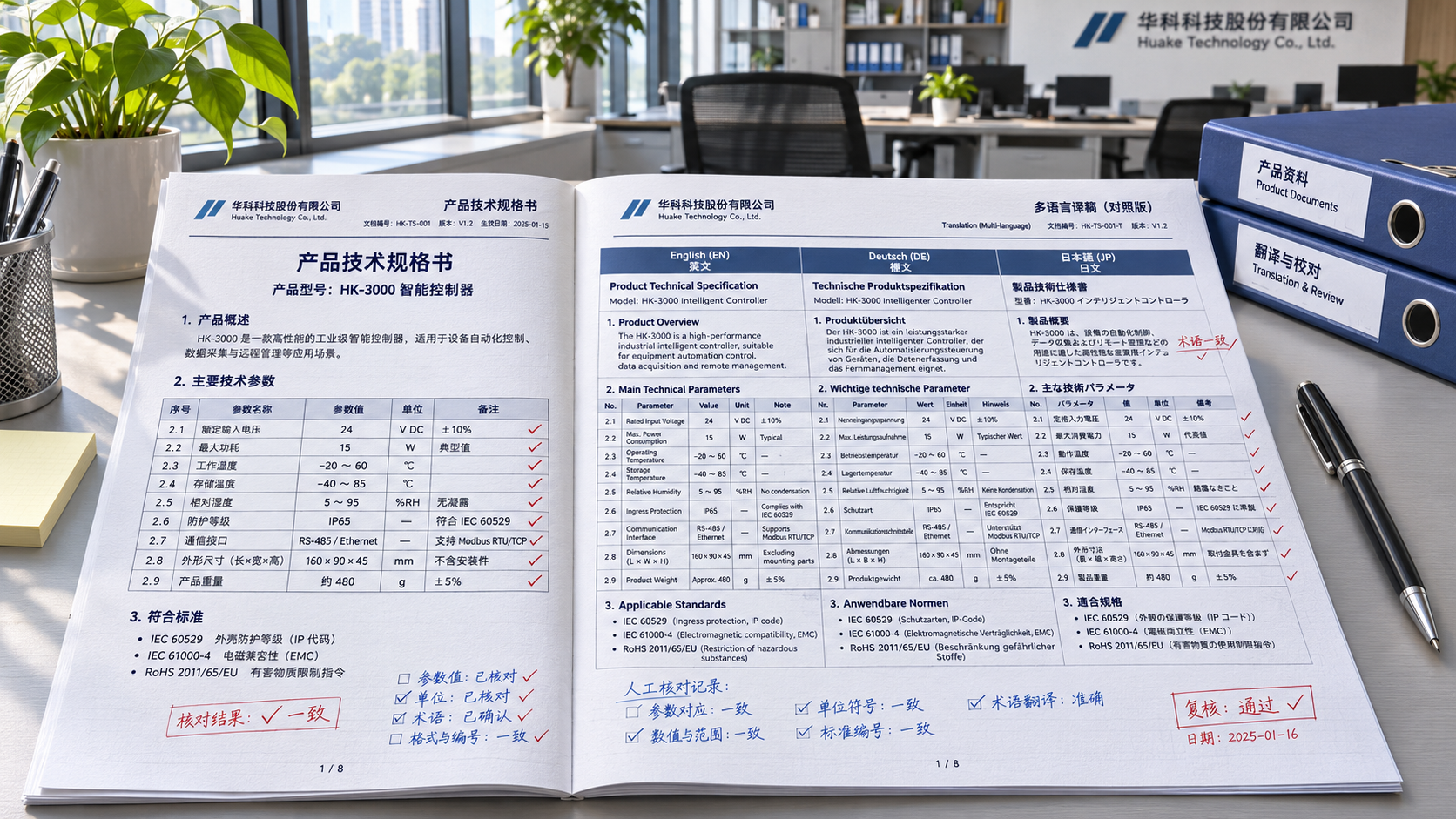
Model numbers, part numbers, and standard names should generally retain their original forms. Units, symbols, and values should be checked item by item against current technical documentation. For certifications, applicable standards, or operating conditions, the scope stated on the page must match the actual supporting documents. Do not broaden the scope just because a shorter translation looks neater.
A terminology list should guide usage, not just store translations
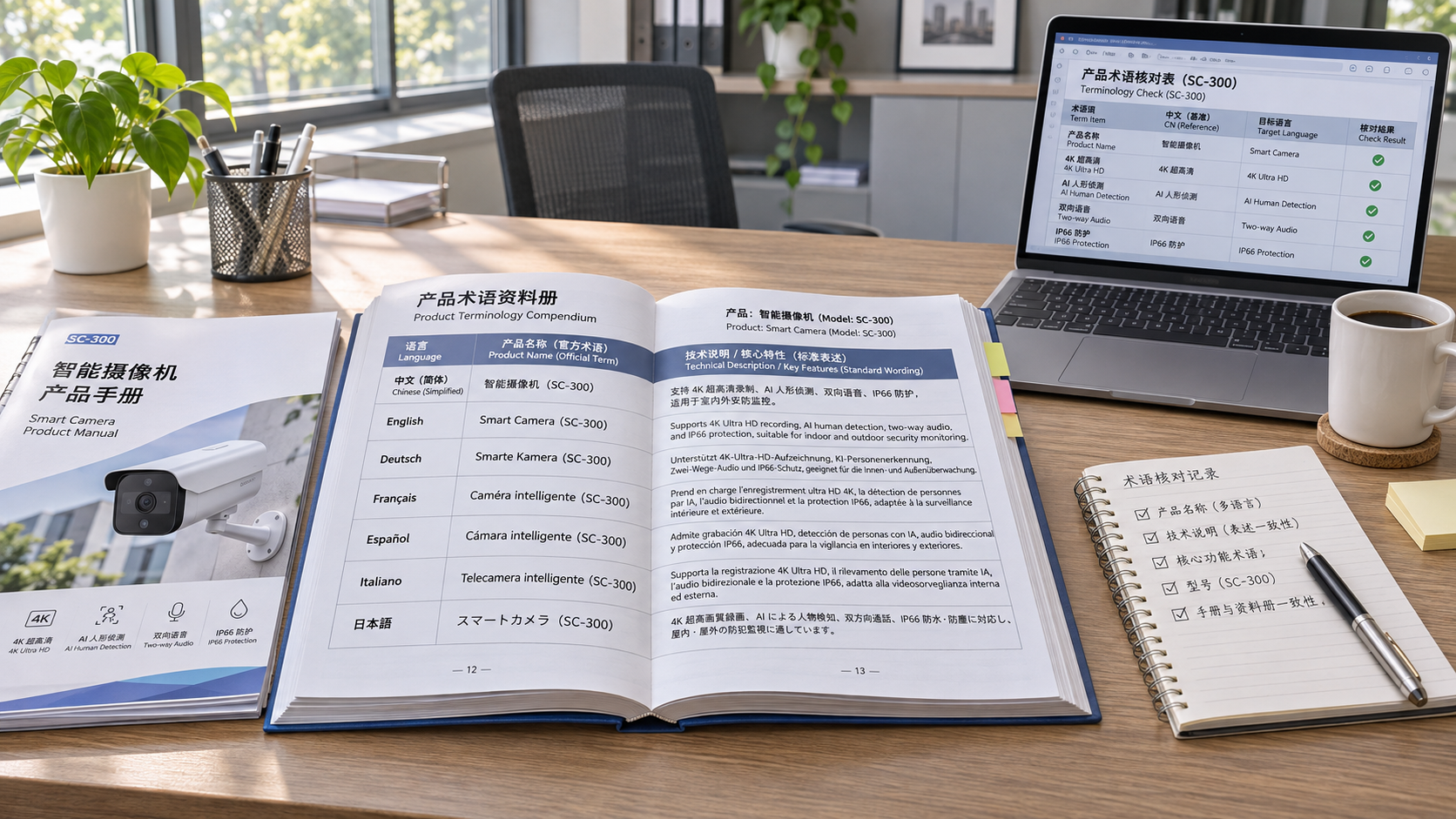
A practical terminology list should record at least the Chinese name, approved Korean equivalent, product definition, applicable models, usage context, reference materials, reviewer, and version. For terms that are easily confused, it should also specify prohibited translations and the reasons for prohibiting them. For example, whether a name applies only to a complete machine or also to a component, and whether a parameter refers to a rated value or a test value under specific conditions.
Do not require every page to mechanically use only one term. The standard name preferred by technical staff may differ from the everyday term buyers use in searches. You can designate a primary name and record commonly used alternatives that have been verified: use the primary name consistently in product titles and specification sheets, and use alternative names in natural explanatory copy. Whether an alternative is appropriate should be assessed against Korean market websites from industry peers, customer inquiries, and sales feedback—not inferred from Chinese synonyms.
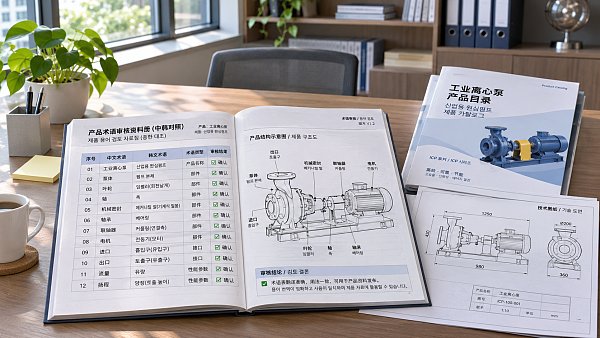
The terminology list should also clearly indicate each term’s status. “Pending confirmation” and “Approved” must not be mixed together; otherwise, temporary translations can easily find their way onto official pages when the project is under time pressure. For names that are still disputed, it is better to keep them on hold for publication than to meet the launch deadline by using one term in the product catalog and another in the technical documentation.
Build review into the website development process instead of fixing issues just before launch
A reliable approach is to test-translate a representative product page and review it together with the navigation, specification sheet, application information, and inquiry form fields. Product staff should confirm the technical meaning, Korean-language reviewers with relevant industry experience should check the wording, and sales or local market staff should assess whether customers can understand it easily. When the three groups disagree, product facts should remain the foundation while leaving room for customer-friendly explanations.
Processing the remaining pages in batches after the test translation has been approved is usually more cost-effective than translating everything first and revising it later. AI tools can help organize candidate translations and find inconsistent wording, but they cannot replace technical review. Safety notices, performance limits, and certification claims in particular must be checked item by item against the original documentation.
During acceptance testing, do not review only the product detail pages. Old names may remain in navigation categories, site search, image captions, downloadable materials, inquiry emails, and automated replies. Starting with a model number, simulate the entire customer journey—searching, browsing, downloading, and submitting an inquiry—and check that every touchpoint refers to the same product. Parameters and text embedded in images may not be updated along with webpage text, so they should be included in the review separately.
Websites, search, and inquiries should all use the same reference
After a Korean-language website goes live, advertising, search optimization, and sales follow-up will continue to generate new content. If an ad uses one product name, the landing page uses another, and the inquiry response reverts to an old catalog name, customers may find it difficult to confirm whether they are asking about the same product. The terminology list should be accessible to the website development, content, advertising, and sales teams, with a clear agreement on who is responsible for approving changes.
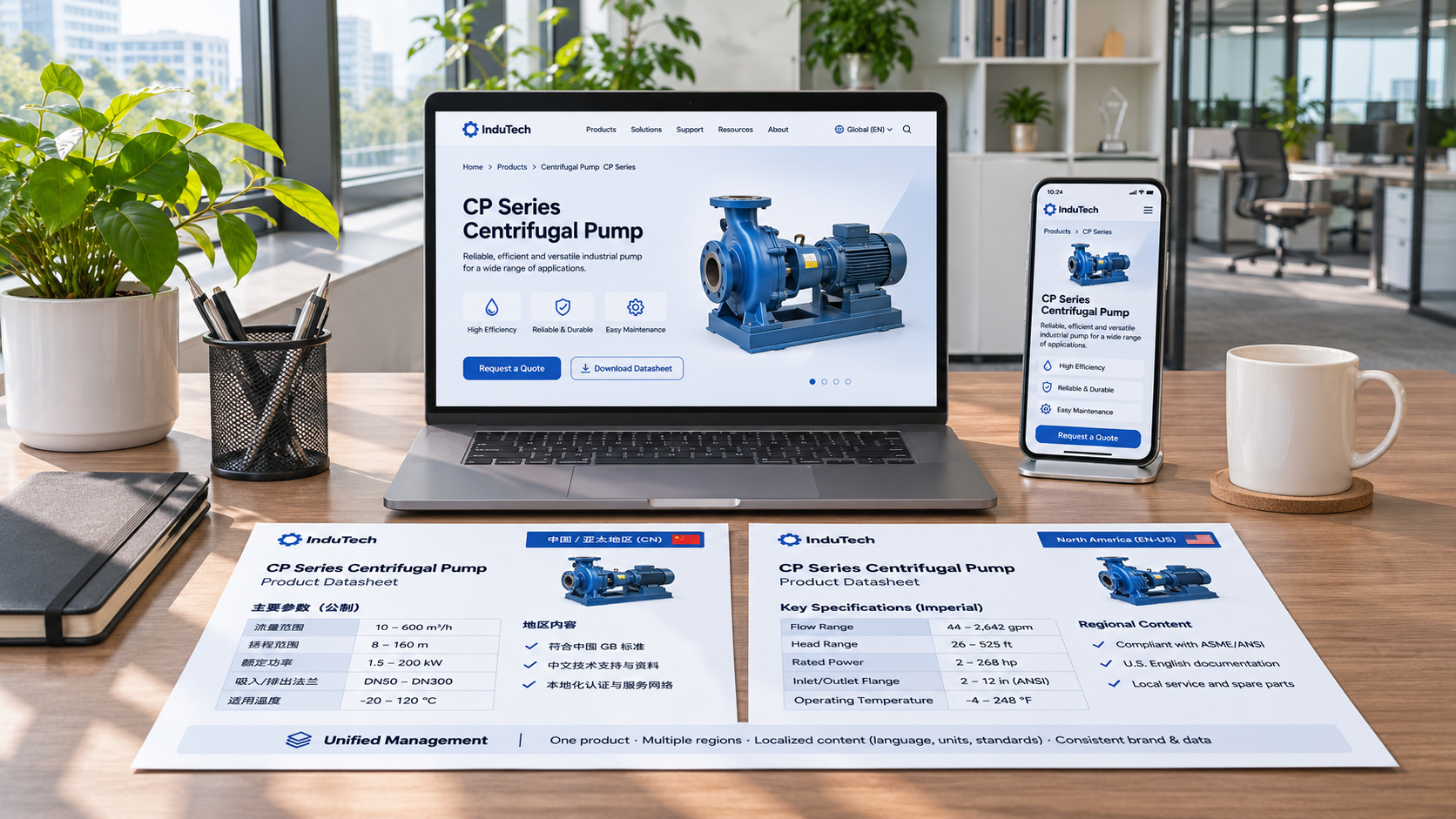
Search terms can help identify alternative names, but products with different scopes of application should not be forced into the same category just to capture search traffic. For similar models, it is more useful to explain the key differences, applicable operating conditions, and information needed for selection on the page, so customers know what details to provide before submitting an inquiry. Product names, model numbers, and required parameters in the form should also match those on the detail page.
When using integrated website development and overseas marketing services—for example, when Yiyingbao helps manage a multilingual website and its associated promotional content—the project manager still needs to confirm who owns the terminology list, who has review and approval rights, and how change records will be handed over. A service provider can help organize webpages and promotional materials, but the company’s staff who understand the products should have final responsibility for confirming product specifications and technical claims.
After launch, provide a clear channel for terminology updates: sales staff should be able to submit a change when a customer asks about a product name, and the technical department should be able to do so when it issues a new specification. Once a change is approved, check the product pages, downloadable materials, and promotional landing pages for consistency. For a project about to begin, consider piloting one page for a core product first. Confirm the terminology, responsible parties, and update process before deciding which pages to translate in bulk.
Related Articles
 Can a website localization platform adapt content for different regions?
 How can AI translation keep product terminology consistent?
 How Can You Avoid Product Specification Errors When Translating a B2B Website?
Related Products
 Yiyingbao SaaS Intelligent Website Building and Marketing SystemYiyingbao SaaS Intelligent Website Building and Marketing System, AI-powered no-code website building, rapid creation of multilingual B2B international websites in 10 minutes, global server acceleration, AI-powered SEO optimization, helping businesses connect efficiently with global markets. The perfect integration of technology and operation makes building an international trade website remarkably simple
 AI+SEM Intelligent Advertising Marketing SystemAI+SEM drives intelligent ad creation, empowering full-funnel precision advertising marketing. The system automatically generates weekly/monthly reports, AI recommends keywords and target countries, monitors core metrics in real-time with intelligent alerts, and enables one-click high-conversion ad solutions to help quickly acquire customers and improve ROI.
 AI+SEO Dual-Engine System Optimization ServicesYiyingbao’s AI+SEO dual-engine optimization system helps foreign trade enterprises acquire high-quality organic traffic through AI-powered keyword research, content generation, and comprehensive technical optimization, significantly improving search rankings and conversion rates.
 AI+SNS Social Media Marketing SystemYingbao AI+SNS Social Media Marketing System - Precision social capture for the social media era. Supports one-click content synchronization across major platforms like Facebook and LinkedIn. AI intelligently rewrites posts for enhanced relevance. 24/7 AI customer service and user profiling analysis empower businesses to efficiently expand into global markets.
 AI+SEO营销解决方案易营宝AI+SEO营销解决方案,通过AI批量写作、智能生成TDK、精准关键词扩词等功能,全面优化网站SEO效果,提升流量与转化率。助力企业构建高效智能网站新生态。
 AI+SEM Advertising Marketing SolutionsAI+SEM Advertising Marketing Solution leverages AI technology to deeply empower SEM ad campaigns. It automatically generates weekly/monthly reports using AI, presenting account data across multiple dimensions for comprehensive insights into campaign performance and trends. The system precisely recommends keywords and target countries, intelligently generates high-conversion ad copy, and enables one-click activation of efficient campaign plans to help businesses rapidly acquire customers. Simultaneously, it monitors core metrics in real time, intelligently identifies abnormal fluctuations, and issues timely alerts to ensure stable, high-return advertising results.
 Domain Name ServicesEasyWin provides professional domain name services, including intelligent queries, one-stop registration, brand protection, and full lifecycle management, helping businesses build a digital brand image.
 EasyOperate B2C Cross-Border E-Commerce Platform & Independent WebsiteEasyStore B2C Cross-border E-commerce Independent Store is an intelligent website building and cross-border e-commerce integrated solution independently developed by EasyStore Information Technology (Beijing) Co., Ltd. The system is specially designed for small and medium-sized as well as large export enterprises, integrating 'website building, operation, marketing, advertising, and conversion' into one, helping enterprises quickly establish cross-border e-commerce independent stores to achieve brand globalization and global sales growth.
The platform supports multiple languages, multiple currencies, and multi-channel marketing, with built-in AI intelligent translation and SEO optimization systems, suitable for mainstream markets such as Southeast Asia, Europe and America, Latin America, and the Middle East, assisting Chinese manufacturing enterprises in efficiently deploying international e-commerce strategies. SSL证书易营宝提供专业SSL安全证书服务,包括单域名和泛域名证书,确保网站数据传输加密、身份验证和完整性保护,助力企业建立安全可信的在线业务环境。









