









- Which customer acquisition channels will be affected by cross-border marketing trends in 2026?Sep 06, 2026View details
- Which homogenization risks should be considered in an analysis of the AI-powered website building industry?Aug 30, 2026View details
- How Will AI Marketing Trends 2026 Change Advertising Budget AllocationAug 28, 2026View details
- Is the EV SSL certificate market shrinking or upgrading? How should companies assess certificate procurement?Aug 11, 2026View details
- Why the old AMP SEO 2020 practices no longer work and what has changed in current optimization prioritiesAug 02, 2026View details
- How to Choose Topics for an Industry News Section to Attract More Organic Search TrafficJul 29, 2026View details
Why multilingual cms global enterprises place greater emphasis on regional compliance and publishing efficiency
Regional Compliance Is Reshaping the Priorities of Multilingual Website Development
For global enterprises, multilingual cms global enterprises is no longer just a content management tool. It is also closely related to regional compliance, brand consistency, and publishing efficiency. Whoever can adapt to local markets faster is more likely to gain a head start in growth.
Over the past few years, many enterprises have still understood multilingual websites as simply “translating one main website into multiple language versions.” This approach is clearly no longer sufficient in today’s international markets. What truly creates a competitive gap is not the number of pages, but whether an enterprise can simultaneously manage privacy policies, data storage, Cookie management, form fields, product descriptions, qualification disclosures, and local marketing schedules across different regions. At the content level, it may appear to involve only changing a few paragraphs, but behind it lies a competition in the collaborative efficiency of legal, marketing, sales, and technology teams.
An increasingly clear signal is that cross-regional corporate websites are shifting from “centralized publishing by headquarters” to “centralized governance with rapid regional publishing.” The reason is not complicated. Policy environments in global markets are becoming more detailed, channel updates are happening faster, and purchasing decisions depend more heavily on local trust. If enterprises continue to use traditional CMS platforms for centralized revisions, they often encounter two obstacles: first, approval chains are lengthy; second, regional websites cannot be adjusted flexibly without disrupting the main brand framework. This delay directly affects search indexing, advertising landing-page conversion, and the speed of sales-lead follow-up.
Compliance Is No Longer a Legal Issue, but a Publishing-System Capability
Many decision-makers have recently noticed that legal and data-compliance teams are getting involved earlier in discussions about corporate website projects. This does not mean that processes are becoming unnecessarily complicated. Rather, enterprises are beginning to realize that as regional operations expand, the website itself becomes a compliance touchpoint. In the European market, for example, companies are generally more cautious about the use of personal data, Cookie consent mechanisms, and authorization for marketing subscriptions. When entering markets such as the Middle East, Southeast Asia, and Latin America, although regulatory maturity and enforcement intensity are not entirely consistent, local payment methods, logistics, after-sales information, religious and cultural sensitivities, and restrictions on advertising language also impose different requirements on site content structures.
This is why more and more enterprises evaluating multilingual cms global enterprises solutions are no longer asking only, “How many languages are supported?” Instead, they are asking more specific questions: Can independent privacy terms be configured for different regions? Can form fields and user-consent logic be switched by country? When multi-site templates are updated, which modules can be distributed uniformly, and which modules can be maintained independently by regional teams? If these capabilities are missing, enterprises can only rely on development teams to modify code frequently. As a result, every launch becomes slower and every expansion becomes more expensive.
Based on project experience in integrated website and marketing services, what truly concerns enterprises after their overseas business expands is often not “whether multilingual pages are available,” but “whether they can continue publishing in a stable and low-risk manner.” Once a website takes on multiple roles, including SEO, advertising, social media engagement, and brand endorsement, the publishing mechanism itself becomes part of the growth system. Whoever can turn compliance requirements into templates, permissions, components, and regional rules will find it easier to operate a global website network.
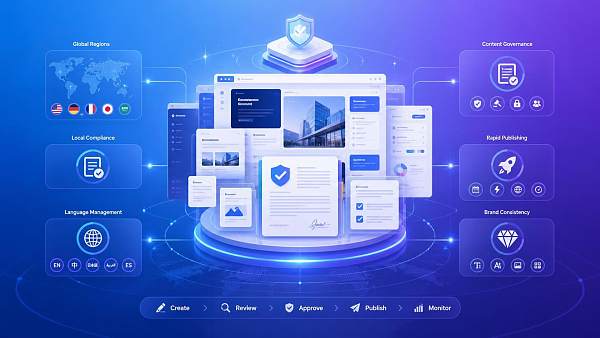
The Efficiency Competition Has Shifted from Website-Building Speed to Content-Supply-Chain Speed
Another clear change is that the efficiency metrics for multilingual websites are being redefined. In previous years, the focus was on “how long it takes to launch an overseas corporate website.” Now, what matters more is “how many times regional pages can be iterated within a quarter without fragmenting the brand.” Search engine algorithms, advertising reviews, social media content schedules, and the way AI search results are presented are all changing. If enterprises still operate international websites according to an annual-revision model, they can easily miss the window for responding to market changes.
This is essentially a change in the content supply chain. For manufacturing companies, cross-border e-commerce businesses, and brands expanding overseas, product-line updates, marketing campaign changes, trade-show milestones, and channel-policy adjustments can all create a need for rapid page-level modifications. In the past, adding an industry solution page to a regional website might require the complete process of translation, design, slicing, front-end development, testing, and launch. Today, mature enterprises place greater emphasis on reusable modules, AI-assisted content generation, multilingual version management, terminology databases, and batch configuration of SEO elements, because these capabilities determine whether global content can be produced at scale rather than being limited to carefully managed operations in a small number of key markets.
This is particularly significant for B2B enterprises. A common problem with B2B websites is not insufficient traffic, but that pages respond to market changes too slowly. If a regional distributor policy changes, demand from a particular industry segment rises, or a certification statement needs to be supplemented, the sales front line will first suffer lead losses if website updates still depend on cross-department scheduling. By contrast, a CMS with multi-regional content collaboration capabilities allows marketing teams to move from “waiting for a development window” to “publishing independently within defined rules.” This type of efficiency improvement often delivers greater long-term value than a one-time website build.
Brand Consistency No Longer Means Completely Identical Content
In the past, many headquarters teams worried that regional autonomy would lead to a loss of brand control, so they preferred all websites to use the same pages, copy, and CTAs. This logic is reasonable during the early stages of brand building, but its side effects are becoming increasingly apparent as global markets deepen. Users in different regions have different search expressions, purchasing concerns, case-study preferences, and bases for trust. Completely standardized content may look orderly on the surface, but in practice it may fail to resonate with anyone.
Therefore, the more widely recognized approach today is to break brand consistency into several levels: core visual elements, product-naming principles, and the main narrative framework are controlled by headquarters; industry scenarios, case-study presentation, call-to-action buttons, and landing-page structures are optimized regionally. This organizational approach requires the CMS to unify assets while also supporting fine-grained permission allocation. Otherwise, headquarters and regional teams will repeatedly negotiate, ultimately resulting either in efficiency losses or distorted localization.
These changes also affect supplier selection. Enterprises no longer look only at whether a website development company can “build a website.” They also assess whether it understands the interaction among search, advertising, social media, and on-site conversion. If a website is merely a display tool, the value of multilingual capabilities is limited. Once a website becomes customer-acquisition infrastructure, the decision criteria rise significantly. Service models like that of 易营宝, which integrate intelligent website building, SEO, advertising, and multi-regional operations within the same system, have been more likely to enter enterprise evaluation lists in recent years. The reason is straightforward: customers do not want a standalone tool, but a digital-asset foundation that is consistent across channels and executable across regions.
In Multilingual Scenarios, AI Is Beginning to Shift from a “Translation Tool” to a “Governance Tool”
There is extensive discussion of AI in the market, but when applied to enterprise-level multilingual websites, its most valuable role is not limited to generating initial drafts. What truly deserves attention is that AI is helping enterprises solve problems that were previously difficult to manage at scale: terminology consistency, identification of page differences, batch optimization of titles and metadata, detection of outdated content, synchronization of regional versions, FAQ expansion, and organization of content structures for AI search.
This means that the competitive focus of multilingual cms global enterprises is shifting from “whether AI capabilities are available” to “whether AI is embedded in the publishing workflow.” If AI remains limited to copywriting, enterprises will soon encounter unstable content quality, increased review pressure, and drifting brand language. By contrast, when a system can combine AI with templates, knowledge bases, approval workflows, SEO rules, and regional permissions, AI can truly begin to deliver economies of scale.
This governance approach also echoes the topic of ESG in certain ways. As enterprises improve digital efficiency, they are increasingly concerned with whether governance structures are sustainable, whether information disclosures are traceable, and whether cross-regional operations can be audited. On the reading lists of some managers, content such as An Analysis of Implementation Paths for ESG to Support the Development of New Quality Productive Forces in Enterprises attracts attention not because the concept is merely popular, but because it offers another perspective: if technology investment cannot be transformed into organizational governance capabilities, the cost of subsequent expansion will usually be higher.
What to Watch Next Is Not the Number of Languages, but the Depth of Regional Operations
For some time to come, the multilingual CMS market will likely continue to diverge. One type of enterprise will remain in the broad-coverage stage of “using more languages to reach more countries.” Another type will shift toward deep operations in key regions, placing greater emphasis on whether websites can support local search strategies, compliance adjustments, advertising engagement, and closed-loop sales conversion. The latter may not have more pages, but it operates at a greater depth and therefore requires more capable systems.
For enterprises evaluating a global corporate website system, one practical criterion is not to look only at whether the demonstration website is attractive, but to consider three questions: Can regional teams publish quickly within their authorized scope? Can headquarters govern the brand and risks consistently? Can content be reused across SEO, advertising, social media, and AI search? A system that can answer all three questions effectively is closer to the mainstream direction of the next stage.
Based on industry experience, this change will not end in the short term. Regulatory requirements will continue to become more detailed, search entry points will continue to evolve, and enterprises’ expectations for the quality of overseas leads will only increase. A multilingual corporate website is no longer merely the public face of an enterprise expanding overseas; it is part of its regional operating capabilities. Whoever is first to place compliance, content, and publishing efficiency within the same underlying system is more likely to take the initiative in the next round of global market competition.
Related Articles

Related Products
 Yiyingbao SaaS Intelligent Website Building and Marketing SystemYiyingbao SaaS Intelligent Website Building and Marketing System, AI-powered no-code website building, rapid creation of multilingual B2B international websites in 10 minutes, global server acceleration, AI-powered SEO optimization, helping businesses connect efficiently with global markets. The perfect integration of technology and operation makes building an international trade website remarkably simple
 AI+SEM Intelligent Advertising Marketing SystemAI+SEM drives intelligent ad creation, empowering full-funnel precision advertising marketing. The system automatically generates weekly/monthly reports, AI recommends keywords and target countries, monitors core metrics in real-time with intelligent alerts, and enables one-click high-conversion ad solutions to help quickly acquire customers and improve ROI.
 AI+SEO Dual-Engine System Optimization ServicesYiyingbao’s AI+SEO dual-engine optimization system helps foreign trade enterprises acquire high-quality organic traffic through AI-powered keyword research, content generation, and comprehensive technical optimization, significantly improving search rankings and conversion rates.
 AI+SNS Social Media Marketing SystemYingbao AI+SNS Social Media Marketing System - Precision social capture for the social media era. Supports one-click content synchronization across major platforms like Facebook and LinkedIn. AI intelligently rewrites posts for enhanced relevance. 24/7 AI customer service and user profiling analysis empower businesses to efficiently expand into global markets.
 AI+SEO营销解决方案易营宝AI+SEO营销解决方案,通过AI批量写作、智能生成TDK、精准关键词扩词等功能,全面优化网站SEO效果,提升流量与转化率。助力企业构建高效智能网站新生态。
 AI+SEM Advertising Marketing SolutionsAI+SEM Advertising Marketing Solution leverages AI technology to deeply empower SEM ad campaigns. It automatically generates weekly/monthly reports using AI, presenting account data across multiple dimensions for comprehensive insights into campaign performance and trends. The system precisely recommends keywords and target countries, intelligently generates high-conversion ad copy, and enables one-click activation of efficient campaign plans to help businesses rapidly acquire customers. Simultaneously, it monitors core metrics in real time, intelligently identifies abnormal fluctuations, and issues timely alerts to ensure stable, high-return advertising results.
 Domain Name ServicesEasyWin provides professional domain name services, including intelligent queries, one-stop registration, brand protection, and full lifecycle management, helping businesses build a digital brand image.
 EasyOperate B2C Cross-Border E-Commerce Platform & Independent WebsiteEasyStore B2C Cross-border E-commerce Independent Store is an intelligent website building and cross-border e-commerce integrated solution independently developed by EasyStore Information Technology (Beijing) Co., Ltd. The system is specially designed for small and medium-sized as well as large export enterprises, integrating 'website building, operation, marketing, advertising, and conversion' into one, helping enterprises quickly establish cross-border e-commerce independent stores to achieve brand globalization and global sales growth.
The platform supports multiple languages, multiple currencies, and multi-channel marketing, with built-in AI intelligent translation and SEO optimization systems, suitable for mainstream markets such as Southeast Asia, Europe and America, Latin America, and the Middle East, assisting Chinese manufacturing enterprises in efficiently deploying international e-commerce strategies. SSL证书易营宝提供专业SSL安全证书服务,包括单域名和泛域名证书,确保网站数据传输加密、身份验证和完整性保护,助力企业建立安全可信的在线业务环境。









