









- Which customer acquisition channels will be affected by cross-border marketing trends in 2026?Sep 06, 2026View details
- Which homogenization risks should be considered in an analysis of the AI-powered website building industry?Aug 30, 2026View details
- How Will AI Marketing Trends 2026 Change Advertising Budget AllocationAug 28, 2026View details
- Is the EV SSL certificate market shrinking or upgrading? How should companies assess certificate procurement?Aug 11, 2026View details
- Why the old AMP SEO 2020 practices no longer work and what has changed in current optimization prioritiesAug 02, 2026View details
- How to Choose Topics for an Industry News Section to Attract More Organic Search TrafficJul 29, 2026View details
Can AI translation achieve real-time translation? How low must latency be to make it usable?
Can AI translation achieve real-time translation? The answer is yes, but there is a complete set of engineering challenges between “being able to run” and “being usable in business.” Model generation speed is only one part of the equation. Speech capture, endpoint detection, speech recognition, text translation, speech synthesis, network round trips, and frontend playback buffering all add up to the waiting time users actually experience. For technical evaluators, the first step should be to define the scenario: meeting captions, customer service calls, live-stream interactions, or instant inquiries on multilingual websites? Different scenarios have different requirements for latency, accuracy, and fault tolerance.
Real-time translation is not a single metric, but an end-to-end chain
Many solutions demonstrate that “as soon as a sentence is spoken, the translation appears immediately,” making them seem close to real time. However, technical acceptance should not focus solely on the response time of the translation API. Taking speech-to-speech translation as an example, the system must first determine when the user has finished speaking. This step is called endpoint detection. Cutting off too early may omit words, while waiting too long can noticeably slow down the conversation. Speech recognition must then handle accents, environmental noise, technical terminology, and numbers. If the translated output needs to be spoken aloud, it must also go through speech synthesis and client-side buffering.
Therefore, procurement or integration should distinguish among three types of latency: first-word latency, meaning how long after the user begins speaking the first caption segment appears; stable translation latency, meaning the time required before the key meaning of a sentence no longer changes significantly; and turn latency, meaning the time before the other party can hear a complete and understandable translation. The first two affect the sense of real-time following, while the last determines whether people frequently talk over one another. Simply asking, “How many milliseconds is the API latency?” will usually not provide an answer sufficient to assess usability.
How low must latency be before users consider it usable?
There is no universal threshold in the industry that applies to every business, but internal acceptance criteria can be established based on interaction intensity. In general, text chat has the highest tolerance: if users receive a natural and complete translation within a few seconds after sending a message, it can often meet the needs of cross-border inquiry handling. Meeting captions place greater emphasis on continuity, allowing translations to lag slightly behind the original speech, but not to the point where the next speaker has already begun. Telephone calls, video negotiations, and live-stream call-ins are the most sensitive. Once latency accumulates to the point where both parties must pause and wait, the communication rhythm quickly becomes a fragmented “one sentence from you, one sentence from me” pattern.
In practice, low latency does not mean blindly pursuing shorter audio segments. If segments are cut too short, speech recognition cannot obtain sufficient context, and translation may mishandle negatives, quantities, model numbers, and sentence subjects. If segments are too long, accuracy may be more stable, but conversational fluency is sacrificed. In foreign trade negotiations, the risk caused by a single mistranslation of information such as “tax excluded,” “delivery time,” “minimum order quantity,” or “material grade” is often greater than waiting a little longer. Usability requires trade-offs between speed and semantic completeness.
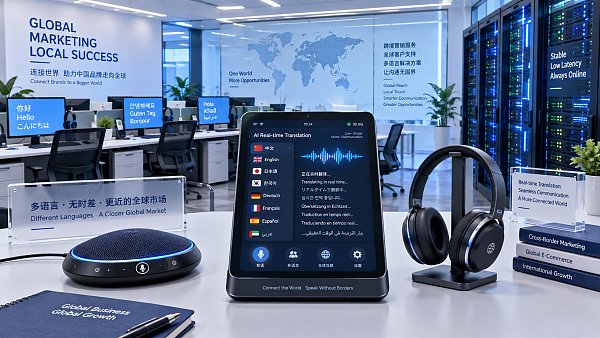
What determines the experience is often not the translation model itself
Network conditions are easily overlooked. In cross-border business, visitors may come from North America, Europe, the Middle East, Southeast Asia, or Latin America. If audio streams, translation services, and the business frontend are deployed in regions far apart from one another, network round-trip time can directly consume the gains from model-side optimization. Technical evaluations should not be limited to stress testing on office networks. They should simulate access paths in target markets and record performance under weak networks, packet loss, and network switching.
A second common issue is repeated revision after streaming output. Some systems first provide a provisional translation and then revise it as more context becomes available. For captions, this capability can reduce the wait for the first word. However, in customer quotation communications, if amounts, dates, or product parameters are revised one after another, users may remember only the incorrect version. A more mature approach is to distinguish provisional results from confirmed results in both the interface and business logic, while adding extra verification or manual confirmation options for numbers, currencies, model numbers, and proper nouns.
The third issue is differences between language pairs. Language combinations with relatively abundant resources, such as English and Chinese, are generally more likely to achieve stable results. Low-resource languages, mixed accents, and expressions containing industry abbreviations often require longer context or terminology intervention. Do not use the results of a general English demonstration to infer the actual experience in Russian, Arabic, Japanese, or less commonly used language markets. In particular, frontend presentation also requires separate testing for right-to-left text display, honorific expressions, and unit and date formats.
Website and marketing scenarios may not require “full-time simultaneous interpretation”
For multilingual websites, the value of real-time translation is mainly concentrated in interactive elements rather than replacing all page content. Product pages, brand introductions, technical documentation, compliance statements, and long-term advertising landing pages should still prioritize reviewed localized content. The reason is simple: these pages affect user trust and also carry search engine indexing, advertising quality, and conversion paths. Even if dynamic translation reads smoothly, it may not accurately convey the purchasing context.
A more reasonable combination is usually this: fixed pages use a multilingual website-building system to maintain structured content; online chat and initial form screening use instant translation; and sales personnel review the original text when entering critical stages such as quotations, contracts, and specification confirmations. Eyb has long served foreign trade companies, manufacturing factories, cross-border e-commerce sellers, and overseas brand expansion projects. Its cloud intelligent website-building, cross-border e-commerce mall, and overseas marketing services cover multilingual official websites, advertising landing pages, social media traffic generation, and other stages. Viewed within this type of chain, AI translation should not be deployed in isolation. It is necessary to consider whether lead sources, page languages, customer service responses, CRM records, and subsequent content accumulation are coherent.
During technical acceptance, do not test only “Hello, may I ask the price?”
Before evaluating a solution, it is recommended to prepare real but anonymized corpora: product model numbers, materials, dimensions, packaging methods, trade terms, delivery cycles, payment terms, and the question formats commonly used by customers in target markets. Testing should cover at least continuous speech, multiple speakers interrupting each other, background noise, network fluctuations, and mixed Chinese and English. If the system provides a terminology glossary or custom dictionary, it is also necessary to verify whether it takes effect before recognition, during translation, or only for final replacement; the three have different impacts on real-time performance and accuracy.
It is also necessary to clarify what happens in the event of failure. After an API timeout, should the original text be displayed, should users be prompted to retry, or should a sentence be silently lost? Does the model mark low-confidence results when it is uncertain? Do conversation audio and text need to be retained, and how should the storage location, permissions, and retention period be configured? These questions may be less eye-catching than “How many languages are supported?” but they directly determine whether a cross-border business can remain online in the long term.
Therefore, AI translation can certainly achieve real-time translation, but there is no business-independent standard answer for latency that is “low enough to be usable.” Customer service scenarios can allow a little more time for accuracy, meeting captions need to control cumulative latency, and real-time interpreting must include network conditions, streaming processing, and interaction design in the acceptance process. Testing the complete chain before deciding on the model and deployment method is usually closer to real-world results than focusing on a single millisecond figure.
Related Articles
Related Products
 Yiyingbao SaaS Intelligent Website Building and Marketing SystemYiyingbao SaaS Intelligent Website Building and Marketing System, AI-powered no-code website building, rapid creation of multilingual B2B international websites in 10 minutes, global server acceleration, AI-powered SEO optimization, helping businesses connect efficiently with global markets. The perfect integration of technology and operation makes building an international trade website remarkably simple
 AI+SEM Intelligent Advertising Marketing SystemAI+SEM drives intelligent ad creation, empowering full-funnel precision advertising marketing. The system automatically generates weekly/monthly reports, AI recommends keywords and target countries, monitors core metrics in real-time with intelligent alerts, and enables one-click high-conversion ad solutions to help quickly acquire customers and improve ROI.
 AI+SEO Dual-Engine System Optimization ServicesYiyingbao’s AI+SEO dual-engine optimization system helps foreign trade enterprises acquire high-quality organic traffic through AI-powered keyword research, content generation, and comprehensive technical optimization, significantly improving search rankings and conversion rates.
 AI+SNS Social Media Marketing SystemYingbao AI+SNS Social Media Marketing System - Precision social capture for the social media era. Supports one-click content synchronization across major platforms like Facebook and LinkedIn. AI intelligently rewrites posts for enhanced relevance. 24/7 AI customer service and user profiling analysis empower businesses to efficiently expand into global markets.
 AI+SEO营销解决方案易营宝AI+SEO营销解决方案,通过AI批量写作、智能生成TDK、精准关键词扩词等功能,全面优化网站SEO效果,提升流量与转化率。助力企业构建高效智能网站新生态。
 AI+SEM Advertising Marketing SolutionsAI+SEM Advertising Marketing Solution leverages AI technology to deeply empower SEM ad campaigns. It automatically generates weekly/monthly reports using AI, presenting account data across multiple dimensions for comprehensive insights into campaign performance and trends. The system precisely recommends keywords and target countries, intelligently generates high-conversion ad copy, and enables one-click activation of efficient campaign plans to help businesses rapidly acquire customers. Simultaneously, it monitors core metrics in real time, intelligently identifies abnormal fluctuations, and issues timely alerts to ensure stable, high-return advertising results.
 Domain Name ServicesEasyWin provides professional domain name services, including intelligent queries, one-stop registration, brand protection, and full lifecycle management, helping businesses build a digital brand image.
 EasyOperate B2C Cross-Border E-Commerce Platform & Independent WebsiteEasyStore B2C Cross-border E-commerce Independent Store is an intelligent website building and cross-border e-commerce integrated solution independently developed by EasyStore Information Technology (Beijing) Co., Ltd. The system is specially designed for small and medium-sized as well as large export enterprises, integrating 'website building, operation, marketing, advertising, and conversion' into one, helping enterprises quickly establish cross-border e-commerce independent stores to achieve brand globalization and global sales growth.
The platform supports multiple languages, multiple currencies, and multi-channel marketing, with built-in AI intelligent translation and SEO optimization systems, suitable for mainstream markets such as Southeast Asia, Europe and America, Latin America, and the Middle East, assisting Chinese manufacturing enterprises in efficiently deploying international e-commerce strategies. SSL证书易营宝提供专业SSL安全证书服务,包括单域名和泛域名证书,确保网站数据传输加密、身份验证和完整性保护,助力企业建立安全可信的在线业务环境。









