









- Can the average annual growth rate reflect real opportunities in overseas markets?Oct 07, 2026View details
- Which customer acquisition channels will be affected by cross-border marketing trends in 2026?Sep 06, 2026View details
- Which homogenization risks should be considered in an analysis of the AI-powered website building industry?Aug 30, 2026View details
- How Will AI Marketing Trends 2026 Change Advertising Budget AllocationAug 28, 2026View details
- Is the EV SSL certificate market shrinking or upgrading? How should companies assess certificate procurement?Aug 11, 2026View details
- Why the old AMP SEO 2020 practices no longer work and what has changed in current optimization prioritiesAug 02, 2026View details
Should construction and renovation companies have multilingual websites for foreign trade?
When architectural and interior decoration companies enter overseas markets, website language is often treated as a “post-launch add-on”: first build an English website, then add other languages after traffic increases; or submit Chinese materials to machine translation in bulk to cover more markets as quickly as possible. While this approach may appear to save upfront investment, it can easily fall short where professional trust truly needs to be established.
This is particularly true for categories such as door and window hardware, curtain wall fittings, fasteners, sanitary hardware, decorative materials, and construction auxiliary materials. Overseas visitors do not only look at product images. They verify materials, dimensions, tolerances, surface treatments, load-bearing capacity, applicable standards, installation conditions, and packaging methods. Therefore, the core issue of a multilingual website is not “how many languages can it be translated into,” but whether each language can accurately support search, understanding, product selection, and inquiries.
Returning to a specific question that concerns many companies: Is AI sufficient for translating product pages on foreign trade websites for hardware fasteners? If “sufficient” only means quickly generating readable text, AI is usually sufficient; if the standard is whether overseas buyers are willing to use the page as a basis for product selection and quotation requests, relying solely on AI is usually not enough. The key is not to reject AI, but to clarify which content can be automated and which content must be reviewed by people familiar with the products and markets.
Multilingual Does Not Mean Copying a Chinese Website into Multiple Versions
Export markets for architectural and interior decoration products are highly fragmented. English can cover a considerable range of business communication, but this does not mean English pages can achieve the same search performance and trust effect in all regions. Procurement practices, commonly used terminology, engineering standards, and search languages vary across markets in Germany, France, Spain, Italy, Poland, Russia, the Middle East, Latin America, and Southeast Asia.
For example, the same type of fastener may have different names in different markets. The Chinese term for “self-tapping screw” cannot be mechanically fixed as a single English term; an accurate choice must be made among expressions such as “self-tapping screw,” “sheet metal screw,” and “self-drilling screw” based on thread type, substrate material, head type, drill-point structure, and application scenario. If terminology is inconsistent across page titles, specification tables, and body text, search engines will find it difficult to determine the page topic, while buyers may also question whether the supplier is sufficiently familiar with the product itself.
For architectural and interior decoration companies, a multilingual website should perform at least three different functions:
- Enable potential customers to find the company and its products using commonly used local languages;
- Enable technical, procurement, or project personnel to quickly confirm whether products are suitable;
- Complete part of the basic screening before an inquiry is submitted, reducing the cost of repeatedly explaining specifications and application limitations.
If only the company profile, factory photos, and a small number of product names are translated, the value of multilingual content will be very limited. What truly affects overseas business efficiency is usually whether product details, technical materials, case content, downloadable files, inquiry fields, and subsequent email communication can form a consistent information system.
The Difference Between AI Translation, Human Translation, and “AI First Draft + Professional Review”
The differences among these three methods should not be judged only by per-word pricing or delivery speed, but by the consequences once errors enter the official website.
For companies with many product models and rapidly changing parameters, the third approach is usually more practical. AI is suitable for preparing first drafts, organizing formats, generating basic text for long-tail pages, and updating versions; product engineers, foreign trade staff, or language professionals familiar with the local industry should be responsible for confirming key fields. These fields include product names, material grades, dimensional units, performance grades, surface treatments, applicable substrates, applicable standards, installation instructions, certification descriptions, and warranty statements.
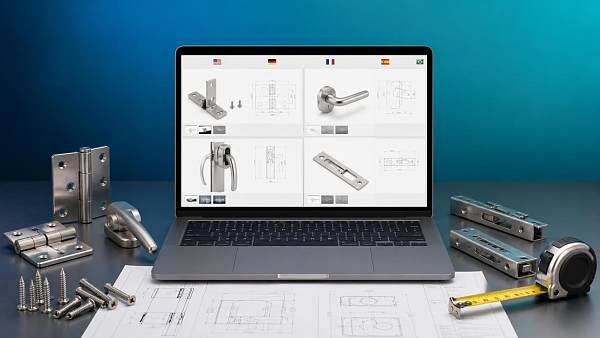
There is a common misconception here: that “grammatical fluency” means a translation is correct. For hardware fasteners and decoration engineering materials, the most dangerous errors are often not grammar issues, but cases where technical qualifiers are weakened, omitted, or replaced. For example, describing coatings, corrosion resistance grades, applicable environments, or load-bearing conditions too broadly may cause customers to select products for the wrong scenarios; directly applying specifications commonly used in China to overseas market practices can also increase friction in subsequent quotations and communication.
What Determines Whether to Build a Multilingual Website Is Not the Number of Countries, but the Conversion Path
Not all architectural and interior decoration companies should build websites in more than a dozen languages from the outset. Whether to add languages should be determined based on existing markets and customer acquisition paths.
If a company mainly closes deals through trade shows, long-term agents, or regular customers, the website serves primarily as an endorsement and information display. An English main website plus core pages for key markets may already meet its needs. Blindly expanding multilingual content at this stage may instead result in a large number of pages that are not updated over the long term and contain inconsistent parameters.
If a company expects to continuously acquire new inquiries through Google organic search, regional search engines, overseas social media content, or advertising landing pages, the priority of multilingual content will rise significantly. This is because customers in non-English-speaking markets often use their native languages to search for specific product categories, specifications, and application issues. A product page available only in English, even if understandable, may not cover actual local search expressions.
Situations more suitable for prioritizing investment in multilingual content include: stable inquiries or agent networks have already emerged in certain countries; products have clear regional applications, such as door and window systems, curtain wall fittings, roof installation, sanitary fittings, or building anchoring; the company can provide specifications, packaging, documents, and after-sales support commonly used in the relevant markets; and the sales team has the capability to handle inquiries in local languages.
Conversely, if product information itself is still incomplete, English specifications frequently contradict one another, or quotations, delivery schedules, and certification documents cannot be provided consistently, a multilingual website cannot solve the problem of export growth. It will only spread incomplete information to more markets more quickly.
Four Types of Risks Most Easily Overlooked in Product Page Translation
Mixed use of units and specification systems. Millimeters, inches, thread specifications, length markings, packaging quantities, and weight units must be presented consistently, with the conversion logic explained. Numbers cannot simply be retained as they are while assuming overseas customers will understand them on their own. Particular verification is needed when threads, hole diameters, wrench sizes, and installation depths are involved.
Standard names are “translated.” Standard numbers such as ISO, DIN, EN, and ASTM generally should not be casually rewritten; however, companies should not merely pile up standard abbreviations. Pages need to explain the specific standards with which products comply or that they reference, as well as the applicable version, scope, and actual configuration of the standards. Unconfirmed statements that a product “complies with a certain standard” may create compliance and commercial risks.
Distorted descriptions of materials and surface treatments. Content such as stainless steel, carbon steel, alloy steel, zinc plating, Dacromet-type coatings, phosphating, and spray coating relates to corrosion resistance, cost, and operating environments. AI can recognize common terms, but it cannot automatically determine the precise process corresponding to an internal company abbreviation, nor can it replace confirmation of the product’s actual condition.
Overpromising application scenarios. Architectural and interior decoration products are often used indoors, outdoors, in humid environments, coastal areas, or load-bearing structures. Directly using absolute claims such as “suitable for all environments,” “high strength,” or “permanently rust-proof” on a page not only appears unprofessional but may also lead to subsequent disputes. A more prudent approach is to specify applicable conditions and remind customers to confirm based on substrate material, load, environmental classification, and local regulations.
The Challenge of Multilingual SEO Lies in Page Structure, Not Just the Body Text
After completing translation, many companies find that their non-English pages receive no exposure for a long time. The issue often lies not in language quality itself, but in website structure. Different language versions need clear, crawlable, independent URLs and corresponding relationships; page titles, descriptions, navigation, product categories, image alternative text, downloadable materials, and form prompts should also be localized simultaneously. Replacing only the body text with another language while retaining Chinese links, English categories, or confusing redirect rules will weaken search engines’ ability to determine the language and target region of a page.
Another issue is “one term covering all markets.” Languages such as Spanish, French, and Arabic span multiple countries and regions, where the names of the same product and procurement priorities may differ. Companies do not need to copy the entire website separately for every country, but should use actual market data to prioritize high-value category pages, core product pages, and landing pages, avoiding the creation of low-quality pages through large amounts of similar content.
From a long-term operational perspective, the most valuable thing is not how many languages are launched at once, but establishing a sustainable content update mechanism: when product parameters change, all language versions can be updated simultaneously; when new models are added, pages can be generated using unified terminology; after business personnel receive new questions, they can turn them into installation instructions, selection guides, or frequently asked questions; and when search terms in key markets change, categories and page wording can be adjusted.
A More Practical Decision-Making Approach: Tier Content by Risk Rather Than Applying a One-Size-Fits-All Language Strategy
Architectural and interior decoration companies can divide website content into three levels. Corporate news, general brand introductions, and non-technical service processes can be first translated by AI and then linguistically polished; product category descriptions, standard product pages, and application articles should use AI first drafts plus terminology review; while specification tables, installation manuals, testing report descriptions, certification declarations, and load-bearing or weather-resistance performance descriptions should enter a strict review process and, where necessary, be confirmed by the technical manager.
The value of this approach is not only to reduce translation costs, but more importantly to allocate limited human resources to the areas most likely to affect inquiry quality, order liability, and brand credibility. A multilingual website should not become a material transfer project; it should be part of a company’s overseas sales system.
For companies evaluating website development or redesign, the question truly worth asking is not “Should we build a multilingual website?” but “Which markets are already worth building trust in through local languages, and can the company continuously maintain these commitments?” AI can significantly improve content production efficiency, but it cannot replace product definition, market judgment, or technical responsibility. For highly specialized products such as hardware fasteners, the most reliable path is usually to first use AI to improve coverage speed, then use professional review to safeguard accuracy, ensuring that every page entering overseas markets can withstand the scrutiny of search, inquiries, and actual product selection.
Related Articles
Related Products
 Yiyingbao SaaS Intelligent Website Building and Marketing SystemYiyingbao SaaS Intelligent Website Building and Marketing System, AI-powered no-code website building, rapid creation of multilingual B2B international websites in 10 minutes, global server acceleration, AI-powered SEO optimization, helping businesses connect efficiently with global markets. The perfect integration of technology and operation makes building an international trade website remarkably simple
 AI+SEM Intelligent Advertising Marketing SystemAI+SEM drives intelligent ad creation, empowering full-funnel precision advertising marketing. The system automatically generates weekly/monthly reports, AI recommends keywords and target countries, monitors core metrics in real-time with intelligent alerts, and enables one-click high-conversion ad solutions to help quickly acquire customers and improve ROI.
 AI+SEO Dual-Engine System Optimization ServicesYiyingbao’s AI+SEO dual-engine optimization system helps foreign trade enterprises acquire high-quality organic traffic through AI-powered keyword research, content generation, and comprehensive technical optimization, significantly improving search rankings and conversion rates.
 AI+SNS Social Media Marketing SystemYingbao AI+SNS Social Media Marketing System - Precision social capture for the social media era. Supports one-click content synchronization across major platforms like Facebook and LinkedIn. AI intelligently rewrites posts for enhanced relevance. 24/7 AI customer service and user profiling analysis empower businesses to efficiently expand into global markets.
 AI+SEO营销解决方案易营宝AI+SEO营销解决方案,通过AI批量写作、智能生成TDK、精准关键词扩词等功能,全面优化网站SEO效果,提升流量与转化率。助力企业构建高效智能网站新生态。
 AI+SEM Advertising Marketing SolutionsAI+SEM Advertising Marketing Solution leverages AI technology to deeply empower SEM ad campaigns. It automatically generates weekly/monthly reports using AI, presenting account data across multiple dimensions for comprehensive insights into campaign performance and trends. The system precisely recommends keywords and target countries, intelligently generates high-conversion ad copy, and enables one-click activation of efficient campaign plans to help businesses rapidly acquire customers. Simultaneously, it monitors core metrics in real time, intelligently identifies abnormal fluctuations, and issues timely alerts to ensure stable, high-return advertising results.
 Domain Name ServicesEasyWin provides professional domain name services, including intelligent queries, one-stop registration, brand protection, and full lifecycle management, helping businesses build a digital brand image.
 EasyOperate B2C Cross-Border E-Commerce Platform & Independent WebsiteEasyStore B2C Cross-border E-commerce Independent Store is an intelligent website building and cross-border e-commerce integrated solution independently developed by EasyStore Information Technology (Beijing) Co., Ltd. The system is specially designed for small and medium-sized as well as large export enterprises, integrating 'website building, operation, marketing, advertising, and conversion' into one, helping enterprises quickly establish cross-border e-commerce independent stores to achieve brand globalization and global sales growth.
The platform supports multiple languages, multiple currencies, and multi-channel marketing, with built-in AI intelligent translation and SEO optimization systems, suitable for mainstream markets such as Southeast Asia, Europe and America, Latin America, and the Middle East, assisting Chinese manufacturing enterprises in efficiently deploying international e-commerce strategies. SSL证书易营宝提供专业SSL安全证书服务,包括单域名和泛域名证书,确保网站数据传输加密、身份验证和完整性保护,助力企业建立安全可信的在线业务环境。









