









- Which customer acquisition channels will be affected by cross-border marketing trends in 2026?Sep 06, 2026View details
- Which homogenization risks should be considered in an analysis of the AI-powered website building industry?Aug 30, 2026View details
- How Will AI Marketing Trends 2026 Change Advertising Budget AllocationAug 28, 2026View details
- Is the EV SSL certificate market shrinking or upgrading? How should companies assess certificate procurement?Aug 11, 2026View details
- Why the old AMP SEO 2020 practices no longer work and what has changed in current optimization prioritiesAug 02, 2026View details
- How to Choose Topics for an Industry News Section to Attract More Organic Search TrafficJul 29, 2026View details
Signal from the FHA Exhibition: Southeast Asian Buyers Are Including SGX Electronic Contract Evidence Preservation in Their Independent Website Requirements
The FHA Singapore International Food & Hotel Exhibition held in April 2026 conveyed a noteworthy change for food trade and catering supply chain companies. According to the information provided this time, leading importers and restaurant chain groups from Singapore, Thailand, Malaysia and other countries generally put forward a new requirement during discussions: the partner’s independent website must integrate an SGX-standard electronic contract signing and blockchain evidence-preservation module that complies with the revised framework of Singapore’s Electronic Transactions Act. This capability has been incorporated into the core indicators of their supplier digitalization rating.
This means that the role of an independent website in cross-border food ingredient trade is extending beyond product presentation and inquiry collection to contract signing, fulfillment records and compliance coordination. For suppliers targeting the high-end food ingredient market in Southeast Asia, whether a website has verifiable electronic contract capabilities may no longer be merely a technical configuration issue, but may begin to influence purchasers’ assessment of cooperation efficiency, compliance standards and fulfillment credibility.
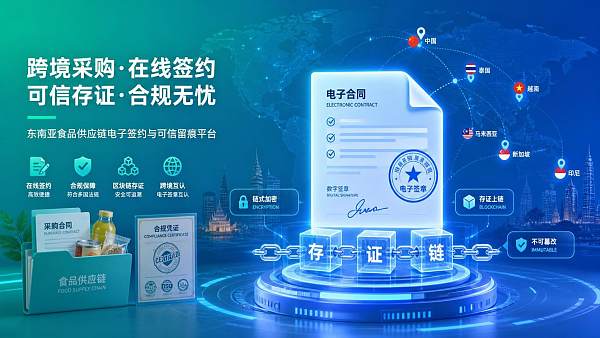
From “Online Presentation” to “Transaction Infrastructure”
Based on the information currently available, the fact that purchasers have collectively put forward a unified direction for technical requirements reflects a shift in their focus when evaluating suppliers. In the past, independent websites mainly served to communicate brand and product information; today, procurement teams clearly place greater emphasis on whether the transaction process can be completed online, particularly whether standardized capabilities are available for contract signing, document evidence preservation and subsequent traceability.
The industry signal behind this change is direct: in high-end food ingredient procurement scenarios, digital capabilities are becoming more specific and verifiable. Compared with general statements about “digital transformation,” the requirements put forward by purchasers this time are practical and implementable functions. Companies’ ability to meet them can be quickly identified by purchasers and is more likely to be incorporated into supplier tier management.
Why This Requirement Deserves the Attention of Exporters and Supply Chain Companies
For relevant suppliers, the impact of the new requirement may first appear in the early-stage customer acquisition and business conversion process. Even if a product, pricing and supply capability are competitive, a company may face additional explanation costs during the initial communication stage if its independent website cannot support a compliant signing and evidence-preservation process. It may even affect the opportunity to enter the purchaser’s approved supplier list.
More importantly, once such requirements become a consensus among leading purchasers, their spillover effects often extend beyond a single exhibition or individual negotiation. In the short term, the requirements may first become concentrated among importers and restaurant chain groups with higher compliance, audit and process efficiency expectations. If these practices continue, other purchasing entities may also follow suit and regard electronic contract and evidence-preservation capabilities as basic requirements for cross-border cooperation.
What Companies Are Being Asked to Do Is More Than Simply “Add a Function”
On the surface, this involves adding electronic signing and blockchain evidence-preservation modules to an independent website; in actual business operations, however, it is closer to a restructuring of the transaction process. Companies need to consider not only whether there is a contract-signing entry point on the page, but also whether contract initiation, identity verification, version management, record retention and integration with existing business processes are all seamless.
If a company’s independent website is still primarily used for static presentation, the next issue to consider may be whether the website system is capable of supporting transaction-oriented functions. If a temporary third-party tool is simply added without establishing a clear and stable process that purchasers can identify, the results may not be ideal. What purchasers emphasize is the verifiability of standards, evidence preservation and compliance, rather than simply having an “electronic signing function.”
This May Also Change the Logic of Supplier Digitalization Ratings
It is worth noting that the summary clearly states that this function has become a core indicator of supplier digitalization ratings. This wording indicates that purchasers do not regard it as an optional bonus, but are more likely to treat it as an important threshold influencing cooperation decisions. For industry professionals, this deserves greater attention than a general technical preference, because once rating standards are established, they often further affect procurement access, communication priority and the efficiency of advancing cooperation.
However, based on the information currently provided, it remains necessary to continue observing the extent to which this requirement will spread and whether different purchasing entities will have completely consistent requirements regarding integration depth, process standards and evidence-preservation formats. Further details worthy of attention will generally come from additional information disclosed publicly by companies, information released by regulatory authorities, documents from standards organizations and further details in public industry reports.
As far as this information itself is concerned, the clearest signal has already emerged: in Southeast Asia’s high-end food ingredient procurement scenarios, independent websites are increasingly being required to undertake stronger compliance and transaction functions. For companies wishing to continue serving leading regional importers and restaurant chain customers, whether to promptly assess their independent websites’ contract-signing and evidence-preservation capabilities has become a practical business issue.
Related Articles
 What are the fundamental differences between B2B website translation and B2C website translation?
 Website Localization Is More Than Translation: What Else Should Be Adjusted Before Entering a New Market?
 How Can Multilingual Website Translation Avoid Machine Translation Distortion and Brand Messaging Inconsistencies



Related Products
 Yiyingbao SaaS Intelligent Website Building and Marketing SystemYiyingbao SaaS Intelligent Website Building and Marketing System, AI-powered no-code website building, rapid creation of multilingual B2B international websites in 10 minutes, global server acceleration, AI-powered SEO optimization, helping businesses connect efficiently with global markets. The perfect integration of technology and operation makes building an international trade website remarkably simple
 AI+SEM Intelligent Advertising Marketing SystemAI+SEM drives intelligent ad creation, empowering full-funnel precision advertising marketing. The system automatically generates weekly/monthly reports, AI recommends keywords and target countries, monitors core metrics in real-time with intelligent alerts, and enables one-click high-conversion ad solutions to help quickly acquire customers and improve ROI.
 AI+SEO Dual-Engine System Optimization ServicesYiyingbao’s AI+SEO dual-engine optimization system helps foreign trade enterprises acquire high-quality organic traffic through AI-powered keyword research, content generation, and comprehensive technical optimization, significantly improving search rankings and conversion rates.
 AI+SNS Social Media Marketing SystemYingbao AI+SNS Social Media Marketing System - Precision social capture for the social media era. Supports one-click content synchronization across major platforms like Facebook and LinkedIn. AI intelligently rewrites posts for enhanced relevance. 24/7 AI customer service and user profiling analysis empower businesses to efficiently expand into global markets.
 AI+SEO营销解决方案易营宝AI+SEO营销解决方案,通过AI批量写作、智能生成TDK、精准关键词扩词等功能,全面优化网站SEO效果,提升流量与转化率。助力企业构建高效智能网站新生态。
 AI+SEM Advertising Marketing SolutionsAI+SEM Advertising Marketing Solution leverages AI technology to deeply empower SEM ad campaigns. It automatically generates weekly/monthly reports using AI, presenting account data across multiple dimensions for comprehensive insights into campaign performance and trends. The system precisely recommends keywords and target countries, intelligently generates high-conversion ad copy, and enables one-click activation of efficient campaign plans to help businesses rapidly acquire customers. Simultaneously, it monitors core metrics in real time, intelligently identifies abnormal fluctuations, and issues timely alerts to ensure stable, high-return advertising results.
 Domain Name ServicesEasyWin provides professional domain name services, including intelligent queries, one-stop registration, brand protection, and full lifecycle management, helping businesses build a digital brand image.
 EasyOperate B2C Cross-Border E-Commerce Platform & Independent WebsiteEasyStore B2C Cross-border E-commerce Independent Store is an intelligent website building and cross-border e-commerce integrated solution independently developed by EasyStore Information Technology (Beijing) Co., Ltd. The system is specially designed for small and medium-sized as well as large export enterprises, integrating 'website building, operation, marketing, advertising, and conversion' into one, helping enterprises quickly establish cross-border e-commerce independent stores to achieve brand globalization and global sales growth.
The platform supports multiple languages, multiple currencies, and multi-channel marketing, with built-in AI intelligent translation and SEO optimization systems, suitable for mainstream markets such as Southeast Asia, Europe and America, Latin America, and the Middle East, assisting Chinese manufacturing enterprises in efficiently deploying international e-commerce strategies. SSL证书易营宝提供专业SSL安全证书服务,包括单域名和泛域名证书,确保网站数据传输加密、身份验证和完整性保护,助力企业建立安全可信的在线业务环境。









