









- Which customer acquisition channels will be affected by cross-border marketing trends in 2026?Sep 06, 2026View details
- Which homogenization risks should be considered in an analysis of the AI-powered website building industry?Aug 30, 2026View details
- How Will AI Marketing Trends 2026 Change Advertising Budget AllocationAug 28, 2026View details
- Is the EV SSL certificate market shrinking or upgrading? How should companies assess certificate procurement?Aug 11, 2026View details
- Why the old AMP SEO 2020 practices no longer work and what has changed in current optimization prioritiesAug 02, 2026View details
- How to Choose Topics for an Industry News Section to Attract More Organic Search TrafficJul 29, 2026View details
How Can Multilingual Website Translation Avoid Machine Translation Distortion and Brand Messaging Inconsistencies
When overseas customers open a website, they do not naturally understand the brand simply because the content has been translated into English, Japanese, or Spanish. An apparently harmless literal translation may make product advantages sound stiff, turn call-to-action buttons into commands, or even create ambiguity in otherwise rigorous technical descriptions. For personnel responsible for website content maintenance, product listing, or overseas marketing execution, the real challenge of multilingual website translation is not replacing Chinese with another language, but enabling users in different markets to receive information that is equally clear, credible, and aligned with the brand’s character.
This is especially true for export manufacturing, cross-border e-commerce, and B2B lead-generation websites, where every sentence on a page may affect whether users continue browsing or submit a form. To avoid machine-translation distortion and deviations in brand messaging, it is necessary to establish a working method covering content preparation, translation execution, and pre-launch verification, rather than putting all website text into a translation tool at once.
Multilingual Website Translation: Distortion Often Starts with the Chinese Source Copy
Many people find that foreign-language pages sound unnatural and immediately assume that machine translation is not good enough. In practice, however, the problem often lies in the source-language content itself: a single Chinese sentence may stack multiple selling points, industry abbreviations, and modifiers with unclear subject-predicate relationships; product models, dimensional units, and delivery terms may be mixed into one paragraph; and claims such as “high quality” or “capable manufacturer” may lack specific evidence. Even when such content is handed over to human translators, it is difficult to achieve accurate and natural results.
Before translation, it is advisable to first prepare the content for translation. Break up long sentences, and clearly distinguish technical parameters, application scenarios, certification information, and service commitments; standardize product names, models, specification units, and terminology; and provide context for terms that may be easily misunderstood. For example, “customized” may be translated as customized, tailor-made, or made-to-order on different pages. The specific wording depends on product attributes and transaction methods and should not be mechanically replaced across the entire website.
For operational personnel, a concise glossary is highly valuable. At a minimum, it should include whether brand names should remain in the original language, core product names, industry terminology, prohibited translations, commonly used button copy, and unit and date formats. It serves as both a translation reference and a basis for maintaining consistency when adding pages or updating products later.
Machine Translation Can Participate, but It Cannot Determine the Final Wording on Its Own
AI translation is suitable for initial translation, batch processing, and terminology pre-matching, and can significantly reduce repetitive work. However, it does not understand what a company truly wants to emphasize, nor can it automatically determine whether a sentence should take a more technical, sales-oriented, or service-oriented tone. Therefore, a more reliable multilingual website translation process should be “machine acceleration + human calibration + native-language review.”
- Machine initial translation: Used to create a basic version and process repetitive product fields, category names, and standard descriptions.
- Business proofreading: Conducted by people familiar with the products to confirm whether facts such as parameters, materials, processes, lead times, and compatibility ranges are accurate.
- Localization polishing: Performed by people proficient in the target language who understand marketing or the industry, to adjust sentence order, wording, and reading flow.
- Page acceptance: Checks layout, links, buttons, form prompts, and mobile display in the actual website environment.
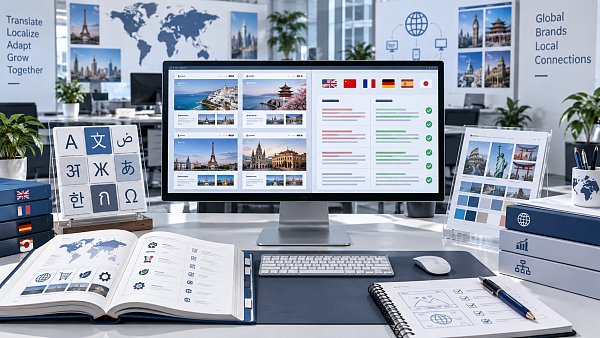
Here, “human proofreading” is not merely about correcting grammar. For example, a Chinese page may say “Consult Now”; on an English B2B website, it may be more appropriate to use “Request a Quote,” “Talk to Our Team,” or “Get Product Details,” depending on the context. Translating everything as “Consult Now” may not be grammatically wrong, but it does not match the habits of many overseas procurement users. Although buttons, navigation menus, pop-ups, and form fields are short, they directly affect the user experience and therefore require even more careful handling.
Brand Messaging Deviations Are Usually Hidden in Three Easily Overlooked Areas
First, an unbalanced tone. Chinese marketing often emphasizes words such as “leading,” “top-tier,” and “the best online.” If such absolute claims remain on overseas pages, they can easily appear exaggerated. Rather than repeatedly emphasizing adjectives, use verifiable information instead, such as production capacity ranges, supported service stages, product testing items, or application industries. Brand credibility often comes from restraint, specificity, and consistency.
Second, cultural context misalignment. Different markets have different levels of acceptance regarding forms of address, privacy, promotions, and after-sales commitments. Pages targeting markets such as Germany and France should pay particular attention to the accurate expression of data collection notices, Cookie prompts, and terms of service. For markets in the Middle East, Latin America, or Southeast Asia, holiday visuals, images of people, color associations, and local information related to payment and logistics should be handled carefully. Translating text is only one part of localization; the page context must also be reviewed accordingly.
Third, brand language gets “translated away.” A brand mission, value proposition, and differentiated capabilities should not be expressed differently on every page. A standard version of core statements should be established, while allowing natural adjustments in different languages without changing the meaning. What should be retained is the brand promise, not Chinese sentence structures. For abstract concepts such as enterprise digitalization and AI capabilities, avoid vague terminology; relevant content may draw on the ideas of system coordination and accurate information delivery in An Analysis of the Integrated Development Path of Enterprise Artificial Intelligence and Accounting Informatization, translating complex capabilities into specific scenarios that users can understand.
Before Launch, Check Pages Through “User Tasks” Rather Than Only Reviewing the Translation
Comparing every sentence on a foreign-language page with the Chinese original can easily lead to the misconception that literal equivalence is necessary for reassurance. A more effective approach is to simulate the target user completing tasks: Can they understand what you sell within 30 seconds? Can they understand the product parameters and minimum order conditions? After clicking to make an inquiry, are the form prompts clear? Does the successful submission page tell them what will happen next?
It is advisable to conduct acceptance checks according to page priority. The homepage, core product pages, solution pages, inquiry pages, and advertising landing pages should be prioritized for in-depth human review. News pages, FAQs, and long-tail product pages can use “AI initial translation + sample review” after terminology has been standardized. For Google SEO pages, also check whether titles, descriptions, image alt text, and internal-link anchor text match search habits in the target language. A direct translation of Chinese keywords does not necessarily mean that anyone will search for them; when necessary, page topics should be rewritten based on the wording commonly used by local users.
Keep Translated Content Continuously Manageable Instead of Reworking It from Scratch with Every Revision
The greatest concern for multilingual websites is that “the initial work is good, but later changes become increasingly disorganized.” When new products are launched, Chinese copy is updated, or promotional campaigns are replaced, old translations, outdated links, and inconsistent terminology will continue to accumulate without version management. In practice, each page can be marked with the source-language update date, translation status, proofreader, and items pending confirmation. When core terminology is adjusted, search related pages across the entire website simultaneously rather than changing only the item currently in view.
Yiyingbao provides AI-powered website development, multilingual website development, SEO, and advertising marketing services for overseas promotion scenarios. During the website development stage, language versions, page structures, and promotion requirements can be incorporated into unified management. For enterprises, the value of tools is not to completely replace judgment, but to reduce disconnects among content updates, translation collaboration, and multi-channel advertising.
Ultimately, good multilingual website translation makes users barely feel that “this is a translated page.” What they see is clear product information, communication methods that match their habits, and a brand worth learning more about. When translation is treated as a new expression for local users, an overseas website becomes more than a site with several language entry points—it truly gains the ability to connect with the market.
Related Articles
 Website Localization Is More Than Translation: What Else Should Be Adjusted Before Entering a New Market?
 How Can Multilingual Website Translation Avoid Machine Translation Distortion and Brand Messaging Inconsistencies
 How Can a Multilingual Website SEO Architecture Prevent Country Sites from Competing for Rankings?

Related Products
 Yiyingbao SaaS Intelligent Website Building and Marketing SystemYiyingbao SaaS Intelligent Website Building and Marketing System, AI-powered no-code website building, rapid creation of multilingual B2B international websites in 10 minutes, global server acceleration, AI-powered SEO optimization, helping businesses connect efficiently with global markets. The perfect integration of technology and operation makes building an international trade website remarkably simple
 AI+SEM Intelligent Advertising Marketing SystemAI+SEM drives intelligent ad creation, empowering full-funnel precision advertising marketing. The system automatically generates weekly/monthly reports, AI recommends keywords and target countries, monitors core metrics in real-time with intelligent alerts, and enables one-click high-conversion ad solutions to help quickly acquire customers and improve ROI.
 AI+SEO Dual-Engine System Optimization ServicesYiyingbao’s AI+SEO dual-engine optimization system helps foreign trade enterprises acquire high-quality organic traffic through AI-powered keyword research, content generation, and comprehensive technical optimization, significantly improving search rankings and conversion rates.
 AI+SNS Social Media Marketing SystemYingbao AI+SNS Social Media Marketing System - Precision social capture for the social media era. Supports one-click content synchronization across major platforms like Facebook and LinkedIn. AI intelligently rewrites posts for enhanced relevance. 24/7 AI customer service and user profiling analysis empower businesses to efficiently expand into global markets.
 AI+SEO营销解决方案易营宝AI+SEO营销解决方案,通过AI批量写作、智能生成TDK、精准关键词扩词等功能,全面优化网站SEO效果,提升流量与转化率。助力企业构建高效智能网站新生态。
 AI+SEM Advertising Marketing SolutionsAI+SEM Advertising Marketing Solution leverages AI technology to deeply empower SEM ad campaigns. It automatically generates weekly/monthly reports using AI, presenting account data across multiple dimensions for comprehensive insights into campaign performance and trends. The system precisely recommends keywords and target countries, intelligently generates high-conversion ad copy, and enables one-click activation of efficient campaign plans to help businesses rapidly acquire customers. Simultaneously, it monitors core metrics in real time, intelligently identifies abnormal fluctuations, and issues timely alerts to ensure stable, high-return advertising results.
 Domain Name ServicesEasyWin provides professional domain name services, including intelligent queries, one-stop registration, brand protection, and full lifecycle management, helping businesses build a digital brand image.
 EasyOperate B2C Cross-Border E-Commerce Platform & Independent WebsiteEasyStore B2C Cross-border E-commerce Independent Store is an intelligent website building and cross-border e-commerce integrated solution independently developed by EasyStore Information Technology (Beijing) Co., Ltd. The system is specially designed for small and medium-sized as well as large export enterprises, integrating 'website building, operation, marketing, advertising, and conversion' into one, helping enterprises quickly establish cross-border e-commerce independent stores to achieve brand globalization and global sales growth.
The platform supports multiple languages, multiple currencies, and multi-channel marketing, with built-in AI intelligent translation and SEO optimization systems, suitable for mainstream markets such as Southeast Asia, Europe and America, Latin America, and the Middle East, assisting Chinese manufacturing enterprises in efficiently deploying international e-commerce strategies. SSL证书易营宝提供专业SSL安全证书服务,包括单域名和泛域名证书,确保网站数据传输加密、身份验证和完整性保护,助力企业建立安全可信的在线业务环境。









