









- AliExpress Announces New Service Rules for Russia, Linked to Wildberries Product IntegrationOct 28, 2026View details
- Black Friday Preparations Enter the Final Sprint Week as Cross-Border E-Commerce Platforms Roll Out Their PlansOct 28, 2026View details
- CBP Finalizes Electronic Rail Export Manifest Rule, Effective October 26, 2026Oct 26, 2026View details
- Amazon’s 2026 peak season surcharge takes effect on October 25Oct 26, 2026View details
- AI Is Eating SaaS: Three Real-World Cases in One AfternoonOct 25, 2026View details
- Exiger CEO: The SaaS Apocalypse Is Real, but It Means Something DifferentOct 25, 2026View details
How Can You Keep Product Terminology Consistent Across Multilingual Website Translations?
How Can You Keep Product Terminology Consistent Across Multilingual Websites?
What should you pay attention to when translating a multilingual website? Inconsistent product terminology is an easy issue to overlook. The same piece of equipment may be given one name on the category page, described differently on the product page, and referred to by an outdated name in a downloadable spec sheet. Customers may not point out the translation issue, but they may wonder: Is this a different product? Are the accessories compatible?
Resolving this issue takes more than asking translators to “check for consistency.” A more reliable approach is to link product concepts and target-language names to the publishing process. This is especially important when different people manage the website, advertising, and social media: everyone needs a shared source of truth for terminology.
Confirm That It’s the Same Concept Before Standardizing the Translation
Many translation disagreements actually stem from the Chinese source materials. For example, “control cabinet,” “electrical control cabinet,” and “power distribution cabinet” should not be treated as the same term just because they look similar. Product or technical staff need to confirm whether these are different names for the same product or refer to equipment with different functions. If the source concepts are unclear, a more uniform translation can simply make it easier to replicate the error at scale.
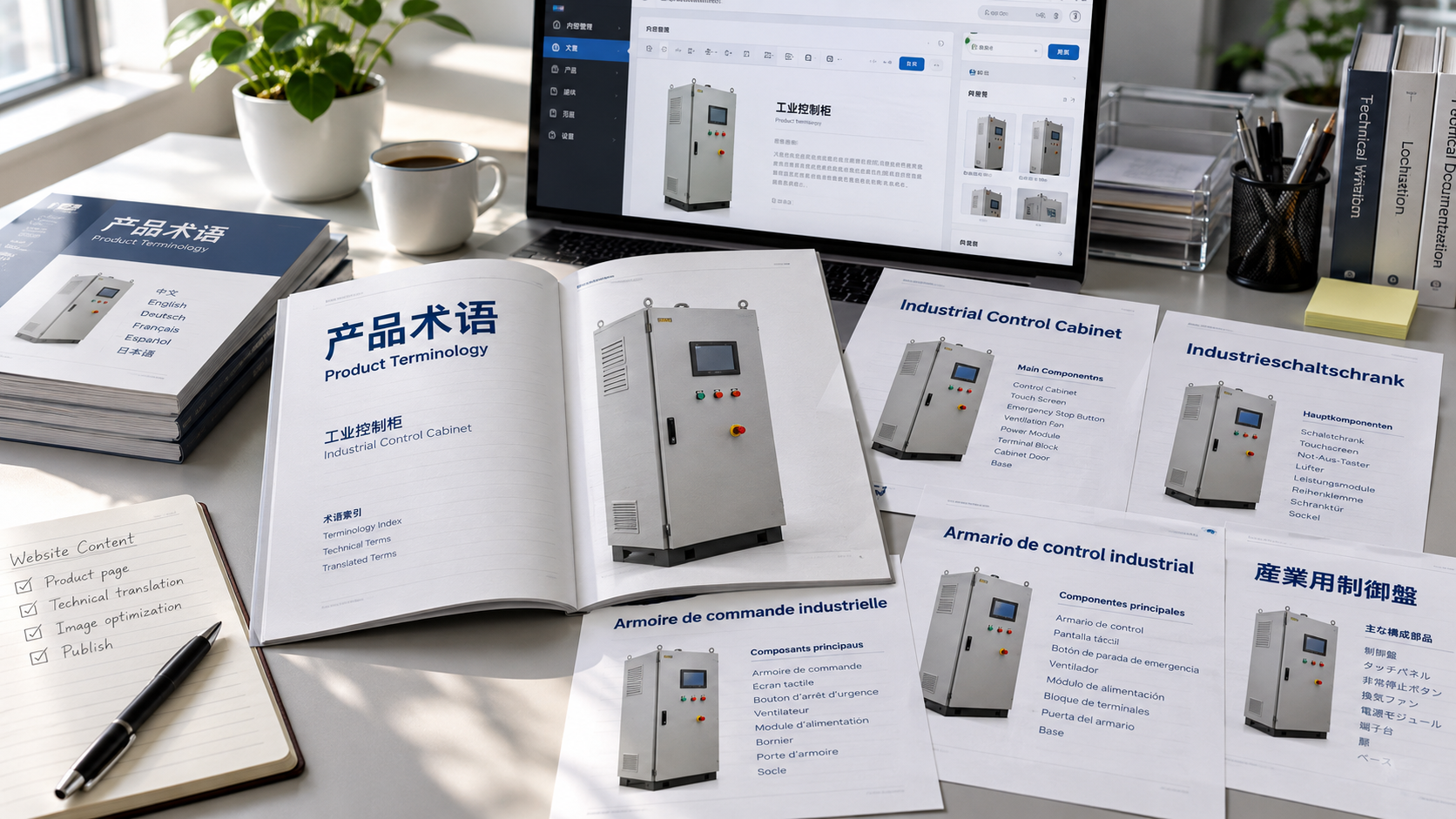
Start with product categories, key models, and frequently used accessories. Assign an internal ID to each concept and link it to the model, purpose, and any relevant structural images. The ID is not for customers; it helps website teams, translators, and marketers confirm whether they are working with the same product.
A Terminology Database Should Guide Work, Not Just List Two Columns
A table with only “Chinese name” and “foreign-language translation” is often insufficient when regional differences and near-synonyms arise. A practical product terminology database should include at least the following information:
- Concept description: What the product is, where it is used, and which similar components it must not be confused with.
- Preferred name: Record the name by language and target region, noting abbreviations where necessary.
- Prohibited or outdated translations: Explain why they should not be used, making it easier to check existing pages.
- Usage scope: Distinguish between the product’s official name, marketing aliases, and search-related synonyms.
- Approval record: Keep track of the reviewer, update date, and applicable product range.
You don’t need to organize every product before starting translation. It is usually easier to put the core product categories and potentially confusing terms in order first, then add to the database as new products are launched. Terms that are still under discussion should be marked as pending confirmation and kept out of bulk publishing workflows.
It is also important to distinguish a terminology database from a translation memory: the former governs how key concepts are expressed, while the latter reuses previously translated sentences and segments. If past translations were inconsistent, reusing them without review will only perpetuate the problem.
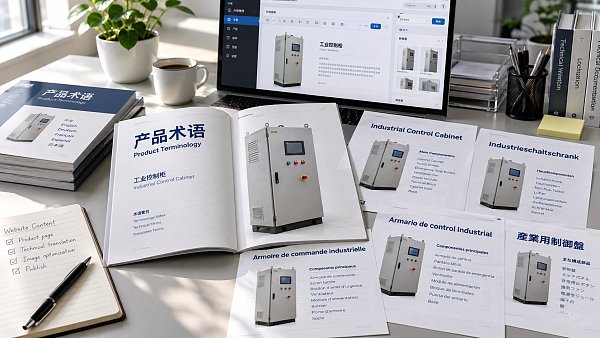
Keep the Product Identity Consistent, Not Every Page’s Wording
Terminology consistency does not mean there can only be one way to express something. Buyers may use different industry terms for the same product in different markets, even within the same language. Consider local industry websites, the wording used in customer inquiries, and actual search performance instead of relying on dictionaries alone. Regional names may differ, but they should all be linked to the same product concept.
On product pages, use the confirmed official name in the product title and specifications table. The body copy can naturally explain common local aliases to help customers understand. Ad headlines can be shorter, but don’t describe an accessory as a complete machine or present an optional feature as standard just to attract clicks. Search synonyms can provide additional information, but should not make the same product appear to belong to multiple categories.
Models, material grades, units, and interface names also need to be checked individually. Follow the brand owner’s existing rules for whether brand names and registered names should be translated. Statements about performance and certifications must be checked against product documentation; translators should not “optimize” them on their own.
Build Checks into the Publishing Process Instead of Fixing Problems After Launch
When using AI-assisted translation, provide the terminology list, product background, and items that must not be changed. “Be professional and accurate” is too vague. Specifying which terms must be retained and which names must not appear makes the instructions actionable. However, providing a terminology list does not guarantee that the output will follow it, so you still need to check for omissions, variants, and incorrect usage in context.
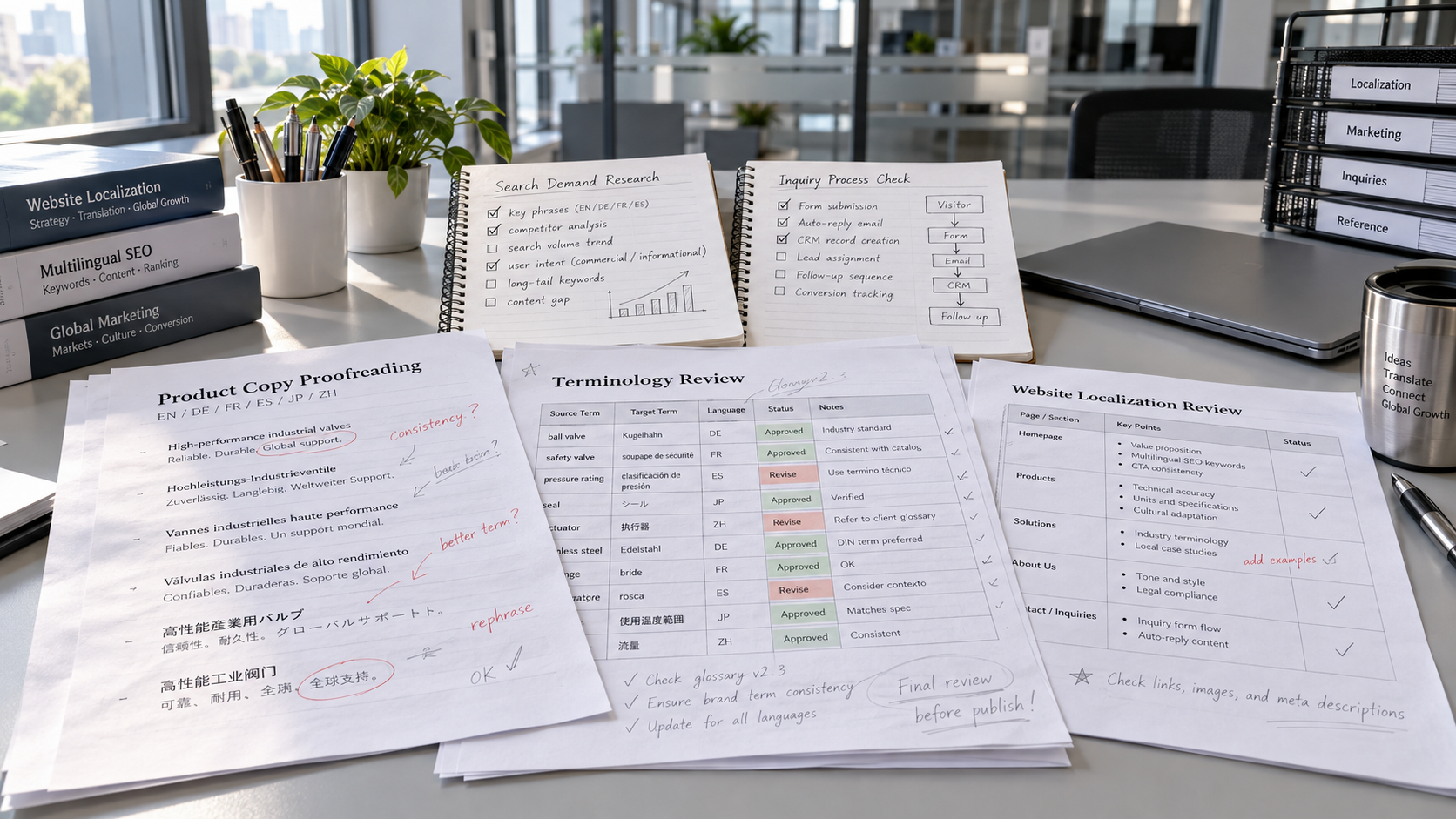
Reviews can be divided by role: product staff check the technical meaning, target-language reviewers assess whether the wording fits local conventions, and website operations staff check how the content appears on the site. Automated comparisons can help identify outdated terms and model-number discrepancies, but they cannot replace semantic judgment. Pay particular attention to whether relationships such as “suitable for” and “compatible with” have been translated correctly.
Checks should also go beyond the body copy. Navigation, filters, text in images, search snippet descriptions, downloadable materials, and inquiry forms may all contain outdated names. Before launch, follow one product through the “category page–product page–downloadable materials–inquiry” journey in each language. This makes it easier to spot the points where customers may encounter inconsistencies.
When Product Names Change, Update Marketing Content Too
For an integrated service like Yiyingbao, which covers intelligent website building, multilingual websites, search optimization, and ad campaigns, terminology handoffs need to span every stage—not end when the translation is delivered. Businesses can use the approved terminology database as a shared reference and clearly define who can make changes and which teams must be notified when updates are made.
When updating terminology, first list the affected pages, ad landing pages, and materials, then plan the replacements and review. Don’t run a sitewide find-and-replace without checking the context. If a name change affects a URL, separately assess how links and redirects should be handled. The most practical starting point is to choose one key product and check its name across all languages and channels. Once that process works smoothly, expand it to the entire product catalog.
Related Articles
 How Can Brands Going Global Assess a Multilingual Website Provider’s Localization Capabilities?
 How to Validate RTL Layouts for Arabic Website Development Services in Shanghai
 How Can You Keep Product Terminology Consistent Across Multilingual Website Translations?
Related Products
 Yiyingbao SaaS Intelligent Website Building and Marketing SystemYiyingbao SaaS Intelligent Website Building and Marketing System, AI-powered no-code website building, rapid creation of multilingual B2B international websites in 10 minutes, global server acceleration, AI-powered SEO optimization, helping businesses connect efficiently with global markets. The perfect integration of technology and operation makes building an international trade website remarkably simple
 AI+SEM Intelligent Advertising Marketing SystemAI+SEM drives intelligent ad creation, empowering full-funnel precision advertising marketing. The system automatically generates weekly/monthly reports, AI recommends keywords and target countries, monitors core metrics in real-time with intelligent alerts, and enables one-click high-conversion ad solutions to help quickly acquire customers and improve ROI.
 AI+SEO Dual-Engine System Optimization ServicesYiyingbao’s AI+SEO dual-engine optimization system helps foreign trade enterprises acquire high-quality organic traffic through AI-powered keyword research, content generation, and comprehensive technical optimization, significantly improving search rankings and conversion rates.
 AI+SNS Social Media Marketing SystemYingbao AI+SNS Social Media Marketing System - Precision social capture for the social media era. Supports one-click content synchronization across major platforms like Facebook and LinkedIn. AI intelligently rewrites posts for enhanced relevance. 24/7 AI customer service and user profiling analysis empower businesses to efficiently expand into global markets.
 AI+SEO营销解决方案易营宝AI+SEO营销解决方案,通过AI批量写作、智能生成TDK、精准关键词扩词等功能,全面优化网站SEO效果,提升流量与转化率。助力企业构建高效智能网站新生态。
 AI+SEM Advertising Marketing SolutionsAI+SEM Advertising Marketing Solution leverages AI technology to deeply empower SEM ad campaigns. It automatically generates weekly/monthly reports using AI, presenting account data across multiple dimensions for comprehensive insights into campaign performance and trends. The system precisely recommends keywords and target countries, intelligently generates high-conversion ad copy, and enables one-click activation of efficient campaign plans to help businesses rapidly acquire customers. Simultaneously, it monitors core metrics in real time, intelligently identifies abnormal fluctuations, and issues timely alerts to ensure stable, high-return advertising results.
 Domain Name ServicesEasyWin provides professional domain name services, including intelligent queries, one-stop registration, brand protection, and full lifecycle management, helping businesses build a digital brand image.
 EasyOperate B2C Cross-Border E-Commerce Platform & Independent WebsiteEasyStore B2C Cross-border E-commerce Independent Store is an intelligent website building and cross-border e-commerce integrated solution independently developed by EasyStore Information Technology (Beijing) Co., Ltd. The system is specially designed for small and medium-sized as well as large export enterprises, integrating 'website building, operation, marketing, advertising, and conversion' into one, helping enterprises quickly establish cross-border e-commerce independent stores to achieve brand globalization and global sales growth.
The platform supports multiple languages, multiple currencies, and multi-channel marketing, with built-in AI intelligent translation and SEO optimization systems, suitable for mainstream markets such as Southeast Asia, Europe and America, Latin America, and the Middle East, assisting Chinese manufacturing enterprises in efficiently deploying international e-commerce strategies. SSL证书易营宝提供专业SSL安全证书服务,包括单域名和泛域名证书,确保网站数据传输加密、身份验证和完整性保护,助力企业建立安全可信的在线业务环境。









