









- Can the average annual growth rate reflect real opportunities in overseas markets?Oct 07, 2026View details
- Which customer acquisition channels will be affected by cross-border marketing trends in 2026?Sep 06, 2026View details
- Which homogenization risks should be considered in an analysis of the AI-powered website building industry?Aug 30, 2026View details
- How Will AI Marketing Trends 2026 Change Advertising Budget AllocationAug 28, 2026View details
- Is the EV SSL certificate market shrinking or upgrading? How should companies assess certificate procurement?Aug 11, 2026View details
- Why the old AMP SEO 2020 practices no longer work and what has changed in current optimization prioritiesAug 02, 2026View details
How to Reduce Repeated Rework in Multilingual Content Production
How to Reduce Rework in Multilingual Content Production
Delays in launching overseas websites are often not caused by insufficient translation speed, but because problems only become apparent after the content has been “translated”: product specifications are updated but the English page is not synchronized; an ambiguous promotional statement in Chinese is interpreted differently by teams for different languages; the marketing department temporarily changes advertising selling points, requiring landing pages, emails, and social media materials to be proofread again. What project leaders find most challenging is often not a single revision, but that no one can clearly explain which languages, pages, and campaign assets are affected by this round of changes.
How can multilingual content production workflows be optimized? The key is not to shorten the translation process, but to turn content from “copy files” into manageable, traceable, reusable project assets. For teams responsible for website development, search optimization, advertising, and social media operations at the same time, once content is detached from a unified workflow, rework will continuously multiply across channels: a change on the website is missed on an ad landing page, while search pages retain the old wording. Ultimately, this affects not only the delivery schedule but also customers’ perception of brand professionalism.
Rework Usually Does Not Occur During Translation, but Before It
A common misconception is to finish writing the Chinese pages first and then hand the entire website over for translation. This may seem convenient, but it actually leaves the most difficult issues for later. This is particularly evident on product pages for manufacturing companies: model names, applicable operating conditions, material descriptions, delivery scope, and certification statements are often scattered across sales materials, technical documents, and verbal explanations from business personnel. Translators receive only the page copy, yet cannot determine whether “optional configurations” and “standard configurations” need to be clearly distinguished, nor do they know whether a certain parameter applies only to specific models.
A more subtle issue is that the source content itself lacks a finalization standard. For example, the phrase “customization supported” may include dimensions, colors, and packaging for sales personnel, while overseas buyers may understand it to mean that the entire equipment solution can be redesigned. Once the business team later adds restrictions, multilingual pages must be revised accordingly, including headings, body copy, inquiry form prompts, and ad creatives. So-called translation rework is essentially rework in defining requirements.
Therefore, at the start of a project, it is advisable to establish a “content source file” before rushing to assign languages. It does not need to be as extensive as a technical specification, but it should at least define the product name, key selling points, sources of specifications, prohibited wording, target markets, page purpose, and responsible persons. Content involving prices, delivery times, compliance, and performance commitments should be marked as high-risk fields; such fields should not be rewritten by operations personnel based on experience, nor are they suitable for being entirely left to machine translation.
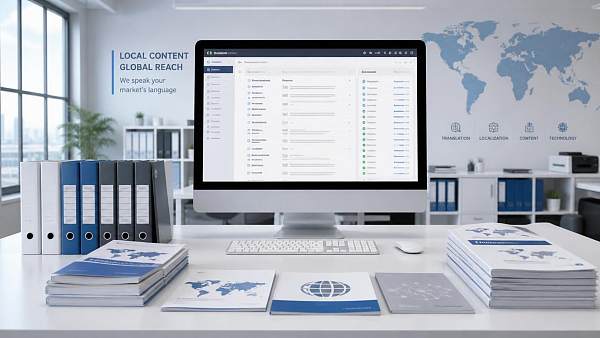
Clarify Content Levels First—Do Not Let Every Page Become an Independent File
An effective way to reduce rework is to divide content into “globally reusable” and “market-specific localization required” sections. Brand positioning, basic product specifications, after-sales processes, and company qualification descriptions can usually be managed as standardized content modules; while heading wording, use cases, call-to-action buttons, units of measurement, and payment and delivery notices often need to be adjusted by market. When these two types of content are mixed in one document, every subsequent update forces the team to reassess whether each sentence needs to be changed.
The content structure of a website system also directly determines the cost of rework. If pages in different languages are maintained separately after being copied, version control can easily get out of control as the number of pages grows. A more suitable approach for long-term operations is to establish clear relationships among the same product, category, and component: when basic specifications are updated, the system can indicate which languages are pending synchronization; when a call-to-action button is modified for a particular market, it will not inadvertently overwrite wording for other markets. This logic also applies across multilingual corporate websites, cross-border online stores, and advertising landing pages.
Reviews Should Not Be Set Only at the End; Establish Several Checkpoints That Can Truly Stop Problems
Many projects have only one review point—“post-translation proofreading.” As a result, reviewers must simultaneously deal with terminology, facts, tone, page layout, and link errors, leaving them only able to make remedial corrections. A more reliable process is to move review responsibilities forward and separate them. Technical or product owners confirm facts, marketing owners confirm information priorities and conversion paths, native-language reviewers or local operations personnel confirm whether wording is natural, and website operations personnel then check page presentation, redirects, and forms.
The key issue to avoid here is that “everyone can give opinions, but no one has final decision-making authority.” The project sheet should clearly specify the decision-maker for each type of issue. For example, whether search keywords should be included in a title should be determined by marketing and content owners based on local search habits; whether parameter units can be converted must be confirmed by the technical team; even if a local team considers a selling point “not attractive enough,” it cannot directly change it into a commitment that exceeds the product’s capabilities. Without such boundaries, additional review rounds only lead to repeated back-and-forth discussions.
AI Can Accelerate First Drafts, but Cannot Replace Version Management and Local Judgment
AI is suitable for highly repetitive tasks, such as extracting terminology, generating initial translations, completing descriptions based on page structures, or checking whether a module has been omitted across multiple languages. For teams with complex product lines and frequent page updates, this can reduce omissions caused by manual copying and pasting. However, it does not know which order terms a company actually accepts, nor does it naturally understand whether buyers in a particular country care more about certifications, delivery times, or after-sales response.
When using AI, it is recommended to first provide clear boundaries: a unified glossary, brand terms and model numbers that must not be translated, an acceptable brand tone, performance claims that must not be exaggerated, and the conversion goal of the target page. Especially for search and advertising content, it is not enough to check whether sentences read smoothly; it is also necessary to verify whether core terms align with how local users search and whether landing page content can support the promises made in advertisements. Otherwise, the copy may be generated quickly, only to require rework later because the terminology is inappropriate or the page does not match.
Place Websites, SEO, and Campaigns Within the Same Content Chain
When a website is only a display tool, content teams can still deliver content by page; but once the website takes on customer acquisition responsibilities, content must consider its traffic sources. Organic search requires stable topic coverage and clear page hierarchies, advertising requires landing pages corresponding to keywords, and social media content requires shorter, more scenario-driven wording. If three teams each write their own set of copy, this may seem flexible initially, but it will inevitably cause brand messaging to become fragmented over time.
Taking integrated service scenarios such as Yiyingbao, which cover intelligent website development, multilingual websites, SEO, advertising, and social media operations, as an example, what truly deserves attention is not merely whether multilingual pages can be generated quickly, but whether content, page modules, and marketing channels can share the same version logic. When selecting tools or service solutions, companies should focus on asking: How is the scope of impact identified after source content changes? Can different markets retain independent page strategies? Are review records traceable? Can ad landing pages be maintained in sync with corporate website content? These questions are closer to actual delivery risks than “how many languages are supported.”
Finally, here is a practical recommendation for project leaders: do not pursue simultaneous launch across the entire website, all languages, and all channels from the outset. First select one key product line and one target market, establish a closed loop covering the content source, translation, local review, page publication, and update feedback, and then replicate it in other markets. The greatest risk in multilingual production is not being slow, but moving faster and faster on the wrong content architecture. As long as versions have a single source of truth, responsibilities are clearly assigned, and the scope of impact from changes can be tracked, repeated rework will usually be significantly reduced.
Related Articles
Related Products
 Yiyingbao SaaS Intelligent Website Building and Marketing SystemYiyingbao SaaS Intelligent Website Building and Marketing System, AI-powered no-code website building, rapid creation of multilingual B2B international websites in 10 minutes, global server acceleration, AI-powered SEO optimization, helping businesses connect efficiently with global markets. The perfect integration of technology and operation makes building an international trade website remarkably simple
 AI+SEM Intelligent Advertising Marketing SystemAI+SEM drives intelligent ad creation, empowering full-funnel precision advertising marketing. The system automatically generates weekly/monthly reports, AI recommends keywords and target countries, monitors core metrics in real-time with intelligent alerts, and enables one-click high-conversion ad solutions to help quickly acquire customers and improve ROI.
 AI+SEO Dual-Engine System Optimization ServicesYiyingbao’s AI+SEO dual-engine optimization system helps foreign trade enterprises acquire high-quality organic traffic through AI-powered keyword research, content generation, and comprehensive technical optimization, significantly improving search rankings and conversion rates.
 AI+SNS Social Media Marketing SystemYingbao AI+SNS Social Media Marketing System - Precision social capture for the social media era. Supports one-click content synchronization across major platforms like Facebook and LinkedIn. AI intelligently rewrites posts for enhanced relevance. 24/7 AI customer service and user profiling analysis empower businesses to efficiently expand into global markets.
 AI+SEO营销解决方案易营宝AI+SEO营销解决方案,通过AI批量写作、智能生成TDK、精准关键词扩词等功能,全面优化网站SEO效果,提升流量与转化率。助力企业构建高效智能网站新生态。
 AI+SEM Advertising Marketing SolutionsAI+SEM Advertising Marketing Solution leverages AI technology to deeply empower SEM ad campaigns. It automatically generates weekly/monthly reports using AI, presenting account data across multiple dimensions for comprehensive insights into campaign performance and trends. The system precisely recommends keywords and target countries, intelligently generates high-conversion ad copy, and enables one-click activation of efficient campaign plans to help businesses rapidly acquire customers. Simultaneously, it monitors core metrics in real time, intelligently identifies abnormal fluctuations, and issues timely alerts to ensure stable, high-return advertising results.
 Domain Name ServicesEasyWin provides professional domain name services, including intelligent queries, one-stop registration, brand protection, and full lifecycle management, helping businesses build a digital brand image.
 EasyOperate B2C Cross-Border E-Commerce Platform & Independent WebsiteEasyStore B2C Cross-border E-commerce Independent Store is an intelligent website building and cross-border e-commerce integrated solution independently developed by EasyStore Information Technology (Beijing) Co., Ltd. The system is specially designed for small and medium-sized as well as large export enterprises, integrating 'website building, operation, marketing, advertising, and conversion' into one, helping enterprises quickly establish cross-border e-commerce independent stores to achieve brand globalization and global sales growth.
The platform supports multiple languages, multiple currencies, and multi-channel marketing, with built-in AI intelligent translation and SEO optimization systems, suitable for mainstream markets such as Southeast Asia, Europe and America, Latin America, and the Middle East, assisting Chinese manufacturing enterprises in efficiently deploying international e-commerce strategies. SSL证书易营宝提供专业SSL安全证书服务,包括单域名和泛域名证书,确保网站数据传输加密、身份验证和完整性保护,助力企业建立安全可信的在线业务环境。









