









- Can the average annual growth rate reflect real opportunities in overseas markets?Oct 07, 2026View details
- Which customer acquisition channels will be affected by cross-border marketing trends in 2026?Sep 06, 2026View details
- Which homogenization risks should be considered in an analysis of the AI-powered website building industry?Aug 30, 2026View details
- How Will AI Marketing Trends 2026 Change Advertising Budget AllocationAug 28, 2026View details
- Is the EV SSL certificate market shrinking or upgrading? How should companies assess certificate procurement?Aug 11, 2026View details
- Why the old AMP SEO 2020 practices no longer work and what has changed in current optimization prioritiesAug 02, 2026View details
When Is a B2B Export Marketing Website Suitable for Manufacturing Companies?
Are manufacturing companies suitable for using B2B foreign trade marketing websites? When products have relatively stable production capacity, export business is no longer limited to occasional orders, and the goal is to continuously obtain overseas inquiries, the answer is usually yes. The value of a website is not in translating factory photos and product catalogs into English, but in organizing the information buyers need to assess supply capability according to their search, comparison, and contact journey.
Especially for industrial products with long order cycles, significant specification variations, and requirements for technical communication, relying solely on trade show business cards, referrals from existing customers, or third-party inquiry platforms often makes it difficult to fully present process limitations and delivery conditions. A searchable, continuously updatable, inquiry-capable website can become a fixed entry point in the overseas customer acquisition process. However, not every stage is suitable for immediate investment. Assessing business conditions first can help avoid creating a website that only serves as a display but cannot support sales progress.
When These Business Signals Appear, Website Investment Is More Likely to Create Value
The first type of signal is that products and production capacity are already relatively clear. For example, the material system, processing methods, standard size range, minimum order quantity, sampling lead time, monthly production capacity, and primary delivery methods have already been defined consistently. Overseas customers typically do not look only at broad descriptions such as “customizable”; they will ask further about aluminum alloy grades, sheet thickness, tolerances, surface treatment, assembly methods, testing requirements, or packaging solutions. Without information that can be confirmed externally, even if the website generates traffic, repeated clarification will reduce response efficiency later.
The second type of signal is the ability to define target markets and typical applications. Mechanical components, packaging equipment, industrial consumables, metal structural parts, or electrical cabinets involve different search terms, page content, and inquiry fields. If the business has identified the countries or regions where a certain product line is mainly sold, and whether it is used for equipment integration, engineering projects, maintenance replacement, or OEM production, the website can configure content around the relevant scenarios instead of placing all products on a single category page.
The third type of signal is that the sales team can handle leads. B2B inquiries often include drawings, BOMs, target quantities, ports of destination, quality standards, and delivery requirements, and website form submissions are only the starting point. Quotations, technical confirmation, samples, contracts, production scheduling, and shipping documents require clear coordination. If no one is responsible for initial screening, no technical department confirms manufacturability, and no response time limit is agreed upon, promotional budgets can easily be spent on leads that cannot be followed up.
A Suitable Website Is Not Simply a “Multilingual Product Brochure”
A foreign trade website for manufacturers must first answer the core questions in the purchasing process: Can the product be manufactured? Can it be manufactured to requirements? Is delivery controllable? Is communication reliable? The homepage can explain the main products and application areas, but the content that truly affects inquiry quality is usually found in product details, capability pages, quality information, and contact processes.
Take a custom part page as an example. The page should at least distinguish between standard models and optional items, and specify materials, processes, dimensional ranges, key parameters, applicable operating conditions, drawing format requirements, and packaging and transportation restrictions. For products with installation requirements, it should also explain interface types, installation space, maintenance intervals, or wearing parts. Parameter tables cannot simply copy internal documents: units need to be consistent, terminology must conform to target-market conventions, and theoretical values, optional configurations, and standard delivery specifications must not be mixed in the same column.
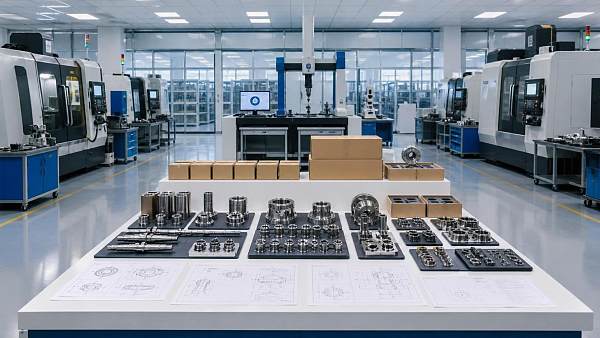
A factory capability page should not merely display an equipment list. CNC machining centers, laser cutting machines, injection molding machines, or automated production lines cannot by themselves directly demonstrate delivery capability. More meaningful information includes the materials and dimensional limits covered by each process, batch characteristics, inspection stages, and how outsourced processes are managed. When external collaboration involves surface coating, heat treatment, molds, electronic components, or similar services, public descriptions should be consistent with the actual scope of control to avoid inconsistencies when customers make inquiries.
Review Content First, Then Determine the Website Scope
Before building a website, existing materials can be divided into “ready for public release,” “requiring technical review,” and “not suitable for public release at this time.” Materials ready for public release include standard product categories, basic materials, application industries, and standard packaging methods. Information requiring review may include accuracy grades, temperature resistance ranges, load data, delivery lead time descriptions, and compatible models. Information involving customer drawings, unreleased projects, supply sources, or internal costs should not be placed directly on pages.
- When there are many product lines, prioritize series with high inquiry value, stable parameters, and a clear profit structure as the first batch of pages, rather than launching all SKUs at once.
- Existing English materials also need to be verified. Expressions such as “customized,” “high quality,” and “professional production” in Chinese are generally insufficient after translation to support search and comparison; actual specifications and application limitations need to be added.
- Questions repeatedly appearing in quotations, brochures, and sales emails are often more suitable as website content sources than internal promotional language, such as whether small trial orders are accepted, commonly used trade terms, drawing confidentiality procedures, or spare parts supply methods.
This review process can also reveal a common misjudgment: treating “website launch” as market validation itself. A website can test search demand, advertising keywords, and content directions, but it cannot replace product positioning. If the same page targets distributors, engineering contractors, and end-user factories at the same time, inquiry forms, case-study materials, and value propositions may all become unclear. Only after determining one or two primary conversion paths can the page structure have a basis for prioritization.
When It Is Not Advisable to Rush Into a High-Investment Website
If products are still undergoing frequent revisions and their names, models, core parameters, and supply methods have not yet been finalized, it is usually more prudent to first establish a basic website that can be adjusted quickly. Publishing unverified parameters for the long term not only increases later maintenance costs but may also cause concerns among customers who have already visited the pages.
If export business relies entirely on a single intermediary and there are no plans for independent customer development, brand exposure, or directly handling inquiries, a marketing website may have a lower priority than standardizing product materials, organizing quality documents, and streamlining delivery processes. Conversely, when a company starts engaging direct customers in multiple countries or seeks to reduce its reliance on a single channel, a website is more worth building as a long-term asset.
Another situation in which it is not advisable to launch hastily is when there is no clear responsibility for content maintenance. Prices, lead times, and inventory do not all need to be public, but discontinued models, contact details, brochure downloads, form notifications, and privacy statements must remain valid. When overseas visitors submit inquiries and receive no response for a long time, the loss is not limited to one opportunity; it can also affect the evaluation of subsequent promotional data.
Websites and Marketing Services Need to Be Designed Along the Same Line
After a manufacturing website goes live, search optimization, advertising landing pages, social media content, and sales follow-up should use consistent product terminology and conversion objectives. Search content can focus on processes, materials, application questions, and model keywords; advertising pages are more suitable for concentrating on a product series or a specific solution scenario; social content can present process segments, testing procedures, packaging details, or trade show activities. Website pages reached through different channels should not all lead to a generic homepage.
Form design must also balance conversion rates and screening efficiency. Basic fields may include name, company email, country, and requirement description. For technical products, options such as product model, quantity, drawing upload, and required delivery date can be added, but it is not advisable to request too much information during the first contact. After a form is submitted, notification recipients, lead ownership, and document filing methods need to be defined to avoid sales, technical, and foreign trade personnel repeatedly requesting the same information.
To determine whether a website is suitable for continued expansion of investment, do not look only at traffic. More meaningful indicators include: which pages generate valid inquiries, whether inquiries match target products, whether they can proceed to quotation after technical confirmation, and which search terms bring demand that does not match existing production capacity. Only by continuously recording this information can product pages, content topics, and advertising scope be gradually adjusted, allowing the website to truly become part of the day-to-day foreign trade collaboration process.
Related Articles


Related Products
 Yiyingbao SaaS Intelligent Website Building and Marketing SystemYiyingbao SaaS Intelligent Website Building and Marketing System, AI-powered no-code website building, rapid creation of multilingual B2B international websites in 10 minutes, global server acceleration, AI-powered SEO optimization, helping businesses connect efficiently with global markets. The perfect integration of technology and operation makes building an international trade website remarkably simple
 AI+SEM Intelligent Advertising Marketing SystemAI+SEM drives intelligent ad creation, empowering full-funnel precision advertising marketing. The system automatically generates weekly/monthly reports, AI recommends keywords and target countries, monitors core metrics in real-time with intelligent alerts, and enables one-click high-conversion ad solutions to help quickly acquire customers and improve ROI.
 AI+SEO Dual-Engine System Optimization ServicesYiyingbao’s AI+SEO dual-engine optimization system helps foreign trade enterprises acquire high-quality organic traffic through AI-powered keyword research, content generation, and comprehensive technical optimization, significantly improving search rankings and conversion rates.
 AI+SNS Social Media Marketing SystemYingbao AI+SNS Social Media Marketing System - Precision social capture for the social media era. Supports one-click content synchronization across major platforms like Facebook and LinkedIn. AI intelligently rewrites posts for enhanced relevance. 24/7 AI customer service and user profiling analysis empower businesses to efficiently expand into global markets.
 AI+SEO营销解决方案易营宝AI+SEO营销解决方案,通过AI批量写作、智能生成TDK、精准关键词扩词等功能,全面优化网站SEO效果,提升流量与转化率。助力企业构建高效智能网站新生态。
 AI+SEM Advertising Marketing SolutionsAI+SEM Advertising Marketing Solution leverages AI technology to deeply empower SEM ad campaigns. It automatically generates weekly/monthly reports using AI, presenting account data across multiple dimensions for comprehensive insights into campaign performance and trends. The system precisely recommends keywords and target countries, intelligently generates high-conversion ad copy, and enables one-click activation of efficient campaign plans to help businesses rapidly acquire customers. Simultaneously, it monitors core metrics in real time, intelligently identifies abnormal fluctuations, and issues timely alerts to ensure stable, high-return advertising results.
 Domain Name ServicesEasyWin provides professional domain name services, including intelligent queries, one-stop registration, brand protection, and full lifecycle management, helping businesses build a digital brand image.
 EasyOperate B2C Cross-Border E-Commerce Platform & Independent WebsiteEasyStore B2C Cross-border E-commerce Independent Store is an intelligent website building and cross-border e-commerce integrated solution independently developed by EasyStore Information Technology (Beijing) Co., Ltd. The system is specially designed for small and medium-sized as well as large export enterprises, integrating 'website building, operation, marketing, advertising, and conversion' into one, helping enterprises quickly establish cross-border e-commerce independent stores to achieve brand globalization and global sales growth.
The platform supports multiple languages, multiple currencies, and multi-channel marketing, with built-in AI intelligent translation and SEO optimization systems, suitable for mainstream markets such as Southeast Asia, Europe and America, Latin America, and the Middle East, assisting Chinese manufacturing enterprises in efficiently deploying international e-commerce strategies. SSL证书易营宝提供专业SSL安全证书服务,包括单域名和泛域名证书,确保网站数据传输加密、身份验证和完整性保护,助力企业建立安全可信的在线业务环境。









