









- Which customer acquisition channels will be affected by cross-border marketing trends in 2026?Sep 06, 2026View details
- Which homogenization risks should be considered in an analysis of the AI-powered website building industry?Aug 30, 2026View details
- How Will AI Marketing Trends 2026 Change Advertising Budget AllocationAug 28, 2026View details
- Is the EV SSL certificate market shrinking or upgrading? How should companies assess certificate procurement?Aug 11, 2026View details
- Why the old AMP SEO 2020 practices no longer work and what has changed in current optimization prioritiesAug 02, 2026View details
- How to Choose Topics for an Industry News Section to Attract More Organic Search TrafficJul 29, 2026View details
How to localize a multilingual cross-border store? Translation, currency, and SEO setup tips
Multilingual cross-border marketplace localization, don’t rush to just translate first
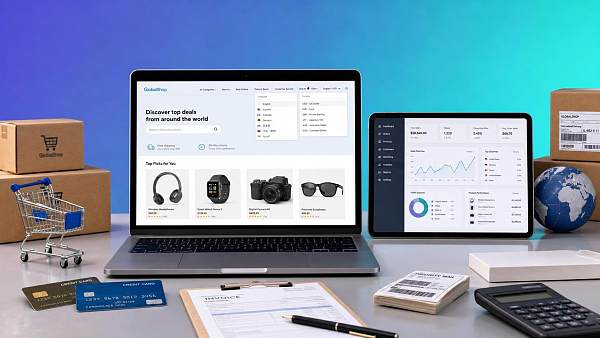
To truly engage overseas users for a multilingual cross-border marketplace, it is not enough to simply translate the pages. You must also synchronize currency, payment, language switching, and SEO localization settings. This article focuses on practical implementation points to help operators improve user experience and overseas search traffic.
When many teams launch a multilingual cross-border marketplace, the first step is often to add language packs. The pages may look more diverse, but the conversion rate does not improve significantly. The problem usually is not whether there is translation, but whether it is truly localized.
After entering a marketplace, overseas users immediately judge three things: whether they can understand it, whether they can pay smoothly, and whether they are willing to keep browsing. If even one of these experiences feels awkward, the bounce rate will increase.
Therefore, localization for a multilingual cross-border marketplace is not only a matter of content. It also affects customer acquisition, conversion, and repeat purchases. Only by doing it carefully can a marketplace be both searchable and purchasable.
Build the localization framework first: language, region, and page structure
In actual business, it is recommended to first clarify that “language” and “region” are not the same thing. For example, on English pages, users in the United States, the United Kingdom, and Singapore may have different wording, currencies, and delivery commitments.
This also means that a multilingual cross-border marketplace cannot be split by language alone; it must also create regional versions based on target markets. A common approach is to set up independent directories by country or region to facilitate SEO recognition and operations management.
In terms of page structure, it is recommended to prioritize unifying the following content:
- The homepage, category pages, product pages, shopping cart, and checkout page all support multilingual switching.
- Shipping fees, taxes, delivery times, and return/exchange policies are configured separately by region.
- Customer service entry points, form fields, and confirmation emails are localized in sync.
- On-site search results should also match the current language version.
If these basic modules are not synchronized, users often encounter language confusion, currency changes, or inconsistent policies when moving from the product page to checkout. Such drop-offs are very common.
Translation is not literal translation; the key is making users want to place an order
What multilingual cross-border marketplace translation fears most is “the words are correct, but the meaning is wrong.” In particular, if headlines, selling points, specifications, and after-sales commitments are translated mechanically, they often sound stiff and can even affect trust.
A more reliable approach is to break translation into three layers:
- Accurately translate basic information, including product names, parameters, materials, dimensions, and usage instructions.
- Localize marketing copy, including selling-point headlines, promotional wording, and call-to-action language.
- Synchronize and optimize trust information, including review display, certification marks, and return policy descriptions.
Recent changes show that overseas users are more sensitive to content authenticity. Overly exaggerated claims, stiff wording, and mixed terminology all make a multilingual cross-border marketplace appear less professional.
Especially on product pages, it is recommended to prioritize optimizing these areas: main title, subtitle, core selling points, FAQs, shipping information, and return policy. They directly affect purchase decisions.
Currency and payment settings determine whether the final step converts
Many multilingual cross-border marketplaces have a solid front end, but lose orders at the payment stage. When the price users see does not match the final charge, or when familiar payment methods are unavailable, checkout will be interrupted.
Therefore, currency settings should follow two principles: clear display and consistent settlement. Do not let users first see local currency, only to suddenly switch back to US dollars at checkout. This kind of experience hurts conversion badly.
You can focus on checking the following items:
- Product prices, discount amounts, shipping fees, and taxes are displayed in the same currency.
- Exchange rate update times are clear to avoid excessive price fluctuations.
- Common payment methods are matched by region, such as credit cards, local wallets, and installment payments.
- The order confirmation page shows the final payable amount and refund rules.
A more obvious signal is that users care more and more about “transparent total cost.” If taxes, customs clearance, and additional shipping fees are hidden too deeply, even a good multilingual cross-border marketplace will be abandoned.
Language switching experience: don’t make users guess
Language switching seems like a small function, but it actually has a big impact on dwell time. Many multilingual cross-border marketplaces hide the switch entry too deeply, or send users back to the homepage after switching, which interrupts the browsing path.
A more practical approach is to keep users on the corresponding version of the current page after switching languages. This way, they do not need to search for the product again, and the experience is much smoother.
At the same time, automatic region detection can be used, but it should not force redirection. A better approach is “detection + prompt confirmation.” Giving users the choice is usually more reliable than letting the system decide for them directly.
If the marketplace also needs to work with social media traffic, content synchronization must also remain localized and consistent. For example, when connecting standalone site campaign pages with overseas platform content, AI+SNS Social Media All-in-One Marketing System can be used for multi-platform content adaptation and automatic synchronization, reducing issues caused by inconsistent language version distribution.
For multilingual cross-border marketplace SEO settings, the focus is not only on keywords
If a multilingual cross-border marketplace wants organic traffic, SEO localization must start with the page structure. Simply translating Chinese keywords into foreign languages and then stuffing them into titles usually has limited effect.
What really matters is letting search engines clearly understand: which page corresponds to which language, which region it serves, and what need it solves.
It is recommended to complete these SEO settings first:
- Configure clear URL structures for different language and regional versions.
- Set corresponding page titles, descriptions, and canonical tags.
- Use correct multilingual and regional markup to reduce duplicate content conflicts.
- Rewrite category terms, product terms, and question terms according to the target market.
- Let blogs, guides, FAQs, and product pages form content linkage.
There is a common misconception here: one English page can cover all English-speaking markets at once. The result is often that none of them are covered deeply. A more effective method is to build long-tail content around key markets.
For example, even within a multilingual cross-border marketplace, search habits, price sensitivity, and shipping concerns differ between Europe and Southeast Asia, so the content strategy naturally cannot be one-size-fits-all.
When going live, check this localization checklist first
If you are currently promoting a multilingual cross-border marketplace, you can use the checklist below for a quick review. Fix the high-frequency conversion-impacting issues first; this is usually more effective than making large changes all at once.
If you also need to keep doing content acquisition and social media reach, you can work with AI+SNS Social Media All-in-One Marketing System to automatically adapt on-site content to multiple overseas platforms, improving exposure continuity and outbound response efficiency.
Conclusion: the more carefully localization is done, the more room for growth a multilingual cross-border marketplace has
At the end of the day, competition in a multilingual cross-border marketplace is not just about how many languages the pages appear to have, but who can truly connect content, pricing, payment, search, and trust.
First make the translation natural, then connect currency and payment, and at the same time improve SEO localization settings. The marketplace’s traffic quality and conversion efficiency will usually become more stable.
If you are optimizing a multilingual cross-border marketplace, it may be best to start with these three areas: product pages, checkout pages, and regional SEO versions. Once the paths are clear, later language expansion and market expansion will be much easier.
Related Articles


Related Products
 Yiyingbao SaaS Intelligent Website Building and Marketing SystemYiyingbao SaaS Intelligent Website Building and Marketing System, AI-powered no-code website building, rapid creation of multilingual B2B international websites in 10 minutes, global server acceleration, AI-powered SEO optimization, helping businesses connect efficiently with global markets. The perfect integration of technology and operation makes building an international trade website remarkably simple
 AI+SEM Intelligent Advertising Marketing SystemAI+SEM drives intelligent ad creation, empowering full-funnel precision advertising marketing. The system automatically generates weekly/monthly reports, AI recommends keywords and target countries, monitors core metrics in real-time with intelligent alerts, and enables one-click high-conversion ad solutions to help quickly acquire customers and improve ROI.
 AI+SEO Dual-Engine System Optimization ServicesYiyingbao’s AI+SEO dual-engine optimization system helps foreign trade enterprises acquire high-quality organic traffic through AI-powered keyword research, content generation, and comprehensive technical optimization, significantly improving search rankings and conversion rates.
 AI+SNS Social Media Marketing SystemYingbao AI+SNS Social Media Marketing System - Precision social capture for the social media era. Supports one-click content synchronization across major platforms like Facebook and LinkedIn. AI intelligently rewrites posts for enhanced relevance. 24/7 AI customer service and user profiling analysis empower businesses to efficiently expand into global markets.
 AI+SEO营销解决方案易营宝AI+SEO营销解决方案,通过AI批量写作、智能生成TDK、精准关键词扩词等功能,全面优化网站SEO效果,提升流量与转化率。助力企业构建高效智能网站新生态。
 AI+SEM Advertising Marketing SolutionsAI+SEM Advertising Marketing Solution leverages AI technology to deeply empower SEM ad campaigns. It automatically generates weekly/monthly reports using AI, presenting account data across multiple dimensions for comprehensive insights into campaign performance and trends. The system precisely recommends keywords and target countries, intelligently generates high-conversion ad copy, and enables one-click activation of efficient campaign plans to help businesses rapidly acquire customers. Simultaneously, it monitors core metrics in real time, intelligently identifies abnormal fluctuations, and issues timely alerts to ensure stable, high-return advertising results.
 Domain Name ServicesEasyWin provides professional domain name services, including intelligent queries, one-stop registration, brand protection, and full lifecycle management, helping businesses build a digital brand image.
 EasyOperate B2C Cross-Border E-Commerce Platform & Independent WebsiteEasyStore B2C Cross-border E-commerce Independent Store is an intelligent website building and cross-border e-commerce integrated solution independently developed by EasyStore Information Technology (Beijing) Co., Ltd. The system is specially designed for small and medium-sized as well as large export enterprises, integrating 'website building, operation, marketing, advertising, and conversion' into one, helping enterprises quickly establish cross-border e-commerce independent stores to achieve brand globalization and global sales growth.
The platform supports multiple languages, multiple currencies, and multi-channel marketing, with built-in AI intelligent translation and SEO optimization systems, suitable for mainstream markets such as Southeast Asia, Europe and America, Latin America, and the Middle East, assisting Chinese manufacturing enterprises in efficiently deploying international e-commerce strategies. SSL证书易营宝提供专业SSL安全证书服务,包括单域名和泛域名证书,确保网站数据传输加密、身份验证和完整性保护,助力企业建立安全可信的在线业务环境。









