









- Which customer acquisition channels will be affected by cross-border marketing trends in 2026?Sep 06, 2026View details
- Which homogenization risks should be considered in an analysis of the AI-powered website building industry?Aug 30, 2026View details
- How Will AI Marketing Trends 2026 Change Advertising Budget AllocationAug 28, 2026View details
- Is the EV SSL certificate market shrinking or upgrading? How should companies assess certificate procurement?Aug 11, 2026View details
- Why the old AMP SEO 2020 practices no longer work and what has changed in current optimization prioritiesAug 02, 2026View details
- How to Choose Topics for an Industry News Section to Attract More Organic Search TrafficJul 29, 2026View details
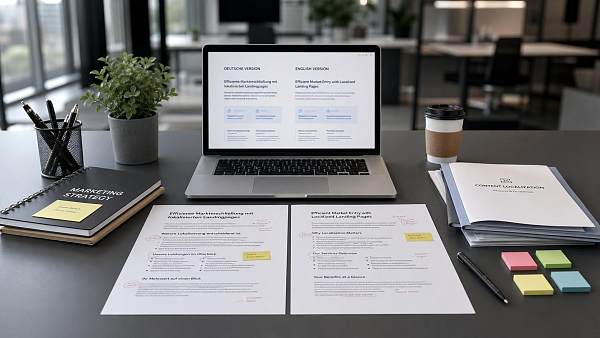
Do German and English advertising landing page content need to be exactly the same?
To put it simply: It does not need to be identical word for word, but the versions should not be written independently
What business evaluators most often ask is not “Can it be translated directly?” but “Will this affect advertising performance, brand consistency, and subsequent management?” The answer is clear: German and English advertising landing pages usually do not need to have exactly the same content, but their core commercial information must be consistent. For example, the product or service offered, scope of services, pricing logic, contact details, form objective, and boundaries of commitments must remain consistent. The German version and English version cannot present completely different information.
What truly needs to be adjusted is the way information is expressed, the order of persuasion, wording details, and the way trust is established. In other words, the underlying information should remain consistent while the page presentation is localized. This ensures stable brand and business messaging while also better matching the reading habits of users of different languages.
Why do many German and English advertising landing pages not look like “mirror-image pages”?
Because an advertising landing page is not an information page; its goal is conversion. The biggest problem for a conversion page is that it may be “translated correctly but not persuasive enough.” English pages commonly use more direct expressions, with value propositions presented more quickly. German pages often place greater emphasis on information completeness, logical order, and the credibility of details.
Consider a common scenario: for pages promoting industrial products, equipment, or business services, the English version may place greater emphasis on efficiency, results, and calls to action. If the German version simply copies this rhythm, users may sometimes feel that the information is not sufficiently solid. This is particularly true for technical specifications, delivery details, applicable scope, and company identity information, where a lack of trust may easily arise.
Therefore, “not being completely identical” does not mean making arbitrary changes. It means adjusting the page’s persuasive path based on how users in the target market read and respond.
Which content must remain consistent?
This is the most critical step in a business evaluation. Whenever commercial commitments, transaction expectations, or lead attribution are involved, the German and English versions must not be changed arbitrarily. Content that typically needs to remain consistent includes:
- Product or service definition: what exactly is being sold and what problem it solves.
- Core value proposition: the English version cannot say “full-process services” while the German version only says “partial support.”
- Conversion objective: the primary objective should be consistent, whether it is an inquiry, appointment, information download, or trial registration.
- Form fields and submission destination: otherwise, subsequent tracking will become disorganized and sales follow-up may easily go wrong.
- Compliance-related information: privacy statement access, data collection notices, contact details, and company identity information.
If these foundational elements are inconsistent, the issue is no longer merely “different translation styles”; the advertising conversion logic becomes inaccurate. The campaign team sees the same product line, while the sales team may receive customers with two different expectations.
Which sections can be adjusted for different language markets?
They can be adjusted, and in many cases they should be. Common elements suitable for localization mainly include page tone, paragraph order, headline wording, case study presentation, and button copy.
The most practical way to assess this in business terms is: Do not change the meaning of content that affects the customer’s understanding of the essence of the same service; content that only affects the reading experience and conversion rhythm can be expressed differently.
What problems arise if the content is exactly the same and only directly translated?
There are three most common types of problems.
- It reads as “correct, but not as though it was written for me.” Such pages often have a relatively high bounce rate, especially in the above-the-fold section and the persuasive copy before the form.
- Lower keyword relevance. Users have different search habits, so directly translated headlines and subheadings may not match the way people actually search.
- Omissions in compliance and trust-related details. The German market is generally more sensitive to whether company information, privacy notices, and contact details are presented clearly.
Another frequently underestimated issue is that the advertising, website development, and sales teams work with different versions. During subsequent data reviews, it becomes difficult to determine whether the problem lies with traffic or inadequate page localization.
Which metrics should business evaluators examine instead of focusing only on translation quality?
If the evaluation only considers whether the translation is accurate, it is too superficial. A landing page is a marketing asset and should be assessed from at least four perspectives:
- Information consistency: Do the two language versions communicate the same business scope, conversion objective, and delivery commitments?
- Degree of localization: Do the headlines, buttons, case study descriptions, and trust modules match the habits of users of the target language?
- Advertising suitability: Does the page copy connect with the advertising creative, keywords, and audience intent?
- Ongoing management cost: When versions are updated, can they be maintained synchronously to prevent changes made to one version from being missed in the other?
This is also why many companies integrate page planning, translation, localization, and advertising conversion into the same process when building multilingual websites and running overseas campaigns, rather than simply asking someone to translate several sections of copy and then putting them online.
Should the German and English versions use the same page structure?
In most cases, they can share the same overall framework, but they should not be forced to use an entirely identical structure. For example, modules such as the above-the-fold section, value proposition area, trust section, and form area can remain consistent to support brand unity and technical maintenance. However, the text length, information order, and button placement within these modules may need to be adjusted for each language.
German words are generally longer than English words. If the layout of headlines, buttons, and card-based modules from the English version is reused without adjustment, line breaks may become crowded, key points may be pushed aside, and mobile reading may become difficult. This may appear to be a design detail, but it can directly affect conversion.
When can bilingual landing pages be made “nearly identical”?
It is possible, but the conditions are relatively clear. For example, when the product is highly standardized, the purchasing decision chain is short, and the page has a single objective, such as basic lead collection, the content of German and English advertising landing pages can be highly similar.
Conversely, for high-value equipment, customized services, B2B solutions, or businesses involving multi-step communication, the closer the page is to the decision-making stage, the less suitable it is to simply switch languages. Customers care not only about “understanding the content,” but also about “whether they can trust it, whether it is suitable for them, and whether it is worthwhile to make contact next.”
During implementation, how can you determine whether the current page should be translated or rewritten?
A practical approach is to first identify which category the original page belongs to. If the original English page was created for global, consistent brand communication, uses neutral information and clear logic, and has no obvious cultural dependence, you can begin with a high-quality translation followed by partial localization. If the original page strongly reflects English-market expression habits, such as punchy short sentences, an abundance of slogans, and limited detail, it is more appropriate to rewrite key modules for the German version.
During the evaluation, focus on three areas:
- Whether the above-the-fold headline relies mainly on tone to drive action rather than on information;
- Whether the value proposition section lacks the specific explanations required for target users to make a judgment;
- Whether there are sufficient reasons to establish trust before the form.
If these three areas present obvious problems, they usually cannot be resolved by “just translating” the page.
Who should lead multilingual landing pages to minimize deviations?
Ideally, the decision should not be made solely by the translator or designer. Business evaluators should promote a coordinated perspective: the business team confirms the core messaging, the marketing team manages the conversion path, the website team handles structure and user experience, and localization specialists adapt the language to the target-market context.
If the company also involves multilingual website development, advertising, SEO, and page conversion coordination, it is best to advance these efforts within the same project framework. This ensures that advertising keywords, page copy, form objectives, and subsequent data tracking do not operate independently, making continuous optimization easier later on.
What rules should be established to avoid repeated debates in the future?
The most efficient approach is to clearly define the “standardized elements” and “localizable elements” from the outset. Standardized elements include the product definition, core commitments, conversion objective, form logic, and company identity information. Localizable elements include headline wording, value proposition order, trust-building copy, button text, and certain layout details.
For the question “Should the content of German and English advertising landing pages be the same?”, the truly reliable principle is summed up in one sentence: The commercial meaning must remain consistent, while the conversion expression should be adapted to the local market. From a business evaluation perspective, this is closer to actual results than pursuing complete word-for-word consistency, and it is also more conducive to subsequent advertising, optimization, and cross-team collaboration.
Related Articles
Related Products
 Yiyingbao SaaS Intelligent Website Building and Marketing SystemYiyingbao SaaS Intelligent Website Building and Marketing System, AI-powered no-code website building, rapid creation of multilingual B2B international websites in 10 minutes, global server acceleration, AI-powered SEO optimization, helping businesses connect efficiently with global markets. The perfect integration of technology and operation makes building an international trade website remarkably simple
 AI+SEM Intelligent Advertising Marketing SystemAI+SEM drives intelligent ad creation, empowering full-funnel precision advertising marketing. The system automatically generates weekly/monthly reports, AI recommends keywords and target countries, monitors core metrics in real-time with intelligent alerts, and enables one-click high-conversion ad solutions to help quickly acquire customers and improve ROI.
 AI+SEO Dual-Engine System Optimization ServicesYiyingbao’s AI+SEO dual-engine optimization system helps foreign trade enterprises acquire high-quality organic traffic through AI-powered keyword research, content generation, and comprehensive technical optimization, significantly improving search rankings and conversion rates.
 AI+SNS Social Media Marketing SystemYingbao AI+SNS Social Media Marketing System - Precision social capture for the social media era. Supports one-click content synchronization across major platforms like Facebook and LinkedIn. AI intelligently rewrites posts for enhanced relevance. 24/7 AI customer service and user profiling analysis empower businesses to efficiently expand into global markets.
 AI+SEO营销解决方案易营宝AI+SEO营销解决方案,通过AI批量写作、智能生成TDK、精准关键词扩词等功能,全面优化网站SEO效果,提升流量与转化率。助力企业构建高效智能网站新生态。
 AI+SEM Advertising Marketing SolutionsAI+SEM Advertising Marketing Solution leverages AI technology to deeply empower SEM ad campaigns. It automatically generates weekly/monthly reports using AI, presenting account data across multiple dimensions for comprehensive insights into campaign performance and trends. The system precisely recommends keywords and target countries, intelligently generates high-conversion ad copy, and enables one-click activation of efficient campaign plans to help businesses rapidly acquire customers. Simultaneously, it monitors core metrics in real time, intelligently identifies abnormal fluctuations, and issues timely alerts to ensure stable, high-return advertising results.
 Domain Name ServicesEasyWin provides professional domain name services, including intelligent queries, one-stop registration, brand protection, and full lifecycle management, helping businesses build a digital brand image.
 EasyOperate B2C Cross-Border E-Commerce Platform & Independent WebsiteEasyStore B2C Cross-border E-commerce Independent Store is an intelligent website building and cross-border e-commerce integrated solution independently developed by EasyStore Information Technology (Beijing) Co., Ltd. The system is specially designed for small and medium-sized as well as large export enterprises, integrating 'website building, operation, marketing, advertising, and conversion' into one, helping enterprises quickly establish cross-border e-commerce independent stores to achieve brand globalization and global sales growth.
The platform supports multiple languages, multiple currencies, and multi-channel marketing, with built-in AI intelligent translation and SEO optimization systems, suitable for mainstream markets such as Southeast Asia, Europe and America, Latin America, and the Middle East, assisting Chinese manufacturing enterprises in efficiently deploying international e-commerce strategies. SSL证书易营宝提供专业SSL安全证书服务,包括单域名和泛域名证书,确保网站数据传输加密、身份验证和完整性保护,助力企业建立安全可信的在线业务环境。









