









- Which customer acquisition channels will be affected by cross-border marketing trends in 2026?Sep 06, 2026View details
- Which homogenization risks should be considered in an analysis of the AI-powered website building industry?Aug 30, 2026View details
- How Will AI Marketing Trends 2026 Change Advertising Budget AllocationAug 28, 2026View details
- Is the EV SSL certificate market shrinking or upgrading? How should companies assess certificate procurement?Aug 11, 2026View details
- Why the old AMP SEO 2020 practices no longer work and what has changed in current optimization prioritiesAug 02, 2026View details
- How to Choose Topics for an Industry News Section to Attract More Organic Search TrafficJul 29, 2026View details
How to Schedule an Overseas Social Media Content Calendar for More Effective Multi-Platform Publishing
Don't Rush to Fill Your Calendar When Publishing Across Multiple Platforms
Planning an overseas social media content calendar may appear to be a matter of posting order, but in practice it involves three factors: platform rhythms, content production capacity, and the conversion path. Many teams fill an entire week at the outset, launching Facebook, Instagram, LinkedIn, TikTok, YouTube Shorts, and even Pinterest all at once. As a result, what breaks down first after two weeks is not traffic, but execution. If a content calendar is merely about “what to post on which day,” it will quickly become a follow-up schedule. Only when it is organized around customer touchpoints, content reuse, and conversion actions is it truly suitable for publishing across multiple platforms.
This issue is especially apparent when providing integrated website and marketing services. Social media content does not exist in isolation: it needs to drive traffic to an independent website, support advertising remarketing, align with the topic planning of Google SEO, and take into account whether pages in different languages are ready. The reason platforms such as Yiyingbao, which cover intelligent website building, SEO, advertising, and overseas social media operations, can organize content calendars more effectively is not simply that they offer more tools. It is because front-end content, on-site landing pages, and back-end lead handling are already part of the same chain.
Why Does the Same Content Lose Its Meaning Once It Is Published on Multiple Platforms?
Many companies make a mistaken judgment here: they assume that “publishing across multiple platforms” means distributing the same post synchronously. The real challenge is not distribution, but the fact that platforms define content relationships differently. LinkedIn is more suitable for professional insights, industry observations, and project methodologies; Instagram relies more on visual consistency and concise expression; TikTok and Reels focus on capturing attention in the first few seconds; Facebook often handles community interaction, event information, and brand updates; and although YouTube Shorts is also a short-video platform, users have different expectations regarding viewing time and search behavior.
Therefore, a content calendar should not be organized by “titles,” but by “content assets.” For example, if a piece of content about revamping the overseas website of a manufacturing company is based on a case analysis, it can be presented on LinkedIn as “Why the inquiry page should be revised before the homepage”; on Instagram, it may be better suited to a before-and-after comparison graphic; on short-video platforms, it can be adapted into “3 common drop-off points before a website revamp”; and on Facebook, it can direct users to event registration or an on-site article. The titles and rhythms differ, but the underlying asset remains the same thematic resource. Organized this way, the team’s productivity will not be consumed by repetitive work.
This is also why many companies expanding overseas eventually plan their content calendars together with their website categories. If a website lacks stable industry pages, case study pages, product pages, and multilingual landing pages, social media content can only circulate within the platforms and will struggle to create continuous touchpoints.
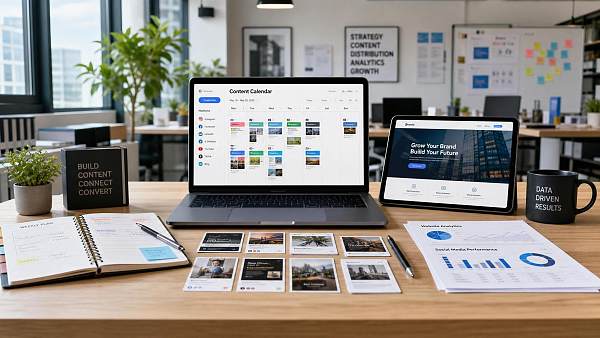
B2B and B2C: The Planning Method May Look Similar, but It Is Not
For B2B companies such as foreign trade factories, equipment manufacturers, and raw material suppliers, the biggest risk in a content calendar is becoming “as lively as a consumer brand.” Customer decisions take longer, involve more participants, and follow a longer inquiry path, so content cannot focus only on engagement figures. For these teams, a more reliable approach is to divide the monthly calendar into three layers: a small amount of brand-presence content, ongoing professional explanatory content, and a small amount of content directly leading to inquiries. Professional explanatory content generally accounts for the larger share, covering topics such as process differences, selection misconceptions, delivery procedures, application limitations, and supporting certification information. It may not generate high engagement in every case, but it is more likely to enter the procurement and technical evaluation stages.
Cross-border e-commerce and DTC brands are completely different. They usually require higher content frequency and stronger coordination between platforms, while the calendar must leave sufficient room for campaign timing, new-product launches, and creative testing. Especially before and after promotional periods, the calendar is not about simply “publishing content,” but about “testing content.” Which opening can retain viewers, which video is more suitable for conversion into a remarketing ad, and which user comments are worth developing into new content should all be planned in advance. If the schedule is too rigid, there will be no room for adjustment during execution.
The method of判断 is actually straightforward: if your website’s conversion depends on explanations, quotations, forms, and consultant follow-up, the calendar should emphasize thematic depth and continuous exposure. If it relies more on immediate purchases, campaign conversions, and visual stimulation, the calendar should focus on short-cycle testing and frequent iteration. Putting these two types of companies into the same rhythm is often the beginning of losing focus while producing content.
A practical calendar is usually constrained first by on-site conditions
Content teams often say they lack materials, but in many cases the real issue is that on-site conditions do not support content production. This is particularly common in manufacturing companies: workshop filming may be restricted, product update cycles may be long, confidential processes may not be shown, overseas customer cases may not be disclosed, and engineers may be unwilling to appear on camera. If such companies are still scheduled according to the “new video every day” rhythm of consumer brands, execution is bound to be difficult. A more suitable approach is to first review sustainable sources of content and then work backward to determine the calendar frequency.
Common content sources can be divided into four categories. The first is existing on-site assets, such as product pages, FAQs, application pages, and blog topics. The second is frequently asked questions from the sales team, such as lead times, minimum order quantities, compatibility, and after-sales boundaries. The third is milestone content from the delivery process, such as sampling, quality inspection, packaging, and shipment preparation. The fourth is low-barrier visual assets, such as detail images, comparison images, exploded views, and operating clips. As long as these four categories can provide a stable supply, the content calendar will not become hollow.
This is also why integrated platforms have greater practical value for publishing across multiple platforms. If the website backend, SEO topic selection, advertising creative management, and social media scheduling are disconnected, the team will waste a great deal of time “finding materials, finding versions, and finding landing pages.” Conversely, when the website-building system, multilingual pages, AI-assisted content organization, advertising accounts, and social media publishing are connected, calendar scheduling becomes not merely an editorial task, but an operational coordination process.
Do Not Focus Only on Posting Times; Define the “Publishing Unit” First
Many teams adjust posting times and frequencies but still feel that publishing across multiple platforms is inefficient. The problem is often that the publishing units are too fragmented. Today it is an image, tomorrow it is a short video, and the day after tomorrow it is a long-form article. Starting from scratch every time is naturally exhausting. A more mature planning method usually takes a week or two as the unit, develops a group of content around one theme, and then adapts it for each platform.
Once the publishing unit has been defined, the calendar is no longer about “thinking of one post every day,” but about “how one theme completes a cycle across different platforms.” This is also more suitable for multilingual operations. Not every platform or market needs to go live at the same time. As long as the core theme remains consistent, the publishing time and level of detail can vary by region.
Conversion Handling Is the Most Easily Underestimated Element of Multi-Platform Scheduling
Some companies have decent social media data but still feel that they have “published a lot without gaining any effective customers.” In such cases, the problem is often not that the calendar is insufficiently active, but that the content is disconnected from the pages receiving the traffic. Social media content may discuss industry pain points while the landing page contains only a company introduction. A short video may explain an application scenario, but users may be unable to find the corresponding product page after clicking through. Multilingual accounts may attract regional traffic, while the website lacks pages in the corresponding languages. The more densely the content is scheduled, the faster users may be lost.
This is the core practical significance of integrated website and marketing solutions. The priority of a content calendar should not be determined only by “which platform is most active recently.” It should also depend on whether the website has pages capable of receiving the traffic, whether those pages can be indexed, and whether they facilitate subsequent advertising remarketing. This is particularly true for B2B companies. After discussing many professional issues on social media, you ultimately still need to return to form design, landing page logic, SEO topic accumulation, and lead follow-up efficiency.
Scheduling Is Not More Professional Simply Because It Is More Detailed; Leave Room for Flexibility
An overly full content calendar usually has two consequences. First, the team has no time for review. Second, trending topics, comment feedback, and front-line sales issues cannot be incorporated. Overseas social media environments change quickly, and platform algorithms, holiday milestones, advertising reviews, and regional time differences can all affect the posting rhythm. If a monthly calendar locks every platform to a specific post every day, execution may look orderly, but it will actually be rigid.
A more reliable approach is to maintain a fixed mainline while reserving flexible slots. Mainline content ensures brand continuity and thematic accumulation, while flexible slots are used for campaigns, popular questions and answers, user feedback, and amplification of advertising creatives. For teams that already have an independent website and an advertising system, some flexible slots can also be reserved specifically for secondary promotion of high-converting pages. This is how an overseas social media content calendar becomes closer to real operations, rather than a table that looks complete but is repeatedly delayed in execution.
To determine whether your planning method is suitable for multiple platforms, first consider three questions: Do you have stable core content assets? Can your website receive the key traffic? Do different platforms have different roles? Unless these three points are clearly defined, no matter how densely the calendar is scheduled, it will only distribute the content pressure across each day. Conversely, once themes, materials, pages, and the conversion chain are connected, publishing across multiple platforms will become increasingly efficient, and the content will be more likely to deliver sustainable results.
Related Articles


Related Products
 Yiyingbao SaaS Intelligent Website Building and Marketing SystemYiyingbao SaaS Intelligent Website Building and Marketing System, AI-powered no-code website building, rapid creation of multilingual B2B international websites in 10 minutes, global server acceleration, AI-powered SEO optimization, helping businesses connect efficiently with global markets. The perfect integration of technology and operation makes building an international trade website remarkably simple
 AI+SEM Intelligent Advertising Marketing SystemAI+SEM drives intelligent ad creation, empowering full-funnel precision advertising marketing. The system automatically generates weekly/monthly reports, AI recommends keywords and target countries, monitors core metrics in real-time with intelligent alerts, and enables one-click high-conversion ad solutions to help quickly acquire customers and improve ROI.
 AI+SEO Dual-Engine System Optimization ServicesYiyingbao’s AI+SEO dual-engine optimization system helps foreign trade enterprises acquire high-quality organic traffic through AI-powered keyword research, content generation, and comprehensive technical optimization, significantly improving search rankings and conversion rates.
 AI+SNS Social Media Marketing SystemYingbao AI+SNS Social Media Marketing System - Precision social capture for the social media era. Supports one-click content synchronization across major platforms like Facebook and LinkedIn. AI intelligently rewrites posts for enhanced relevance. 24/7 AI customer service and user profiling analysis empower businesses to efficiently expand into global markets.
 AI+SEO营销解决方案易营宝AI+SEO营销解决方案,通过AI批量写作、智能生成TDK、精准关键词扩词等功能,全面优化网站SEO效果,提升流量与转化率。助力企业构建高效智能网站新生态。
 AI+SEM Advertising Marketing SolutionsAI+SEM Advertising Marketing Solution leverages AI technology to deeply empower SEM ad campaigns. It automatically generates weekly/monthly reports using AI, presenting account data across multiple dimensions for comprehensive insights into campaign performance and trends. The system precisely recommends keywords and target countries, intelligently generates high-conversion ad copy, and enables one-click activation of efficient campaign plans to help businesses rapidly acquire customers. Simultaneously, it monitors core metrics in real time, intelligently identifies abnormal fluctuations, and issues timely alerts to ensure stable, high-return advertising results.
 Domain Name ServicesEasyWin provides professional domain name services, including intelligent queries, one-stop registration, brand protection, and full lifecycle management, helping businesses build a digital brand image.
 EasyOperate B2C Cross-Border E-Commerce Platform & Independent WebsiteEasyStore B2C Cross-border E-commerce Independent Store is an intelligent website building and cross-border e-commerce integrated solution independently developed by EasyStore Information Technology (Beijing) Co., Ltd. The system is specially designed for small and medium-sized as well as large export enterprises, integrating 'website building, operation, marketing, advertising, and conversion' into one, helping enterprises quickly establish cross-border e-commerce independent stores to achieve brand globalization and global sales growth.
The platform supports multiple languages, multiple currencies, and multi-channel marketing, with built-in AI intelligent translation and SEO optimization systems, suitable for mainstream markets such as Southeast Asia, Europe and America, Latin America, and the Middle East, assisting Chinese manufacturing enterprises in efficiently deploying international e-commerce strategies. SSL证书易营宝提供专业SSL安全证书服务,包括单域名和泛域名证书,确保网站数据传输加密、身份验证和完整性保护,助力企业建立安全可信的在线业务环境。









