









- Which customer acquisition channels will be affected by cross-border marketing trends in 2026?Sep 06, 2026View details
- Which homogenization risks should be considered in an analysis of the AI-powered website building industry?Aug 30, 2026View details
- How Will AI Marketing Trends 2026 Change Advertising Budget AllocationAug 28, 2026View details
- Is the EV SSL certificate market shrinking or upgrading? How should companies assess certificate procurement?Aug 11, 2026View details
- Why the old AMP SEO 2020 practices no longer work and what has changed in current optimization prioritiesAug 02, 2026View details
- How to Choose Topics for an Industry News Section to Attract More Organic Search TrafficJul 29, 2026View details
How CMS Translation Enables Automatic Synchronization: Configuration Methods to Ensure Multilingual Website Updates Are Never Missed
The most common issue with multilingual websites is not the initial translation, but what happens after content enters continuous updates: Chinese product parameters are changed while the English page remains on the old version; new form fields are added to a landing page but are not synchronized to the Japanese page; after an article's title, description, and images are replaced, some language versions still retain the old SEO information. The pages may appear to function normally, but content consistency, conversion paths, and search-engine-recognizable information have already begun to diverge.
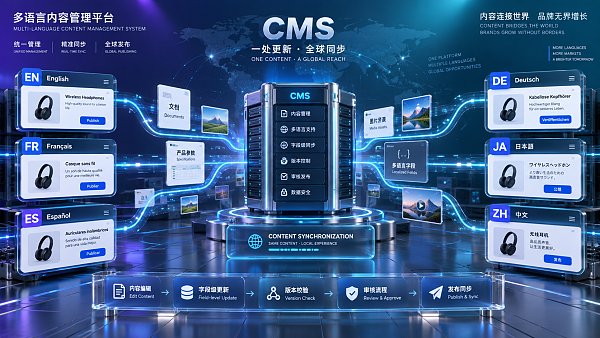
To achieve automatic synchronization in CMS translation, the core is not “machine translation immediately after modification,” but connecting content segmentation, change identification, translation tasks, review and publishing, and version write-back into a traceable workflow. Only when stable relationships are maintained among source content, language versions, and page components can the system determine which fields need updating, which content should not be overwritten, and which translations have not yet been approved.
First distinguish: synchronizing content does not mean retranslating the entire page
When configuring CMS translation, many websites directly set “source-language page update” to “automatically overwrite all target-language pages.” This approach may save effort initially, but it can easily damage translations that have already been manually adjusted later on. For example, the title of an English market page may have been modified according to local search habits. If the source page only updates one product dimension field, overwriting the entire page will replace all manually optimized titles and descriptions.
A more reliable approach is to define the synchronization granularity by content type. Fields can generally be divided into three categories:
- Mandatory synchronization fields:Product models, specifications, pricing logic, inventory status, downloadable files, compliance statements, technical parameters, and more. This information must remain consistent with the source version.
- Fields pending translation:Body paragraphs, product selling points, news content, help documents, and more. Translation tasks should be generated after source content changes, but published pages should not be directly overwritten.
- Localization-retained fields:Local phone numbers, currencies, delivery notices, regional campaign copy, market-specific CTAs, and more. These fields should be maintained independently and should not be written back from the source page.
Complete this classification before configuration so that automatic synchronization does not become “automatically creating differences.” Especially when a page consists of multiple reusable modules, it is essential to specify whether each module is globally shared, language-independent, or allows partial overrides.
Establish identifiable content relationships
Automatic synchronization relies on stable content IDs rather than matching based on titles, URLs, or page positions. Every source article, product, and component should have a unique identifier; its translated version should store the corresponding source content ID, target language code, translation version number, and publication status. When a new module is added to a page, the system can identify it as “new content pending translation” rather than mistakenly treating it as a modification to an existing module.
In practical configuration, it is recommended that the CMS record at least the following information:
The “field-level update time” here is particularly important. Updating an image ALT text on the source page should not trigger all body text to enter the translation queue; when only product parameters are modified, translators should also be able to see the specific changed fields directly instead of comparing the entire page again.
Trigger translation through change events rather than relying on manual inspection
A more reliable workflow is usually initiated by a publishing event: source-language content changes from draft to published, and the CMS generates a content snapshot; the system compares the current snapshot with the previous published version and outputs a list of added, modified, and deleted fields; translation tasks are then created for each language according to field rules. Once the translation service is completed, translations first enter a “pending review” status and update the published target-language version only after approval.
Trigger rules should not consist of only one “translate upon publishing” switch. Different priorities can be set according to business rhythms:
- Changes to product specifications, safety notices, policy-related fields, and similar content should immediately create high-priority tasks and mark the target-language page as “content pending update.”
- Content such as blogs, news, and campaign copy should enter the regular queue, allowing editors to review and publish according to market plans.
- Changes only to layout, internal component configurations, or fields not displayed externally should not create translation tasks.
- When a source page is deleted or taken offline, the target-language page should receive the same type of status change rather than continue to retain an indexable orphan page.
Deletion synchronization is often overlooked. On multilingual websites, if a source page is taken offline while its translation still returns a 200 status, visitors may not only see outdated content, but may also be taken to an invalid page after switching languages. The workflow should clearly define whether deletion means synchronized deletion, conversion to draft status, or retention as a redirect page.
Version validation determines whether “automation” is controllable
After a translation task is completed, it is not enough to check that the task status is successful. It is also necessary to verify whether the source version on which the translation is based is still the latest version. A common scenario is that the source page undergoes a second modification while a translation is being generated. In this case, even if the first batch of returned translations is linguistically correct, it has already fallen behind the current source content.
A “source version lock” mechanism can be used: record the source version number when creating a task; when the translation is returned, the CMS compares that version number with the current source version number. If they match, the translation can enter review; if they do not match, the task is marked as outdated, with the result retained for reference but not allowed to be published directly. For frequently updated product pages, this step can prevent editors from mistakenly publishing outdated translations.
The review interface should preferably highlight differences: newly added fields, deleted sentences, content before and after modification, machine translations, and published translations. Editors should not need to search screen by screen for changes before deciding whether to merge locally or review the entire text again. For pages containing rich text, tables, download links, and embedded components, tags, placeholders, and variables should also be checked to ensure they are fully retained.
Multilingual SEO fields should be incorporated into the same workflow
Completing body text synchronization does not mean that the page has been fully updated. Titles, Meta Descriptions, image ALT text, names and descriptions in structured data, breadcrumbs, and Open Graph fields are often maintained in different CMS configuration layers. If these fields are not linked to translation relationships, situations may occur where the page body contains new content while the search snippet still displays the old version.
It is recommended to treat SEO fields as independent translatable fields and set length and character-limit prompts. URLs are generally not recommended for mechanical synchronization: a consistent language directory structure can be maintained, but target languages should be allowed to use short links that match local search habits. hreflang associations should be automatically updated when language versions are published, taken offline, or URLs are adjusted, preventing deleted language pages from remaining in interlinking relationships.
For pages involving login, orders, member data, or API transmission, it is also necessary to confirm after content synchronization that HTTPS remains available across all language routes. Especially when new language subdomains or new store paths are created, omitted certificate deployment may cause issues with redirects, form loading, or resource requests. With SSL certificates that support automatic deployment, HTTP-to-HTTPS redirection, and mixed-content remediation, transmission security checks for new language paths can be included in pre-publication validation rather than investigated only after browsers display risk warnings.
Before going live, verify more than whether translations exist
After each batch synchronization, prioritize reviewing abnormal statuses rather than browsing page by page. Key items include pages where the source version is newer than the translation version, fields with failed translations, published pages without language associations, translated pages that remain accessible after their source pages are deleted, and content blocks containing unreplaced variables or empty links. For product detail pages, also check whether the units in parameter tables, attachment links, inquiry form fields, and inventory notices are logically consistent with the source page.
Finally, a clear publication threshold can be established: target-language pages must not be published when mandatory synchronization fields are incomplete; when localized fields are missing, publication is allowed but editors are prompted; when only SEO fields are pending review, whether to postpone publication is determined by page type. In this way, automation handles identification and distribution, while editors retain control over market expression and the final version.
Related Articles
 What are the fundamental differences between B2B website translation and B2C website translation?
 Website Localization Is More Than Translation: What Else Should Be Adjusted Before Entering a New Market?
 How Can Multilingual Website Translation Avoid Machine Translation Distortion and Brand Messaging Inconsistencies



Related Products
 Yiyingbao SaaS Intelligent Website Building and Marketing SystemYiyingbao SaaS Intelligent Website Building and Marketing System, AI-powered no-code website building, rapid creation of multilingual B2B international websites in 10 minutes, global server acceleration, AI-powered SEO optimization, helping businesses connect efficiently with global markets. The perfect integration of technology and operation makes building an international trade website remarkably simple
 AI+SEM Intelligent Advertising Marketing SystemAI+SEM drives intelligent ad creation, empowering full-funnel precision advertising marketing. The system automatically generates weekly/monthly reports, AI recommends keywords and target countries, monitors core metrics in real-time with intelligent alerts, and enables one-click high-conversion ad solutions to help quickly acquire customers and improve ROI.
 AI+SEO Dual-Engine System Optimization ServicesYiyingbao’s AI+SEO dual-engine optimization system helps foreign trade enterprises acquire high-quality organic traffic through AI-powered keyword research, content generation, and comprehensive technical optimization, significantly improving search rankings and conversion rates.
 AI+SNS Social Media Marketing SystemYingbao AI+SNS Social Media Marketing System - Precision social capture for the social media era. Supports one-click content synchronization across major platforms like Facebook and LinkedIn. AI intelligently rewrites posts for enhanced relevance. 24/7 AI customer service and user profiling analysis empower businesses to efficiently expand into global markets.
 AI+SEO营销解决方案易营宝AI+SEO营销解决方案,通过AI批量写作、智能生成TDK、精准关键词扩词等功能,全面优化网站SEO效果,提升流量与转化率。助力企业构建高效智能网站新生态。
 AI+SEM Advertising Marketing SolutionsAI+SEM Advertising Marketing Solution leverages AI technology to deeply empower SEM ad campaigns. It automatically generates weekly/monthly reports using AI, presenting account data across multiple dimensions for comprehensive insights into campaign performance and trends. The system precisely recommends keywords and target countries, intelligently generates high-conversion ad copy, and enables one-click activation of efficient campaign plans to help businesses rapidly acquire customers. Simultaneously, it monitors core metrics in real time, intelligently identifies abnormal fluctuations, and issues timely alerts to ensure stable, high-return advertising results.
 Domain Name ServicesEasyWin provides professional domain name services, including intelligent queries, one-stop registration, brand protection, and full lifecycle management, helping businesses build a digital brand image.
 EasyOperate B2C Cross-Border E-Commerce Platform & Independent WebsiteEasyStore B2C Cross-border E-commerce Independent Store is an intelligent website building and cross-border e-commerce integrated solution independently developed by EasyStore Information Technology (Beijing) Co., Ltd. The system is specially designed for small and medium-sized as well as large export enterprises, integrating 'website building, operation, marketing, advertising, and conversion' into one, helping enterprises quickly establish cross-border e-commerce independent stores to achieve brand globalization and global sales growth.
The platform supports multiple languages, multiple currencies, and multi-channel marketing, with built-in AI intelligent translation and SEO optimization systems, suitable for mainstream markets such as Southeast Asia, Europe and America, Latin America, and the Middle East, assisting Chinese manufacturing enterprises in efficiently deploying international e-commerce strategies. SSL证书易营宝提供专业SSL安全证书服务,包括单域名和泛域名证书,确保网站数据传输加密、身份验证和完整性保护,助力企业建立安全可信的在线业务环境。









